-
-
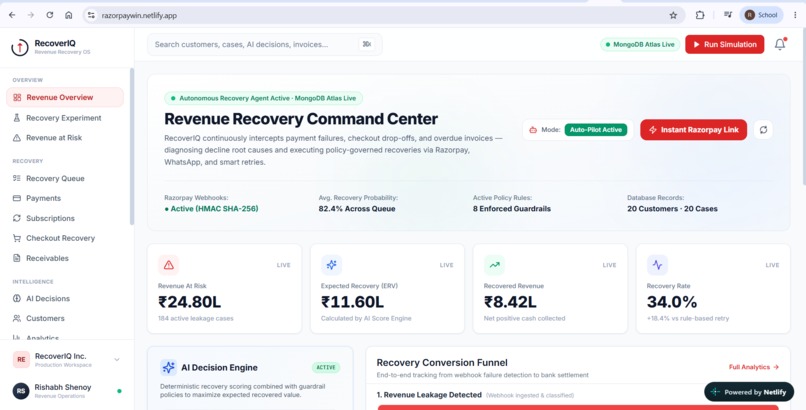
Landing page of RecoverIQ
-
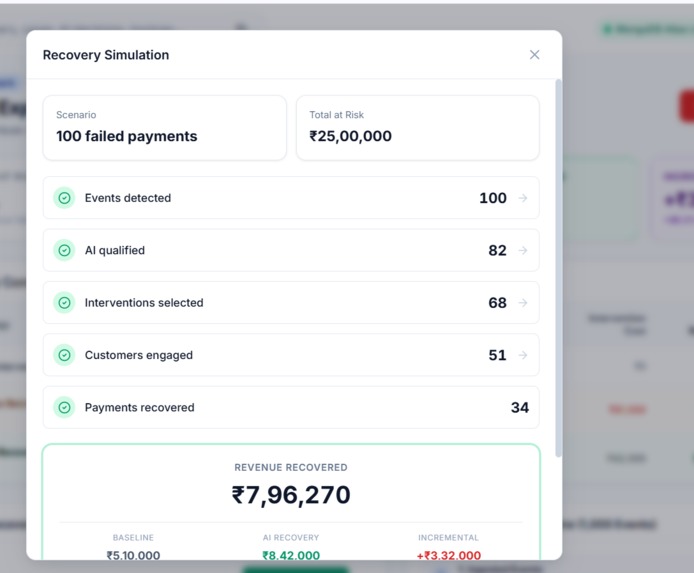
recover money wit actual razorpay integration
💡 Inspiration
Businesses work hard to acquire customers, but revenue can still disappear at the final step of the transaction.
A payment can fail because of a temporary bank issue. A recurring mandate can fail. A customer can abandon checkout. A B2B invoice can remain unpaid for weeks. In many businesses, the response is either blindly retrying the payment or asking operations teams to manually follow up.
We wanted to build something different:
What if failed revenue could be treated as a real-time decision problem instead of a manual operations problem?
That idea became RecoverIQ — an autonomous revenue recovery system that identifies why revenue is at risk, decides what action is appropriate, enforces merchant-defined policies, and executes recovery workflows through payment infrastructure.
🚀 What RecoverIQ Does
RecoverIQ acts as an intelligent recovery layer around the payment lifecycle.
When a revenue event occurs, the system follows a closed-loop process:
Payment Event → AI Diagnosis → Decision → Policy Check → Recovery Action → Payment Verification → Audit Trail
The platform handles multiple forms of revenue leakage:
- 💳 Payment failures — intelligently schedules retries instead of repeatedly retrying blindly.
- 🔄 Subscription mandate failures — initiates customer-authorized recovery flows.
- 🛒 Checkout drop-offs — follows up with payment-link based recovery.
- 🧾 B2B receivables — tracks overdue invoices and accelerates collection workflows.
- 🤝 Promise-to-pay — pauses reminders when customers commit to a payment date and escalates broken promises.
- 🔍 Customer 360 — provides payment history, recovery cases, and communication context.
- 🛡️ Policy & Governance — ensures financial actions stay within merchant-defined limits.
🧠 How We Built It
We designed RecoverIQ around a simple principle:
AI should make the decision, but deterministic policies should control the execution.
The AI layer analyzes the available transaction context and produces a structured diagnosis and confidence score. The decision is then evaluated against explicit merchant policies such as:
- Maximum retry limits
- Customer consent requirements
- Transaction amount thresholds
- Human approval requirements
- Recovery action restrictions
This prevents the AI from directly performing unrestricted financial operations.
For example, a low-risk failed payment may qualify for an automated recovery workflow, while a transaction above a merchant-defined threshold can be routed to human approval.
The backend receives payment events through verified webhooks, processes them through the recovery engine, and records state transitions and actions in MongoDB.
The system also integrates with Razorpay for payment and recovery workflows, including payment links and webhook-driven confirmation.
📊 Proving the Approach
We built a dedicated 1,000-event recovery experiment to compare three strategies:
| Strategy | Recovery Rate | Recovered Value |
|---|---|---|
| Do Nothing | 8.4% | ₹2.1L |
| Naive Retries | 20.5% | ₹5.1L |
| RecoverIQ AI Agent | 33.9% | ₹8.42L |
The experiment demonstrates the core idea behind RecoverIQ: the best recovery strategy is not necessarily more retries — it is choosing the right action for the right failure.
These figures come from our controlled benchmark/demo experiment rather than production merchant data.
🏗️ The Product
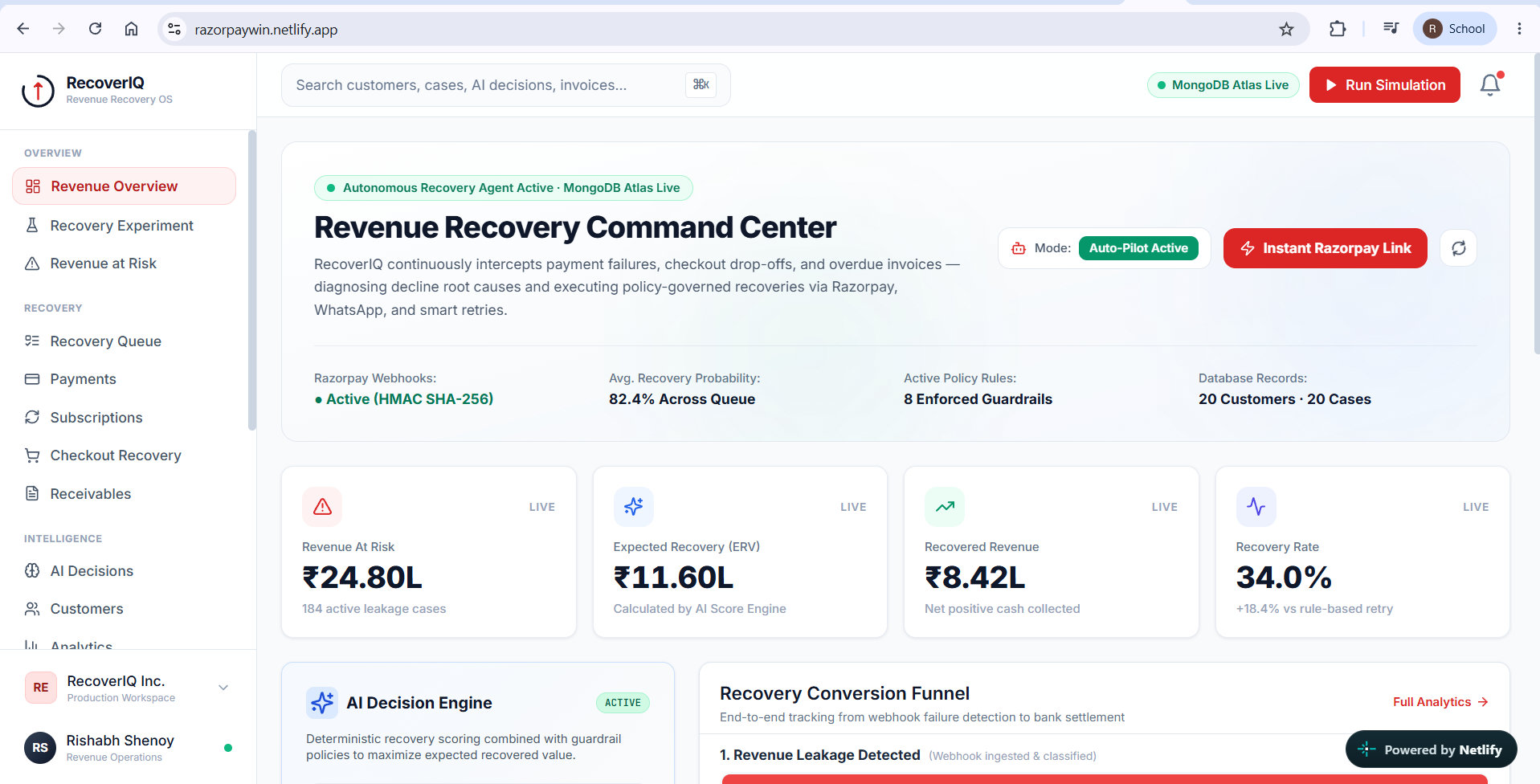
We built a complete Revenue Operations Control Center where a finance or RevOps team can monitor and control the recovery system.
The dashboard provides:
- Revenue at Risk
- Expected Recovery Value
- Recovered Revenue
- Recovery Funnel
- Recovery Queue
- Smart Retry Timeline
- Subscription Recovery
- Checkout Recovery
- B2B Receivables
- AI Decisions
- Customer 360
- Promise-to-Pay workflows
- Audit Trail
- Policy Center
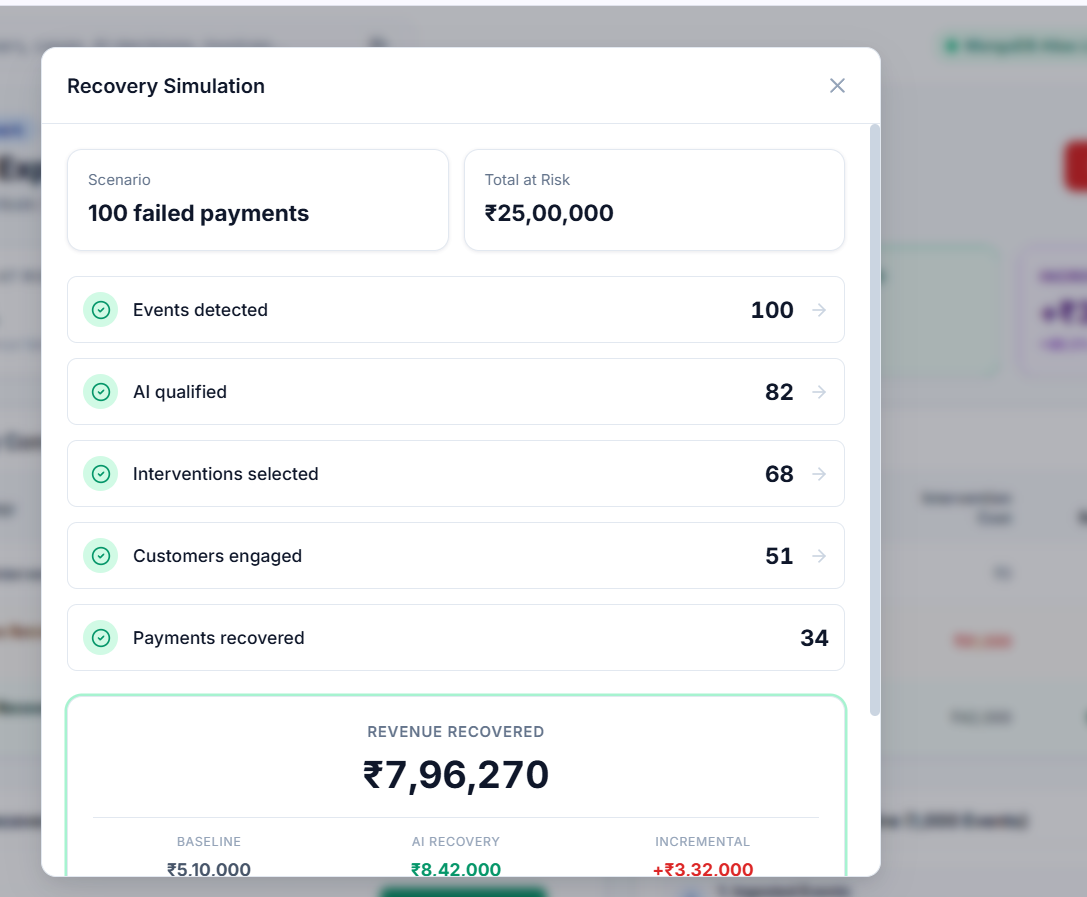
- Razorpay Integration & Simulation
The goal was not to build another analytics dashboard.
We wanted to build an operational system that can actually close the recovery loop.
🔐 Safety and Explainability
Financial automation needs more than an AI model.
Every recovery decision has an explainable structure:
Diagnosis → Confidence → Policy Checks → Recommended Action → Execution → Result
The audit trail records important state transitions such as:
PAYMENT_FAILED → AI_EVALUATED → POLICY_APPROVED → RECOVERY_DISPATCHED → RECOVERY_SUCCESS
This gives operators visibility into why an action was recommended and which policies allowed it.
High-value or restricted transactions can be escalated instead of being executed automatically.
🧩 Challenges We Faced
One of our biggest challenges was designing the system so that AI could be useful without becoming a financial liability.
A purely AI-driven system can make unpredictable decisions. A purely rule-based system becomes rigid and cannot reason about different failure contexts.
We therefore separated reasoning from execution.
The AI provides structured intelligence, while a deterministic policy layer decides whether that recommendation is actually allowed.
Another challenge was creating a realistic end-to-end payment workflow. Instead of treating the payment gateway as a static mock, we designed the backend around webhook events, signature verification, payment states, recovery actions, and confirmation.
We also had to think carefully about idempotency and auditability, because payment events can be delivered more than once and financial actions should never accidentally execute twice.
📚 What We Learned
Building RecoverIQ taught us that an effective AI system for financial operations is not just about using a powerful LLM.
The important part is the system around the model.
We learned how to:
- Design event-driven financial workflows.
- Combine LLM reasoning with deterministic business rules.
- Build webhook-based integrations.
- Handle payment state transitions safely.
- Design idempotent backend operations.
- Create explainable AI decisions.
- Build audit trails for automated actions.
- Think about AI agents as bounded operators rather than unrestricted autonomous systems.
Most importantly, we learned that autonomy and control are not opposites.
The strongest automation is automation with clearly defined boundaries.
🎯 What's Next
RecoverIQ is designed as a foundation for a broader revenue recovery platform.
Future versions could connect additional payment gateways, CRMs, ERPs, communication providers, and merchant-specific recovery policies.
The long-term vision is simple:
Don't just tell businesses where revenue is being lost. Give them an intelligent, safe system that can help win it back.
RecoverIQ turns revenue leakage from a passive reporting problem into an active recovery workflow.
Built With
- agents
- ai
- api
- express.js
- gemini
- generative
- javascript
- jwt
- mongodb
- mongoose
- node.js
- razorpay
- react
- rest
- springboot
- tailwind
- vite
- webhooks

Log in or sign up for Devpost to join the conversation.