-
-
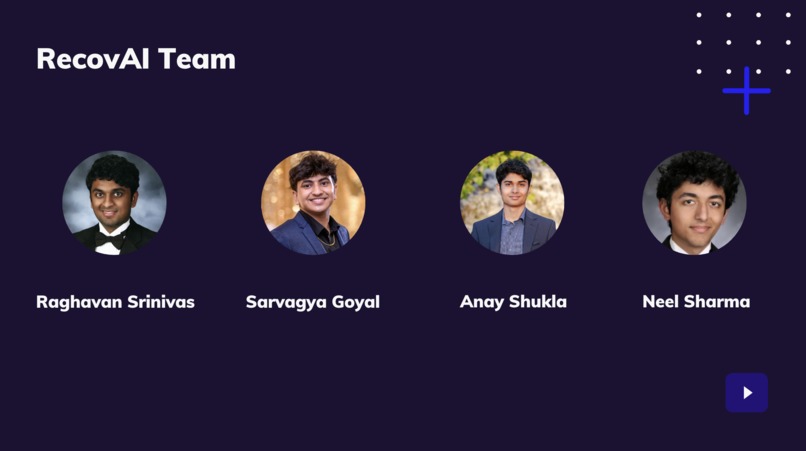
Meet the RecovAI Team!

Inspiration
We were inspired by the struggles many elderly patients face after surgery, particularly the lack of continuous guidance once they leave the hospital. Many of these patients lack caretakers at home and are left to manage complex recovery routines on their own, which can lead to further complications, confusion, and slower healing. We wanted to create a tool that supports recovery both physically and emotionally, especially for those without consistent access to caregivers or follow-up care.
What It Does
RecovAI helps surgery patients recover at home by generating personalized daily wellness schedules based on their dietary needs, restrictions, and recovery goals. It also features a supportive AI chatbot that offers encouragement, answers questions, and provides tailored guidance throughout the healing process.
How We Built It
We built RecovAI using a full-stack approach. The frontend was developed with React, HTML, and CSS to create a clean, responsive user interface. On the backend, we used Node.js and Express to manage routes and connect to a MongoDB database for storing patient data. We integrated Google's Gemini API using Python to power the conversational chatbot and provide empathetic, AI-driven support. Flask was also used during the initial prototyping phase of our AI integration. JavaScript tied everything together across the stack, allowing smooth communication between the frontend and backend components.
Challenges We Ran Into
One major challenge was getting the Gemini API to work with our current API key — we initially tried to use gemini-pro with the official SDK, but ran into compatibility issues due to API access restrictions and had to pivot to using chat-bison-001 via the MakerSuite endpoint. Another challenge was designing a dynamic scheduling system that could adjust in real-time based on patient input like dietary restrictions and recovery stages, while keeping the UX clean and intuitive. Balancing personalization with simplicity required several design iterations.
Accomplishments That We're Proud Of
We're proud of building a fully functional AI assistant that personalizes care in a meaningful way, and especially to those who need it the most. From customizing wellness schedules based on individual needs to offering compassionate conversation, RecovAI brings together empathy and technology in a way that feels truly supportive. We’re also proud of overcoming technical challenges and delivering a polished, end-to-end solution in such a short amount of time.
What We Learned
Through building RecovAI, we learned how to integrate large language models into a real-world application and adapt quickly when APIs didn't behave as expected. We deepened our understanding of full-stack development, especially how frontend and backend components communicate securely and efficiently. We also gained experience working with cloud databases, handling user input dynamically, and designing user interfaces that prioritize both functionality and empathy. Most importantly, we learned how to turn a health-focused idea into a working product that could genuinely improve the patient recovery experience.
What's next for RecovAI In the future, we aim to expand RecovAI into a more comprehensive post-operative care platform. We plan to integrate voice input to make the tool more accessible for patients with limited mobility or visual impairments. A companion mobile app is also in development to ensure patients can access their care plans on the go. Additionally, we hope to implement a clinician dashboard that allows healthcare providers to remotely monitor patient progress, review chatbot interactions, and update recovery plans in real time. Further improvements include adding multilingual support, medication reminders, and the ability to sync with wearable health devices to provide more accurate, responsive care based on real-time vitals. Long-term, we envision partnering with hospitals and clinics to integrate RecovAI into official discharge processes, bridging the gap between in-hospital care and home recovery.


Log in or sign up for Devpost to join the conversation.