Inspiration
Company cards and supplier payments leak money in small, boring ways: a bill paid twice, a one dollar trial that became a monthly plan, a price rise nobody read about, three teams buying tools that do the same job. Each is easy to confirm from a card export and easy to forget, because finding it is one job and fixing it is another. Someone has to tell the card holder, write to the vendor and follow up before the next charge.
Many teams already run follow-up in Jira. What is missing is the step before it: turning a spreadsheet of charges into a short list of provable problems, each already in the tracker with an owner and a date. Recoup is that step.
What it does
A finance or operations person opens Recoup in Jira and imports a company card export or an accounts payable ledger (CSV). Recoup reads it with fixed rules and reports: payments made twice (including the same invoice number paid again), trials that rolled into a paid plan, price rises, bank and card fees, overlapping tools of one kind, one tool paid on several cards, a seat billed to a deactivated Jira user, new subscriptions and unusual charges.
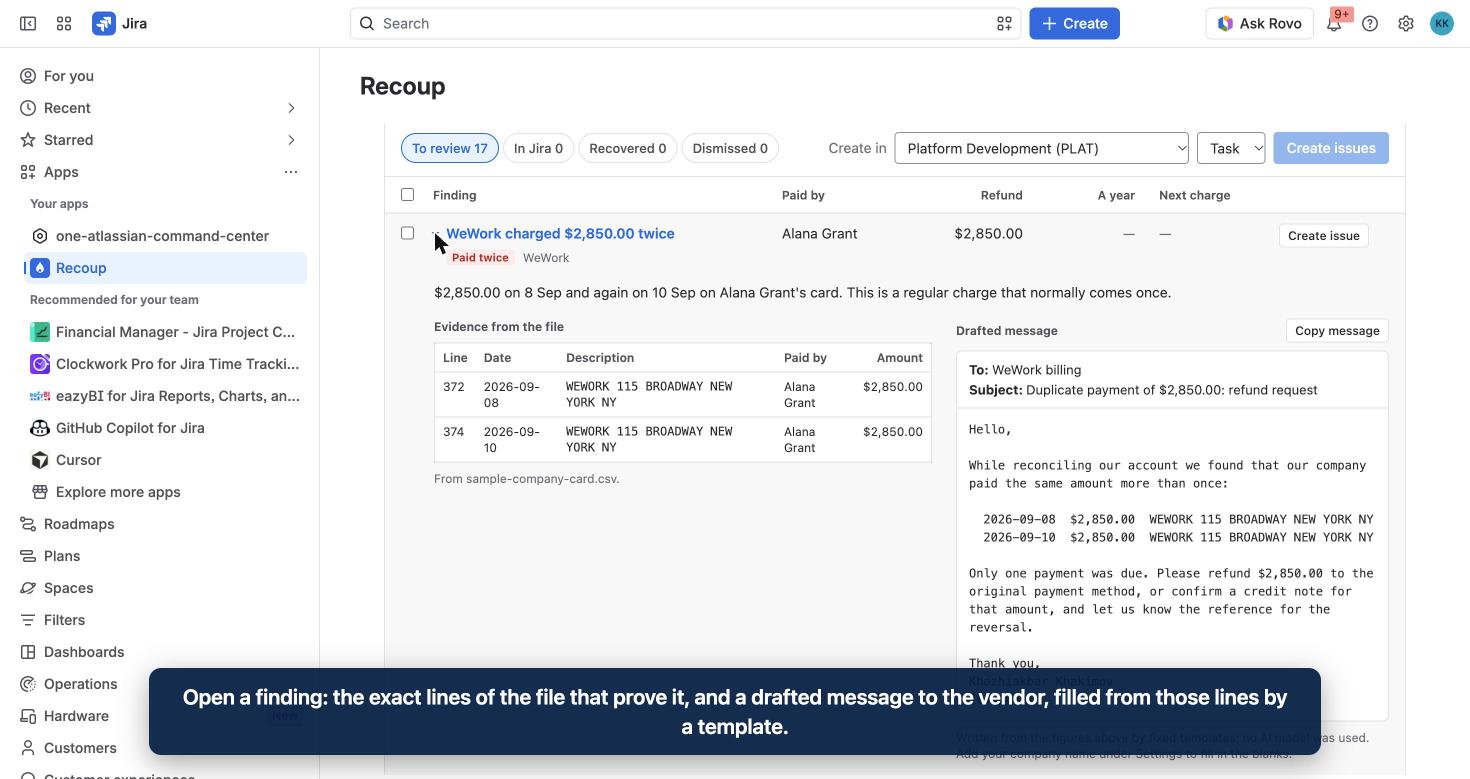
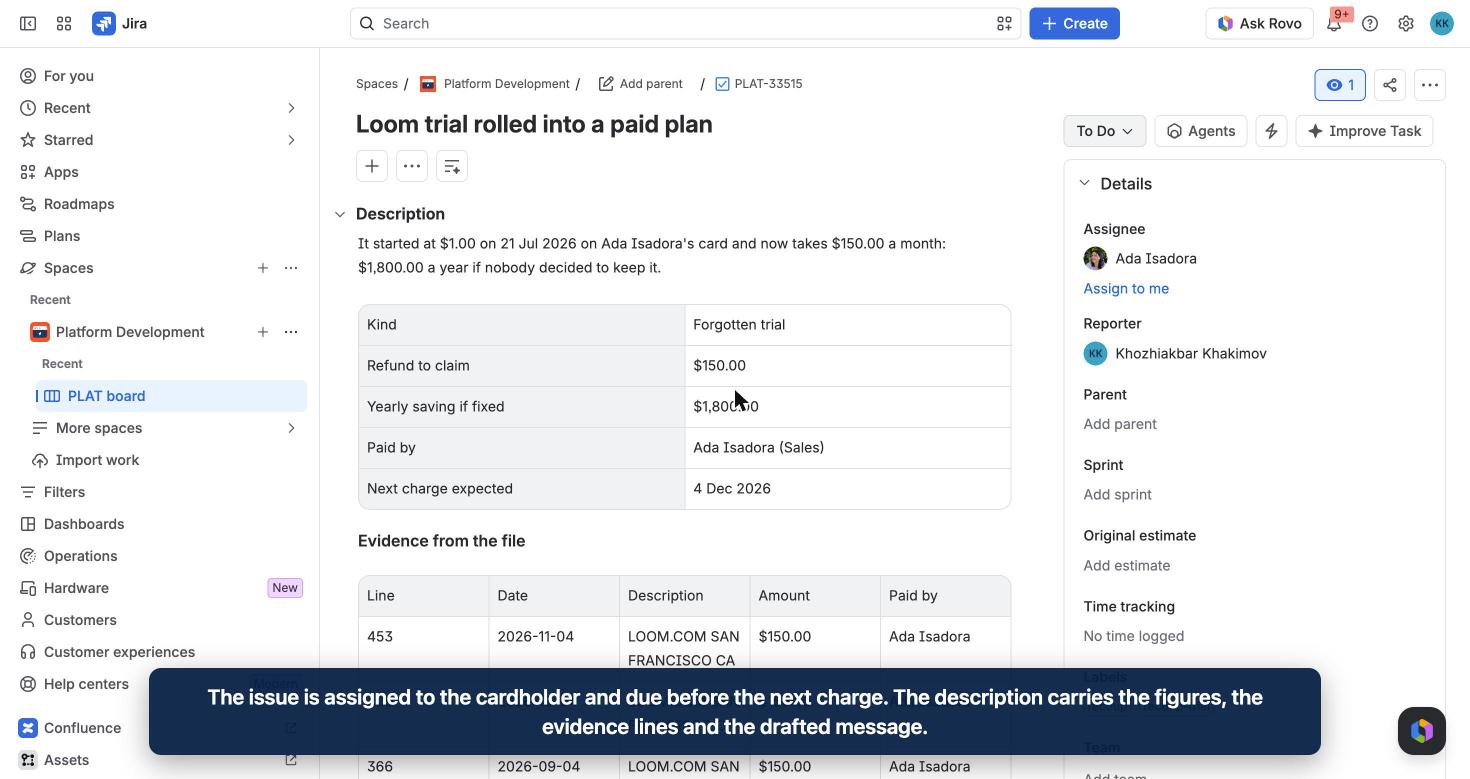
Each finding carries the exact lines of the file it rests on (line number, date, amount, description), the refund to claim, the yearly saving, who pays, the next charge date and a drafted message to the vendor, the bank or the cardholder.
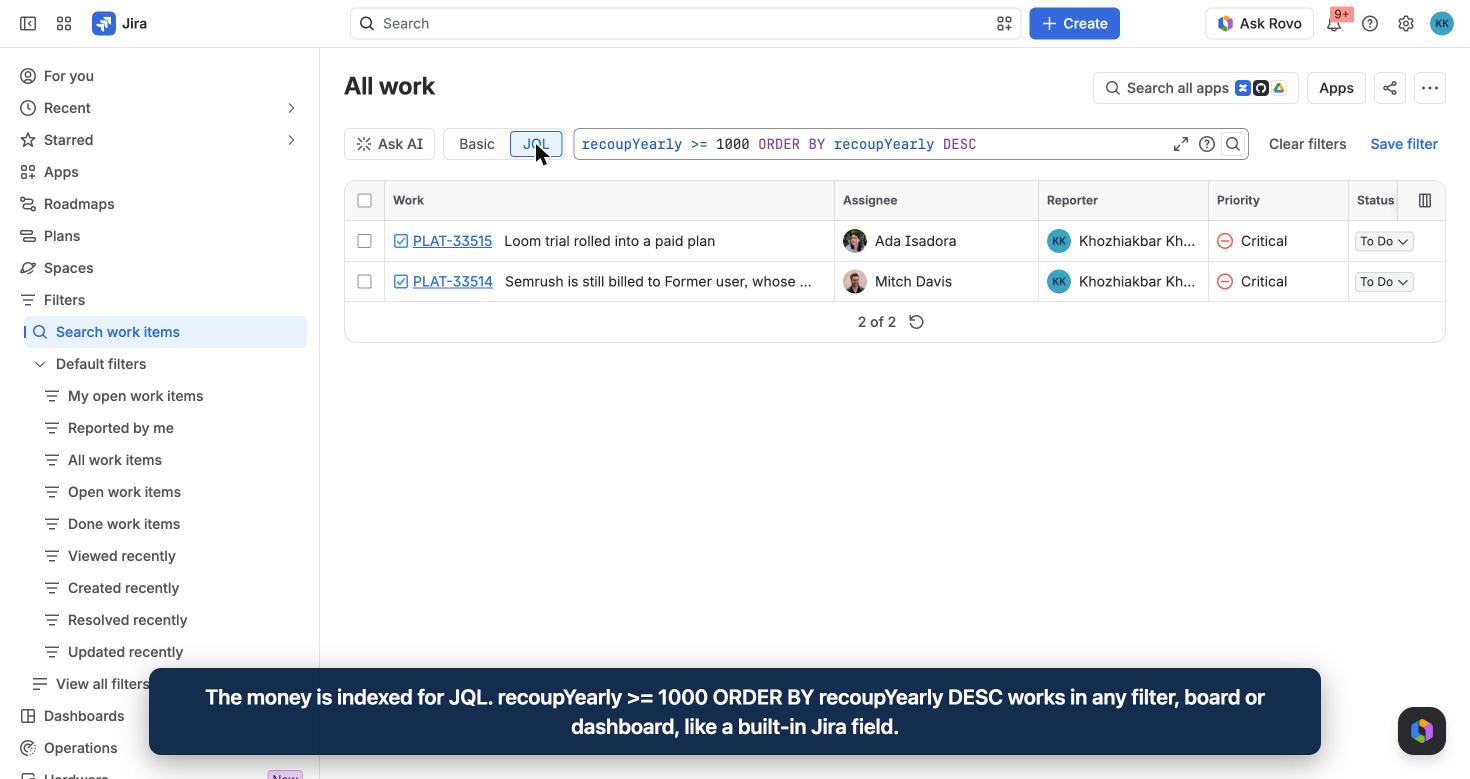
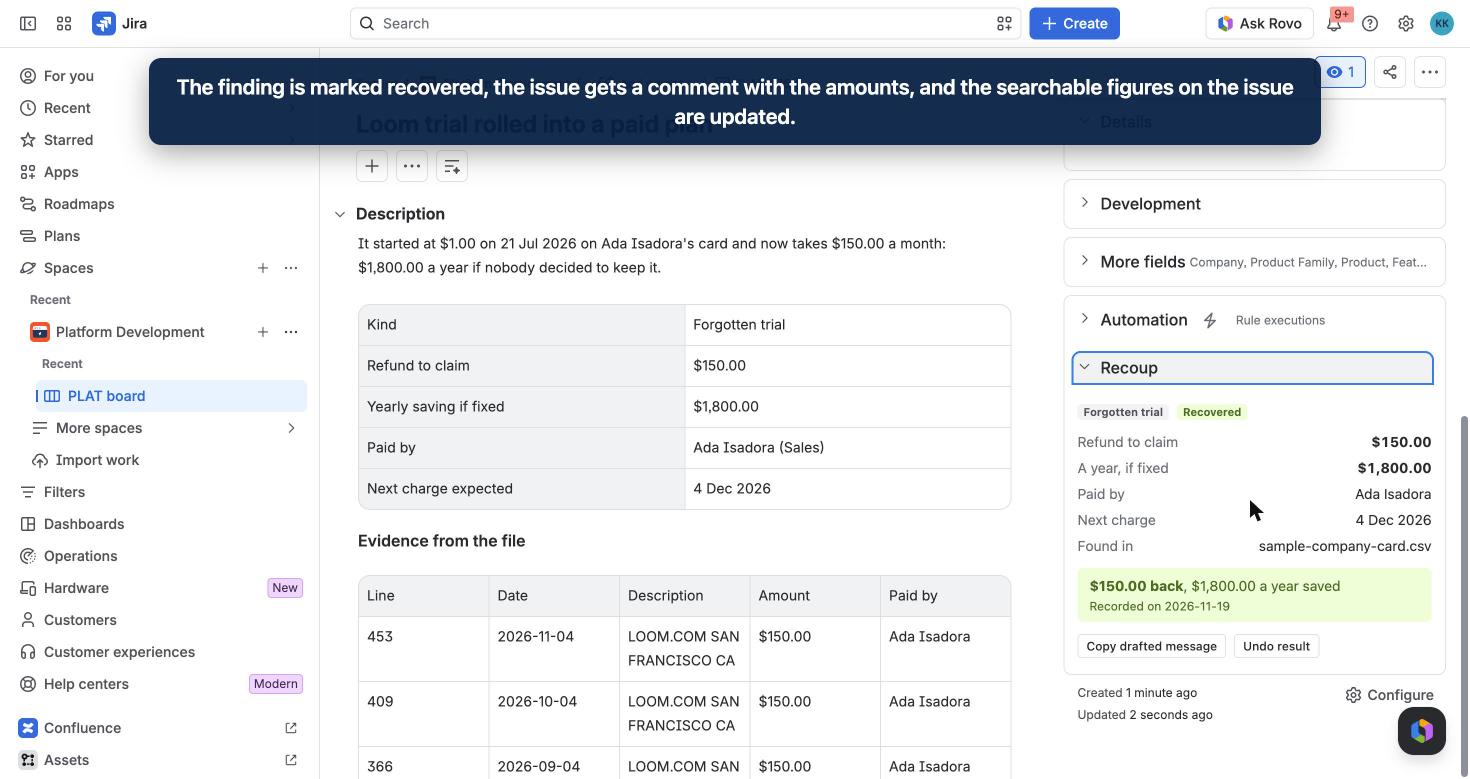
Selected findings become Jira issues in one click. The assignee is the cardholder, matched to a Jira user. The due date falls before the next charge. The description holds an evidence table and the drafted message. An issue property makes the money figures searchable in JQL (recoupYearly, recoupRefund, recoupKind, recoupVendor, recoupState and more). A panel on the issue records what was actually recovered, and the Recoup page keeps the running total.
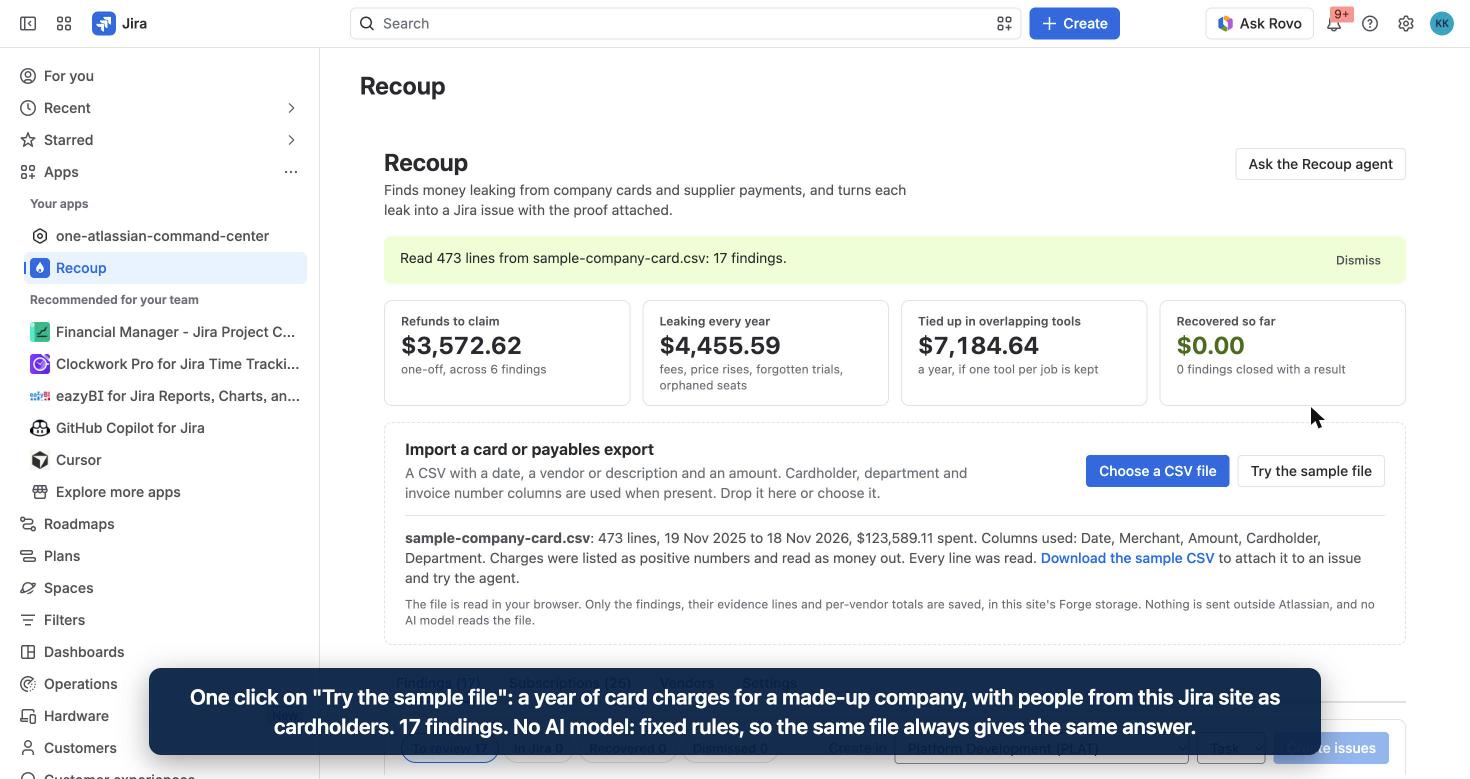
On the built-in sample file (a made-up company, 473 card lines over 12 months) Recoup lists 17 findings: $3,572.62 in refunds to claim, $4,455.59 a year leaking through fees, price rises, a forgotten trial and seats billed to a deactivated account, and $7,184.64 a year tied up in overlapping tools (the figures in the video). Examples: WeWork charged $2,850.00 twice two days apart; a Loom trial that started at $1.00 now takes $150.00 a month.
The importer is built for the files people really have. It finds the header under a title block, tells a payment date from a due date, reads separate debit and credit columns, European number formats and UTF-16 exports from Excel, leaves out declined or voided lines, and never adds two currencies together: lines in a second currency are listed as left out, with the reason. A double payment that the vendor has already credited back is not raised. A second sample, a six-month payments register, is in the repository under samples/.
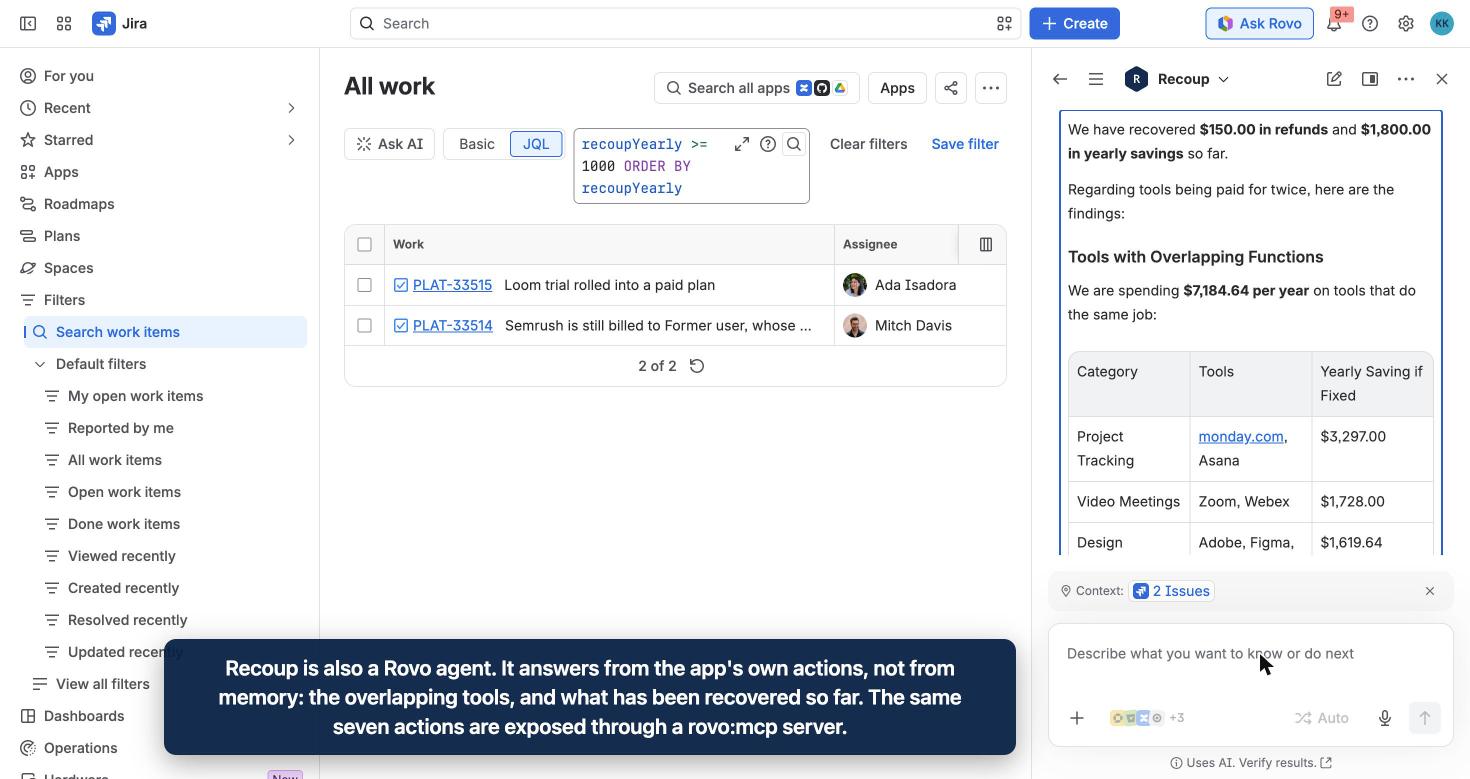
The app makes no LLM calls. Detection is deterministic rules and the drafted messages are templates filled from the file. The only language model involved is Atlassian's own, inside the Rovo agent. The agent, named Recoup, has seven actions (list, explain, analyse a CSV attached to an issue, create issues, record a recovery, dismiss, vendor spend). The same seven are exposed through a rovo:mcp server, and a rovo:skill for a monthly spend review is included.
How we built it
Recoup is a Forge app (Node 22 runtime). The page and the issue panel are Custom UI in TypeScript without a framework. The CSV is parsed in the browser; only findings, their evidence lines and per-vendor totals go to Forge storage (KVS). The app declares no external egress and calls no external service. Issues are created through the Jira REST API as the person using the app.
Forge modules: jira:globalPage, jira:issueContext (shown only on issues carrying the Recoup property), jira:entityProperty (JQL aliases), rovo:agent, rovo:skill, rovo:mcp, scheduledTrigger, action and function. Scopes: read:jira-work, write:jira-work, read:jira-user, storage:app, report:personal-data. The analysis core is dependency-free TypeScript, so one codebase runs in the browser, the Forge backend and the unit tests, which use a stand-in Jira and storage.
Who built it: one person, an undergraduate student of finance and business analytics, working with Claude Code (Anthropic's coding agent). Claude Code proposed the design and wrote nearly all of the code and of this text. The author set the direction and approved each step: the accounts, the public repository, the video and this submission.
Where the code came from: the analysis core started from Clawback, the author's earlier open-source project (Apache-2.0), a personal bank-statement analyser, and was reworked for company data. Everything specific to Forge, Jira and Rovo, and the business detectors (invoice-number duplicates, one tool on several cards, seats on deactivated Jira users, owners and departments), was written for Codegeist during the submission period.
Challenges we ran into
- Evidence has to hold up. A finance person will not chase a vendor on a hunch, so every finding stores the exact file lines it rests on, and drafted messages repeat only amounts and dates found in them.
- Business files differ from personal ones, so vendor names had to be normalised before "paid twice" or "on three cards" meant anything.
- Names in a file are not Jira account IDs, so cardholders are matched to site users by full name. An unmatched name simply leaves the issue unassigned.
- The first run on a real site broke things the local stand-in could not: Forge's bundler delivered a default export differently, a batch of four issues ran past the 25 second limit for one call, and a fresh site answered some calls with gateway errors. The app now creates one issue per call, saves each link at once and retries a gateway error once.
- Exports differ more than expected: title blocks above the table, three date columns, amounts without a sign next to a Debit or Credit word, a stray line in euros. Each one could silently produce a wrong total, so each has a test.
Accomplishments that we're proud of
- A complete loop in one app: import, evidence, issue with owner and date, searchable money fields, recorded recovery.
- No data leaves Atlassian, and no model sits in the detection path, so the same file always gives the same answer.
- Money in JQL:
recoupYearly >= 1000 ORDER BY recoupYearly DESCworks as a filter or board column (checked on the live site). - Privacy handled as a feature: the file is read in the browser, no egress, no AI model, only account references kept for matched people, and a weekly job that reports them to Atlassian's personal data reporting API and erases closed accounts. The app is eligible for Runs on Atlassian according to the Forge CLI.
- One set of seven actions serves both the Rovo agent and an MCP server. 28 unit tests cover the detectors, the importer's file layouts and the service layer.
What we learned
Entity properties with search aliases are a clean way to put app data into JQL. Exposing one set of actions to a Rovo agent and an MCP server costs little when the action descriptions are good. Rules with visible evidence are easier to trust than a summary.
What's next
Scheduled analysis of a CSV attached to a recurring issue, more ledger formats, a recovered-money report by department, and threshold tuning once real users give feedback.
Open source and credits
Apache-2.0: https://github.com/Khozhijon/recoup. The analysis core is reworked from Clawback, the author's earlier open-source project (Apache-2.0). The code was written with Claude Code assisting. The sample data is invented. The demo video is a captioned walkthrough made from screenshots of the live app, with a synthetic voice (Kokoro, open-source text-to-speech).
