-
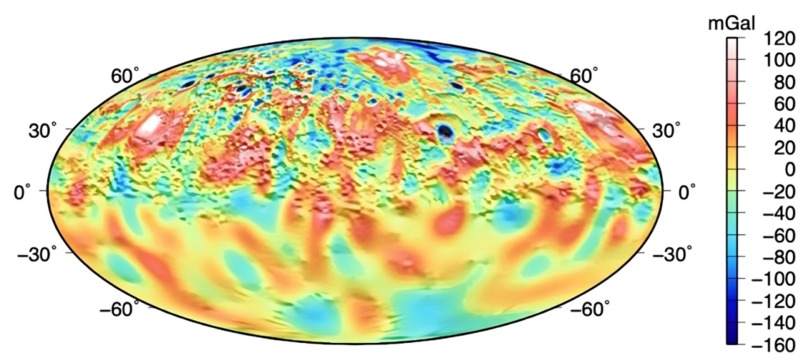
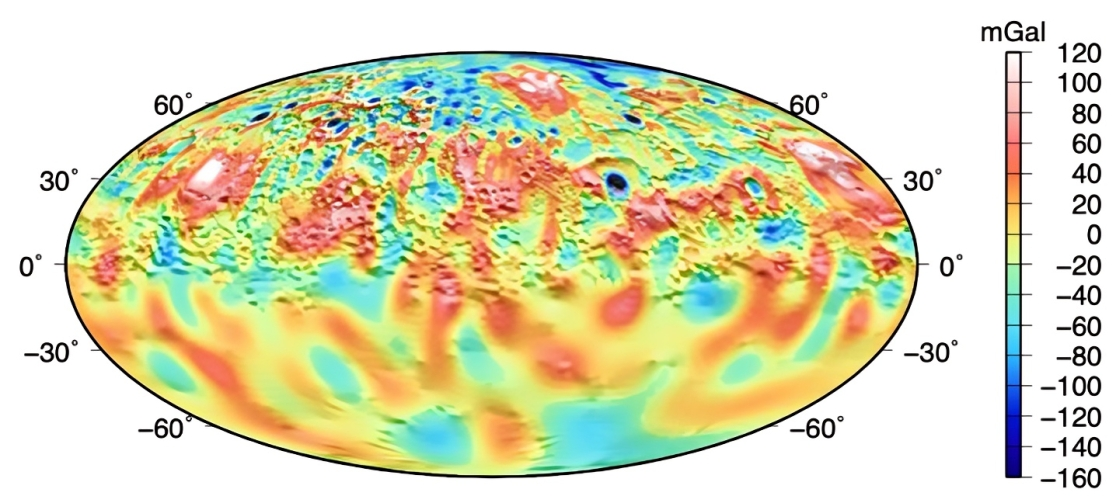
Fig. 1. Map of Mercury’s gravitational field prior to processing
Team Name:
The Messengers
Project Type:
Reimplementing a Paper
Team Members:
Team member 1 CS login: zding37
Team member 2 CS login: bmontoy1
Team member 3 CS login: aagraw73
Project Idea: Short Description (100-500 words)
The recent rise of neural networks in image reconstruction has allowed researchers to contextualize noisy data and technical artifacts. Yet, despite the growing use of deep learning as a robust tool for scientific analyses, its use in planetary science research remains scarce. This project aims to explore various image reconstruction techniques on the planetary data of Mercury. Planetary data on Mercury’s southern hemisphere is low quality due to the near-polar eccentric orbit of the MESSENGER (Mercury Surface, Space Environment, Geochemistry, and Ranging) satellite. By exploring how convolutional neural networks can provide reconstructed models of Mercury’s southern hemisphere, researchers can better understand how to apply convolutional neural networks to observe other planetary bodies. This project proposes that by using examples of topographic maps and gravitational fields from other celestial bodies, such as the moon, Mercury’s raw data collected by MESSENGER in the southern hemisphere can be reconstructed.
This research extends beyond the scope of planetary science as well: fields such as archeology require more research into image reconstruction techniques to better understand how worn ancient texts would have looked and what message they would contain. Medical image reconstruction allows clinicians to better diagnose and treat diseases, converting raw data into images that can expose internal structures and shed light on biochemical functions. Similar to how it is crucial to look at the raw data and low degree spherical harmonics for Mercury’s image reconstruction, these fields require more than enhancing an image because they incorporate more factors beyond just the information on screen. Archeology requires knowing how an ancient artifact degraded over time and medical image reconstruction of proteins is helped by knowing how proteins could fold and interact with itself.
What are some key limitations you anticipate facing when working on this project? (100-500 words)
Neural networks can generate realistic-looking but scientifically incorrect features. The network might fill in craters, ridges, or other features that don't actually exist or hallucinate formations. As a result, the network might produce topographically impossible features. In addition, unlike supervised learning with clear targets, ensuring your reconstructions obey physical laws (conservation principles, gravitational field consistency, etc.) is challenging.
Satellite data collected by MESSENGER has been traditionally used in spherical harmonic form, meaning our model will have to convert from spherical harmonic form to cartesian form in order to map the pixels. Another challenge is training lunar data or Martian data to reconstruct Mercury’s data. The structure of celestial bodies varies, and there are relatively few well-mapped planetary bodies to train on, potentially leading to overfitting.
Project Data Ideas:
Paper: https://www.mdpi.com/2072-4292/12/14/2293
MESSENGER Overview: https://science.nasa.gov/mission/messenger/
Planetary Data (Spherical Harmonic Data): pds-geosciences.wustl.edu/dataserv/gravity_models.htm


Log in or sign up for Devpost to join the conversation.