-
-
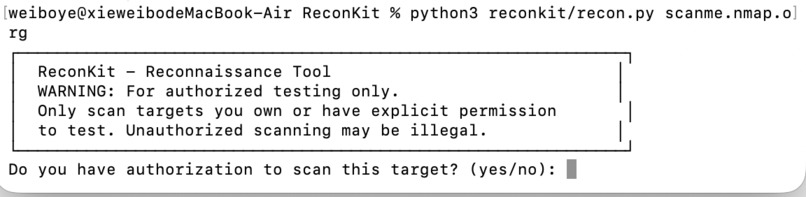
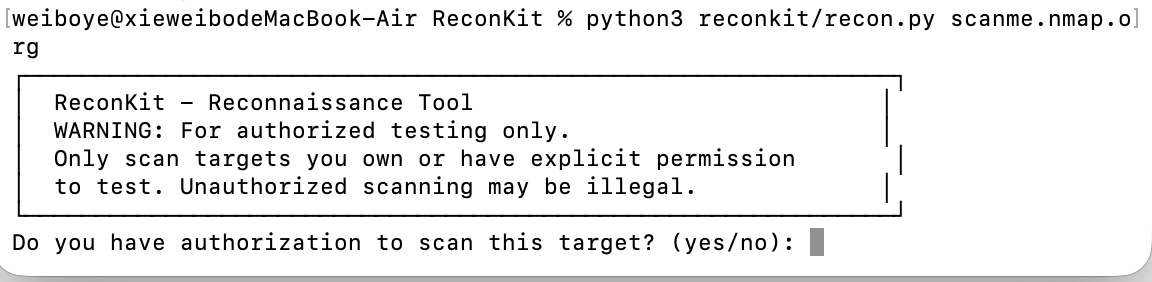
ReconKit authorization disclaimer box — ethical guardrail before any scan begins
-
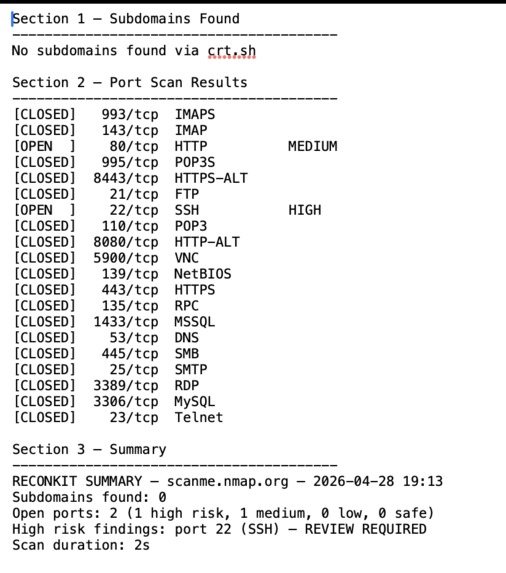
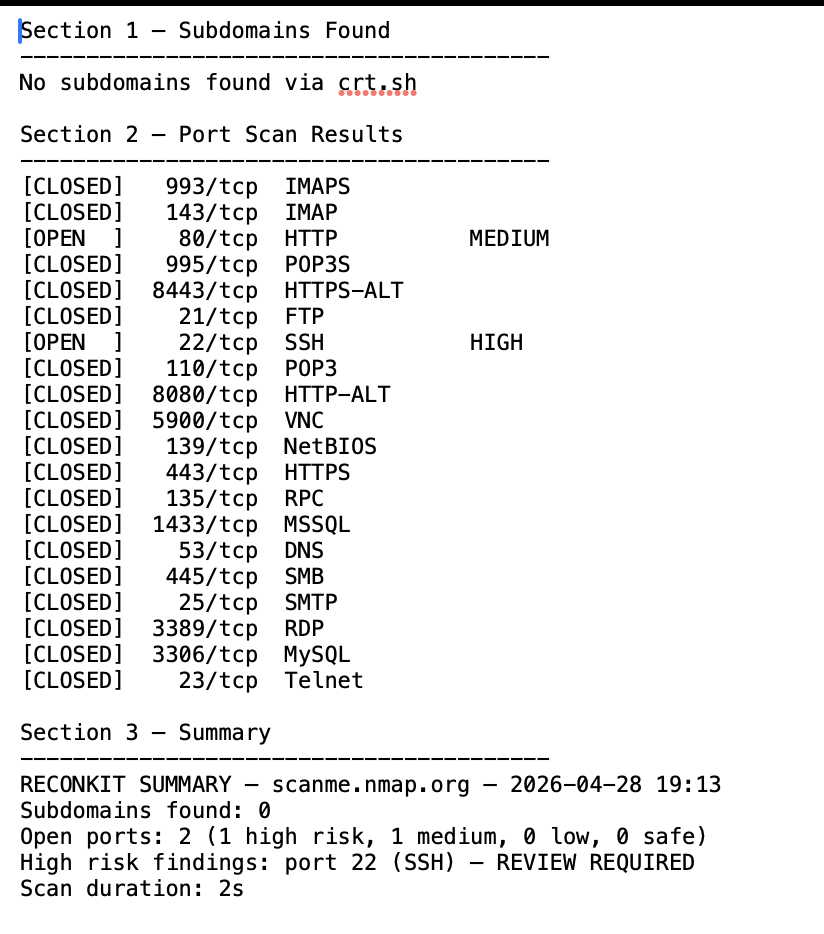
Auto-saved report.txt showing three sections: subdomains, port scan results, and copy-paste-ready summary
-
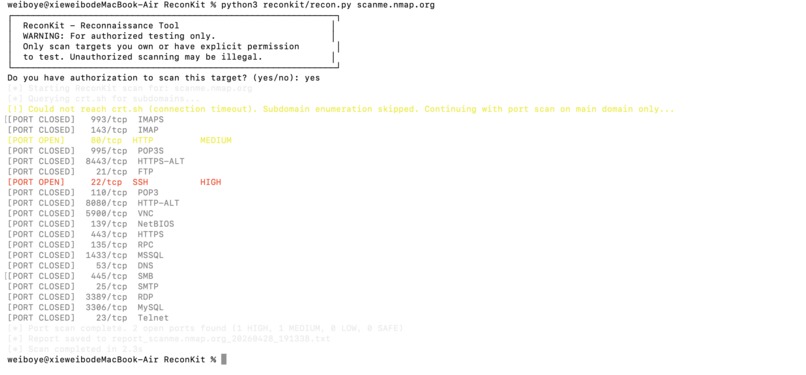
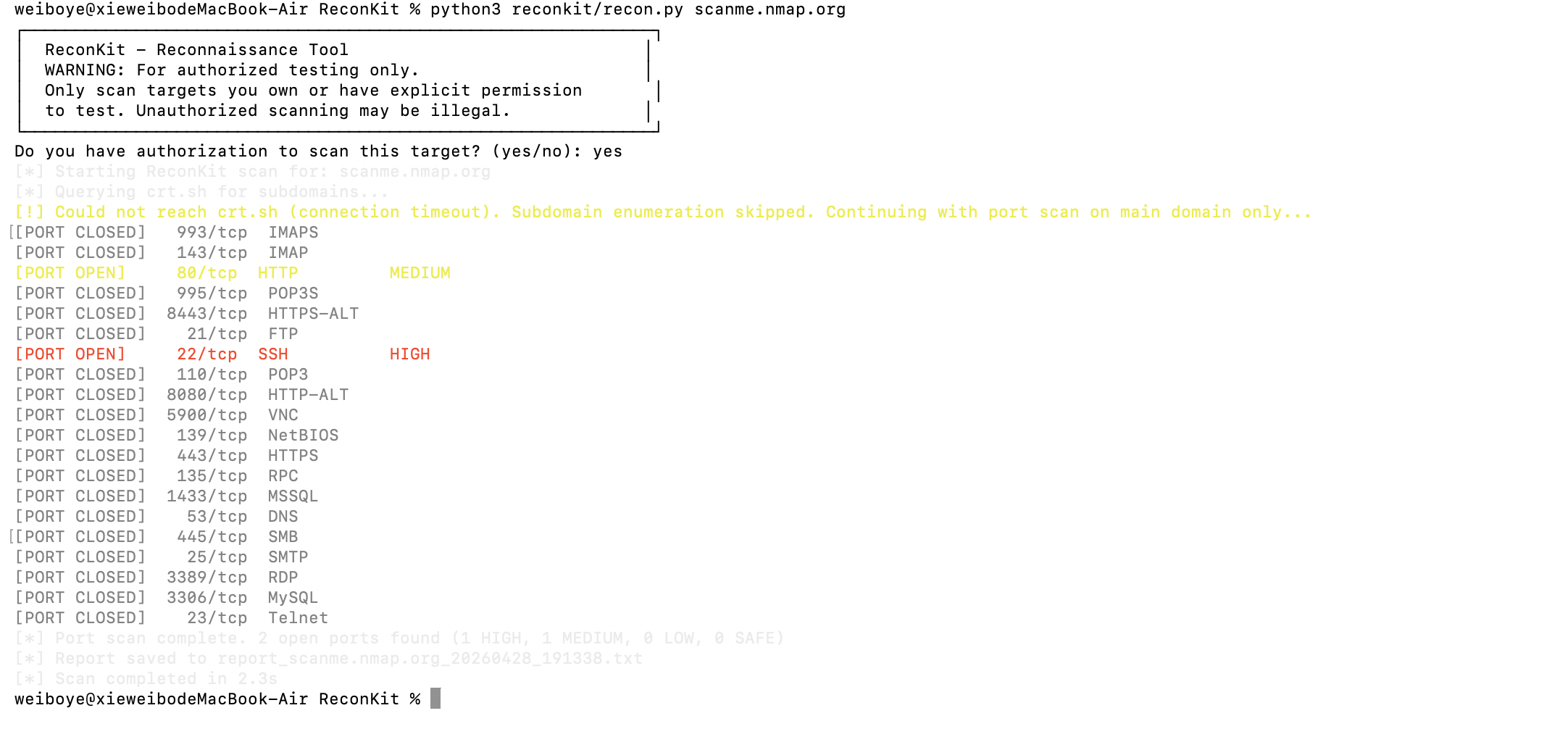
Live colored terminal output — red HIGH-risk ports, yellow MEDIUM, green SAFE, with summary at bottom
Inspiration
Every cybersecurity lab writeup looked the same: stitch together output from nmap, theHarvester, crt.sh, and a DNS lookup, then reformat it all by hand. The recon phase took longer to document than to do. I wanted one command that ran the standard pipeline and gave me a copy-paste-ready summary.
What it does
python3 reconkit/recon.py target.com runs three things in under 60 seconds:
- Subdomain enumeration via crt.sh certificate transparency
- Threaded TCP scan of the top 20 common ports with color-coded risk levels (HIGH/MEDIUM/LOW/SAFE)
- A plain-text report saved automatically with a copy-paste-ready summary block
How we built it
Built with Python 3.11+ standard library only — urllib.request for the crt.sh API call, socket + threading for the port scanner, raw ANSI escape codes for terminal colors. Zero pip installs. The entire project was planned spec-first: scope doc → PRD → technical spec → build checklist, before writing a single line of code.
Challenges we ran into
Concurrent print() calls from threaded port scan results interleave and produce garbled output. Fixed with threading.Lock() so each result prints atomically. Also had to strip ANSI color codes before writing the report file so it's clean for copy-paste.
Accomplishments that we're proud of
Ethical guardrails as a feature, not a footnote — startup consent prompt with strict yes-only acceptance, no skip flag. Passive techniques only. README cites CFAA and Australian Cybercrime Act 2001.
What we learned
Spec-driven development with an AI agent doesn't slow you down — it removes the mid-build "wait, what should this return?" moments that usually eat the most time. The build phase ran almost without surprises because the spec had answered every question already.
What's next for ReconKit
Directory traversal detection, banner grabbing on open ports, and a --urls flag for scanning multiple targets in one run.
Built With
- claude-code
- cli
- cybersecurity
- python
- socket
- threading
- urllib
