-
-
chapter_1
-
Landing Page
-
chapter_5
-
chapter_3
-
report
-
dashboard-1
-
exceptions
-
dashboard-2
Inspiration
Every growing business eventually faces the same problem: reconciling bank transactions with accounting records. What begins as a manageable spreadsheet quickly becomes a repetitive, error-prone process involving bank statements, accounting ledgers, payment gateways, and invoices. Existing enterprise solutions are often too expensive for startups and SMEs, while spreadsheets provide little automation or transparency.
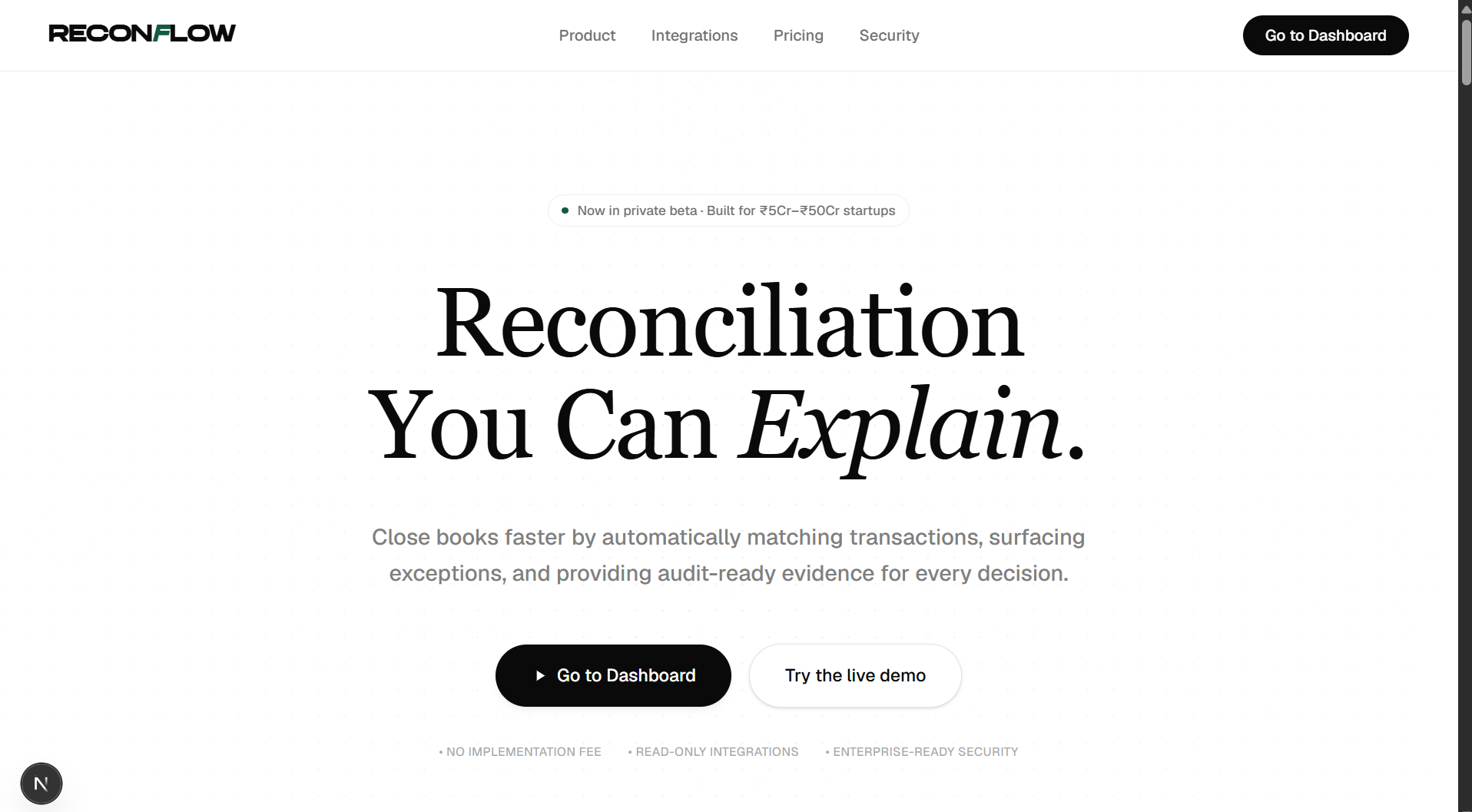
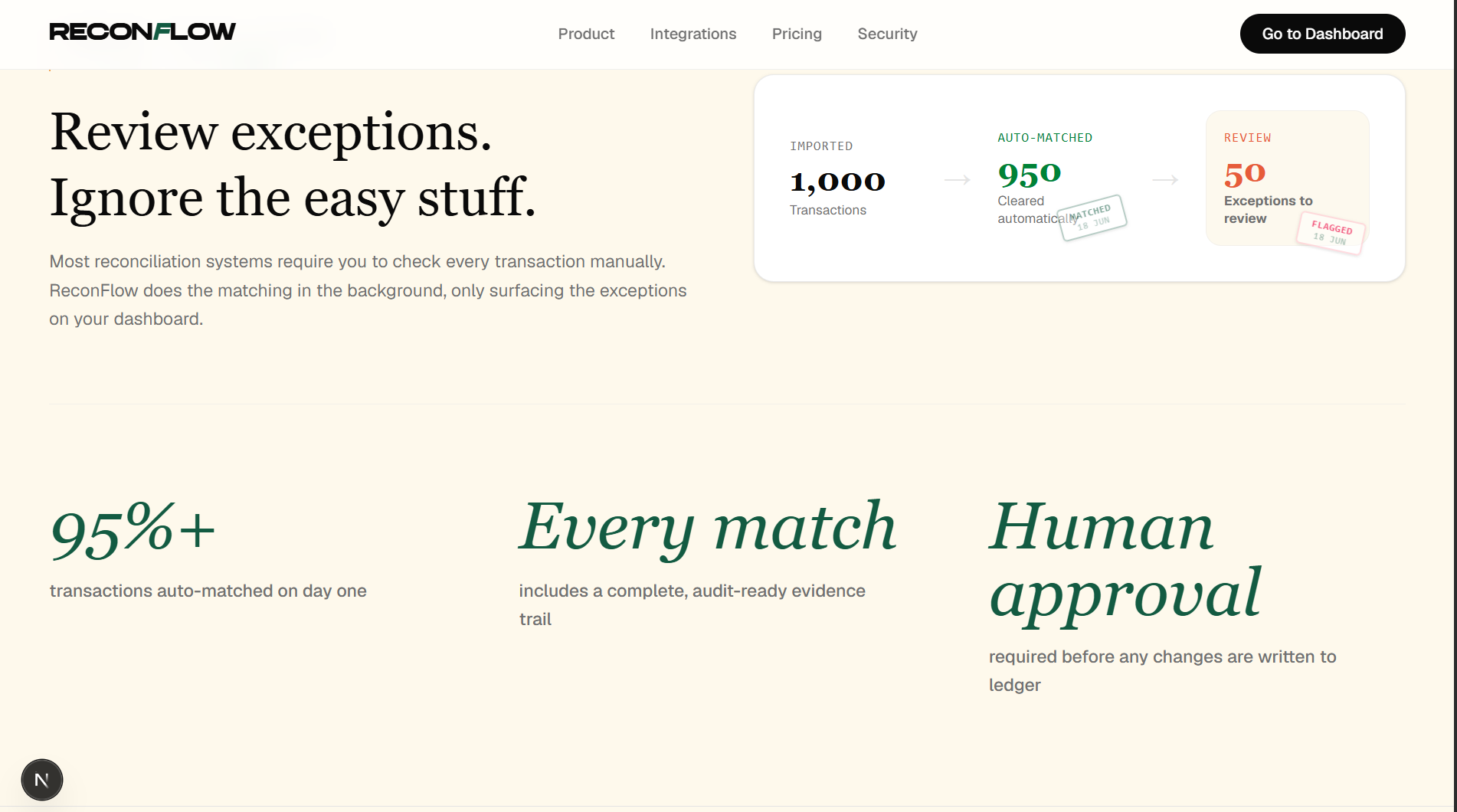
We wanted to build a solution that combines deterministic financial reconciliation with explainable AI. Instead of simply telling accountants that two transactions match, ReconFlow explains why they match and ensures that humans always remain in control of final financial decisions.
What it does
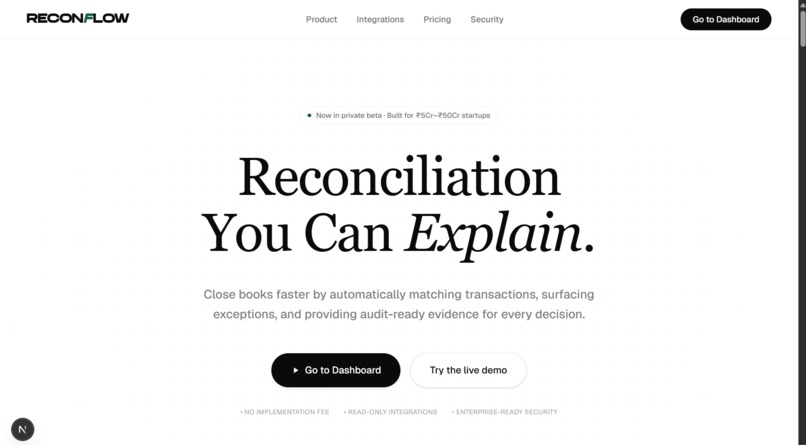
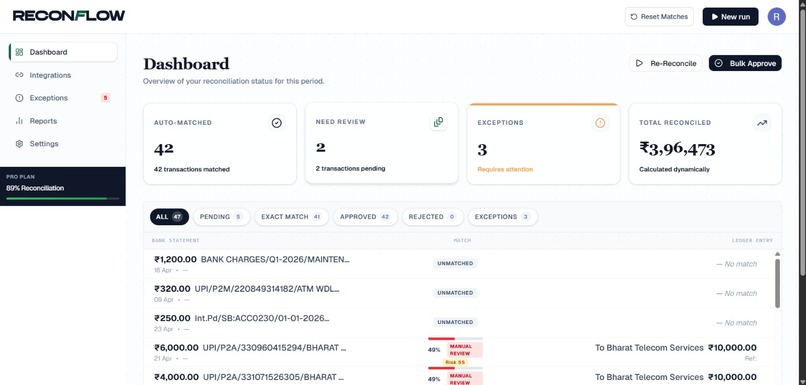
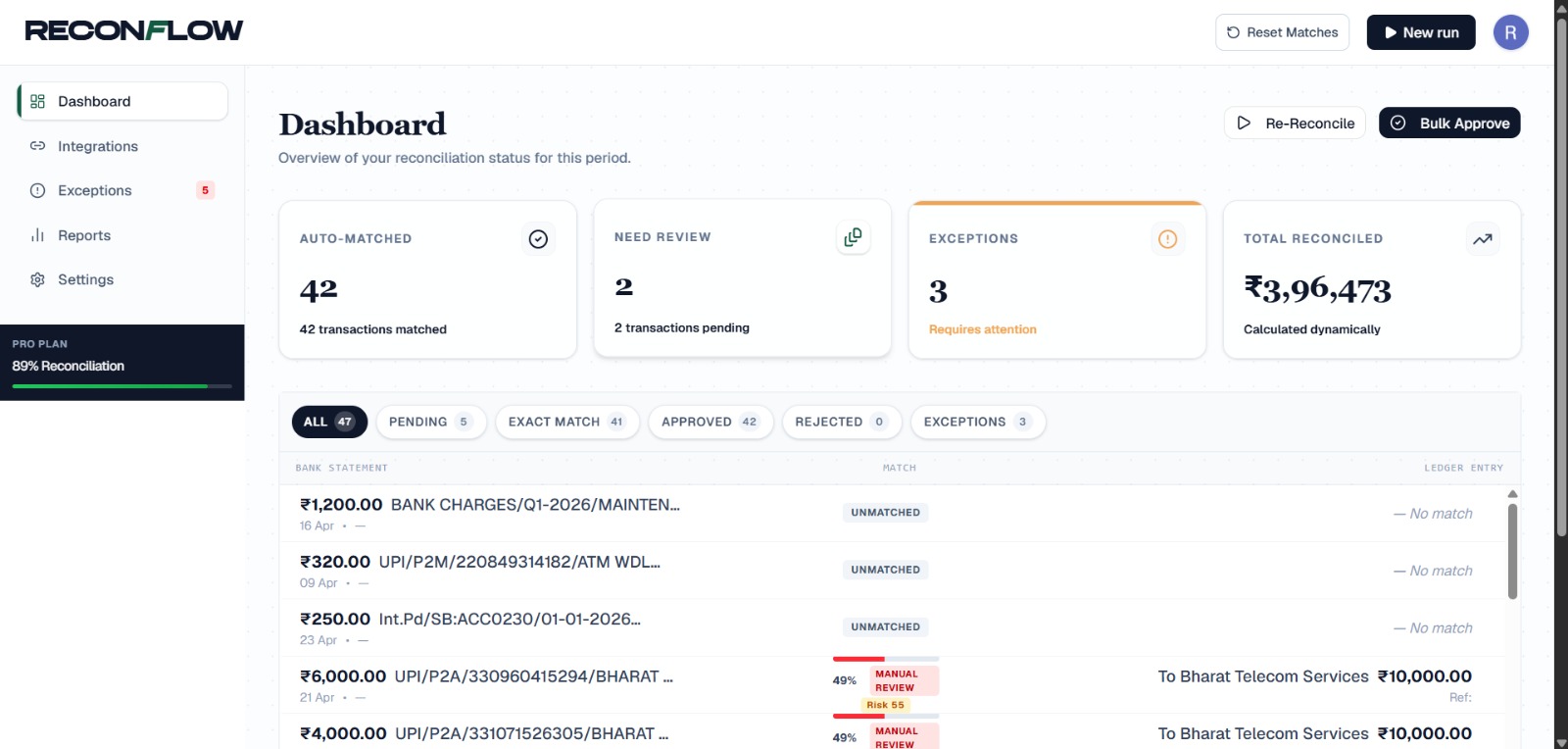
ReconFlow is an AI-powered financial reconciliation platform that automates the reconciliation of bank statements with accounting ledgers.
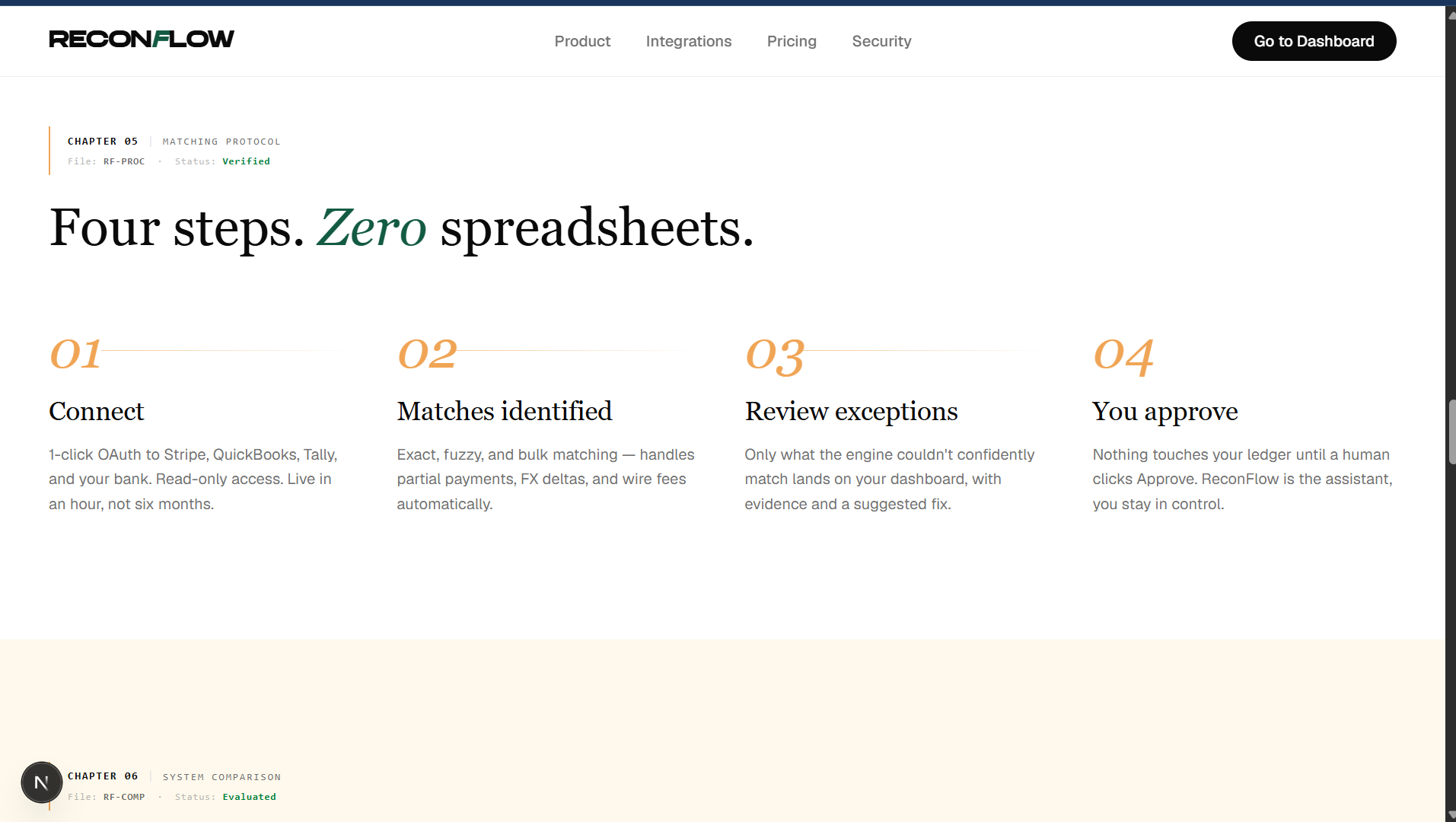
Users can upload bank statements and ledger files in CSV or Excel format, while the platform also supports integrations with QuickBooks and Stripe through OAuth-based connections.
The platform automatically:
- Cleans and normalizes financial data.
- Maps different file formats into a unified schema.
- Runs a multi-pass reconciliation engine.
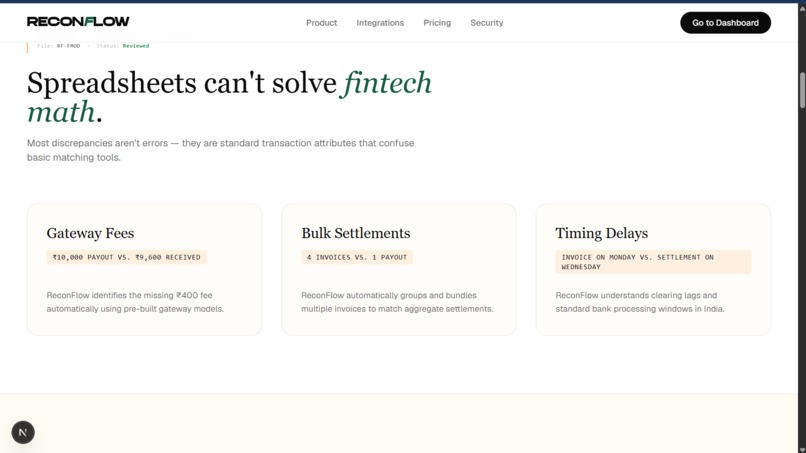
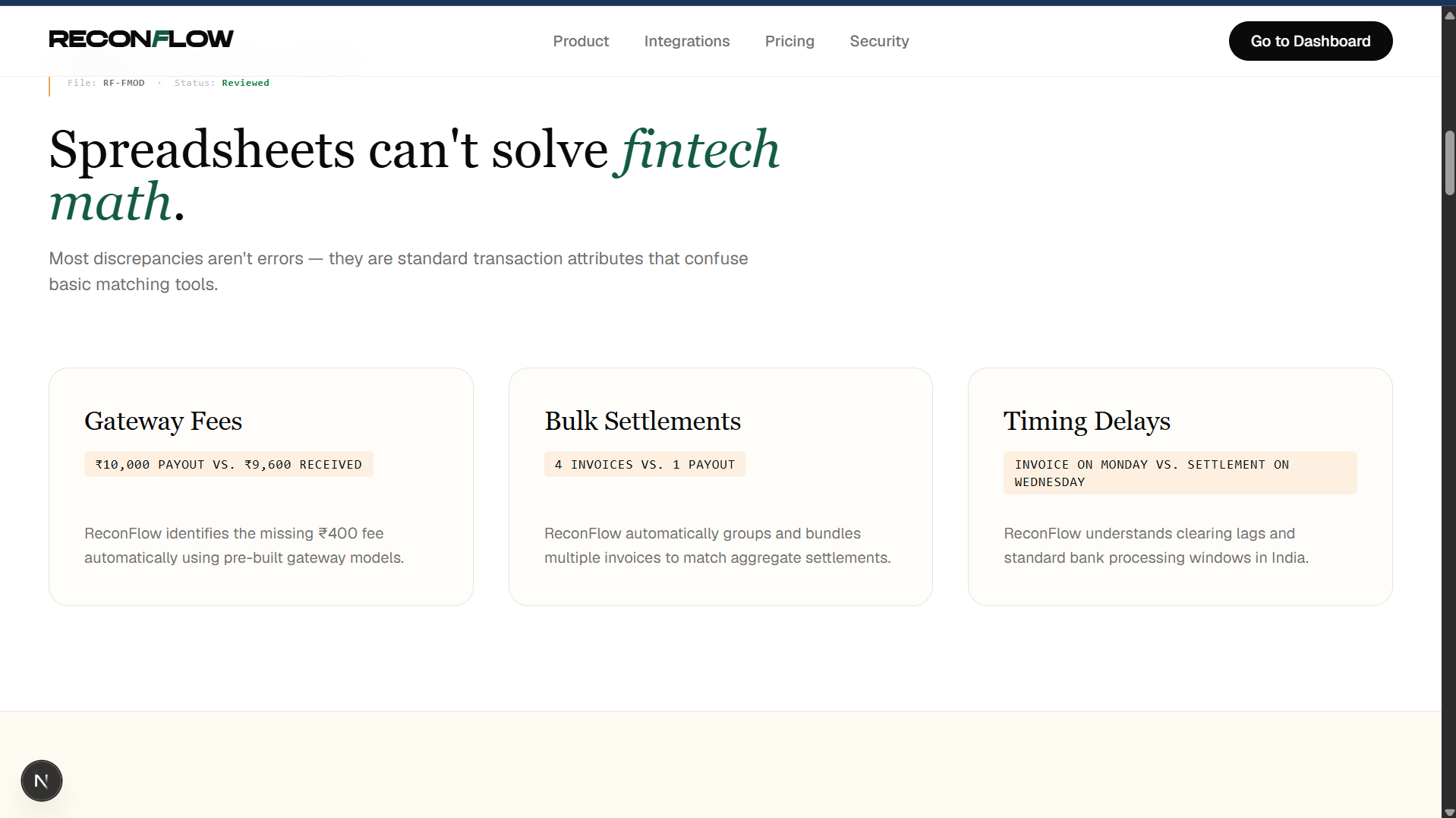
- Classifies discrepancies such as timing differences, processing fees, FX variance, and partial payments.
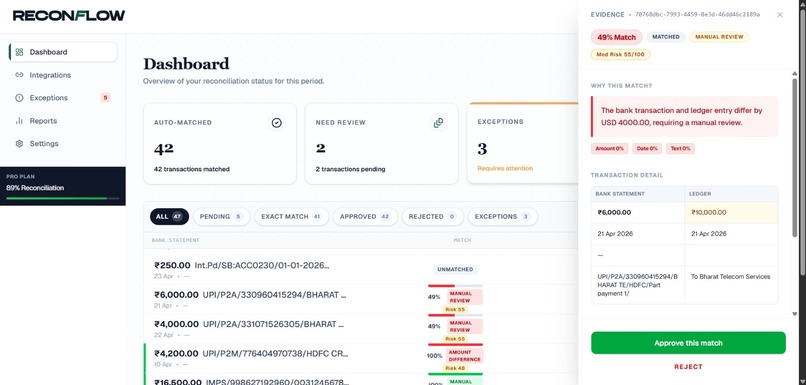
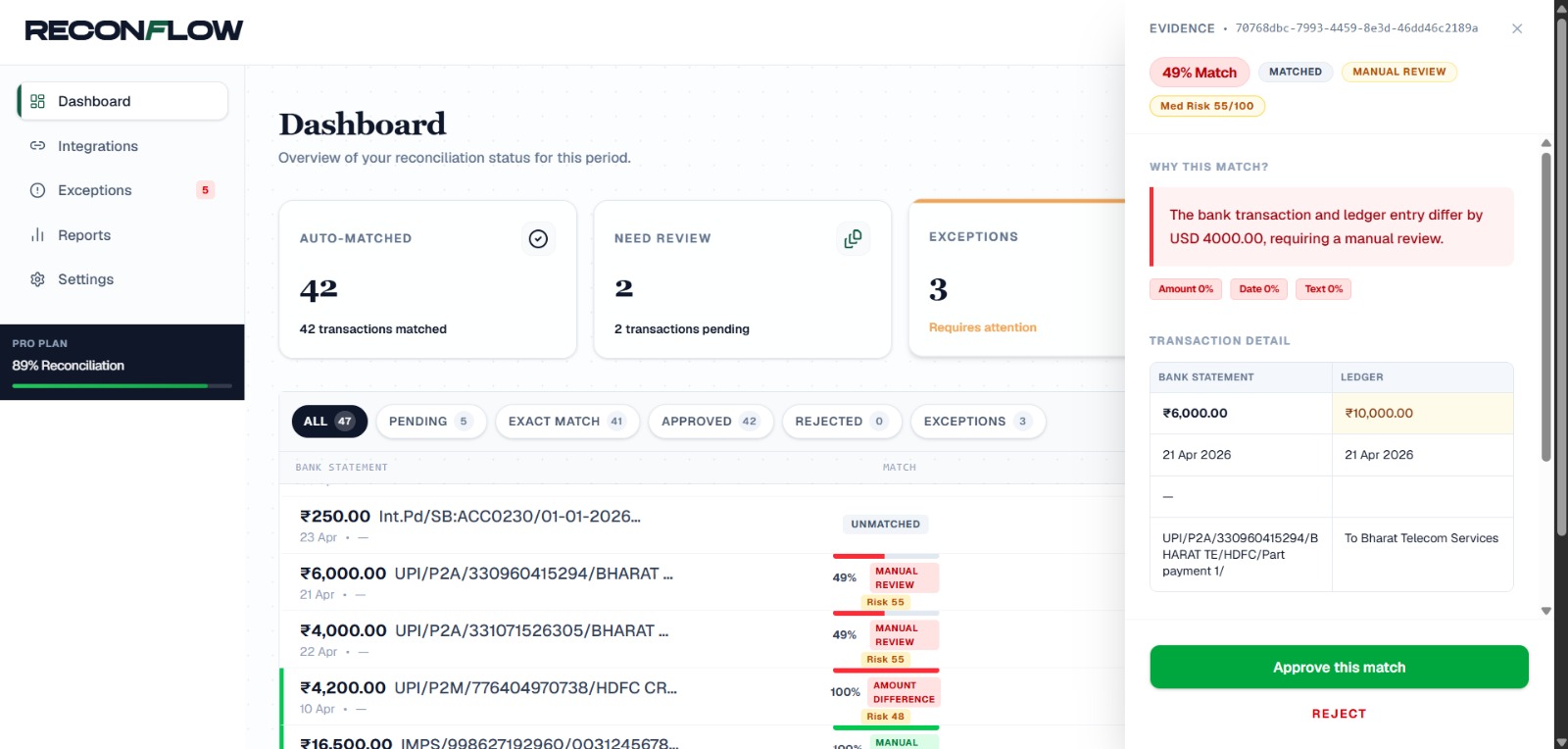
- Generates AI-powered explanations for uncertain matches.
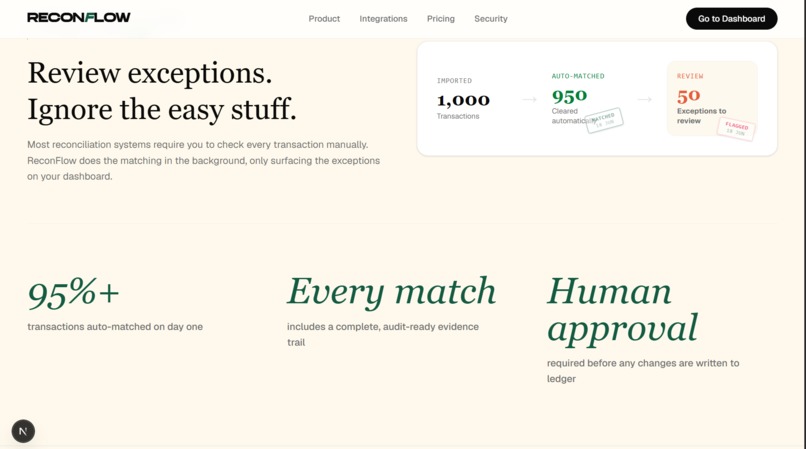
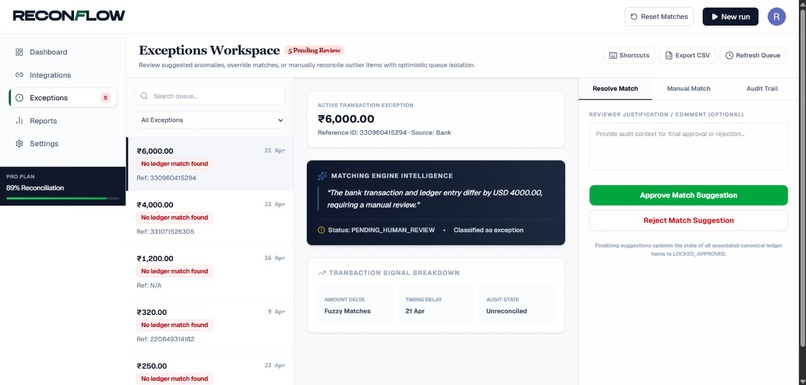
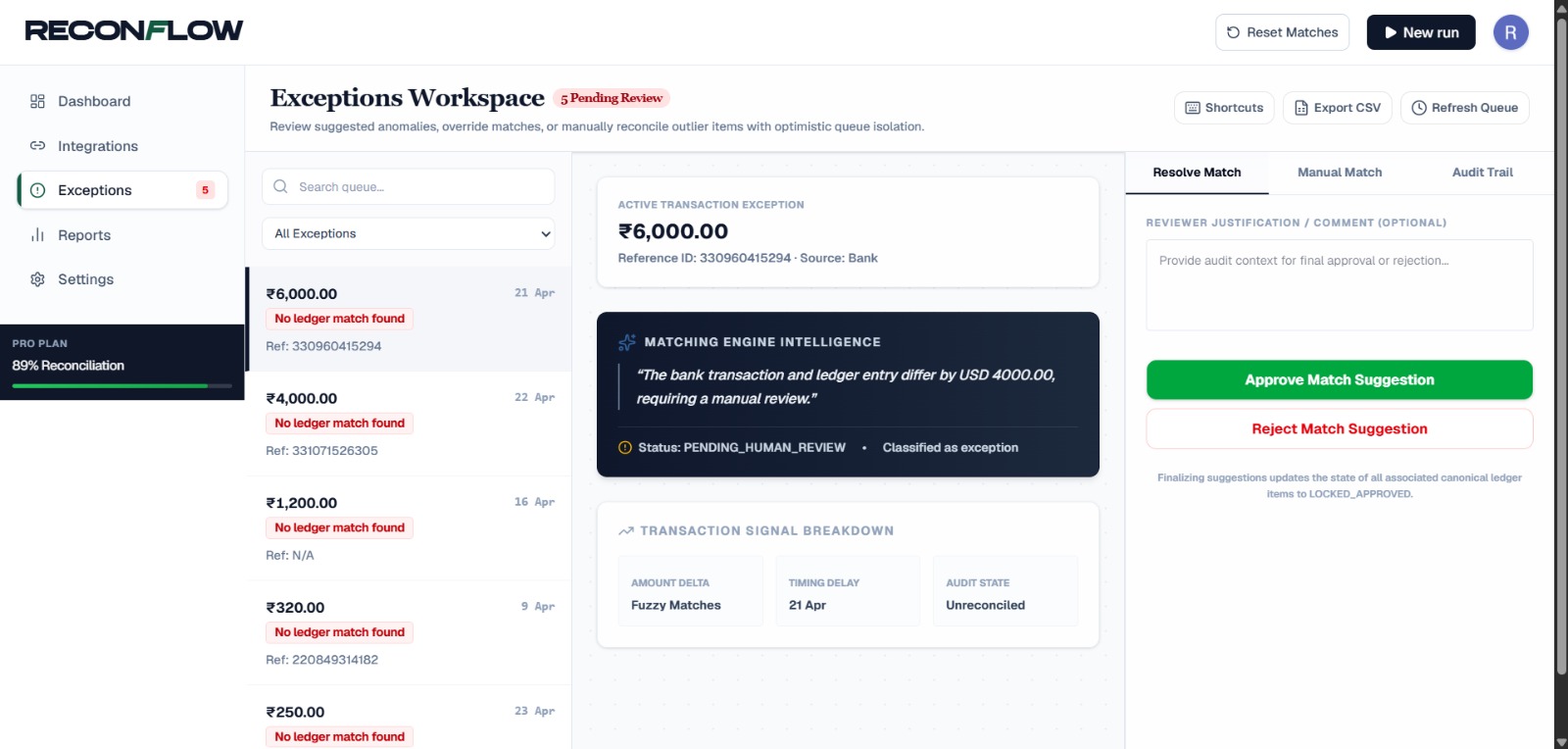
- Routes low-confidence transactions to a human review queue.
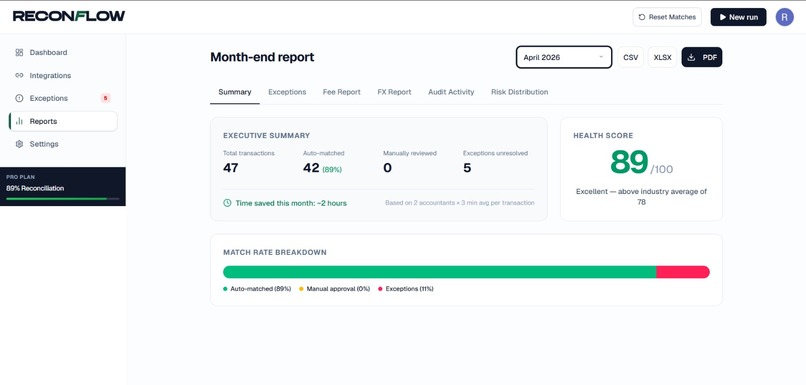
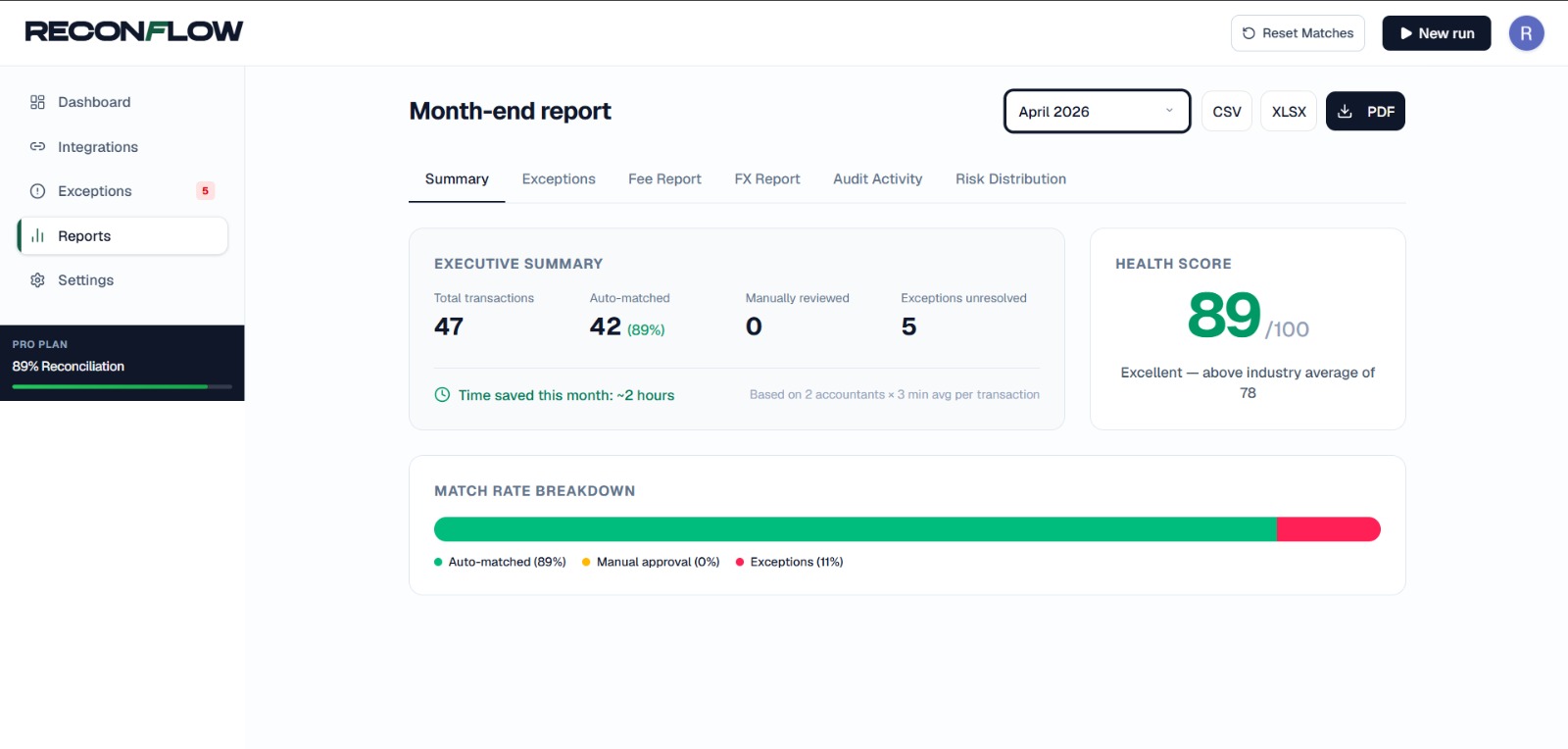
- Produces audit logs, reconciliation reports, and analytics.
The application is fully deployed on Vercel, providing a live, accessible web application for users and judges to experience the complete reconciliation workflow.
How we built it
ReconFlow is built as a full-stack web application using Next.js 15, TypeScript, Tailwind CSS, and ShadCN UI.
The frontend and backend API routes are deployed on Vercel, while financial data is stored using Amazon Aurora PostgreSQL Serverless v2 with Drizzle ORM, providing a scalable cloud-native database.
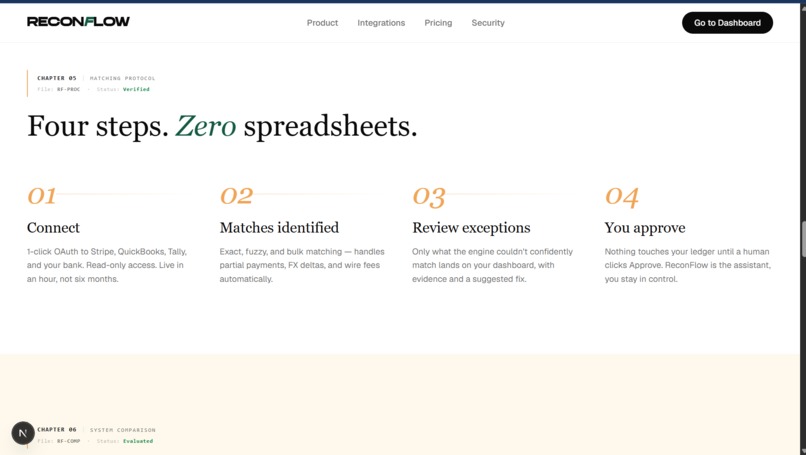
Our reconciliation engine processes financial data through multiple stages including ingestion, cleaning, schema mapping, canonical transaction generation, exact matching, subset matching, fuzzy matching, discrepancy classification, AI reasoning, and human review.
For explainable AI, we integrated Google Gemini 2.5 Flash, which analyzes low-confidence matches and produces plain-English explanations to help accountants understand why transactions were matched or flagged.
The platform also includes authentication using NextAuth.js, reporting dashboards, audit logging, and integrations with QuickBooks and Stripe.
Challenges we ran into
One of our biggest challenges was handling the wide variety of financial data formats produced by banks and accounting software. Even seemingly identical CSV and Excel exports often required different parsing and normalization strategies before they could be reconciled consistently.
Designing a reconciliation engine that balanced deterministic matching with AI-assisted reasoning was another major challenge. We needed to ensure that automation remained reliable while avoiding false positives that could affect financial records.
Deploying the application on Vercel, configuring Amazon Aurora, and ensuring the complete pipeline worked consistently across development and production environments also required significant engineering effort under tight hackathon timelines.
Accomplishments that we're proud of
We're proud of building a working end-to-end reconciliation platform rather than just an AI prototype.
Some highlights include:
- A multi-pass reconciliation engine capable of handling exact, fuzzy, and many-to-one matches.
- AI-generated explanations that make reconciliation decisions transparent instead of acting as a black box.
- A flexible ingestion pipeline supporting both CSV and Excel financial data.
- Human review workflows that keep accountants in control of every financial decision.
- A polished dashboard with reporting, audit logs, analytics, and reconciliation history.
- A live cloud deployment using Vercel with Amazon Aurora PostgreSQL as the backend database.
What we learned
This project taught us that financial software requires much more than accurate algorithms. Reliability, transparency, and user trust are just as important as automation.
We also gained hands-on experience designing scalable data pipelines, building cloud-native applications with Vercel and Amazon Aurora, integrating large language models responsibly, and balancing deterministic systems with AI-generated insights.
Most importantly, we learned that AI delivers the greatest value when it assists human decision-making rather than replacing it.
What's next for ReconFlow
Our vision is to make ReconFlow the intelligent reconciliation platform for startups and growing businesses.
Future plans include:
- Real-time Tally Prime synchronization.
- Automated GST reconciliation.
- Multi-currency reconciliation with live exchange rates.
- Machine learning models for anomaly and fraud detection.
- Collaboration features for finance teams.
- Enterprise-grade security and compliance certifications.
Ultimately, we want ReconFlow to become a comprehensive financial operations platform that dramatically reduces manual reconciliation while providing complete transparency, auditability, and confidence in every financial close.
Built With
- amazon-aurora-postgreqsql
- amazon-web-services
- csv-parse
- drizzleorm
- exceljs
- framermotion
- google-gemini-2.5
- jest
- lucide-react
- next.js
- nextauth.js
- postgresql
- quickbooks
- react
- reactpdf
- shadcn/ui
- stripe
- tailwindcss
- tanstack-react-virtual
- typescript
- vercel
- xlsx

Log in or sign up for Devpost to join the conversation.