Inspiration
Finance teams deal with thousands of invoices, payment requests, and transactions. Even a small mistake, like paying the same invoice twice or missing a failed payment, can create unnecessary costs and extra work.
We wanted to explore a question: What if AI agents could work together like a real finance team, while humans still controlled important financial decisions?
That idea became Reconcilo , a multi-agent finance platform designed to help automate invoice verification, payment processing, reconciliation, and exception handling.
Our goal was not to build another chatbot. We wanted to build a system where AI could understand a financial problem, decide what needed to happen next, and coordinate with other specialized agents to solve it.
What it does
Reconcilo is an AI-powered finance platform that connects customers, specialized AI agents, and a simulated banking system.
Customers can upload an invoice PDF or describe their problem through chat. Instead of requiring them to manually choose the correct department, Reconcilo analyzes their request and directs it through the appropriate workflow.
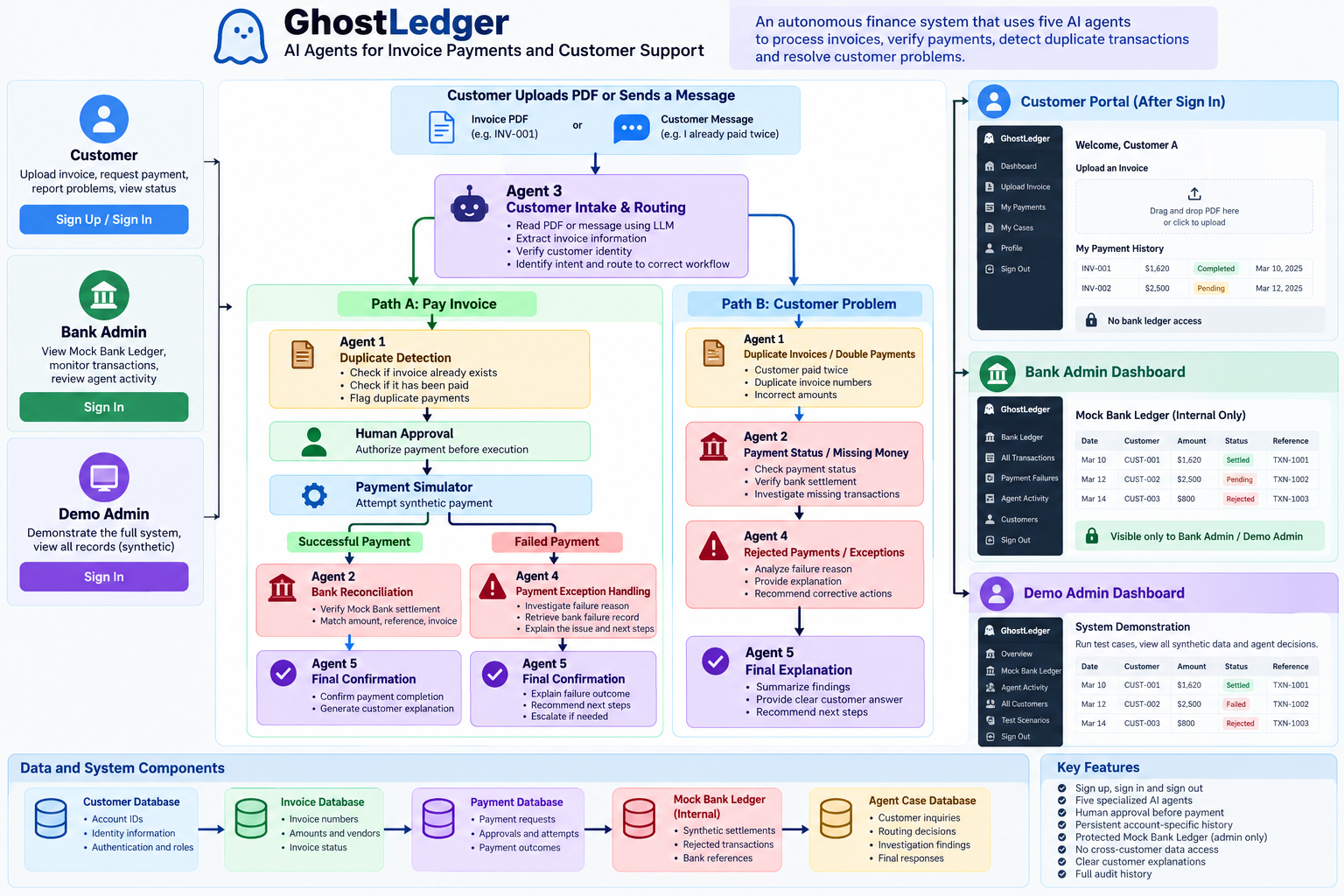
Our system is designed around five specialized agents:
Agent 3 — Customer Verification: Reads uploaded documents, extracts customer and invoice information, verifies available records, and identifies the customer's problem.
Agent 1 — Invoice and Duplicate Detection: Checks whether an invoice has already been paid and helps prevent duplicate payment requests.
Agent 2 — Reconciliation: Compares payment information with simulated bank transactions to identify inconsistencies.
Agent 4 — Payment Exception Handling: Investigates failed, missing, or unclear payments and helps customers understand the next steps.
Agent 5 — Payment Execution and Communication: Handles authorized simulated payment actions and communicates results to customers.
How we built it
We use Large Language Models (LLMs) in Reconcilo our backend to help AI agents understand customer requests and financial documents.
Our backend is built with Python and FastAPI, and the LLM integration is handled through our AI-agent system.
Agent 3 uses an LLM to read uploaded PDF invoices, extract customer information, identify financial problems, and determine which specialized agent should handle the request.
Other agents handle tasks such as duplicate payment detection, payment reconciliation, exception investigation, and customer communication.
We combine AI reasoning with rule-based financial operations to ensure reliability and security. Every payment requires human approval before execution, and all banking transactions are simulated.
For the frontend, we used React to create customer and administrator interfaces for invoice management, payment tracking, and AI workflow visualization.
We integrated large language models to help interpret customer requests and extract meaningful information from uploaded financial documents.
Instead of relying on a single AI model to handle everything, we separated responsibilities across specialized agents. Each agent focuses on a particular task and passes relevant information to the next stage.
Challenges we ran into
One of our biggest challenges was designing a multi-agent system that could make decisions without losing control of the overall workflow.
Initially, we explored using a separate classification model to route customer requests. However, we realized that financial documents often contain more complicated information than a simple category label.
We decided to make Agent 3 the starting point of the workflow. It could examine the customer's document, understand the problem, and select the appropriate next step.
Another challenge was preventing duplicate payments. We needed to distinguish between an invoice that had already been paid, a payment still awaiting approval, and a transaction that might have failed
Accomplishments that we're proud of
This project taught us that building autonomous AI systems is much more complicated than connecting an LLM to an API.
A useful AI agent needs clear responsibilities, access to the right information, and limits on what actions it can perform.
We also learned how important human-in-the-loop design is for sensitive applications like finance. Automation can reduce repetitive work, but critical decisions still need appropriate oversight.
What we learned
This project taught us that building autonomous AI systems is much more complicated than connecting an LLM to an API.
A useful AI agent needs clear responsibilities, access to the right information, and limits on what actions it can perform.
We also learned how important human-in-the-loop design is for sensitive applications like finance. Automation can reduce repetitive work, but critical decisions still need appropriate oversight.
Most importantly, we learned how to think about AI agents as parts of a larger system rather than independent chatbots.
What's next for Reconcilo
Currently, we are using synthetically generated financial datasets instead of real banking data to develop and test our AI models and agent workflows. This allows us to simulate different situations, such as duplicate invoices, failed payments, and transaction errors, without exposing sensitive customer information.
In the future, we plan to improve our system by working with larger, more realistic financial datasets to make our AI agents more accurate and reliable.
We also want to expand our multi-agent system by creating more specialized AI agents for different positions within a finance department. Instead of having only five agents, we envision a complete AI-powered finance team, with agents responsible for accounting, fraud detection, auditing, customer support, financial analysis, and other operations.
Our long-term goal is to build a platform where AI agents can collaborate like employees in a real company, automate repetitive financial tasks, and help businesses operate more efficiently, while humans remain responsible for important financial decisions.

Log in or sign up for Devpost to join the conversation.