-
-
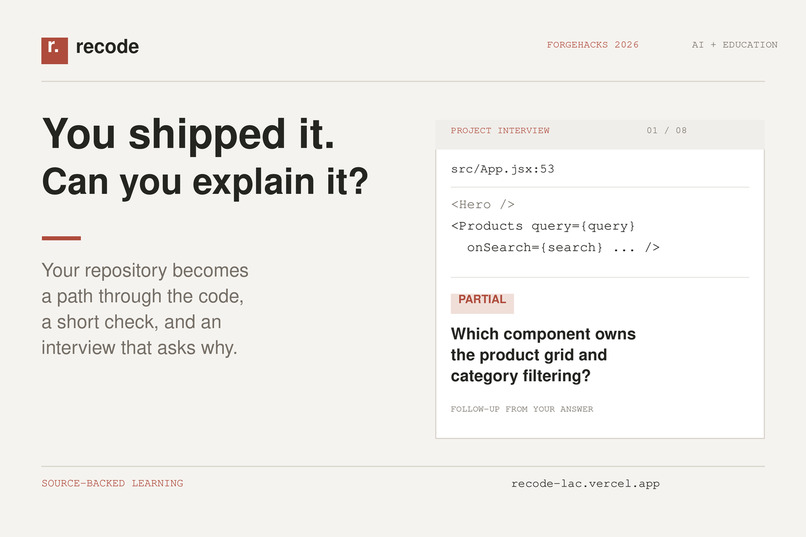
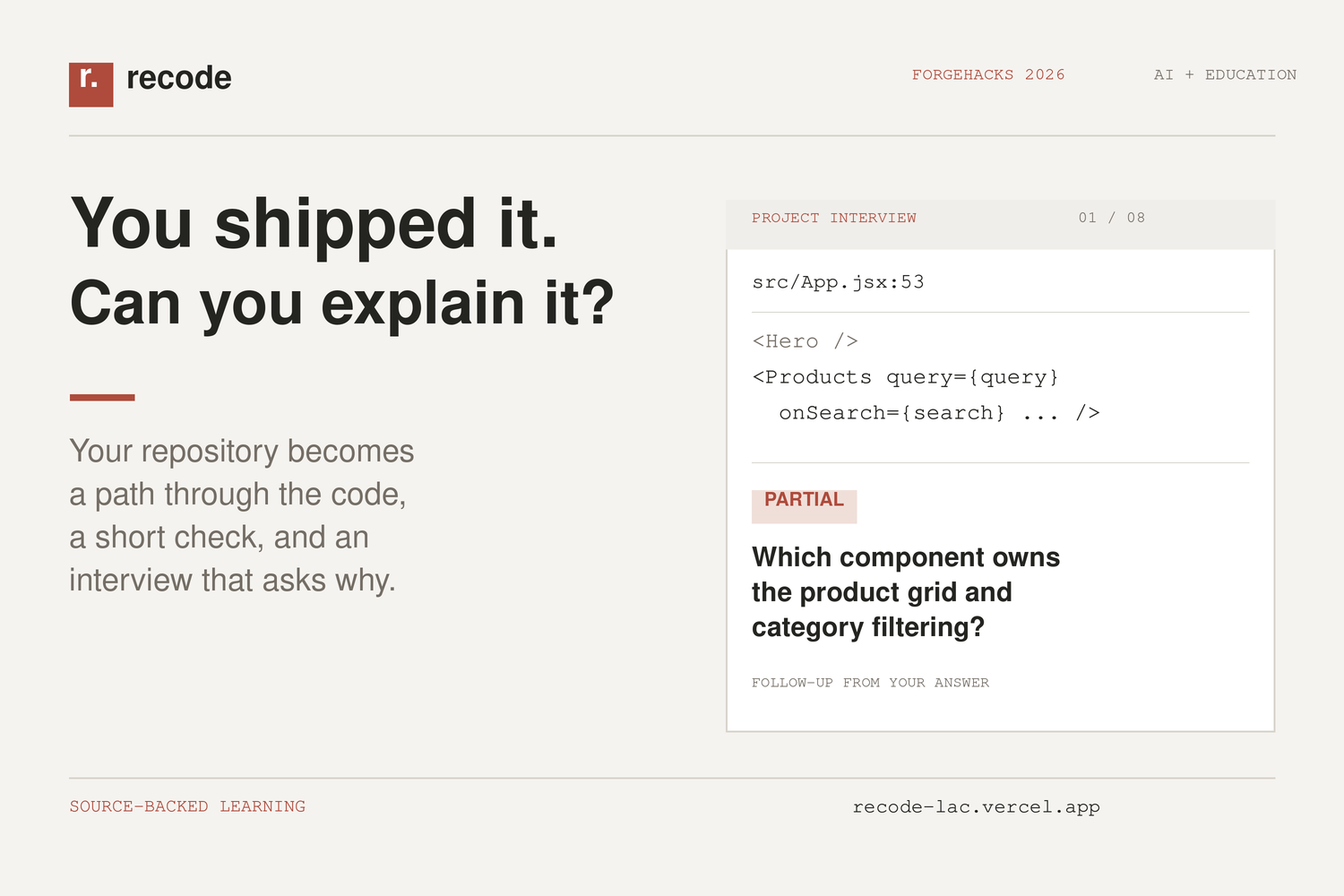
Recode challenges a vague project explanation with a source-linked follow-up, then points the learner to the next file to inspect.
Inspiration
AI coding assistants and fast team builds make it easier to ship software. They do not automatically make someone able to explain the code they shipped.
A developer may know that a project uses React, but still struggle to trace what starts the app, which component owns a feature, how state changes the screen, or what they personally contributed. That gap shows up in interviews, hackathons, code reviews, and when returning to a project weeks later.
Recode helps developers turn a repository they shipped into something they can actually explain.
What it does
Recode turns a public GitHub repository or source ZIP into a source-backed learning path.
It reads supported source files, maps real filenames and excerpts, then guides a learner through the stack, entry point, interactions, styling, and build evidence. A five-question understanding check links every answer back to a file, so a missed answer becomes the next thing to inspect.
Recode also includes project interview practice. The learner selects a target role, adds job requirements, and honestly describes their contribution. Eight project-specific rounds ask about ownership, startup, data, failure cases, design decisions, and release evidence.
With permission, Gemini reviews answers against selected source excerpts, identifies missing detail, asks a relevant follow-up, and directs the learner to a specific file to study next.
How we built it
Recode uses React, TypeScript, Vite, and CSS for the interface.
JSZip reads uploaded source archives. The GitHub API reads public repository trees and raw text files. Local source scanning creates the immediate walkthrough and five-question check.
Vercel Functions call Google Gemini for optional deeper explanations and interview review. The server validates the response structure and checks that cited file paths and lines exist before showing feedback. Imported code is read as text and is never installed or executed.
Challenges we ran into
A valid source citation can still support a weak explanation. We kept the scored five-question check deterministic, show source evidence beside feedback, and describe Gemini review as practice rather than a skill certificate.
The first interview prototype had only a few fixed prompts. We expanded it during ForgeHacks to eight rounds with answer-aware follow-ups and target-role context.
GitHub API limits and AI response time also shaped the small-project scope and the immediate local learning path.
Accomplishments that we're proud of
We built a complete source-to-explanation loop instead of a generic coding chatbot.
A learner can import a real repository, inspect actual evidence, practise explaining the work, receive a challenge when their answer is vague, and leave with a specific file to study.
In our live test with the public SwiftDG/nexstore-ui repository, Recode read 23 files. It marked the answer “I made the homepage with React and made it responsive” as partial, then asked which component owns the product grid and category filtering. A source-aware follow-up received supported feedback and pointed the learner to src/components/Products.jsx.
What we learned
Learning from code works better when the claim and the evidence stay close together. A learner improves faster when they can move from an answer to the exact source that supports or challenges it.
We also learned that useful interview practice should reward honest uncertainty. Recode can show what a repository contains, but it cannot establish authorship, prove that code runs, or guarantee interview readiness.
What's next for Recode
We will improve source selection for larger repositories, deepen backend and AI/ML learning paths, support revision across sessions, and evaluate feedback quality with developers using their own projects.
Built With
- css3
- github-api
- google-gemini
- javascript
- jszip
- react
- typescript
- vercel
- vite


Log in or sign up for Devpost to join the conversation.