What's next for Reco: Autonomous Agent Engineering System
Inspiration
Building production-grade AI agents today is largely an unscientific, manual chore. Developers spend hours tweaking prompts without regression suites, hand-wiring multi-agent topologies based on vibes, and debugging tool schema errors through trial and error. Crucially, fixing an agent for one failure case often silently breaks another.
We asked: Can an AI system engineer other AI agents automatically? What if you could provide a high-level natural language goal, an active tool catalog, and an evaluation benchmark—and an autonomous meta-agent would design the architecture ($V_0$), benchmark it against real data, diagnose root causes of failure, synthesize targeted mutations ($V_1, V_2$), and validate them against an air-gapped held-out split to prove empirical Pareto dominance?
That vision is Reco.
What Reco Does
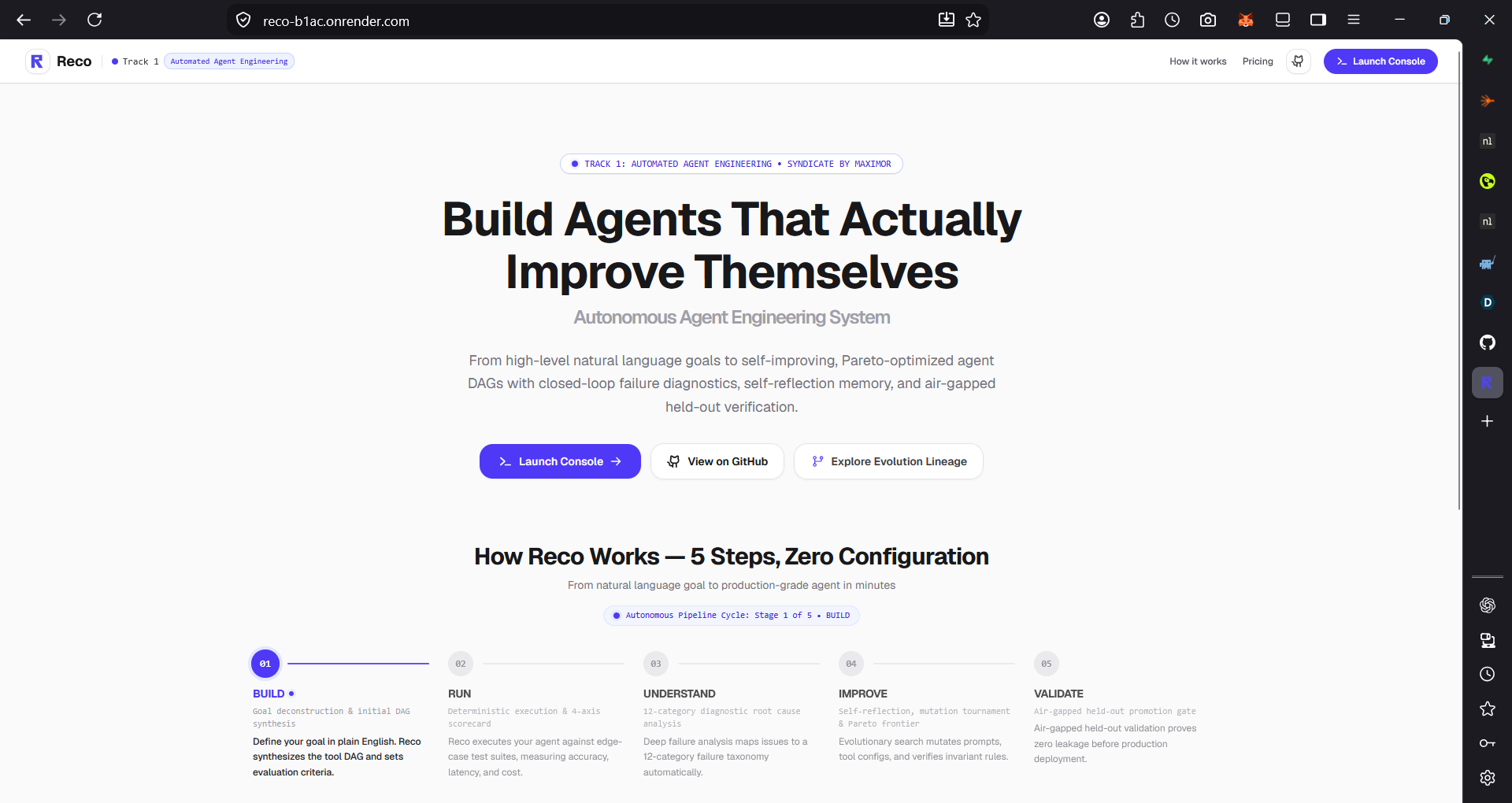
Reco automates the entire end-to-end AI agent engineering lifecycle through a closed-loop evolutionary harness:
- Goal Analysis & Task DAG Synthesis: Decomposes natural language goals and typed tool catalogs into formal task specifications.
- Architecture Generation ($V_0$): Synthesizes verified, acyclic agent topologies (
GraphDefinition), defining node roles, system prompts, routing logic, and authorized tool bindings. - Deterministic Execution Runtime: Executes agents with structured multi-round tool calling powered by TensorMux (GLM-4.7-Flash).
- 4-Axis Pareto Evaluation: Continuously benchmarks agent performance across Accuracy, Reliability, Cost (USD), and Latency (ms).
- 12-Class Failure Diagnosis: Classifies execution failures into actionable root causes (e.g., parameter mismatches, missing verifiers, hallucinated matches).
- Multi-Candidate Mutation Engine: Synthesizes alternative architectures (prompt tightening, tool rebinding, verifier guardrail insertion).
- Zero-Leakage Held-Out Promotion Gating: Tests top candidates against an unseen, held-out evaluation split to issue rigorous decisions:
PROMOTE,REVIEW, orREJECT. - Epistemic Memory Ledger: Extracts postmortem rules from earlier generations into permanent architectural invariants, preventing future regressions.
How We Built It
Reco was built end-to-end inside Agent Orchestrator (AO) and the agy CLI across more than 30 iterative milestones:
- Core Engine & Runtime: Built with Python 3.11, FastAPI, Pydantic v2, and NetworkX for topological validation.
- Model Inference Gateway: Deeply integrated with TensorMux (
https://api.tensormux.com/v1) usingglm-4-7-flashwith native reasoning token extraction, schema translation, and token-level cost accounting. - Distributed Observability: Integrated with Neatlogs to stream hierarchical 5-tier execution traces (
optimization_run→generation→benchmark_case→node_execution→tool_invocation) with direct inspection links and fault-contained async dispatch. - Cloud Ledger & Auth: Built on Supabase PostgreSQL with Row-Level Security (RLS) and GoTrue authentication to persist experiments, version DAGs, candidate scorecards, and failure diagnoses.
- Monetization & Entitlements: Integrated Dodo Payments in
test_modefor recurring Pro subscriptions ($29/mo,pdt_0Nmvzbo4wJETkRyCMAEPt), supporting hosted checkout, customer portal, and cryptographically signed HMAC webhooks with anti-replay protection. - Visual Console: Single-page application built with React 19, TypeScript, and Vite, featuring an interactive DAG graph visualizer, candidate tournament viewer, live trace inspector, and a 1-click Judge Demo Mode.
- Deployment: Unified full-stack web service running on Render.
Verified Multi-Domain Empirical Results
We proved Reco's autonomous self-improvement across three distinct engineering domains with zero code changes to the core engine:
| Domain | Benchmark Split | V0 Accuracy | V1 Accuracy | Held-Out Accuracy | Cost Delta | Latency Delta | Decision |
|---|---|---|---|---|---|---|---|
| Transaction Reconciliation | 12 opt / 8 held-out | 75.00% | 80.00% | 82.50% | -10.38% | -20.54% | PROMOTE |
| Dataset Anomaly Detection | 5 opt / 3 held-out | 80.00% | 100.00% | 66.67% | +30.56% | 0.00% | REVIEW |
| Research Comparison | 5 opt / 3 held-out | 100.00% | 100.00% | 100.00% | -9.83% | -14.75% | PROMOTE |
In Anomaly Detection, Reco demonstrated genuine scientific honesty: despite achieving 100% on the optimization set, the held-out split hit an ambiguous tradeoff (2/3 passed), triggering a REVIEW decision instead of a naive false promotion.
Challenges We Ran Into
- Preventing Overfitting & Benchmark Leakage: Ensuring mutations don't memorize training scenarios required an absolute air-gap between optimization splits and held-out test cases.
- Deterministic Tool Calling over Real APIs: Handling real LLM tool-calling quirks (such as timestamp format mismatches between Unix epochs and ISO-8601 strings) prompted us to build the Epistemic Memory Ledger, where the system synthesizes type-coercion invariants dynamically.
- Multi-Objective Tradeoffs: Balancing speed and cost against accuracy required strict Pareto dominance criteria so the agent doesn't balloon tokens just to gain marginal accuracy.
Accomplishments We're Proud Of
- Complete Closed-Loop Autonomy: Generating, executing, diagnosing, and evolving agent graphs without human intervention.
- Rigorous Engineering Quality: 571 passing backend tests and 51 passing frontend tests.
- Real Pareto Improvements: Up to +25% cumulative accuracy gain, with 10.38% lower inference costs and 20.54% lower latency.
- 100% Sponsor Alignment: Native integrations with TensorMux (GLM-4.7-Flash), Neatlogs, Supabase, Dodo Payments, and built entirely within Agent Orchestrator (AO).
What We Learned
Agents can improve predictably when guided by structured failure taxonomies rather than open-ended prompt tweaking. When failures are classified into explicit categories (e.g., parameter mismatch, verification miss), mutations become focused mathematical operations that yield measurable Pareto gains.
What's Next for Reco
- Dynamic MCP (Model Context Protocol) auto-discovery and sandbox execution.
- Cross-agent transfer learning, allowing durable invariants learned in financial reconciliation to accelerate initial designs in supply-chain agents.
- Multi-model ensemble generation, allowing Reco to assign distinct LLMs to specific nodes within the same DAG based on task complexity.
Built With
- agent-orchestrator
- agy
- dodo-payments
- fastapi
- glm-4-7-flash
- neatlogs
- postgresql
- pydantic
- python
- react
- supabase
- tailwindcss
- tensormux
- typescript
- vite


Log in or sign up for Devpost to join the conversation.