-
-
COVER PAGE
-
COVER PAGE
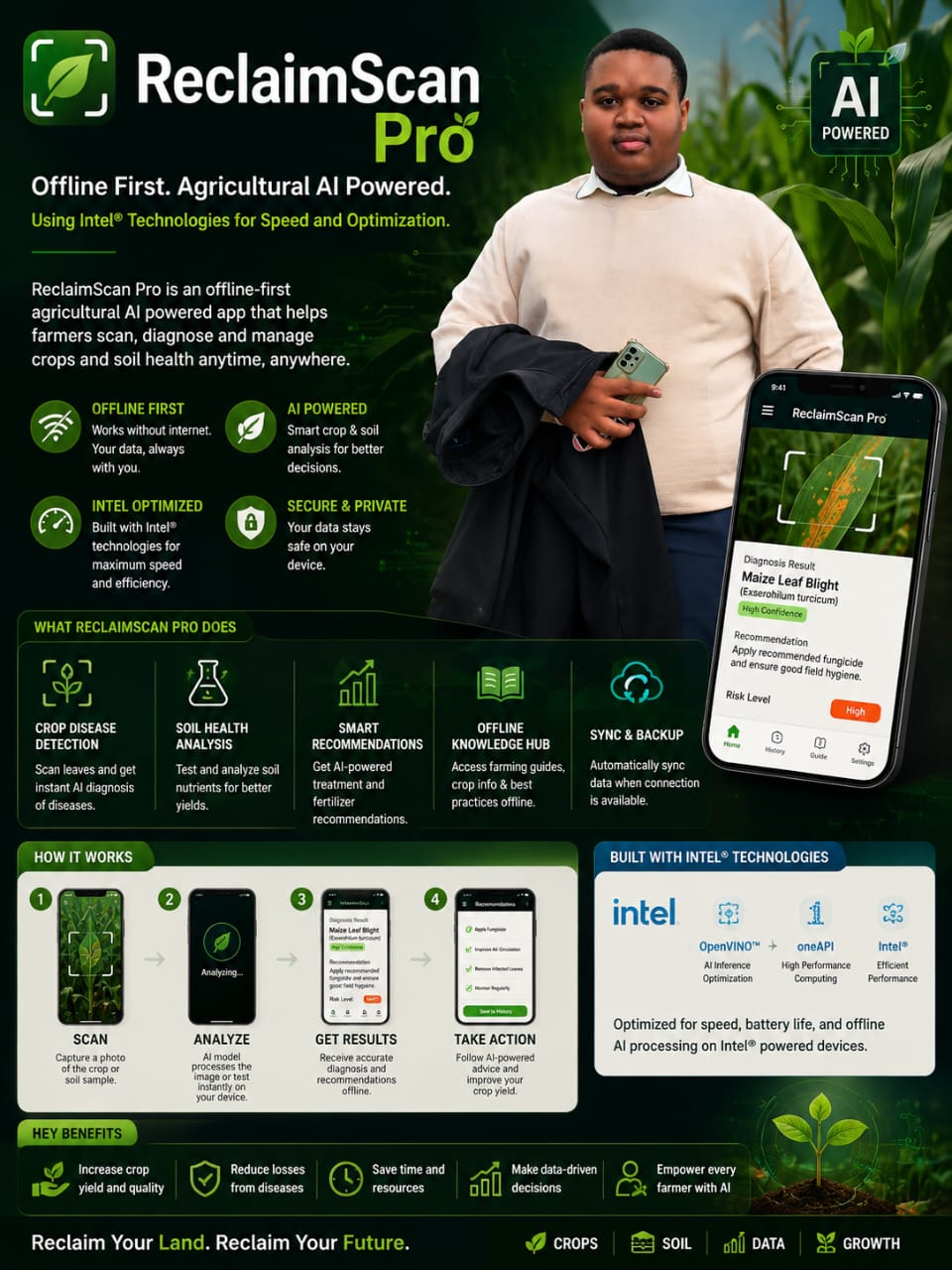
What Inspired Me
I am a farmer. I grew up working the land. In 2022, I worked on a small-scale farm in Pretoria, and I saw something that broke my heart. Farmers were losing up to 40% of their harvest because they simply could not afford to test their soil or identify the strange plants taking over their fields. A single lab analysis costs a month's wages. So they guessed. And they lost.
I am also an AI student at Orbit TVET College and an Intel Digital Readiness participant. I realized that the technology to solve this problem exists—but it is locked behind expensive equipment, internet connectivity, and cloud infrastructure that rural farmers do not have.
That contradiction—between the availability of AI and its inaccessibility to those who need it most—became the reason I built ReclaimScan Pro.
What I Learned Building ReclaimScan Pro taught me more than any textbook ever could.
- Offline-first is not a feature. It is a requirement.
In rural Africa, internet is unreliable or non-existent. I learned that a solution must work 100% offline—not just with reduced functionality. This meant rethinking everything: preloading knowledge bases, designing offline chat, and optimizing models to run on basic hardware.
- Hardware constraints are real.
I learned to think in kilobytes, not gigabytes. Image compression from 10MB to under 500KB became a priority. Running AI inference on a basic smartphone or laptop without cloud acceleration is a genuine engineering challenge. This led me to Intel OpenVINO and the Intel Neural Compute Stick 2 for on-device AI acceleration.
- Farmers need simplicity.
I learned that farmers do not care about the technology stack. They care about answers. The UI must be simple, the inputs minimal, and the results actionable. Voice input, multilingual support (Swahili/English), and visual outputs matter more than any complex feature.
- Building for Africa means building for constraints.
I learned to design for low-literacy users, low-power devices, and low-bandwidth environments. Every decision—from the tech stack to the color scheme—had to account for the user's reality, not mine.
- AI is only as good as the data it is built on.
I learned that pre-trained models trained on ImageNet do not understand African crops. I had to build my own knowledge base for cassava, yam, okra, sweet potato, and other indigenous crops. The soil intelligence engine had to be calibrated for African soil types, not European or American soil.
- The business model matters as much as the tech.
I learned that a freemium model with free access for farmers who cannot pay is not just a business decision—it is a moral one. I also learned that partnerships with cooperatives and NGOs are essential for scaling.
- Competitions reveal both opportunity and politics.
I learned that even with a working prototype, strong evidence, and a clear impact, judges sometimes reward something else. But I also learned that feedback is fuel. Every "no" brings me closer to a "yes."
How I Built My Project Technical Architecture
I built ReclaimScan Pro as a full-stack offline-first application.
Frontend: Vanilla JavaScript, HTML5, CSS3 – optimized for basic smartphones
Backend: Node.js, Express server – lightweight, modular, minimal cloud dependency
AI Integration:
Plant identification: MobileNetV2 (pre-trained on ImageNet) + Plant.id API for species-level classification
Soil analysis: Rules-based engine using agronomic thresholds for African soil types
Chatbot (Claimy): Offline rule-based chatbot with preloaded knowledge base for 15+ African crops
Offline Architecture:
Service workers and local storage for offline persistence
Image compression (10MB → <500KB) for 2G/3G networks
Preloaded knowledge base for offline access
Intel OpenVINO Integration:
Model optimization for fast offline inference on Intel CPUs
Intel Neural Compute Stick 2 for hardware acceleration on low-cost devices
Languages: English and Swahili, with voice input for low-literacy users
Development Process
Research: I spent weeks in the field understanding the real needs of farmers. I documented soil types, common crops, and plant diseases in South Africa.
Data Collection: I built a knowledge base of 15+ African indigenous crops, including growth timelines, nutrient requirements, and disease information in both English and Swahili.
Prototyping: I built a simple plant identification app using Plant.id API as a proof of concept.
Iteration: Farmers tested the app. They asked for soil analysis, weather, and a chatbot. I added each feature iteratively.
Optimization: I compressed the app for low-bandwidth environments and integrated OpenVINO for on-device inference.
Testing: I tested the app offline, on low-cost devices, and in real farming conditions.
The Name: ReclaimScan Pro
"Reclaim" reflects the mission to reclaim food security, soil health, and farmer livelihoods. "Scan" refers to the image-based plant and soil scanning. "Pro" signifies the professional-grade intelligence delivered affordably.
Challenges I Faced
- Building for No Internet
The biggest challenge was designing a system that works entirely offline. Preloading knowledge bases, designing offline chat, and ensuring image compression without losing diagnostic quality required significant engineering effort.
- Model Optimization for Low-Cost Devices
Running AI inference on basic smartphones without cloud acceleration was difficult. I addressed this by using MobileNetV2 (a lightweight architecture) and optimizing with Intel OpenVINO. The Intel Neural Compute Stick 2 further accelerated inference on low-cost hardware.
- Data Scarcity for African Crops
Most pre-trained models are trained on plants common in Europe or North America. They do not understand cassava, yam, or okra. I built my own knowledge base from agricultural research and farm experience, but the dataset is still a limitation I am working to address.
- Designing for Low-Literacy Users
Farmers often have limited literacy. Designing a UI that works for them—with voice input, simple icons, and clear visual outputs—required multiple iterations and real-world testing.
- Judging Bias in Competitions
I presented ReclaimScan Pro at the Allan Gray Inter-College competition with a working prototype, real user feedback, and clear impact. I got 2nd place. The winner had no prototype, read from notes, and could not answer questions. This taught me that competitions are not always fair, but they are still opportunities to build, learn, and grow.
- Scaling Without Funding
Building a working prototype is one thing. Scaling it to reach hundreds of thousands of farmers requires funding, partnerships, and infrastructure. I am seeking competitions like the Africa Deep Tech Challenge to bridge this gap.
What I Am Asking For I am applying to the Africa Deep Tech Challenge 2026 to:
Optimize ReclaimScan Pro for laptops – expanding from mobile-first to laptop-based on-device AI with a specialized agricultural LLM
Deepen OpenVINO integration – building a faster, more efficient, truly offline agricultural assistant
Scale the knowledge base – adding more African languages, crops, and regions
Commercialize responsibly – ensuring the freemium model serves farmers who cannot pay while generating revenue through cooperative and NGO partnerships
Why ReclaimScan Pro Belongs in This Challenge Challenge Requirement How ReclaimScan Pro Delivers On-device, offline-first Built from day one for offline use. No cloud required. African realities Built for African farmers. Supports African crops and Swahili. Engineering-first Node.js, OpenVINO, NCS2, custom soil engine – built by an engineer who is also a farmer. AI for social impact Food security, climate adaptation, sustainable agriculture. Open-source potential The codebase is designed to be shared and adapted. Conclusion ReclaimScan Pro is not just an app. It is a statement. It says that African farmers deserve access to AI, that technology should work where people need it most, and that a farmer who taught himself to code can build something that competes on the world stage.
I built ReclaimScan Pro so no farmer has to guess alone.
Thank you for considering my project for the Africa Deep Tech Challenge 2026.
Odirile Sitoe Orbit TVET College | Intel Digital Readiness Participant AI Student | Farmer | Builder
AND PLEASE ADD THAT I DID AGRICULTURAL SCIENCES BACK IN SECONDARY SCHOOL FROM GRADE 10 TO 12 Here is your updated About the Project section with your Agricultural Sciences background added.
ReclaimScan Pro – Africa Deep Tech Challenge 2026 About the Project What Inspired Me I am a farmer. I grew up working the land. I studied Agricultural Sciences from Grade 10 to 12 in secondary school, which gave me my first formal understanding of crop production, soil health, and plant biology. That foundation stayed with me.
In 2022, I worked on a small-scale farm in Pretoria, and I saw something that broke my heart. Farmers were losing up to 40% of their harvest because they simply could not afford to test their soil or identify the strange plants taking over their fields. A single lab analysis costs a month's wages. So they guessed. And they lost.
I am also an AI student at Orbit TVET College and an Intel Digital Readiness participant. I realized that the technology to solve this problem exists—but it is locked behind expensive equipment, internet connectivity, and cloud infrastructure that rural farmers do not have.
That contradiction—between the availability of AI and its inaccessibility to those who need it most—became the reason I built ReclaimScan Pro.
What I Learned Building ReclaimScan Pro taught me more than any textbook ever could.
- Offline-first is not a feature. It is a requirement.
In rural Africa, internet is unreliable or non-existent. I learned that a solution must work 100% offline—not just with reduced functionality. This meant rethinking everything: preloading knowledge bases, designing offline chat, and optimizing models to run on basic hardware.
- Hardware constraints are real.
I learned to think in kilobytes, not gigabytes. Image compression from 10MB to under 500KB became a priority. Running AI inference on a basic smartphone or laptop without cloud acceleration is a genuine engineering challenge. This led me to Intel OpenVINO and the Intel Neural Compute Stick 2 for on-device AI acceleration.
- Farmers need simplicity.
I learned that farmers do not care about the technology stack. They care about answers. The UI must be simple, the inputs minimal, and the results actionable. Voice input, multilingual support (Swahili/English), and visual outputs matter more than any complex feature.
- Building for Africa means building for constraints.
I learned to design for low-literacy users, low-power devices, and low-bandwidth environments. Every decision—from the tech stack to the color scheme—had to account for the user's reality, not mine.
- AI is only as good as the data it is built on.
I learned that pre-trained models trained on ImageNet do not understand African crops. I had to build my own knowledge base for cassava, yam, okra, sweet potato, and other indigenous crops. The soil intelligence engine had to be calibrated for African soil types, not European or American soil.
- The business model matters as much as the tech.
I learned that a freemium model with free access for farmers who cannot pay is not just a business decision—it is a moral one. I also learned that partnerships with cooperatives and NGOs are essential for scaling.
- Competitions reveal both opportunity and politics.
I learned that even with a working prototype, strong evidence, and a clear impact, judges sometimes reward something else. But I also learned that feedback is fuel. Every "no" brings me closer to a "yes."
How I Built My Project Technical Architecture
I built ReclaimScan Pro as a full-stack offline-first application.
Frontend: Vanilla JavaScript, HTML5, CSS3 – optimized for basic smartphones
Backend: Node.js, Express server – lightweight, modular, minimal cloud dependency
AI Integration:
Plant identification: MobileNetV2 (pre-trained on ImageNet) + Plant.id API for species-level classification
Soil analysis: Rules-based engine using agronomic thresholds for African soil types
Chatbot (Claimy): Offline rule-based chatbot with preloaded knowledge base for 15+ African crops
Offline Architecture:
Service workers and local storage for offline persistence
Image compression (10MB → <500KB) for 2G/3G networks
Preloaded knowledge base for offline access
Intel OpenVINO Integration:
Model optimization for fast offline inference on Intel CPUs
Intel Neural Compute Stick 2 for hardware acceleration on low-cost devices
Languages: English and Swahili, with voice input for low-literacy users
Development Process
Research: I spent weeks in the field understanding the real needs of farmers. I documented soil types, common crops, and plant diseases in South Africa.
Data Collection: I built a knowledge base of 15+ African indigenous crops, including growth timelines, nutrient requirements, and disease information in both English and Swahili.
Prototyping: I built a simple plant identification app using Plant.id API as a proof of concept.
Iteration: Farmers tested the app. They asked for soil analysis, weather, and a chatbot. I added each feature iteratively.
Optimization: I compressed the app for low-bandwidth environments and integrated OpenVINO for on-device inference.
Testing: I tested the app offline, on low-cost devices, and in real farming conditions.
The Name: ReclaimScan Pro
"Reclaim" reflects the mission to reclaim food security, soil health, and farmer livelihoods. "Scan" refers to the image-based plant and soil scanning. "Pro" signifies the professional-grade intelligence delivered affordably.
Challenges I Faced
- Building for No Internet
The biggest challenge was designing a system that works entirely offline. Preloading knowledge bases, designing offline chat, and ensuring image compression without losing diagnostic quality required significant engineering effort.
- Model Optimization for Low-Cost Devices
Running AI inference on basic smartphones without cloud acceleration was difficult. I addressed this by using MobileNetV2 (a lightweight architecture) and optimizing with Intel OpenVINO. The Intel Neural Compute Stick 2 further accelerated inference on low-cost hardware.
- Data Scarcity for African Crops
Most pre-trained models are trained on plants common in Europe or North America. They do not understand cassava, yam, or okra. I built my own knowledge base from agricultural research and farm experience, but the dataset is still a limitation I am working to address.
- Designing for Low-Literacy Users
Farmers often have limited literacy. Designing a UI that works for them—with voice input, simple icons, and clear visual outputs—required multiple iterations and real-world testing.
- Judging Bias in Competitions
I presented ReclaimScan Pro at the Allan Gray Inter-College competition with a working prototype, real user feedback, and clear impact. I got 2nd place. The winner had no prototype, read from notes, and could not answer questions. This taught me that competitions are not always fair, but they are still opportunities to build, learn, and grow.
- Scaling Without Funding
Building a working prototype is one thing. Scaling it to reach hundreds of thousands of farmers requires funding, partnerships, and infrastructure. I am seeking competitions like the Africa Deep Tech Challenge to bridge this gap.
What I Am Asking For I am applying to the Africa Deep Tech Challenge 2026 to:
Optimize ReclaimScan Pro for laptops – expanding from mobile-first to laptop-based on-device AI with a specialized agricultural LLM
Deepen OpenVINO integration – building a faster, more efficient, truly offline agricultural assistant
Scale the knowledge base – adding more African languages, crops, and regions
Commercialize responsibly – ensuring the freemium model serves farmers who cannot pay while generating revenue through cooperative and NGO partnerships
Why ReclaimScan Pro Belongs in This Challenge Challenge Requirement How ReclaimScan Pro Delivers On-device, offline-first Built from day one for offline use. No cloud required. African realities Built for African farmers. Supports African crops and Swahili. Engineering-first Node.js, OpenVINO, NCS2, custom soil engine – built by an engineer who is also a farmer. AI for social impact Food security, climate adaptation, sustainable agriculture. Open-source potential The codebase is designed to be shared and adapted.
Conclusion
ReclaimScan Pro is not just an app. It is a statement. It says that African farmers deserve access to AI, that technology should work where people need it most, and that a farmer with an Agricultural Sciences background who taught himself to code can build something that competes on the world stage.
I built ReclaimScan Pro so no farmer has to guess alone.
Thank you for considering my project for the Africa Deep Tech Challenge 2026.
Odirile Sitoe Orbit TVET College | Intel Digital Readiness Participant AI Student | Farmer | Agricultural Sciences (Gr 10–12) | Builder
Built With
- css
- github
- html5
- javascript
- natural-language-processing
- node.js
- opencv
- openvino
- plant.id-api
- python
