-
-
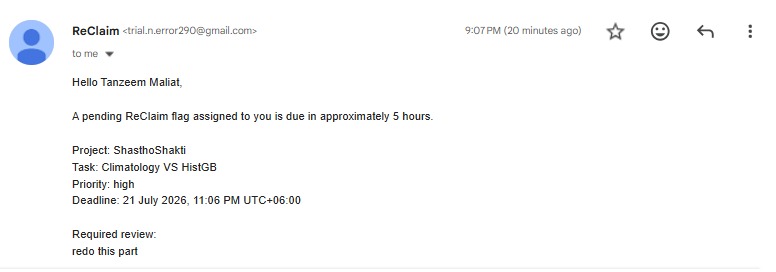
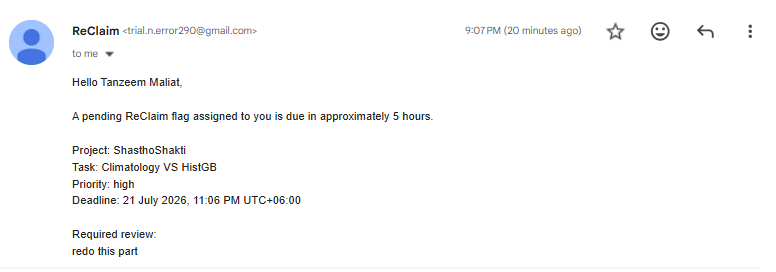
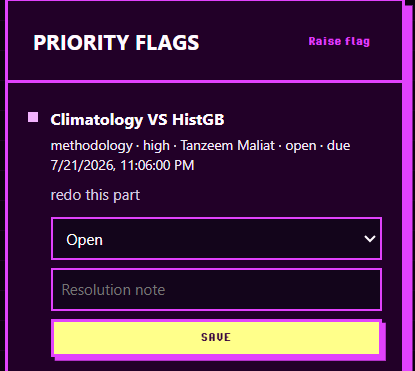
Members getting reminders 5 hours before deadline to fix a raised issue
-
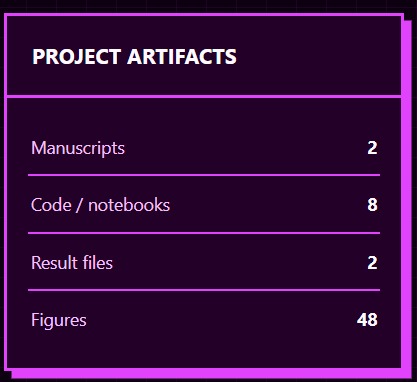
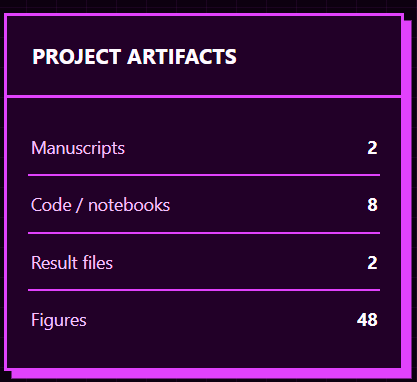
What the pwa actually works with
-
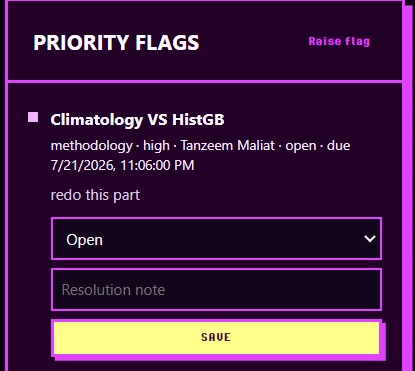
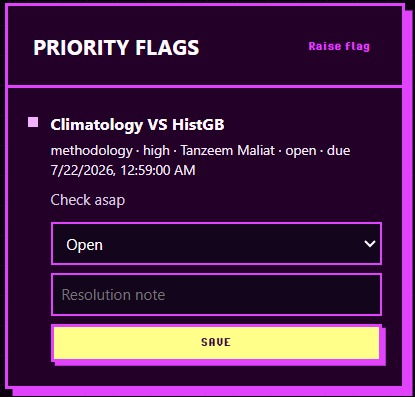
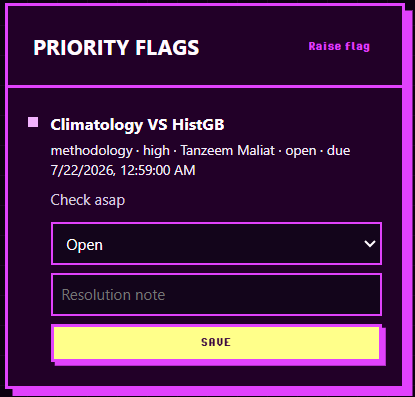
How the priority flags are shown to all the members of the workspace to get the work on the go
-
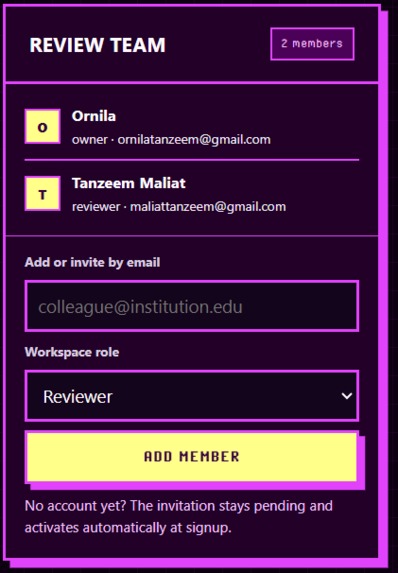
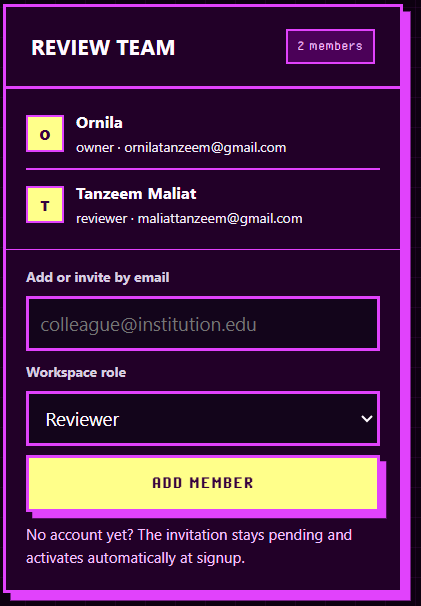
The updated workspace with different access mode for the members, new members can also be invited to join the workspace.
-
-
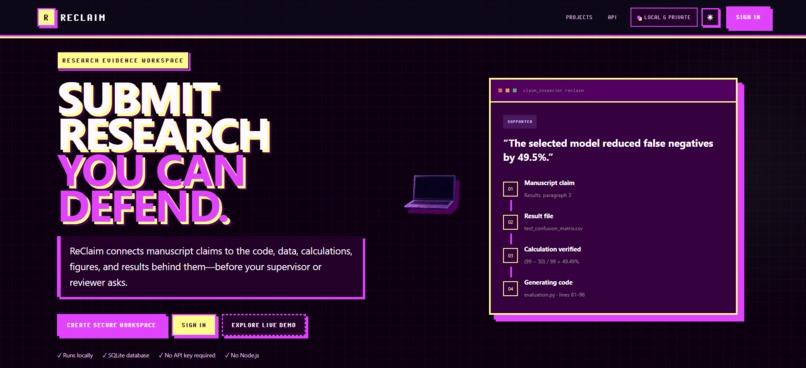
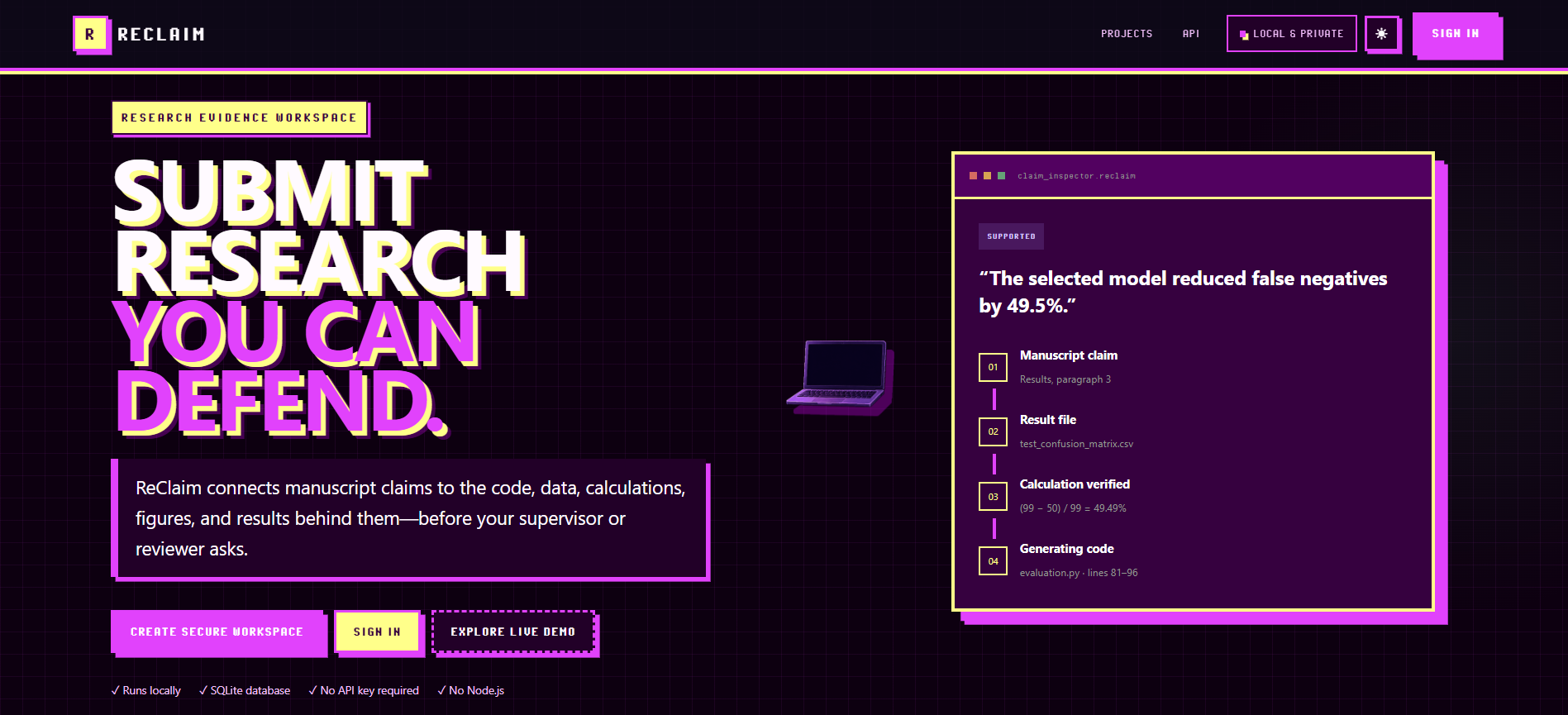
The landing page of ReClaim
Inspiration
Research conclusions are often written in a manuscript while the supporting code, datasets, figures, calculations, and final outputs remain scattered across different files. This creates a difficult question before submission: does the evidence actually support what the paper claims?
ReClaim was inspired by a real example where a manuscript suggested that HistGB performed better for one-month preparedness, while the final held-out test showed that climatology performed better. A result can change during experimentation without the corresponding claim being corrected.
What it does
ReClaim is a private research evidence-review workspace. Researchers upload a ZIP containing their manuscript and supporting project files. ReClaim then:
- Extracts claims from LaTeX, Markdown, text, and PDF manuscripts
- Inspects Python scripts and notebooks without executing them
- Reads CSV and JSON result files
- Connects claims to relevant code, data, figures, and outputs
- Detects numerical mismatches and held-out-test contradictions
- Identifies missing evidence and potential overclaims
- Evaluates claim coverage, traceability, methodology, data integrity, and reproducibility
- Converts findings into priority flags with assignees, reviewers, deadlines, and statuses
- Supports project members, comments, notifications, and version history
- Exports a structured Markdown Evidence Report
The readiness indicators are diagnostic—not publication-acceptance scores or substitutes for expert peer review.
How I built it
ReClaim uses a FastAPI and Python backend with a responsive HTML, CSS, and JavaScript interface. SQLite provides local storage for accounts, projects, memberships, flags, comments, invitations, and review history.
The analysis pipeline securely extracts supported files, identifies manuscript claims, indexes research artifacts, retrieves relevant evidence, and applies deterministic numerical and consistency checks. Uploaded Python code is treated strictly as text and is never executed.
The core application works locally without a paid API. Optional bounded reviewer guidance can run privately through Gemma 3 1B using Ollama. The project also contains an optional OpenAI Responses API integration, which remains disabled unless deliberately configured.
I collaborated with Codex using GPT-5.6 throughout development. Codex helped translate research-review requirements into working features, diagnose backend and interface problems, improve ZIP-upload security, refine the reviewer workflow, create tests, and prepare the repository and documentation. I retained responsibility for the product direction, research interpretation, privacy boundaries, and final design decisions.
Challenges
The hardest challenge was distinguishing between different sources of research weakness. A claim may be unsupported because the manuscript was not updated, the result file is missing, the code does not generate the claimed output, the methodology is incomplete, or the project cannot be reproduced.
Another challenge was keeping the system useful without presenting automated guidance as scientific truth. ReClaim therefore separates deterministic checks from optional reviewer guidance and keeps human approval authoritative.
Securely handling research archives, enforcing project-level access, tracking revised project versions, and supporting email reminders without exposing credentials also required careful design.
What I learned
I learned that research verification is not a single score. Claim support, numerical consistency, methodology, data integrity, and reproducibility must be presented separately so researchers can understand what needs correction.
I also learned that a useful reviewer should not merely say that something is wrong. It should identify the affected artifact, explain the evidence, recommend the next action, and assign responsibility while remaining transparent about uncertainty.
Accomplishments
ReClaim now provides an end-to-end workflow from research-project upload to evidence analysis, collaborative correction, and report export. It includes a built-in synthetic demonstration, secure archive handling, role-based workspaces, project versioning, reminder support, optional local reviewer guidance, and 17 passing automated tests.
What’s next
The next stage is persistent cloud deployment using PostgreSQL and private object storage, followed by stronger document parsing, configurable review policies, richer evidence visualization, and integrations with research repositories and publication workflows.
ReClaim’s goal is simple: help research teams understand what is supported, what is missing, and what must be corrected before they submit work they need to defend.
Built With
- api
- codex
- docker
- fastapi
- github-actions
- gpt
- gpt-5.6
- javascript
- ollama
- openai
- pydantic
- pytest
- python
- responses
- sqlite

Log in or sign up for Devpost to join the conversation.