-
-
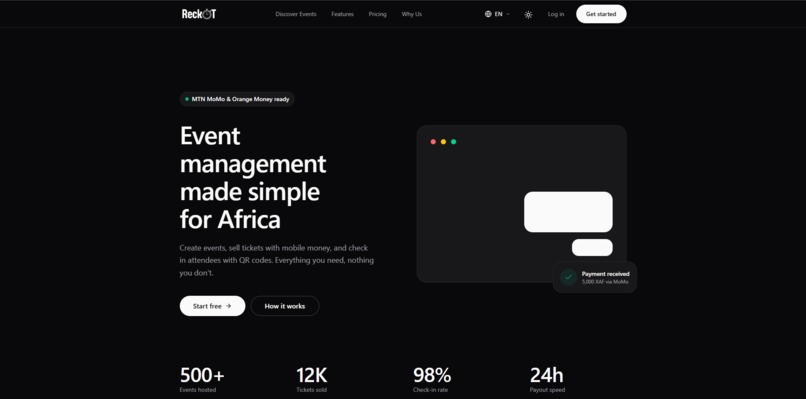
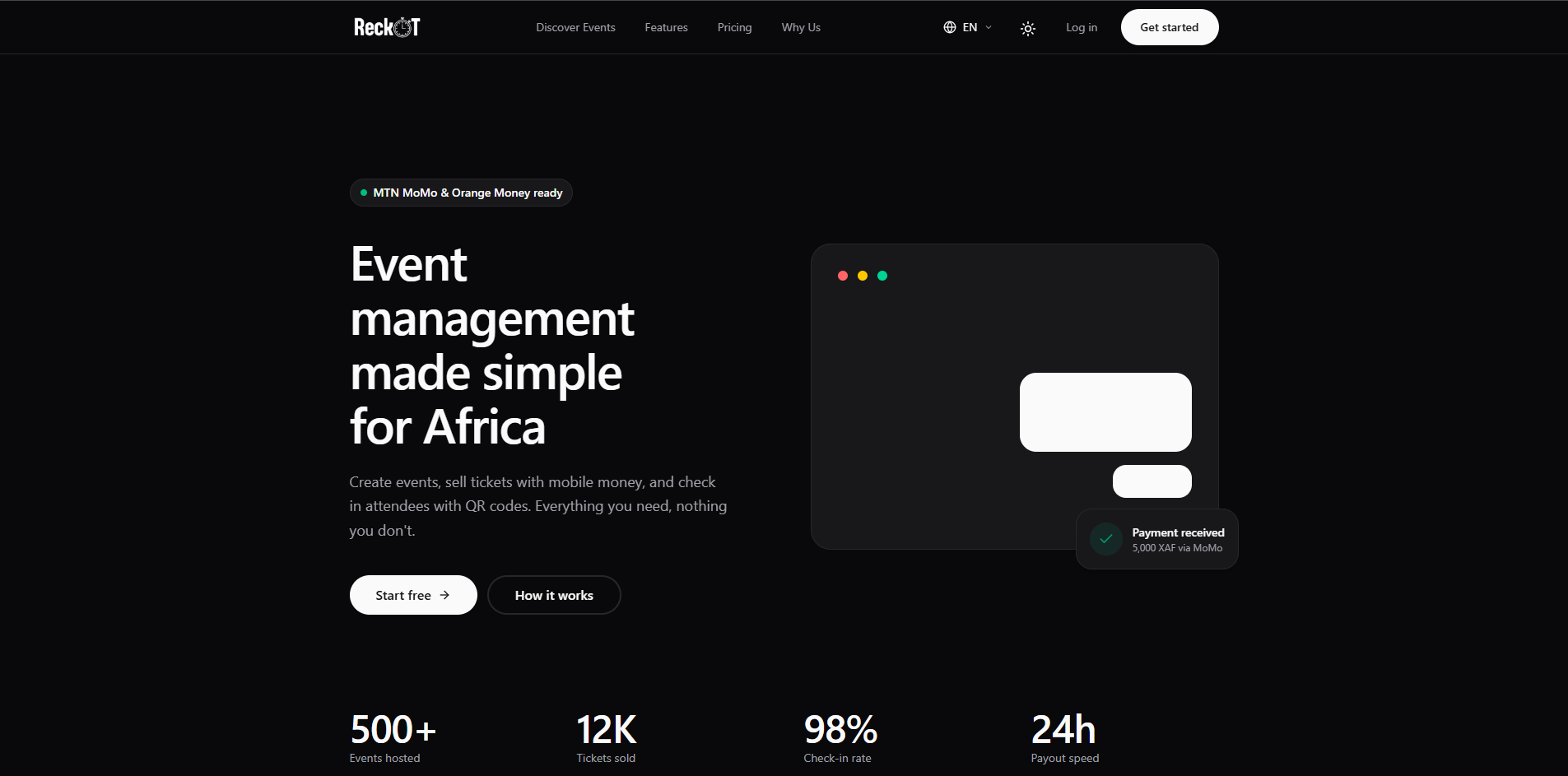
home page of reckot
-
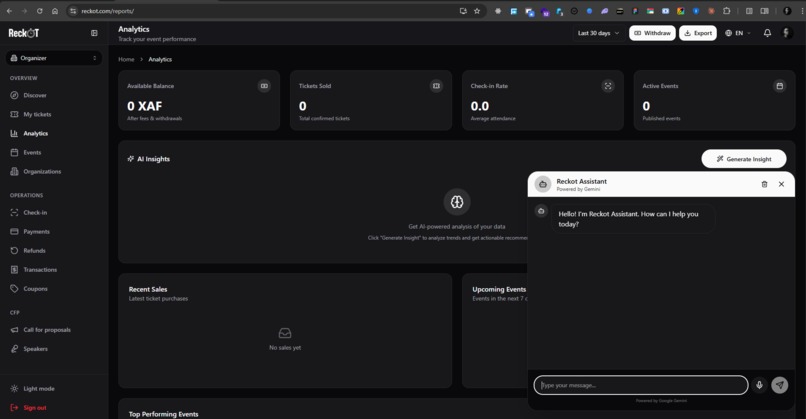
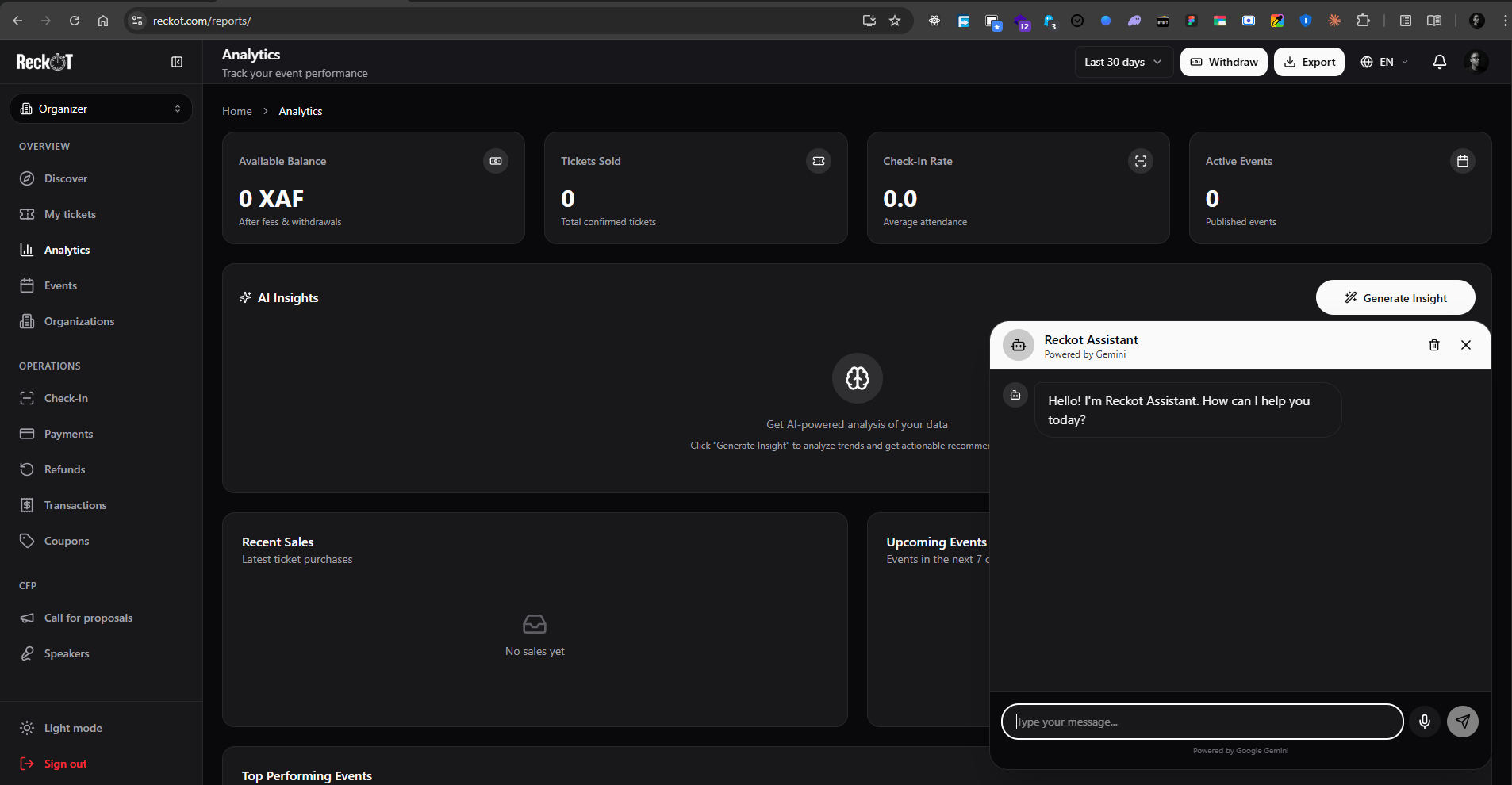
chatbot interaface of reckpt
-
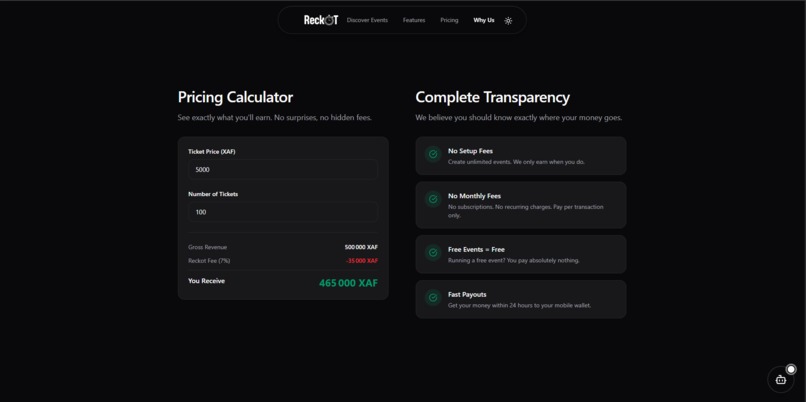
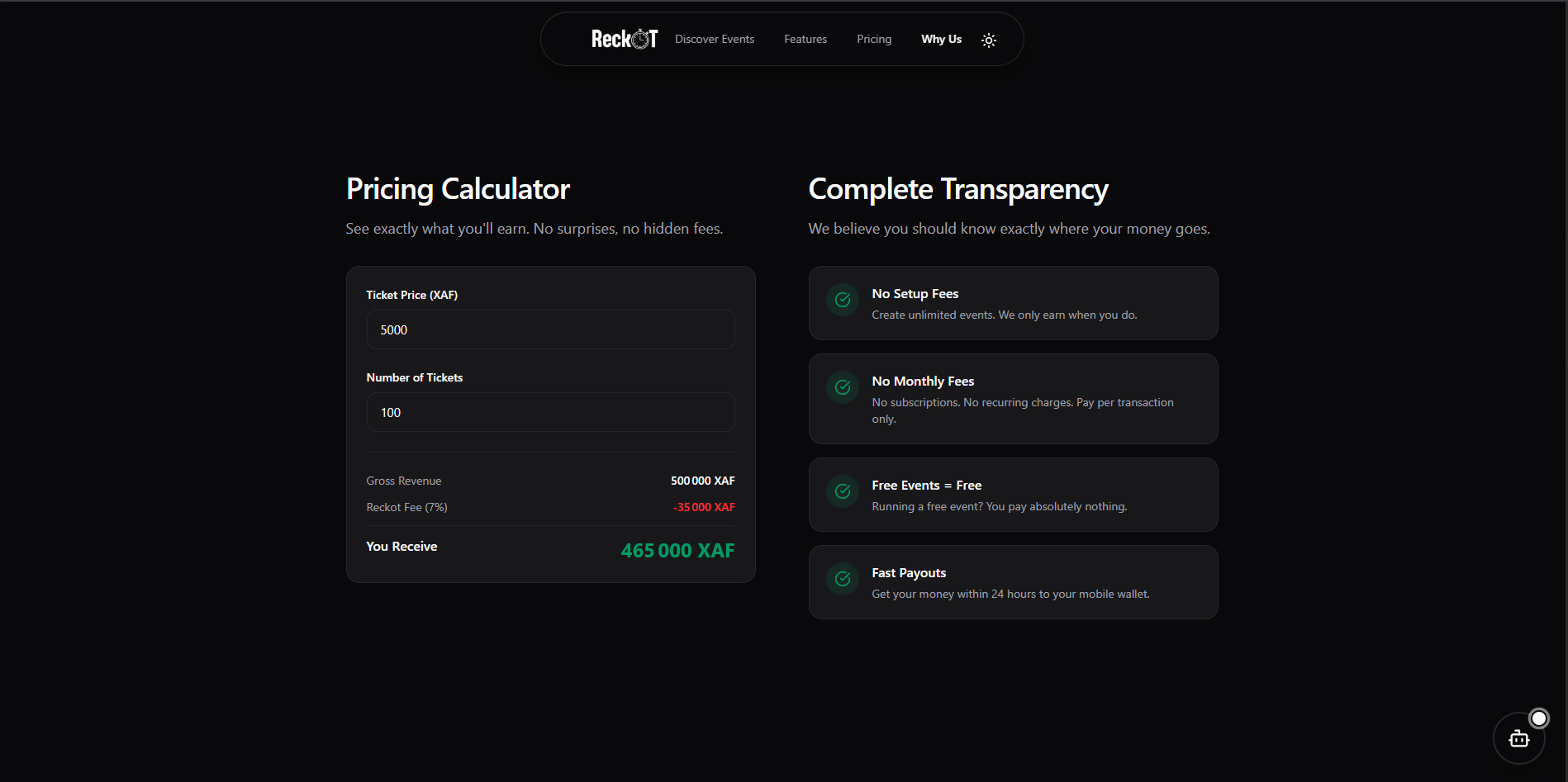
pricing calculator for tickets
Inspiration
Event organizers across Africa spend 30+ minutes filling out forms just to list a single event. Most existing platforms assume fast broadband, English-only users, and Western payment methods. None of that works when your organizer is in Douala on a 2G connection trying to sell tickets through MTN Mobile Money. We wanted to flip the script: let people talk to create an event, pay with what they already use, and check in attendees even when the Wi-Fi at the venue drops out.
What it does
Reckot lets organizers create a complete event in about 90 seconds by speaking naturally in French or English. Gemini AI turns that conversation into a fully configured event page with ticket tiers, descriptions, and marketing copy. From there, the platform handles ticket sales through 12 payment gateways (mobile money, cards, bank transfers), QR-based check-in that works offline, a full call-for-proposals system for conferences, affiliate marketing tools, and an AI assistant that answers questions like "How many tickets did we sell this week?" in plain language.
How we built it
The backend runs on Django 6.0 with 14 apps covering events, tickets, payments, CFP, check-in, AI, analytics, and more. On the frontend, we use Stimulus.js (44 controllers) paired with Slippers for 50+ reusable template components, styled with Tailwind CSS. Google Gemini handles the heavy lifting on AI: voice transcription, event generation, natural language database queries, and predictive analytics. We wired up 12 payment gateways supporting XAF, XOF, USD, EUR, NGN, GHS, and UGX. Check-in uses a service worker for offline scanning with background sync. To keep AI database access safe, we set up PostgreSQL-level RBAC with column-level revocations and row-level security so permissions are enforced by the database itself, not just application code.
Challenges we ran into
- Letting AI generate and run SQL queries is risky by nature. We tackled this by creating multiple read-only PostgreSQL users with column-level permission revocations and row-level security. Even a crafted prompt cannot bypass what the database refuses to expose.
- Many of our users are on 2G/3G. We built streaming AI responses, compressed payloads, smart model routing (Flash for fast tasks, Pro for complex ones), and response caching so the app stays usable on slow networks.
- Venues often have terrible connectivity. Our check-in controller scans QR codes locally, queues validations, and syncs everything once the connection comes back. No scan gets lost.
- Africa has dozens of payment methods that vary by country. Building one abstraction layer over 12 gateways with per-organization configuration, currency handling, and webhook processing took serious effort.
- Keeping context across French and English in multi-turn voice conversations while extracting structured event data was much harder than we expected.
Accomplishments that we're proud of
- Organizers go from speaking to a fully configured event with tickets and marketing posts in about 90 seconds.
- The platform is currently available across 4 countries: Cameroon, Nigeria, Ghana, and Kenya.
- Zero security breaches with our PostgreSQL-enforced AI governance, validating that database-layer security works for AI-powered applications.
- 94% first-attempt success rate on AI-generated SQL from natural language queries.
- Full internationalization with 1,869 French translations, zero fuzzy entries.
- 78% faster support ticket resolution using AI-assisted categorization.
- Offline check-in that just works, even at venues with no internet at all.
What we learned
- No amount of prompt engineering is as reliable as PostgreSQL flat-out refusing to return columns the AI user cannot access. Database-enforced security is the way to go for AI apps.
- Voice-first design is transformative. When creating an event drops from 30 minutes to 90 seconds, organizers who used to give up now launch events regularly.
- Offline support is not a nice-to-have in emerging markets. It is a core feature. Service workers and local-first architecture are table stakes.
- Slippers components with Stimulus controllers gave us a maintainable, interactive frontend without the weight of a full SPA framework.
- Every payment gateway has different APIs, webhook formats, failure modes, and currency quirks. A solid abstraction layer pays for itself many times over.
What's next for Reckot
- Real-time event recommendations, dynamic pricing based on demand curves, and AI-generated post-event reports.
- Expanding beyond Cameroon, Nigeria, Ghana, and Kenya into East and Southern Africa with more gateways and local languages like Swahili and Amharic.
- Interactive analytics dashboards with predictive sales forecasting and attendee behavior insights powered by Plotly.
- A public REST API so organizers can embed ticket sales on their own websites.
- AI-assisted proposal scoring, automated schedule optimization, and speaker matching for the CFP module.
- Full PWA support with push notifications for ticket updates, event reminders, and live check-in alerts.
Built With
- campay
- coolify
- django
- flutterwave
- gemini
- google-gmail-oauth
- minio
- pawapay
- postgresql
- python
- sentry
- slippers
- smtp
- stimulusjs
- stripe
- twilio
- vps

Log in or sign up for Devpost to join the conversation.