-
-
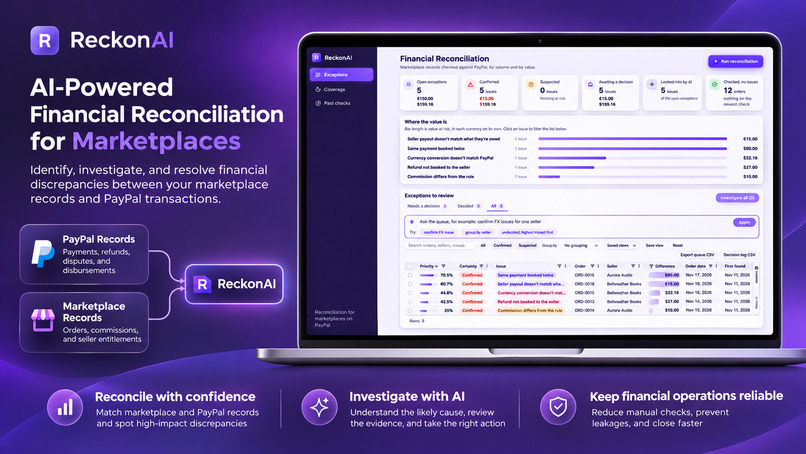
ReckonAI Image Header
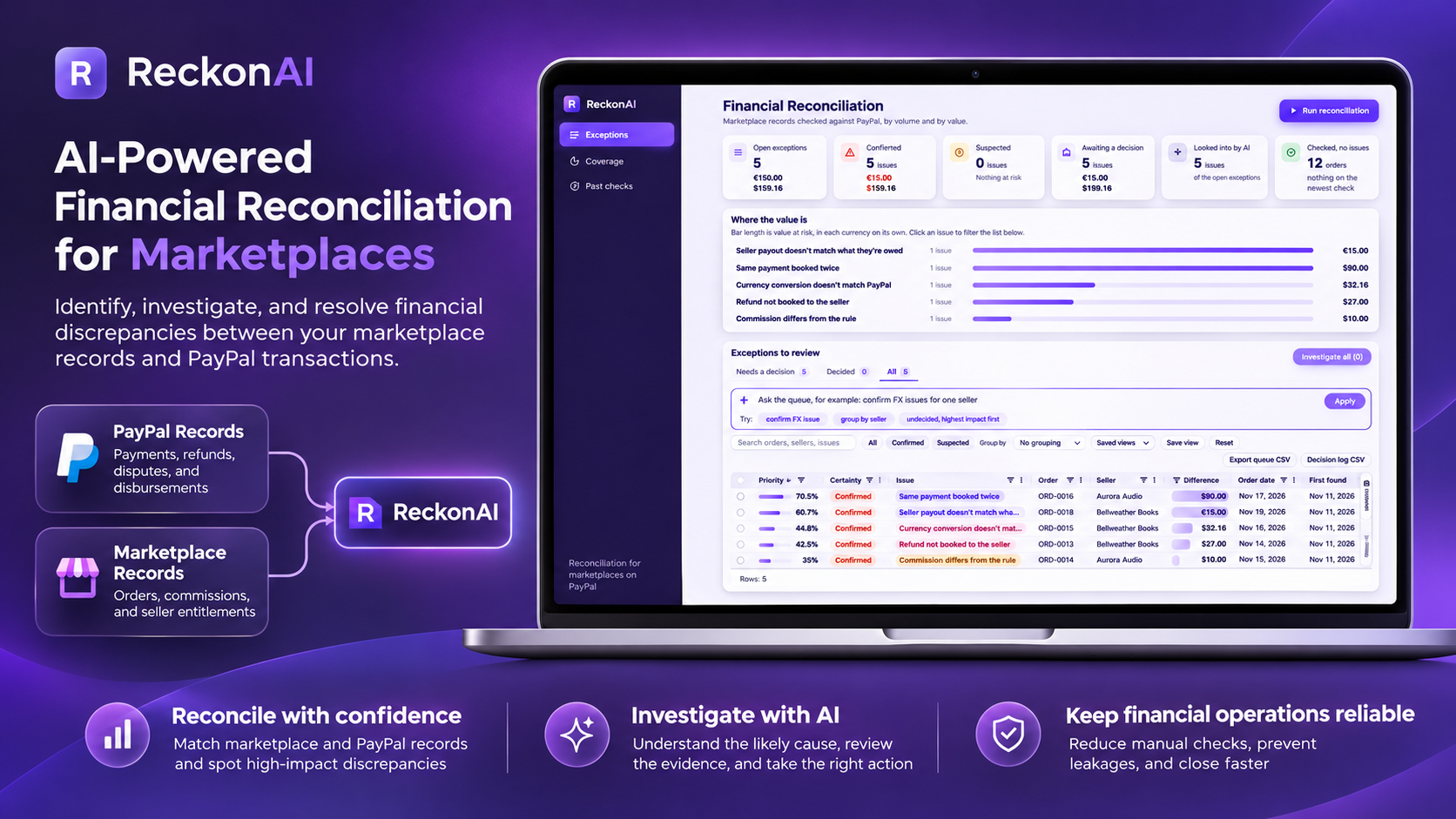
Inspiration
Working as a data engineer in fintech exposed me to the operational complexity of financial data and the challenges finance teams face when trying to establish whether every transaction has been accounted for correctly.
As I explored these challenges further, I realised that reconciliation becomes even more complicated when businesses rely on third-party payment providers. For marketplaces, where money moves between buyers, sellers, platforms, and payment providers, discrepancies can translate into financial leakages that are difficult to identify and investigate.
I started thinking: what if marketplaces had a smarter way to identify these discrepancies, trace their causes, and understand what needs to be done to resolve them? That idea became ReckonAI.
What it does
ReckonAI is an AI-powered financial reconciliation and investigation agent designed to help marketplace finance teams identify, investigate, and resolve financial discrepancies between PayPal transaction records and their internal financial records.
It focuses on three main capabilities:
- Financial data integration: Bringing PayPal and marketplace financial records into a common financial model while preserving original records and currencies.
- Deterministic reconciliation: Comparing expected seller entitlements and marketplace commissions against actual financial records, identifying discrepancies, and distinguishing genuine issues from transactions that are still progressing through their payment lifecycle.
- AI-powered investigation: Investigating identified exceptions, reconstructing transaction histories, identifying probable causes using available evidence, and recommending resolutions for human review.
Rather than simply flagging transactions that do not match, ReckonAI aims to help finance teams understand what happened, why it happened, and what action they should consider taking.
How I built it
I built ReckonAI independently, taking responsibility for the research, product design, architecture, implementation, and validation.
I started by researching marketplace reconciliation and understanding how financial obligations are created across the marketplace and payment provider. This was particularly important because a marketplace transaction involves more than the initial customer payment. It can also involve seller entitlements, platform commissions, refunds, disputes, and seller disbursements.
I then designed the system around a canonical financial data model that brings marketplace and PayPal records into a common structure while preserving their original information.
For the reconciliation engine, I used deterministic logic to handle monetary calculations, compare expected and actual financial records, and classify discrepancies. I deliberately kept these responsibilities outside the LLM because financial calculations need to be precise and reproducible.
I incorporated an AI investigation layer to examine reconciliation exceptions, reconstruct transaction lifecycles, identify probable causes from available evidence, and recommend next steps.
I also designed the workflow around human oversight. ReckonAI can recommend resolutions, but it does not independently initiate refunds, release funds, or modify seller balances.
Challenges I ran into
My biggest challenge was the time constraint. I discovered the hackathon on November 5, and ideation alone took almost an entire day. That left me with less than a week to turn the idea into a working prototype.
I had to balance understanding the problem, researching PayPal's infrastructure, making architectural decisions, implementing the core workflows, and validating the solution within a very short timeframe.
Another major challenge was ensuring that I was building the right thing. I did not want to rush into implementation based on assumptions that did not reflect how marketplace payments actually worked. This led to several rounds of research and replanning as I discovered gaps in my initial understanding.
One particularly important correction was changing my initial integration assumption from a first-party payment model to PayPal's multiparty model. My research revealed that PayPal's marketplace payment infrastructure works differently: it can route seller payments and remit platform fees separately. Building around the wrong model would have meant designing the reconciliation logic around an inaccurate representation of how money actually moves.
That discovery required me to revisit my requirements, data model, and reconciliation approach. Although the repeated replanning was challenging under the deadline, I would rather correct my assumptions than deliver a solution built around the wrong understanding of the problem.
Accomplishments I'm proud of
- I took a problem I had encountered through my experience in fintech and turned it into a working product concept and prototype within less than a week.
- I independently researched and navigated the complexities of PayPal's multiparty payment model to ensure that my solution reflected how marketplace payments actually work.
- I designed a reconciliation approach that separates deterministic financial calculations from AI-powered investigation.
- I incorporated transaction lifecycle awareness so that delayed or incomplete payment processes are not automatically treated as financial discrepancies.
- I built around the principle that financial AI should provide evidence-backed recommendations while leaving consequential financial decisions under human control.
Most importantly, I'm proud that I challenged my initial assumptions and was willing to rework significant parts of the project when my research showed that a different approach was necessary.
What I learned
Building ReckonAI taught me that financial reconciliation is considerably more complex than matching transactions across two systems.
My research into PayPal's multiparty payment infrastructure revealed that a single marketplace transaction can create several financial obligations involving sellers, platform commissions, refunds, disputes, and disbursements. I also discovered that the timing and lifecycle of these obligations matter. For example, a seller whose funds are held under a delayed disbursement arrangement has not necessarily been underpaid. Treating every unmatched record as an error would create false positives and undermine trust in the reconciliation process.
I also learned that AI alone should not be responsible for financial accuracy. Monetary calculations and reconciliation decisions require deterministic logic. AI is most valuable when investigating exceptions: reconstructing transaction histories, identifying probable causes, connecting findings to source evidence, and recommending resolutions.
Finally, I learned that trustworthy financial AI must know when it does not have enough information. Rather than generate plausible explanations for incomplete records, I designed ReckonAI to surface insufficient evidence for human review.
The biggest lesson for me was that building useful AI products requires more than integrating an LLM. It requires understanding the domain, getting the underlying data and business rules right, and knowing exactly where AI should and should not be involved.
What's next for ReckonAI
I want to take ReckonAI beyond the hackathon prototype and develop it into a more comprehensive reconciliation and financial investigation platform for marketplaces.
My next priorities include:
- Strengthening reconciliation coverage: Expanding the range of marketplace payment scenarios, transaction lifecycles, and discrepancy types the system can identify.
- Improving investigation accuracy: Evaluating the AI investigation agent against more complex reconciliation scenarios and edge cases, with particular attention to evidence quality and false positives.
- Expanding data integrations: Exploring support for additional marketplace financial systems and payment providers beyond PayPal.
- Building a stronger review workflow: Improving how finance teams examine evidence, evaluate recommendations, and approve or reject proposed resolutions.
- Validating with real-world workflows: Getting feedback from marketplace finance and operations teams to understand how ReckonAI fits into their existing reconciliation processes.
My long-term vision is to make financial reconciliation less dependent on manual investigation by giving marketplace finance teams a reliable way to detect discrepancies, understand their causes, and make evidence-backed decisions.
Built With
- aggrid
- claude
- fastapi
- openai
- paypal
- postgresql
- python
- render
- typescript
- vite
