Inspiration
Recharge was inspired by personal experience. As introverts, managing social energy has always been something we have struggled with. Social fatigue often builds slowly and isn’t obvious until it becomes overwhelming. Many people push through meetings, classes, or social events without realizing how depleted they are becoming.
This project explores the idea that social energy is real but largely invisible. If people could see patterns in how interactions affect their energy, they could make more intentional decisions about when to recharge, when to step away, and how to pace their day. Recharge imagines a future where subtle aspects of human experience, like social fatigue, can be sensed, visualized, and managed more effectively.
What it does
Recharge is a speculative system that helps users sense, track, and manage their social energy.
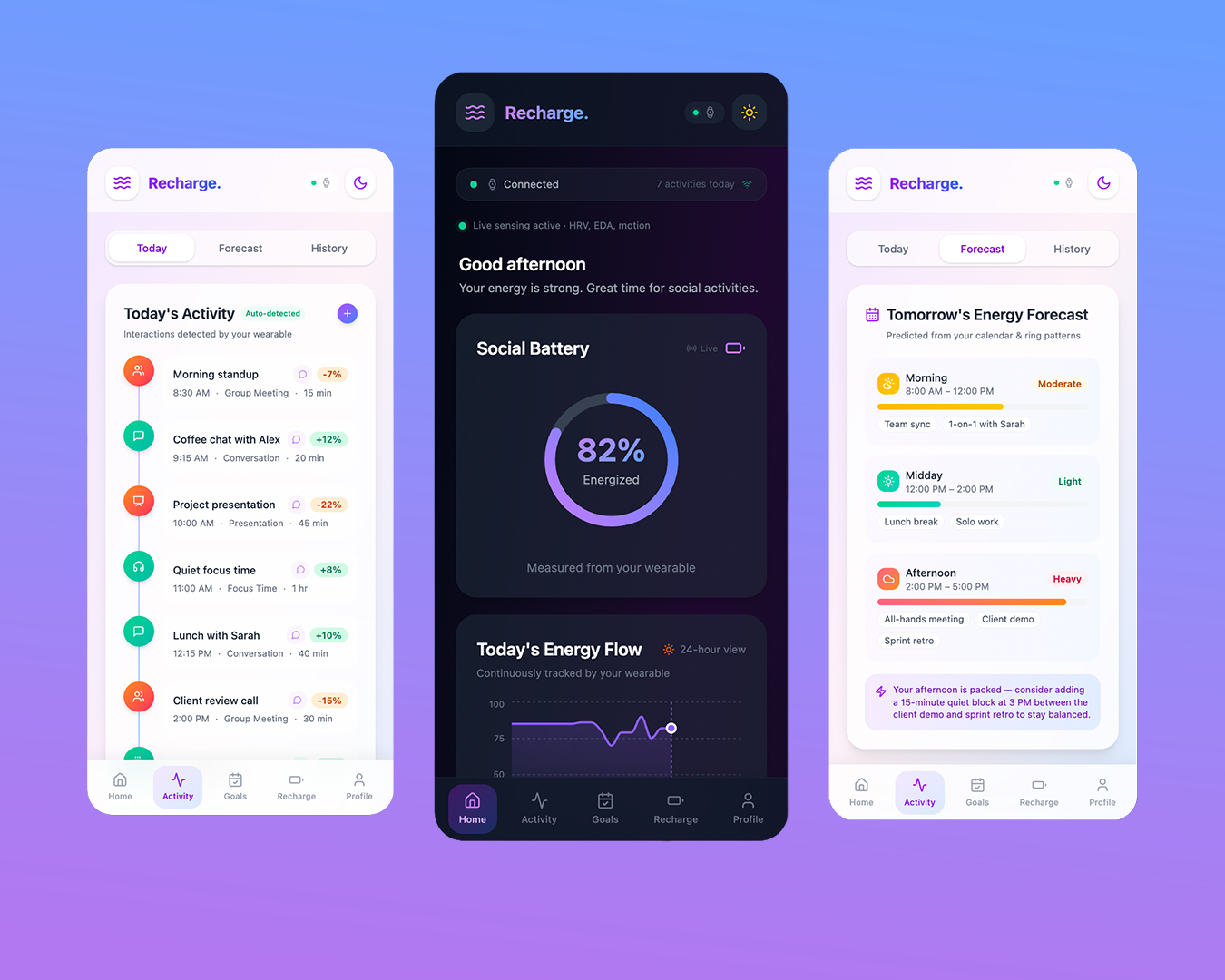
The concept pairs a wearable ring with a companion app that interprets social interactions and environmental context to estimate how different activities impact a user's social energy. The app visualizes this information through a timeline of interactions, energy changes, and suggested recovery moments.
Users can see how meetings, conversations, presentations, or quiet time influence their energy throughout the day. The system also offers tools to help users recover, such as short breathing exercises, quiet reflection timers, or environmental adjustments through an “Ambient Shield” feature.
The goal is to make social energy visible and actionable, helping users better regulate how they engage with others.
How we built it
We designed Recharge using Figma for interface design and Figma Make to rapidly prototype and generate functional UI code.
The process was highly iterative. We moved back and forth between visual design and interactive prototyping, refining the interface structure, interaction flows, and visual hierarchy as the concept evolved.
Figma Make allowed us to quickly test UI components and explore how the interface would behave in a real application. This helped us iterate rapidly on features such as the activity timeline, recharge suggestions, and the wearable integration.
The project evolved through continuous cycles of prototyping, testing, and refining the story we wanted the product to tell.
Challenges we ran into
One of the biggest challenges was balancing speculation with usefulness. The prompt encouraged designing for future possibilities, but we wanted Recharge to feel like something people would genuinely want to use rather than a novelty concept.
We also encountered challenges with UI complexity and interaction clarity. Because the app visualizes a new type of data, social energy, we had to think carefully about how to present that information without overwhelming the user.
On the technical side, working with generated code through Figma Make required troubleshooting UI structure, removing unnecessary components, and refining the interface to match the design vision.
Another challenge was aligning the project with the prompt requirements while still maintaining a coherent and compelling product narrative.
Accomplishments that we're proud of
Given the short timeframe of only a few days, we’re proud of how fully realized the concept became.
We were able to design a cohesive system that includes:
- a wearable sensing device
- a companion mobile interface
- interaction flows for tracking, recovery, and reflection
- multiple speculative use cases
We are especially proud that Recharge feels like a product we would personally want to use. The concept explores a meaningful problem while still imagining future possibilities in sensing and self-awareness.
What we learned
This project taught us a lot about designing quickly while still maintaining intentionality.
We gained experience iterating with Figma Make, experimenting with how generative tools can accelerate interface development while still requiring thoughtful design decisions.
We also learned how to design within ambiguity. Because the technology behind the concept does not fully exist yet, we had to think creatively about how such a system might work and what interactions would feel natural to users.
Finally, the project gave us valuable experience crafting a clear product narrative and pitch, connecting a speculative idea to real human needs.
What's next for Recharge.
Recharge is ultimately a speculative concept, but it reflects a future that may not be far away.
As sensing technologies, wearables, and contextual data collection continue to advance, it may become increasingly possible to measure subtle aspects of human experience like cognitive load, emotional fatigue, or social energy.
If technology evolves in that direction, tools like Recharge could help people better understand themselves and manage their interactions more intentionally.
In the meantime, this project encourages us to keep exploring how design can make invisible human experiences more perceptible and actionable.
Built With
- figma
- figmamake


Log in or sign up for Devpost to join the conversation.