-
-
Logo
-
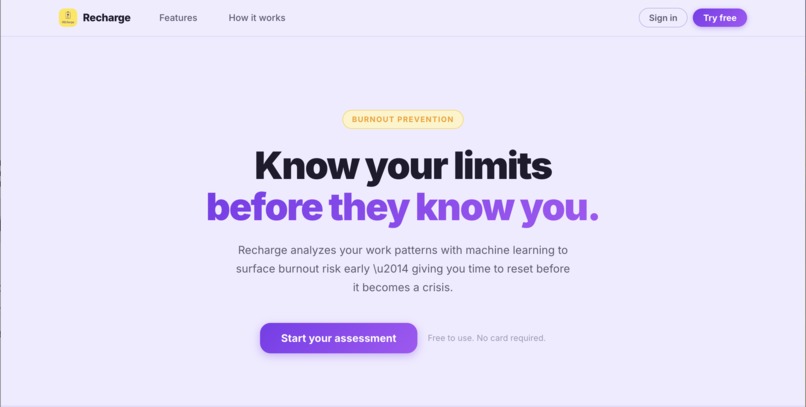
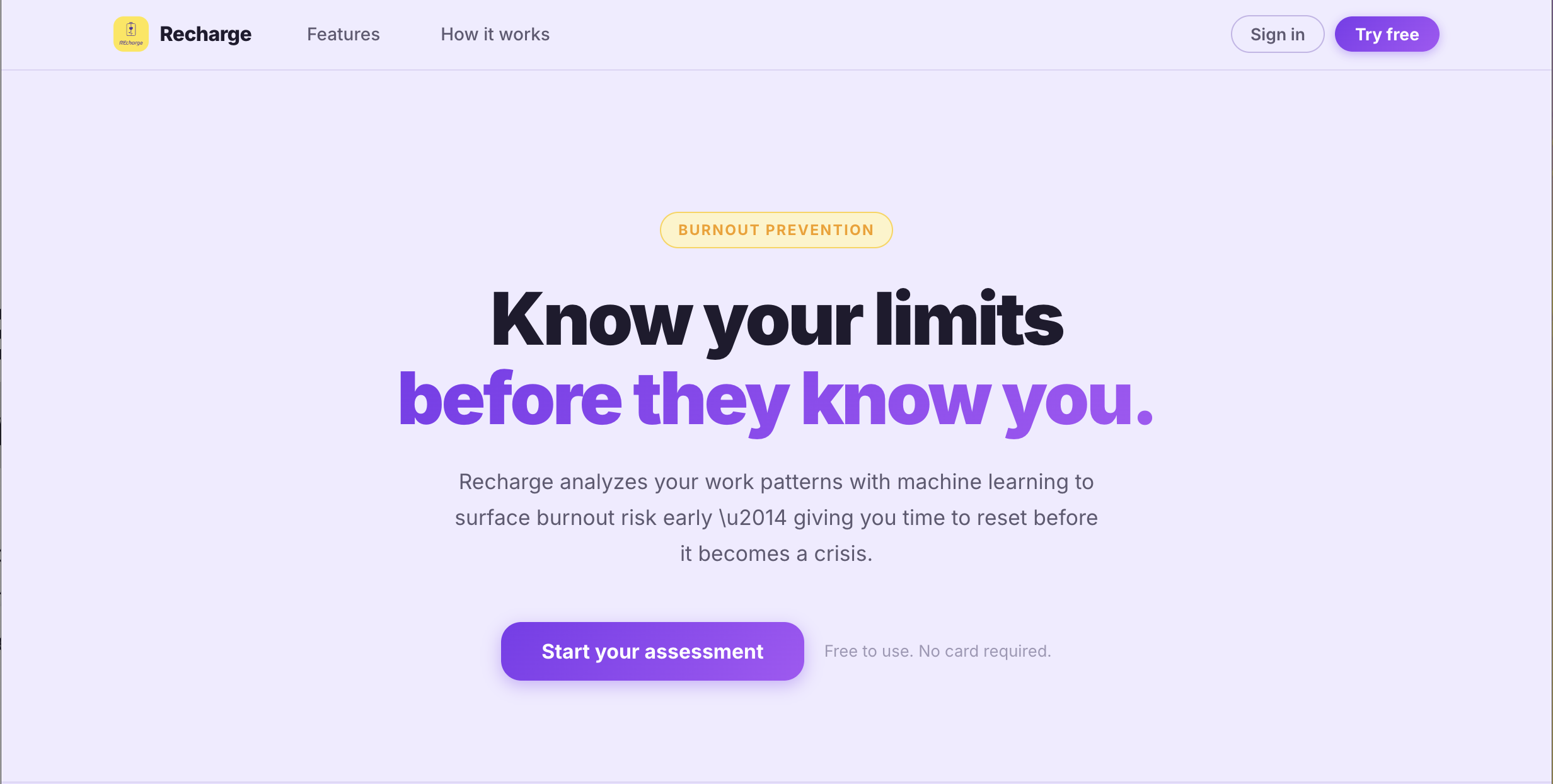
Landing Page
-
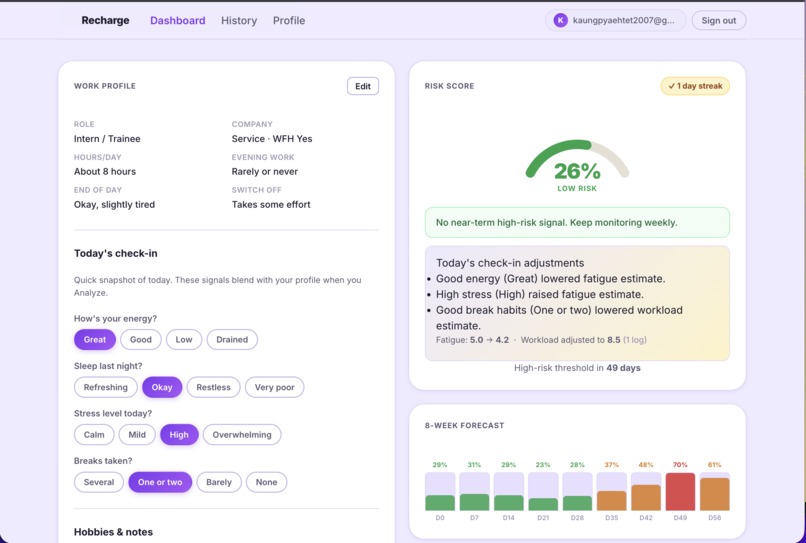
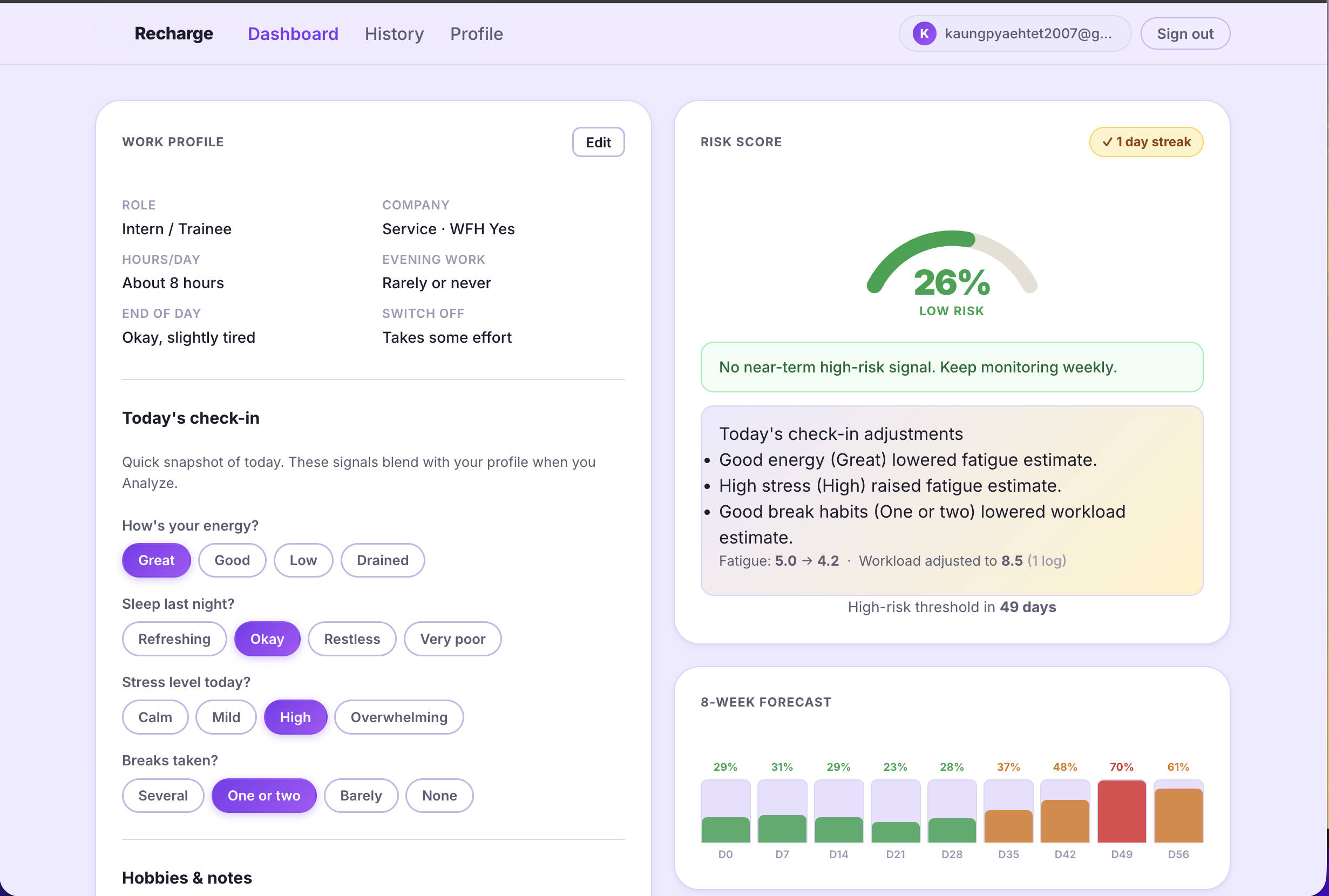
Prediction & Dashboard
Inspiration
Burnout is invisible until it breaks you. We've all pushed through exhausted weeks telling ourselves "just one more sprint" — only to hit a wall. The problem is there's no early warning system. Existing wellness apps track moods reactively; they don't predict risk before it peaks. We wanted to build something that could tell you before you burn out, not after.
From the statistics, we can imagine how severe the workplace stress is. Workplace stress can damage our mental health and cost the productivity negatively.
Credit Image Source: link

Our Solution
Recharge is an application that can predict when users might start getting burnout. By using the XGBoost model and various ML techniques, we trained on the Kaggle dataset: Why are your employees running out?
In the application, you have to first build your profile by choosing your daily workload. Then our application will keep track of that information. Additionally, by choosing options for how the user is feeling today (like stress level, etc), we can show the output of when user might get burn out and the risks of getting burnout.
The best part about our application that no other application has done is that we keep track of the daily analysis into the training data, and the use it again to see if the user might get burnout. We also use the line graph representation so that user can keep track of their daily burnout risks.

How we built it
 Figure: Showing the architecture of our application
- Backend: FastAPI with SQLAlchemy + SQLite for rapid prototyping. JWT auth (bcrypt + PyJWT) with 7-day tokens.
- ML: XGBoost classifier trained on HackerEarth employee burnout data, with SMOTE to handle class imbalance. SHAP values surface top contributing factors per prediction. Model artifacts serialized via joblib.
- NLP: Entirely rule-based sentiment engine — no external ML library dependency. Keyword substring matching ties daily logs to user-registered hobbies.
- Frontend: React 19 + TypeScript + Vite, single-page dashboard with live risk visualization, weekly projections, and a daily journal UI.
- Infra: Deployed on Render (backend) and Vercel (frontend). GitHub Actions CI runs linting and builds on every push. -Datasets: Kaggle (Are your employees burning out?) link
Challenges we ran into
- Collaborating with teammate from different timezone and getting the working prototype rapidly.
- Blended sentiment scoring: Thinking which features should be inputted by users manually and which should be written by the user was a challenge.
- Cold-start UX: New users have no history. Making the risk score feel meaningful without weeks of data meant leaning entirely on the work profile model, which required careful framing in the UI.
Accomplishments that we're proud of
- An end-to-end ML pipeline — data → SMOTE → XGBoost → SHAP — that produces explainable, per-user risk breakdowns, not just a black-box score.
- A fully custom NLP sentiment layer with zero ML library dependencies that still produces reasonable polarity signals.
- A clean, focused UI that surfaces complex model output (8-week projections, SHAP contributors) without overwhelming the user.
- Full JWT auth, hobby CRUD, daily logging, and burnout prediction all shipping in a single hackathon sprint.
What we learned
- Getting the application to analyze and predict the result was hard; so we had to find the matching algorithm using XGBoost method and setup backend api routes quickly with fastAPI.
- Learnt to set up the application on render by writing docker file and render.yaml.
- Working with team together to build a working prototype rapidly through sprints.
What's next for Recharge
- Integrate student mental health dataset to expand our model predictions on the students
- Push notifications — passive risk monitoring via email or mobile alerts when trajectory worsens.
 Figure: Future Plans
Built With
- fastapi
- kaggle
- python
- react
- render
- sqlalchemy
- typescript
- xgboost


Log in or sign up for Devpost to join the conversation.