Inspiration
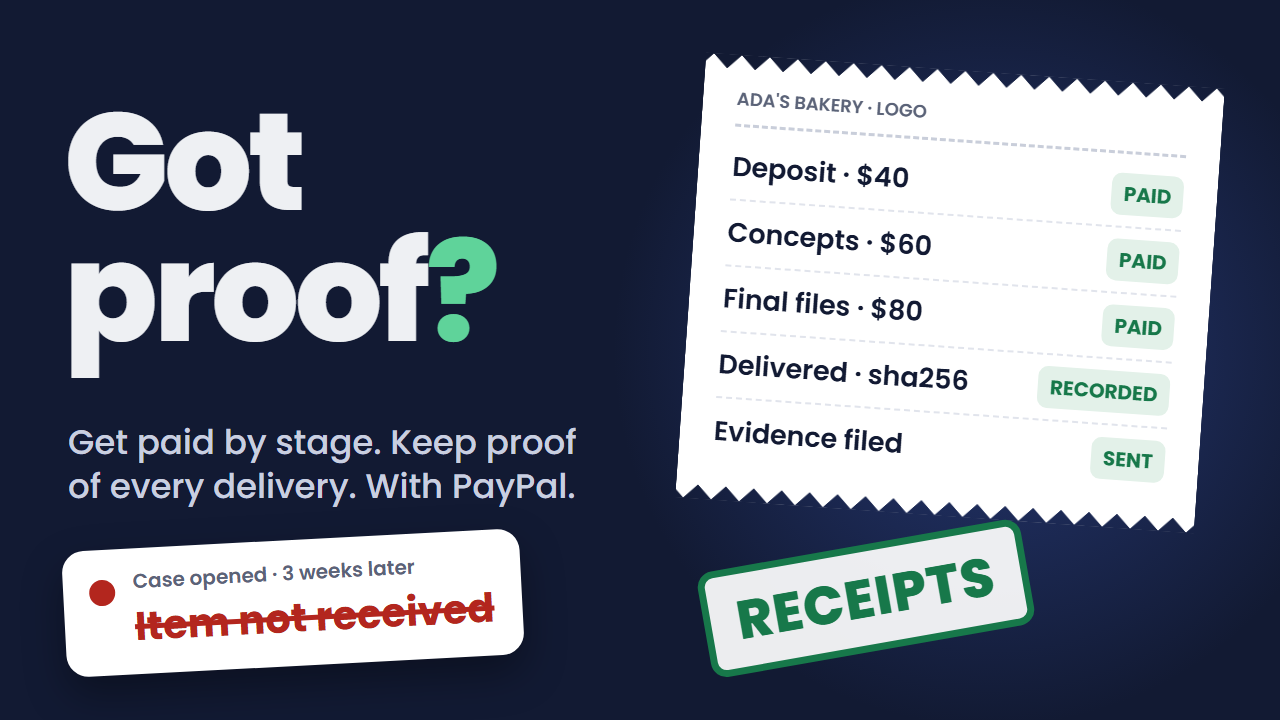
For twenty years, Nigerians could send money with PayPal but not receive it. That changed in January 2026, when receiving through Paga opened up. Some of the first freelancers to try it were limited straight after their first payment. One was paid $380 and couldn't touch it until 9 March, with every document already sent.
We don't think PayPal is being unfair. We think it's being asked to judge blind. A new account, a client abroad, a payment for a service instead of a parcel: from the outside, that looks exactly like fraud. The work that would prove otherwise lives in emails and WhatsApp chats PayPal never sees.
So we asked: what if the proof was captured while the work happened, in a form PayPal could read?
What it does
Receipts works for any freelancer who delivers work in stages to a client abroad: designers, developers, video editors, writers, translators. The freelancer defines the stages and the checks in their own words.
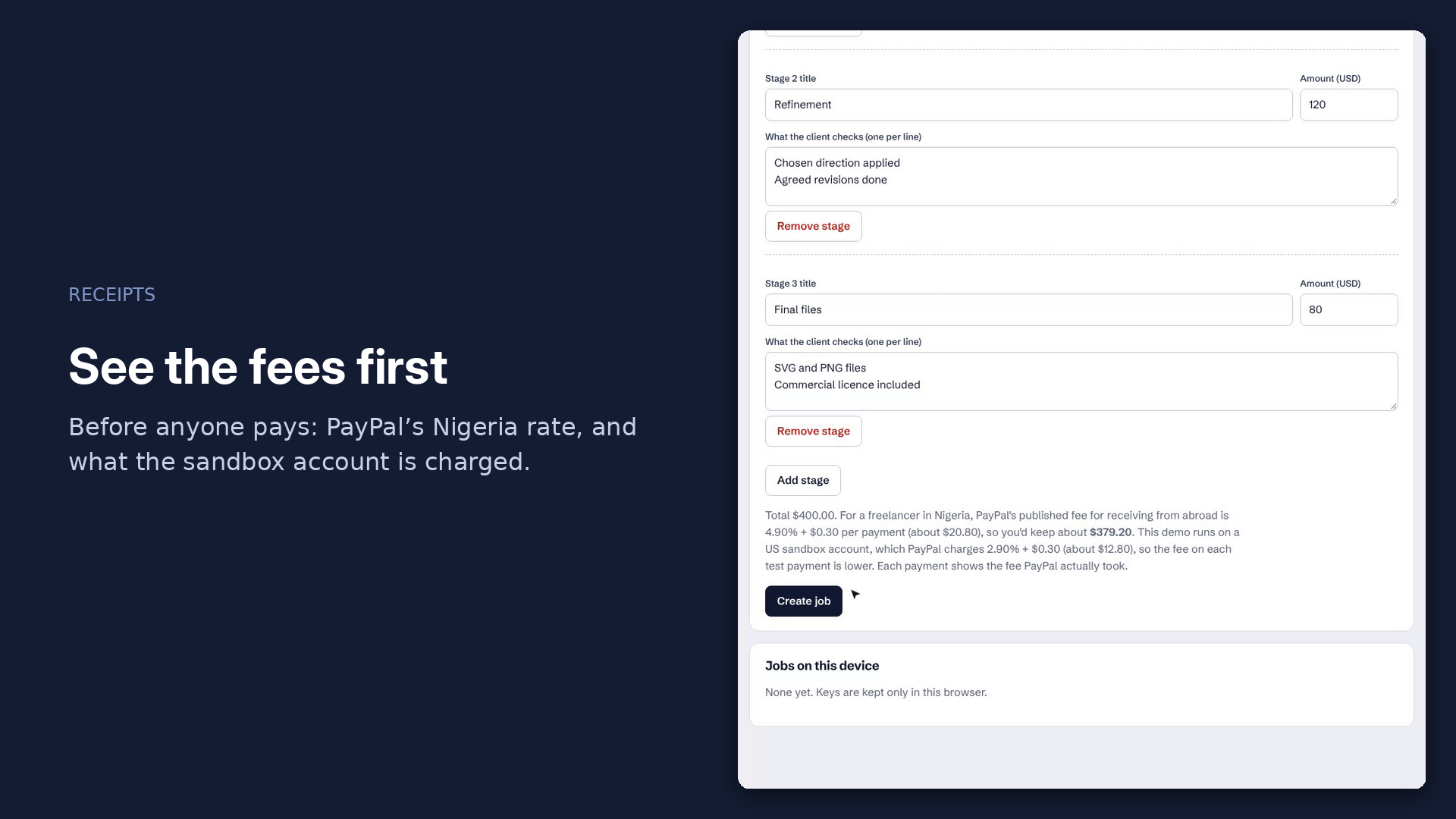
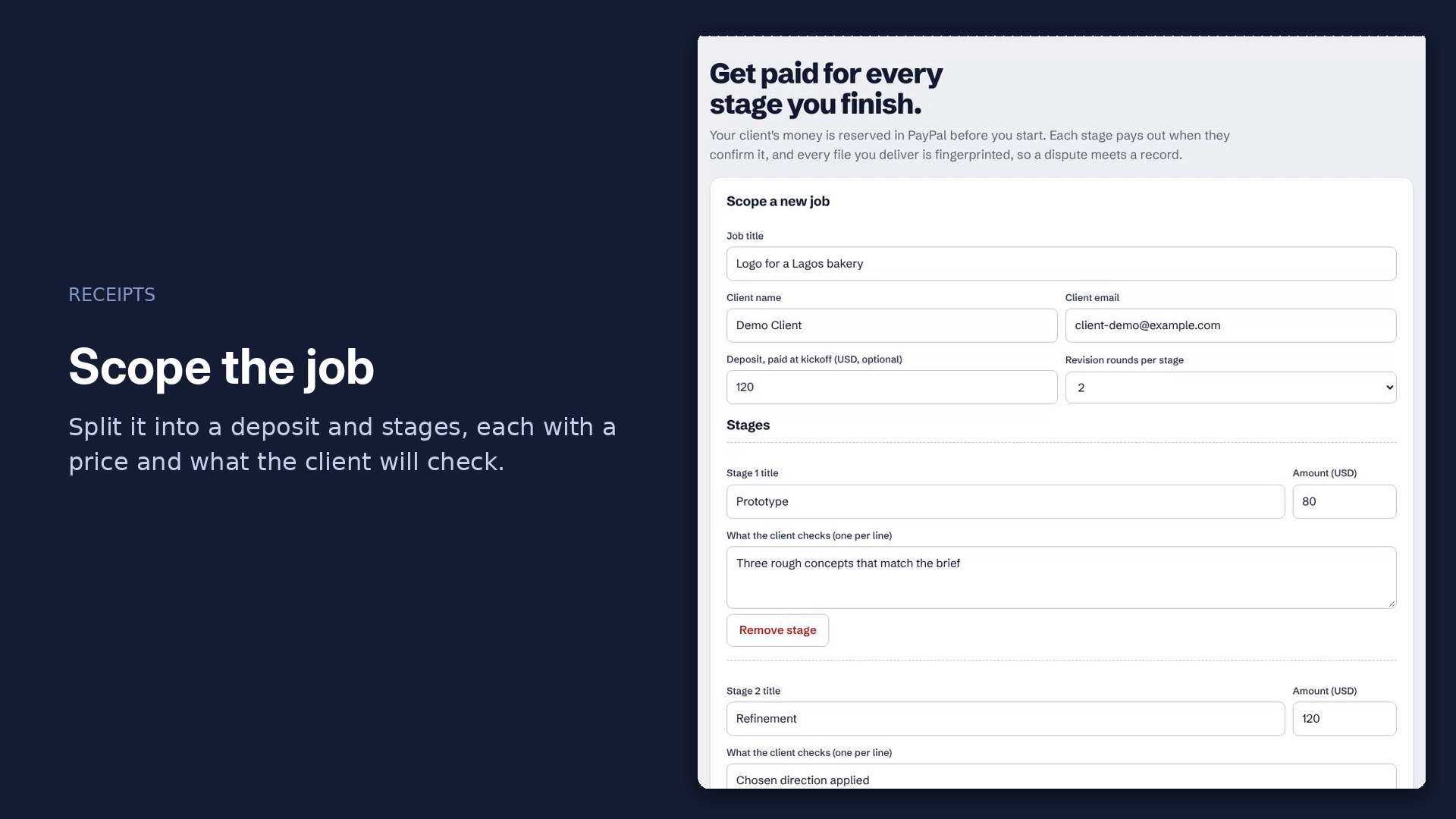
*Scope the job. * The freelancer splits the job into a deposit and stages, and writes what the client will check at each one. Before anyone pays, they see what they'll keep after PayPal's fees.
| Field | A stage might be | What the client checks |
|---|---|---|
| Designer | First concepts | Three directions that match the brief |
| Developer | Working build | Login and checkout work on staging |
| Video editor | Rough cut | Full sequence, under 3 minutes |
| Writer | First draft | 2,000 words covering the agreed outline |
The client pays a deposit. It's captured through PayPal, so the freelancer is paid on day one, not at the very end.
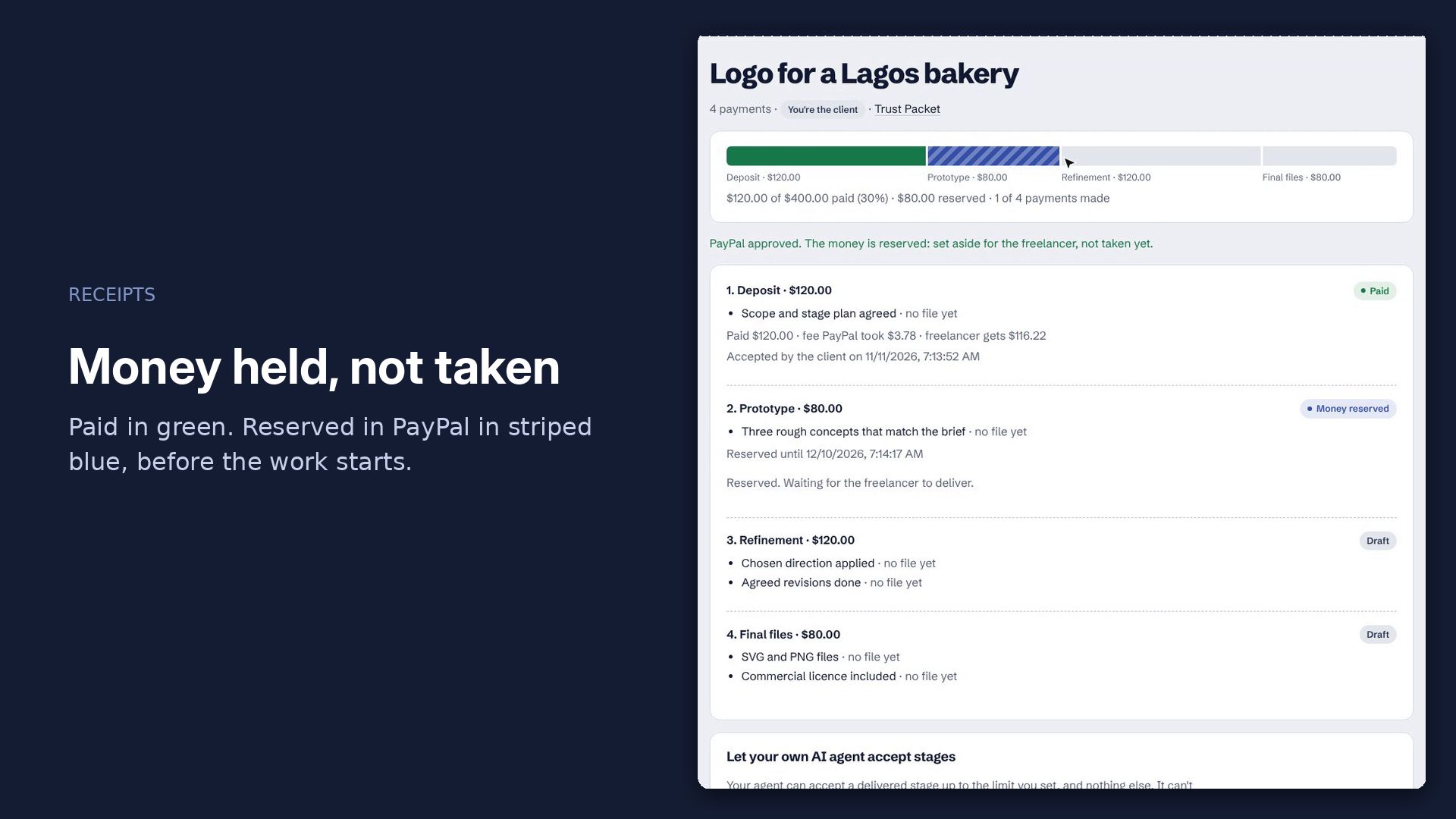
Each stage is reserved before work starts. The client authorizes it in PayPal: the money is set aside but not taken. Nobody works on a promise.
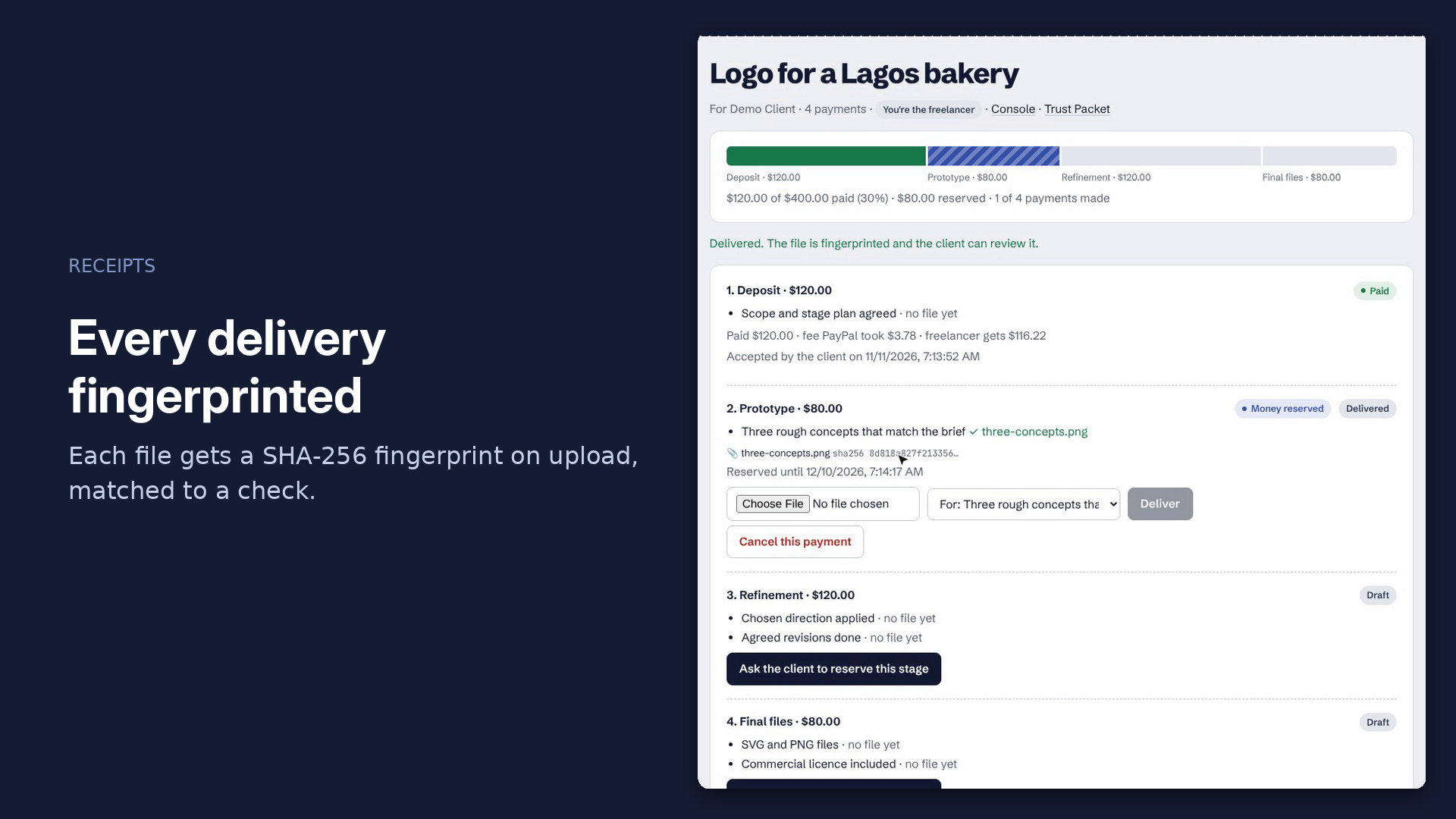
The freelancer delivers. Every file gets a SHA-256 fingerprint the moment it's uploaded, matched to the check it answers. The record can't be quietly changed later.
The client accepts, or asks for a change. Accepting releases that stage's payment straight away. Asking for a change uses one of the revision rounds both sides agreed at the start. Both of them see the same progress bar fill up.
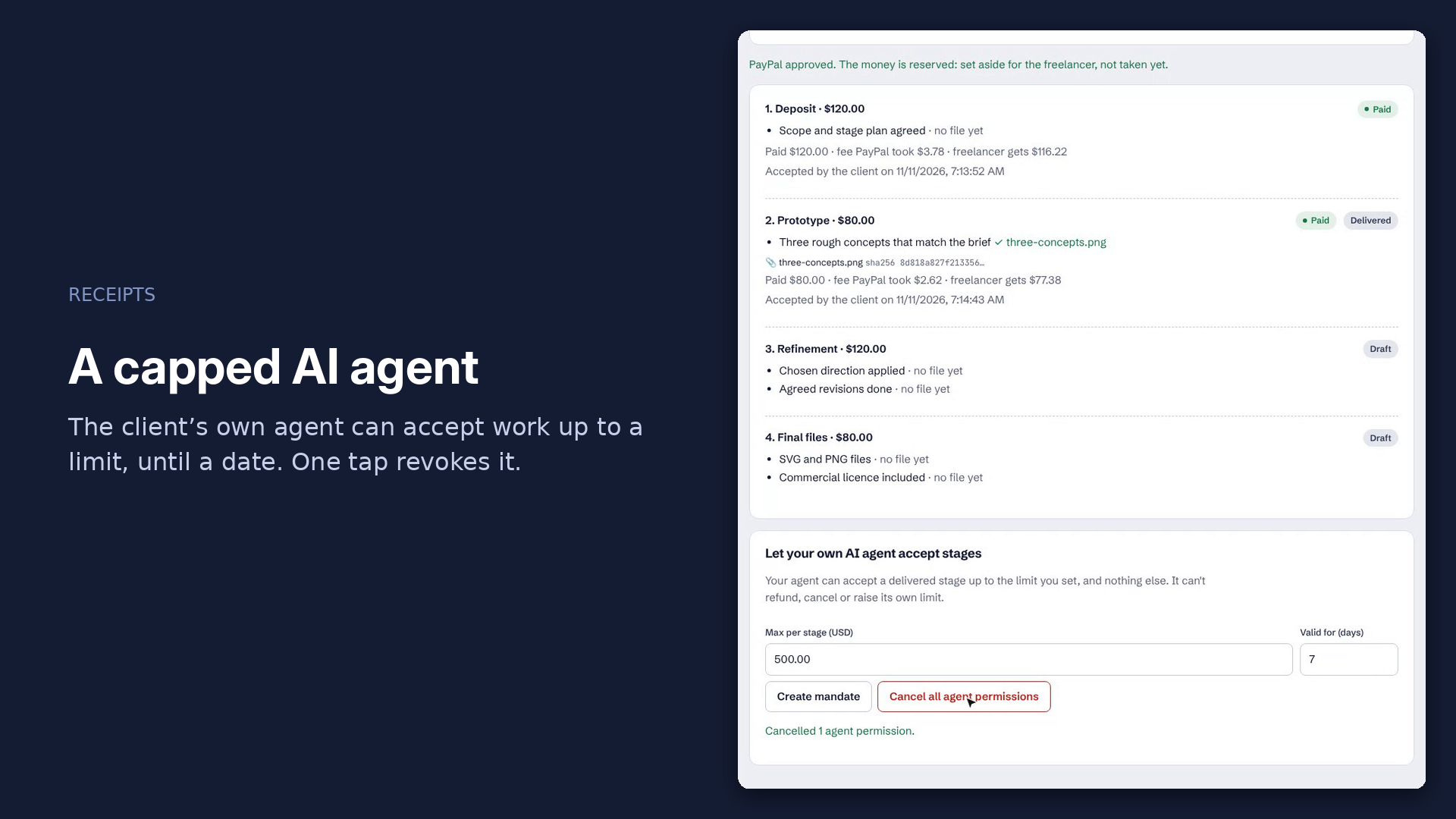
The client can hand the decision to their own AI agent. Its permission is capped at an amount, expires on a date, and can be cancelled with one tap. It can accept work. It can never refund, cancel or raise its own limit.
When a dispute comes, the record answers it. The freelancer presses "Draft my defence". Claude Haiku reads the buyer's message, but it can only answer a few fixed questions, so any instruction hidden in the message is flagged and goes no further. Claude Sonnet writes the evidence from the job's own record and never sees the buyer's words. Fixed rules check the draft, and Claude Opus reviews it as a second key. Nothing goes to PayPal until the freelancer presses File.
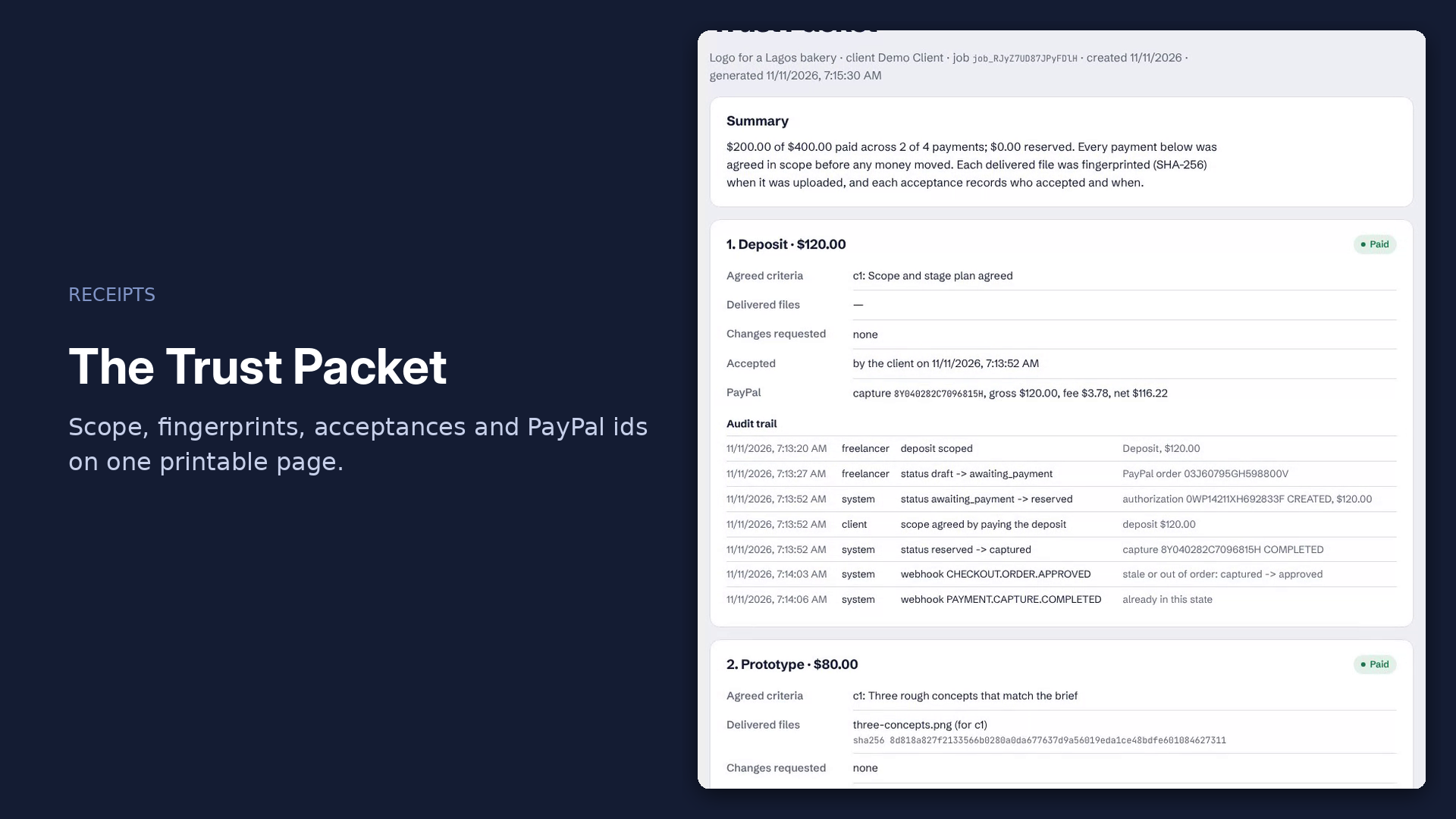
Everything lands in one Trust Packet: the agreed scope, the fingerprints, who accepted what and when, and the PayPal ids. It's the page we'd want a PayPal reviewer to see before holding a freelancer's money.
How we built it
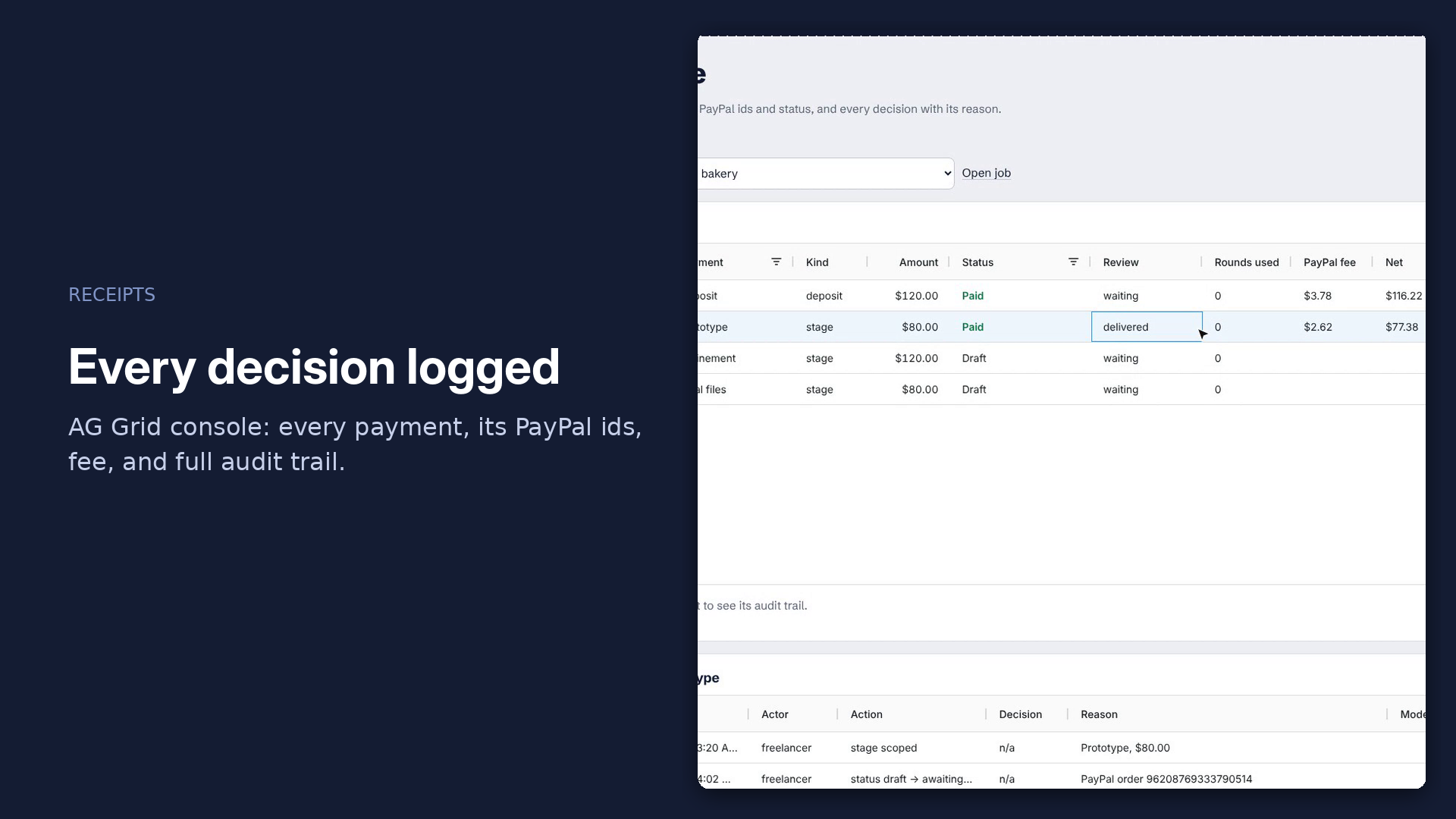
Receipts runs on real PayPal sandbox calls, end to end. It uses Orders v2 to authorize each stage and capture the deposit, Payments v2 to capture or void a reservation, verified webhooks for 13 payment and dispute events, and the Disputes API to file evidence. A TypeScript backend with Postgres keeps an audit trail of every decision, and the screens are a Next.js app with an AG Grid console showing every payment, its PayPal ids, the fee PayPal took and its history. Both run on Render.
We built the safety in from the start:
- Every request carries a key for one role: freelancer, client or agent. Only a hash of each key is stored.
- Money only ever moves through PayPal, and every PayPal call carries an idempotency id, so a retry can never pay twice.
- Webhooks are signature-checked and processed once.
- In the dispute defence, untrusted text only ever reaches a model that can't act, and a person makes the final call.
We built it with Claude Code, two of us working in parallel on one shared contract file between the backend and the screens.
Challenges we ran into
- PayPal's clock. An authorization lasts 29 days, but PayPal only promises the funds for the first 3. A single hold for a whole job didn't fit, so each stage is reserved on its own, just before it starts.
- A buyer's message is an attack surface. Anyone can write anything in a dispute, including orders aimed at an AI. We split the work so the model that reads the buyer can't do anything, and the models that write and check never see the buyer's words.
- Nigeria isn't in the sandbox. PayPal's sandbox has no Nigerian accounts, so a US business account stands in for a Lagos freelancer. The fee preview uses PayPal's published Nigeria rate (4.90% + $0.30); the US test account is charged 2.90% + $0.30, and every payment shows the fee PayPal actually took.
- Giving an AI agent power without giving it too much. The agent's key can accept work and nothing else, and the backend checks the cap and expiry on every call, so even a fooled agent can't overspend.
Accomplishments that we're proud of
- The full flow works on live sandbox PayPal: deposit captured, stage reserved, file fingerprinted, accepted and paid, with PayPal's real fee on every payment.
- A dispute defence where an instruction hidden in the buyer's message is flagged and ignored, and nothing is filed without the freelancer's say-so.
- Agent permissions that are capped, time-limited and revocable, all tested live.
- A two-person team in two lanes that met in the middle without breaking each other's code, because the contract between them was agreed on day one.
What we learned
Trust is mostly about timing. Proof gathered after a dispute starts is too late; proof captured while the work happens is what makes a payment look safe. We also learned that the safest way to use AI on untrusted text is to give the model that reads it no power at all.
What's next for Receipts
A pilot with a handful of Lagos freelancers and their clients, after a legal review of handling client payments. And a conversation with PayPal about whether a Trust Packet could reach the people who review held payments. That's an idea for them to judge, not something we can promise.
Built With
- ag-grid
- claude
- next.js
- node.js
- paypal
- postgresql
- react
- render
- typescript