Inspiration
Today, many people use AI to write reports, essays, research papers, and even legal documents. AI can help us work faster, but sometimes it gives wrong information or citations that do not support what it says.
I found this problem interesting because even a source that really exists can be used incorrectly. For example, a report might use the wrong number from a research paper or explain a court case in the opposite way.
I wanted to build something that helps people check this information before they use it.
That is why I created Receipts, an AI-powered citation checker that shows the actual evidence behind each claim.
What it does
Receipts helps users check whether the sources in their documents really support what they wrote.
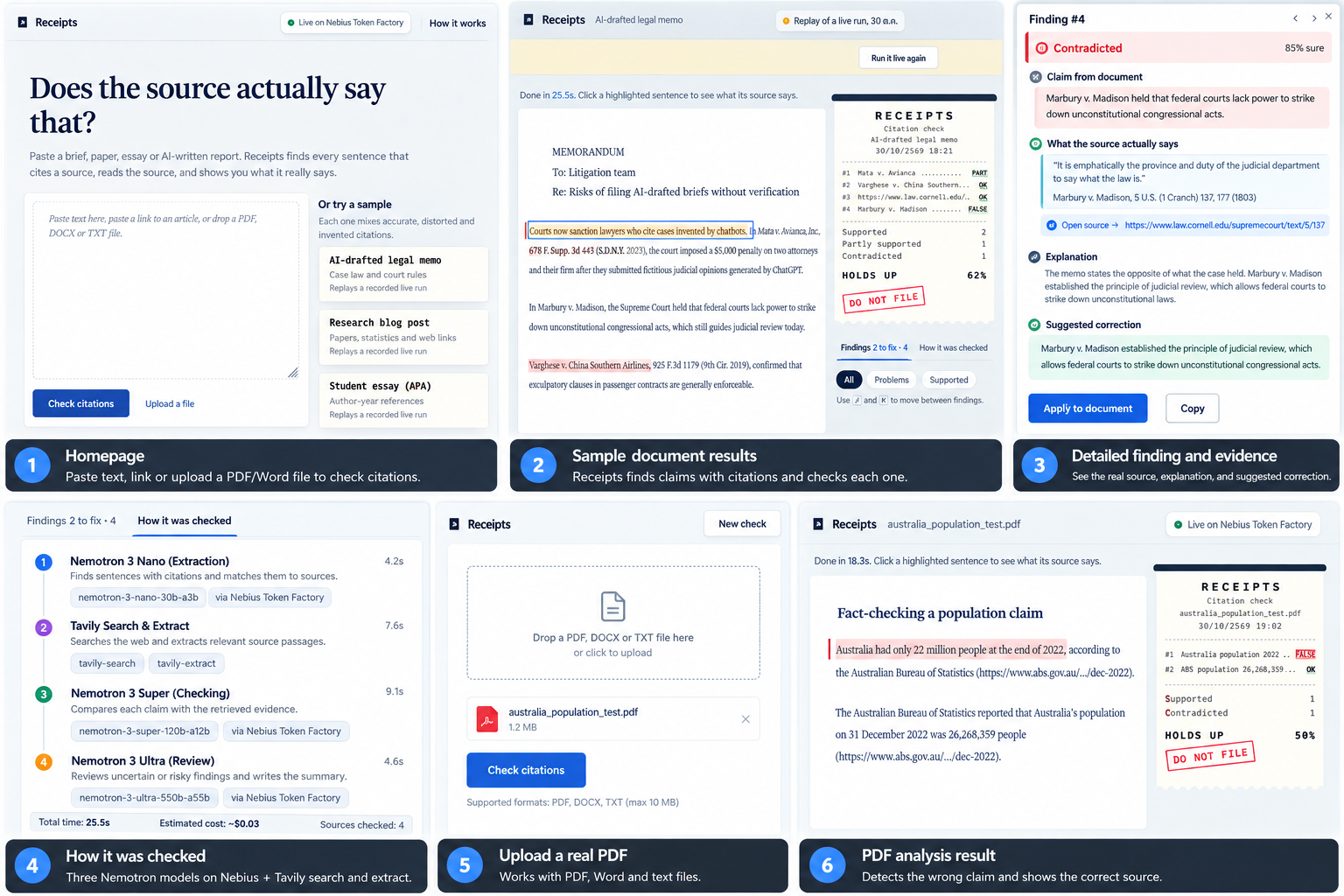
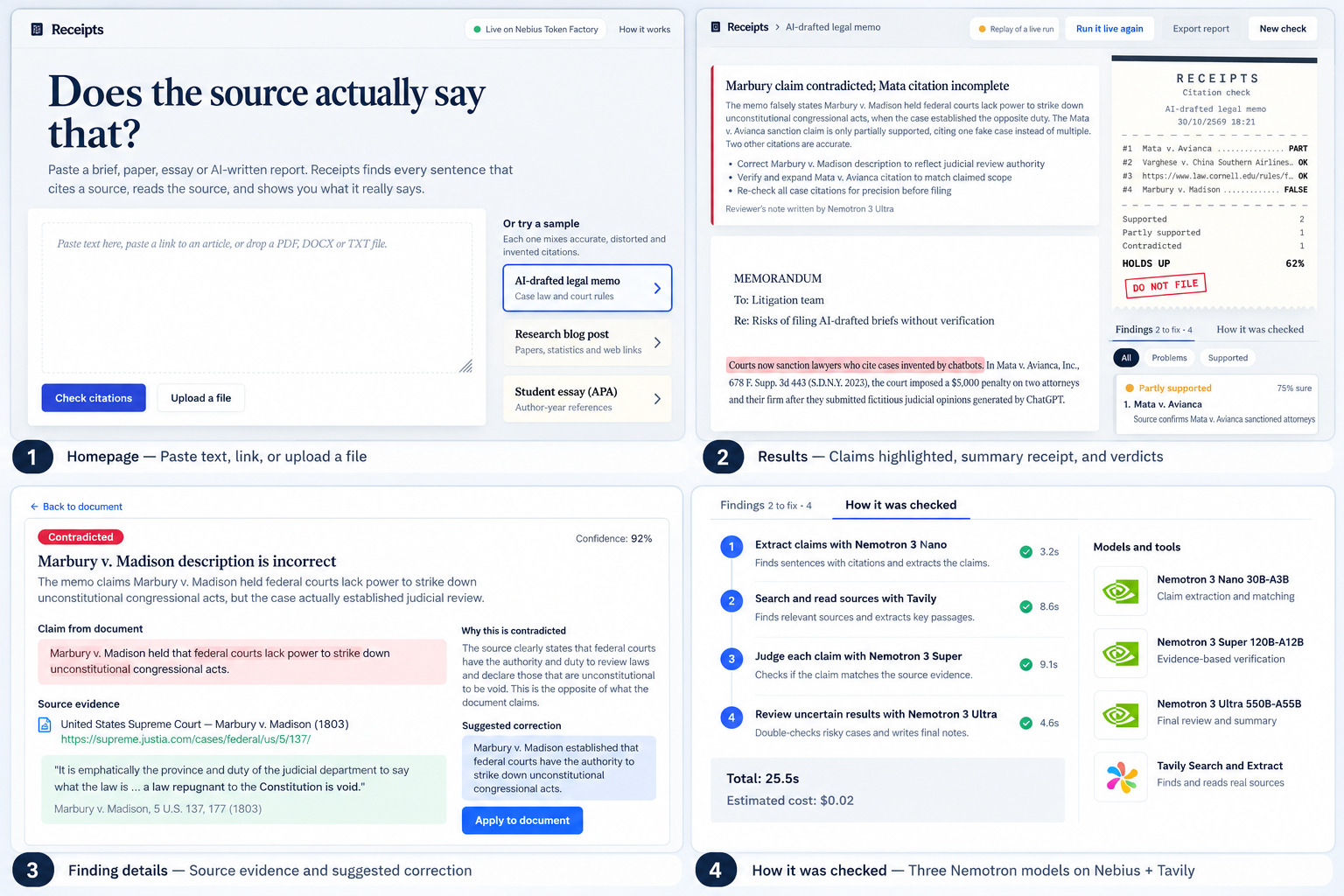
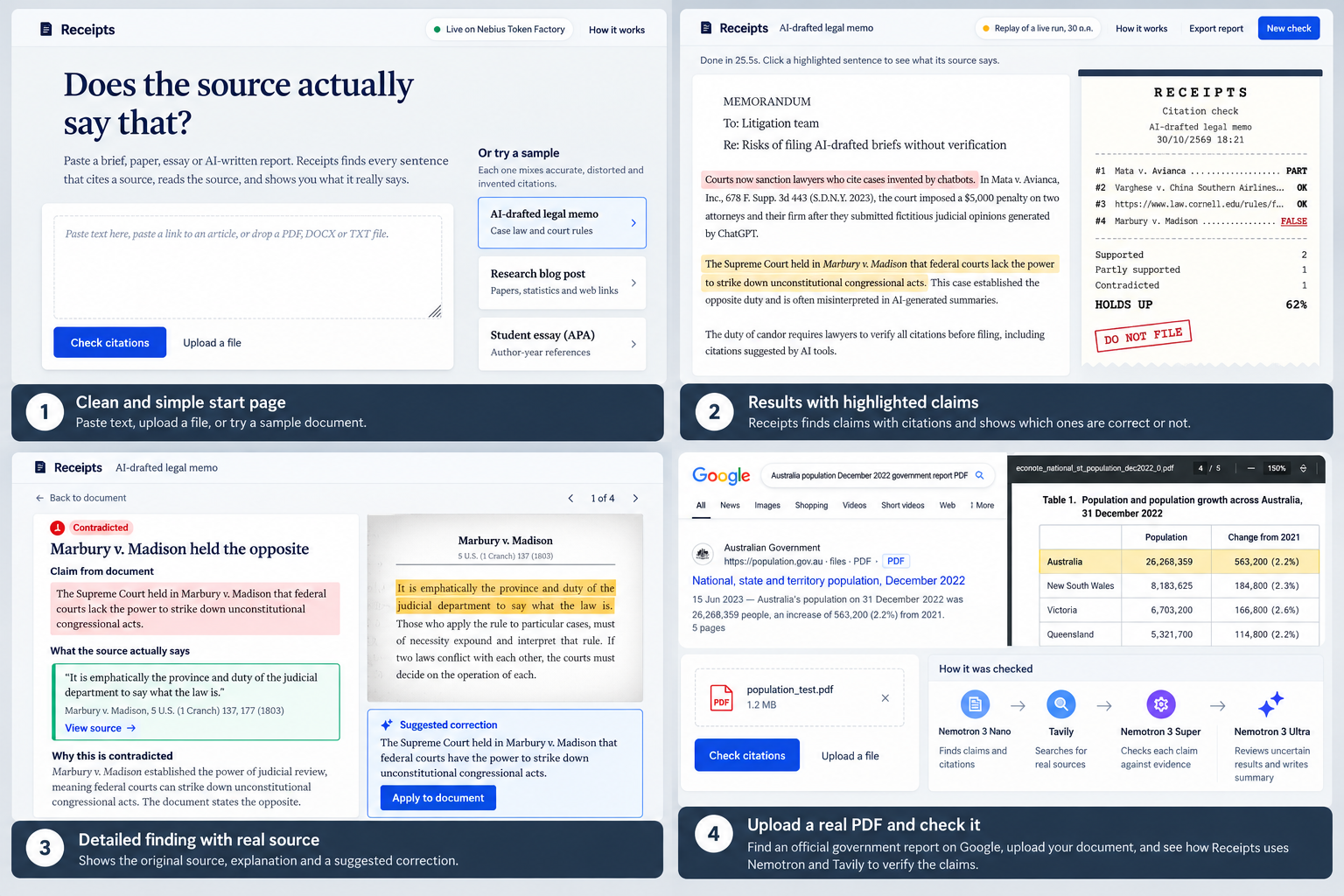
Users can paste text, enter a website link, or upload a PDF or Word document.
Receipts reads the document, finds sentences with citations, and checks them against the original sources.
It classifies each claim as supported, partly supported, misrepresented, contradicted, not found, or unable to verify.
Users can click a highlighted sentence to see the evidence, understand the problem, and view a suggested correction. They can also apply the correction directly to the document.
One feature I really like is the receipt on the right side of the screen. It shows a summary of the citations, including which ones are correct and which ones need attention.
Users can also export a report, use keyboard shortcuts, and switch between light and dark mode. The website does not require an account.
How I built it
I built Receipts using Python, FastAPI, JavaScript, HTML, and CSS.
The main AI system uses three NVIDIA Nemotron 3 models through Nebius Token Factory.
Each model has a different job:
- Nemotron 3 Nano finds claims and citations in the document.
- Nemotron 3 Super compares those claims against the source evidence.
- Nemotron 3 Ultra reviews uncertain or risky results and writes a final summary.
I also used Tavily Search and Extract to find the sources and retrieve information from them.
The backend communicates with the models through Nebius Token Factory's API. Results are sent to the browser as the analysis progresses.
I deployed the application on Render, and the source code is available publicly on GitHub.
Challenges I faced
One of the biggest challenges was making sure the citation checker does not give misleading evidence.
Since the project uses AI to check AI-generated information, I wanted the results to be as transparent as possible.
I added a system that checks whether the evidence quoted by the AI actually appears in the retrieved source.
Another challenge was handling citations that were difficult to find. Some sources might exist but cannot be retrieved correctly, so it is important to separate "Not found" from "Cannot verify."
During testing, I also found that some real web sources were difficult for the system to retrieve. This showed me that the source-searching process still needs improvement.
Accomplishments that I'm proud of
I am proud that I built a working application with three AI models doing different tasks.
Receipts successfully completed live checks on three sample documents, including a legal memo, a research blog post, and a student essay.
It detected problems such as incorrectly described legal decisions, misleading citations, and unsupported claims.
I also made the interface simple to use, with highlighted text, finding cards, evidence, suggested corrections, and the receipt summary.
The website is publicly available, so people can try it without signing up.
What I learned
This project taught me that checking information is more difficult than just asking an AI whether something is true.
I learned how to use different AI models together, connect them to real search results, and build an application using Nebius Token Factory and Tavily.
I also learned that real sources are not always easy to retrieve, and an AI system needs to be careful before saying something is wrong.
What's next for Receipts
In the future, I want to improve how Receipts finds academic papers, legal documents, and government reports.
I also want to add Google Docs and Microsoft Word integration so people can check their writing without leaving their document.
My long-term goal is to make Receipts a useful tool for students, researchers, journalists, and anyone who works with AI-generated information.
