-
-
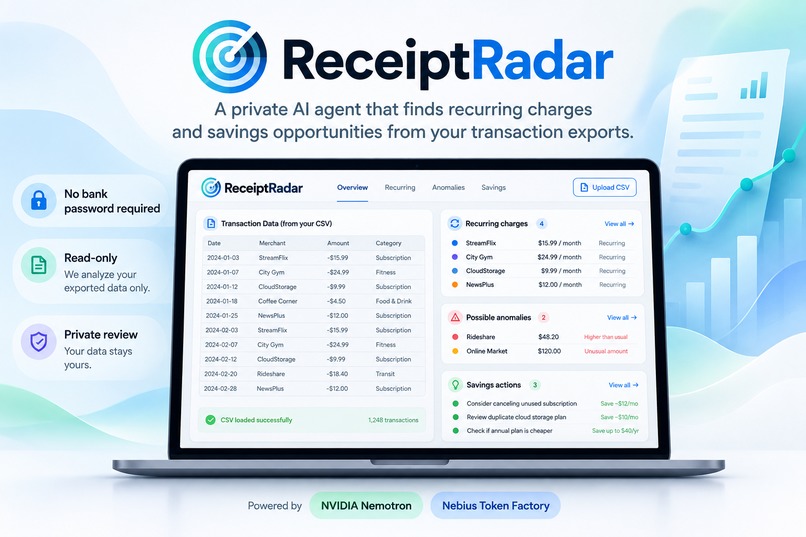
ReceiptRadar — AI-powered recurring charge and spending anomaly detection using NVIDIA Nemotron through Nebius Token Factory.
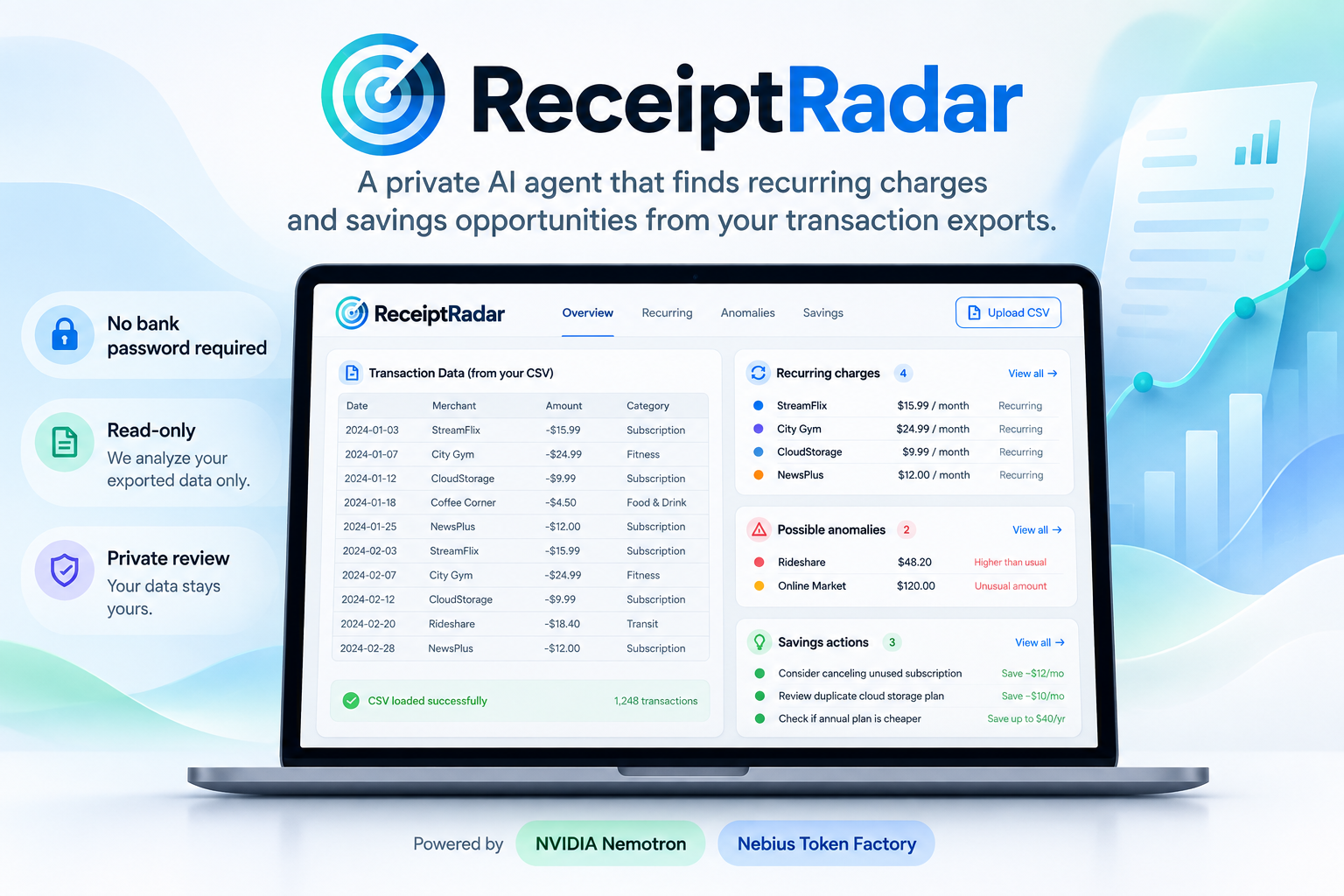
Recurring charges are easy to lose track of. A few subscriptions, memberships, software charges, or other repeating payments can quietly become a meaningful monthly expense.
I wanted to build an AI agent that answers a simple question: what keeps charging me, what looks unusual, and what should I review?
ReceiptRadar is designed to do that without asking for a bank password or permission to move money
What it does
ReceiptRadar analyzes a transaction CSV supplied by the user and identifies:
likely recurring charges
potentially unusual transactions worth reviewing
estimated recurring monthly costs
practical and reversible savings opportunities
The agent is intentionally read-only. It does not make purchases, transfer money, cancel subscriptions, or change financial accounts
How we built it
ReceiptRadar is written in Python with a lightweight web interface.
The project includes an integration path for an NVIDIA Nemotron open model through Nebius Token Factory. Transaction data is converted into structured input and the model is instructed to return structured JSON containing a summary, recurring charges, anomalies, and suggested review actions.
I also built a deterministic local recurring-charge detector. This gives the project a transparent fallback and creates a useful comparison between traditional rules and model-powered reasoning.
The application does not require users to provide bank login credentials. Users remain in control by supplying transaction data they have exported themselves
Challenges we ran into
One of the biggest design decisions was deciding what the agent should not do.
A financial agent capable of taking irreversible actions would create unnecessary risk for this use case, so ReceiptRadar separates intelligence from authority. It can detect and explain, while the user decides whether any financial action should actually happen.
Another challenge is preventing AI-generated financial analysis from inventing information. The model prompt therefore explicitly prohibits creating merchants, transaction amounts, or charges that are not present in the user's data
Accomplishments that we're proud of
Built a working ReceiptRadar prototype with a usable browser interface, deterministic recurring-charge detection, structured AI output, and a production integration path for NVIDIA Nemotron through Nebius Token Factory. The system was intentionally designed so users never have to provide bank passwords and the agent cannot move their money.
What we learned
The biggest lesson was that useful AI does not always need unlimited autonomy. For financial tools, separating analysis from authority can make an agent more useful and more trustworthy. ReceiptRadar handles the repetitive pattern-finding while leaving consequential financial decisions with the user
What's next for ReceiptRadar
Next we want to add merchant normalization, encrypted local history, stronger anomaly detection, receipt ingestion, user-confirmed recurring schedules, and optional tools for finding official subscription-management pages. We also want to benchmark multiple NVIDIA open models running through Nebius infrastructure


Log in or sign up for Devpost to join the conversation.