Inspiration and impact
RecallWeave responds to ForgeHacks AI + Education: reimagining how people learn and teach. Biology practice should connect ATP, redox, and cellular energy rather than only memorize isolated facts.
What it does and how we built it
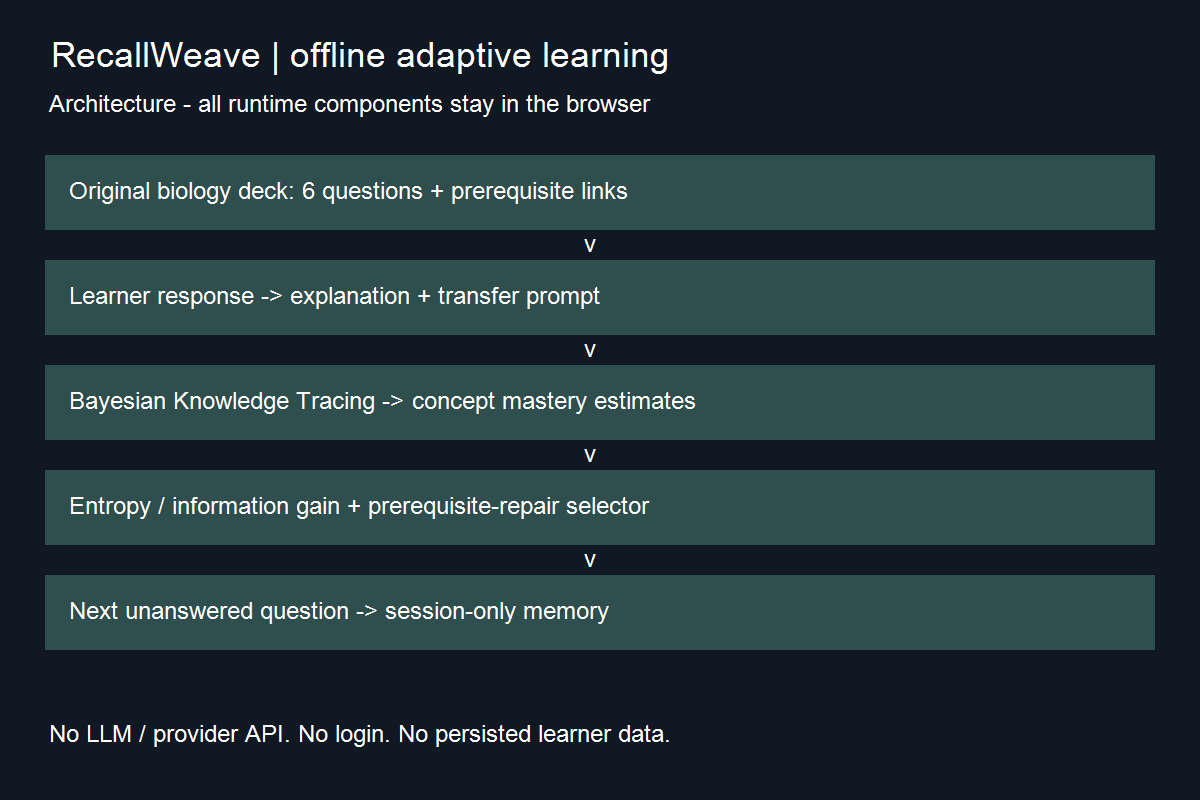
Six original biology questions provide explanations and transfer prompts. JavaScript Bayesian Knowledge Tracing updates estimated concept mastery with explicit learning, guess, and slip probabilities. Expected information gain plus a prerequisite-repair bonus selects the next unanswered question. HTML/CSS render the interface; a Python build script bundles a self-contained demo.html. Open that file locally: no login, cloud inference, or learner-data storage.
Substantially created during this hackathon starting October 5, not recycled from another contest. Concepts are adapted from OpenStax Biology 2e, chapters 7-8, Rice University, CC BY 4.0; question wording is original and attribution is in the deck.
Challenges, learning, and accomplishments
Making adaptation inspectable without presenting a model estimate as a grade was the core challenge. Explicit parameters, stable choices, and explanations make the logic checkable. The build report records seven passing Node tests, a Chromium run through all six questions, and a 390px responsive-layout check.
Limits and next steps
The deterministic toy learner comparison is labeled synthetic, not evidence of learning efficacy. Parameters are defaults, not fitted estimates. Educator-reviewed decks, calibration, and consent-based evaluation against fixed-order practice are next. This is a small offline prototype, not a validated assessment.
AI assistance disclosure
AI assistance developed/tested the implementation and drafted original questions. Runtime AI is local Bayesian Knowledge Tracing and adaptive selection, not an LLM or hosted API.
Built With
- bayesian-knowledge-tracing
- css
- html
- javascript

Log in or sign up for Devpost to join the conversation.