Inspiration
I have always believed that our photos, videos, and documents are more than just digital files. They represent our experiences, achievements, celebrations, journeys, and countless moments that we want to remember. However, as our digital libraries continue to grow, finding a particular memory becomes increasingly difficult.
Sometimes, I remember a moment but not the exact date, filename, or folder where it was stored. Traditional file search methods often require users to know specific details before they can find something.
This made me think: What if people could search for their memories the same way they remember them?
What if someone could simply type, "Show me the pictures from that sunset trip with my friends," instead of manually exploring hundreds of folders?
This idea became the foundation of RecallVault AI — an AI-powered personal memory discovery platform designed to make digital memories easier to search, explore, and rediscover.
My goal was not just to build another file management tool, but to create a more natural and meaningful way for people to reconnect with their digital memories.
What it does
RecallVault AI is an AI-powered personal memory discovery platform designed for UGREEN AI NAS. It aims to transform traditional file browsing into an intelligent, visual, and personalized memory discovery experience.
Instead of relying only on filenames, folders, or exact dates, the platform is designed around how people naturally describe and remember things.
Its key features include:
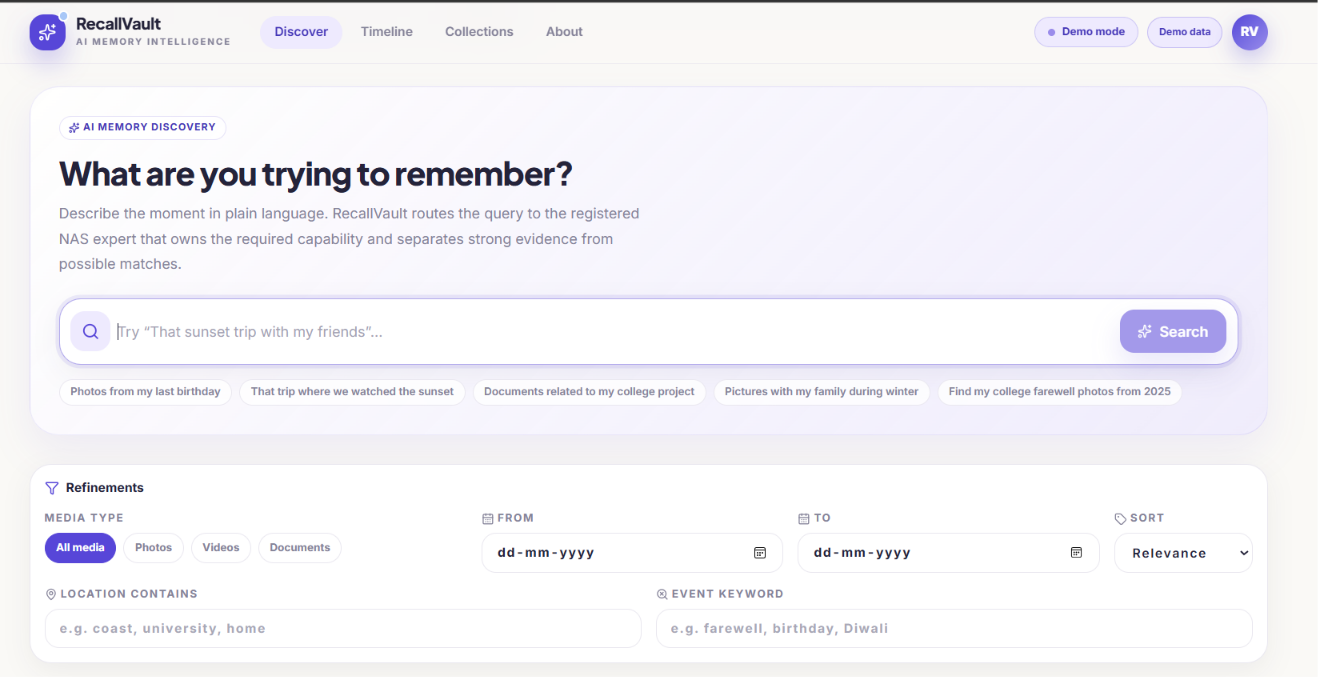
1. Natural Language Memory Search
Users can describe what they are looking for in everyday language. For example:
- "Find photos from my last birthday."
- "Show me pictures from my college events."
- "Find that sunset photo from my trip."
- "Show me documents related to my projects."
The goal is to make searching more intuitive and accessible.
2. Memory Timeline
An interactive timeline organizes memories chronologically, helping users explore their digital history through different dates, months, and years.
3. Smart Collections
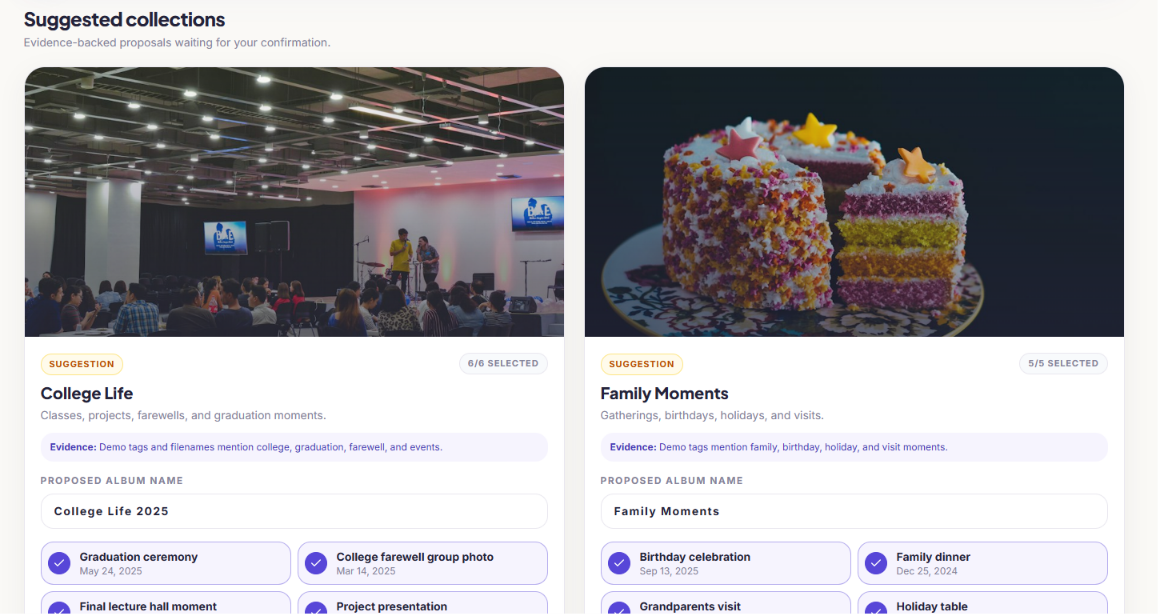
The platform introduces a visual collection experience for grouping meaningful memories into categories such as Family Moments, Travel Diaries, College Memories, and Celebrations.
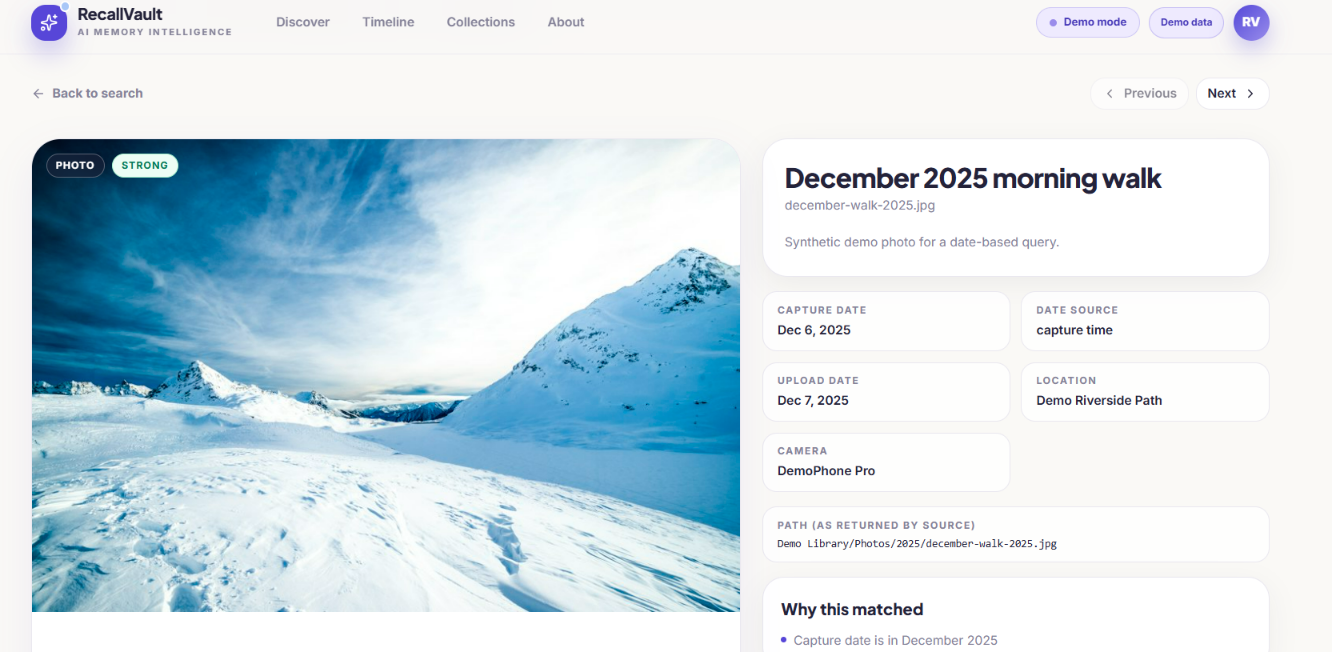
4. Memory Details and Discovery
Users can explore individual memories, view available metadata, and discover related content through a clean and organized interface.
5. UGREEN AI NAS Integration
The project is designed with a separate UGREEN Skill architecture that aims to connect the memory discovery experience with officially supported NAS capabilities.
Together, these features aim to make personal digital libraries feel more organized, searchable, and meaningful.
How I built it
I approached RecallVault AI by separating the user-facing experience from the NAS intelligence and integration layer.
Rather than treating it as a conventional file management application, I focused on building a product experience centered around memory discovery.
Frontend Development
I designed a modern, responsive interface with a photography-focused visual identity. The design uses a warm, minimal aesthetic, elegant typography, carefully arranged image layouts, and subtle interactions to create a premium experience.
The frontend includes:
- A memory-focused home page.
- A natural-language AI search interface.
- An interactive memory timeline.
- Visual smart collections.
- Memory detail views.
- NAS connection and settings sections.
AI and Skill Architecture
I designed the UGREEN Skill as a separate component, following the official UGREEN Skill development approach.
The intention is to use supported UGREEN capabilities for accessing and working with NAS content rather than relying on undocumented APIs or unsupported operations.
Product Architecture
I kept the frontend, data layer, and UGREEN Skill integration separate. This makes the architecture easier to maintain and allows the interface to support a clearly labeled demo experience when real NAS connectivity is unavailable.
I also considered privacy and data handling throughout the design, especially because personal photos and documents can contain sensitive information.
Challenges I ran into
Building RecallVault AI involved several interesting challenges.
1. Moving Beyond Traditional File Search
The biggest challenge was rethinking how people interact with their personal files. I wanted the experience to be based on what users remember rather than forcing them to know filenames, folder structures, or exact dates.
2. Understanding UGREEN Skill Architecture
Working with a platform-specific Skill development approach required understanding the official development standards and keeping the integration aligned with supported capabilities.
3. Separating Frontend and Integration
Another challenge was designing a beautiful frontend without making it dependent on assumptions about NAS functionality. I had to keep the user interface and the actual NAS integration separate.
4. Designing a Meaningful User Experience
Creating a premium interface that feels personal rather than technical was also challenging. I focused on visual storytelling, intuitive navigation, clean layouts, and meaningful interactions.
5. Balancing Innovation with Practicality
I wanted to introduce AI-powered discovery while ensuring that the product remained realistic, privacy-conscious, and aligned with the platform's capabilities.
These challenges helped me think more carefully about both the technical architecture and the actual value the product should deliver.
Accomplishments that I'm proud of
One of the things I'm most proud of is turning a simple observation about digital clutter into a complete product concept with a clear purpose.
I am particularly proud of:
- Creating a memory-first approach to personal file discovery.
- Designing a natural-language search experience instead of relying only on traditional file browsing.
- Developing a modern, photography-focused website interface.
- Creating an interactive timeline concept for exploring memories.
- Introducing smart collections to make personal content more meaningful.
- Separating the frontend architecture from the UGREEN Skill integration.
- Considering privacy and responsible handling of personal data from the beginning.
- Taking ownership of the project as a solo developer, from product planning and architecture to design and implementation.
Most importantly, this project challenged me to think beyond simply building features and focus on solving an everyday problem through a thoughtful AI-powered experience.
What I learned
Working on RecallVault AI taught me that building a meaningful AI product involves much more than integrating an AI model or creating a chatbot.
I learned the importance of understanding the user's actual problem before deciding which technologies to use.
I also gained a deeper understanding of:
- Designing AI-powered experiences around natural human language.
- Structuring frontend applications with separate integration layers.
- Working with platform-specific AI Skill development standards.
- Building clean, responsive, and user-friendly interfaces.
- Considering privacy when working with personal digital content.
- Designing features that are useful, understandable, and technically realistic.
Another important lesson was learning to work within platform limitations rather than assuming every integration or capability would automatically be available.
As a solo developer, I also improved my ability to manage different aspects of a project independently, including planning, design decisions, technical implementation, and documentation.
What's next for RecallVault AI
RecallVault AI is just the beginning of my vision for a more intelligent personal memory experience.
My next priority is to complete and validate the UGREEN Skill integration and test the complete workflow using real NAS capabilities.
Some of the improvements I want to work on include:
1. Complete UGREEN NAS Integration
Connect the platform with supported UGREEN NAS capabilities and validate the actual memory discovery workflow.
2. More Context-Aware Search
Improve search relevance so that users can discover memories using descriptions, dates, available metadata, and contextual information.
3. Better Memory Organization
Develop smarter grouping and collection suggestions to help users organize years of personal content.
4. Related Memory Discovery
Explore ways to help users find connected memories, such as photos from the same event, journey, or period.
5. Improved Personalization
Make the experience more adaptive to individual search patterns and content organization preferences, while respecting privacy.
6. Real-World Testing
Test the complete experience on UGREEN AI NAS, identify limitations, improve reliability, and refine the product based on practical usage.
My long-term vision is to make RecallVault AI more than a search tool. I want it to become a personal memory companion that helps people rediscover the moments, stories, and experiences stored across their digital lives.
Because every memory has a story, and no meaningful moment should get lost in thousands of files.
Built With
- ai-skills
- artificial-intelligence
- css
- framer-motion
- html
- human-computer-interaction
- javascript
- lucide-react
- memory-management
- natural-language-processing
- photo-management
- react
- responsive-design
- smart-search
- tailwind-css
- typescript
- ugreen-ai-nas
- uliya
- vite

