Inspiration
AI study tools can give students fluent answers without making the supporting evidence easy to inspect. Reading an answer also does not show whether someone can recall the idea.
RecallRoom connects those two problems through a simple study loop: find a passage in your own notes, attempt recall, check the original sentence, and return to what needs another attempt.
What it does
RecallRoom turns English lesson notes into source-linked search, recall practice, and a review queue.
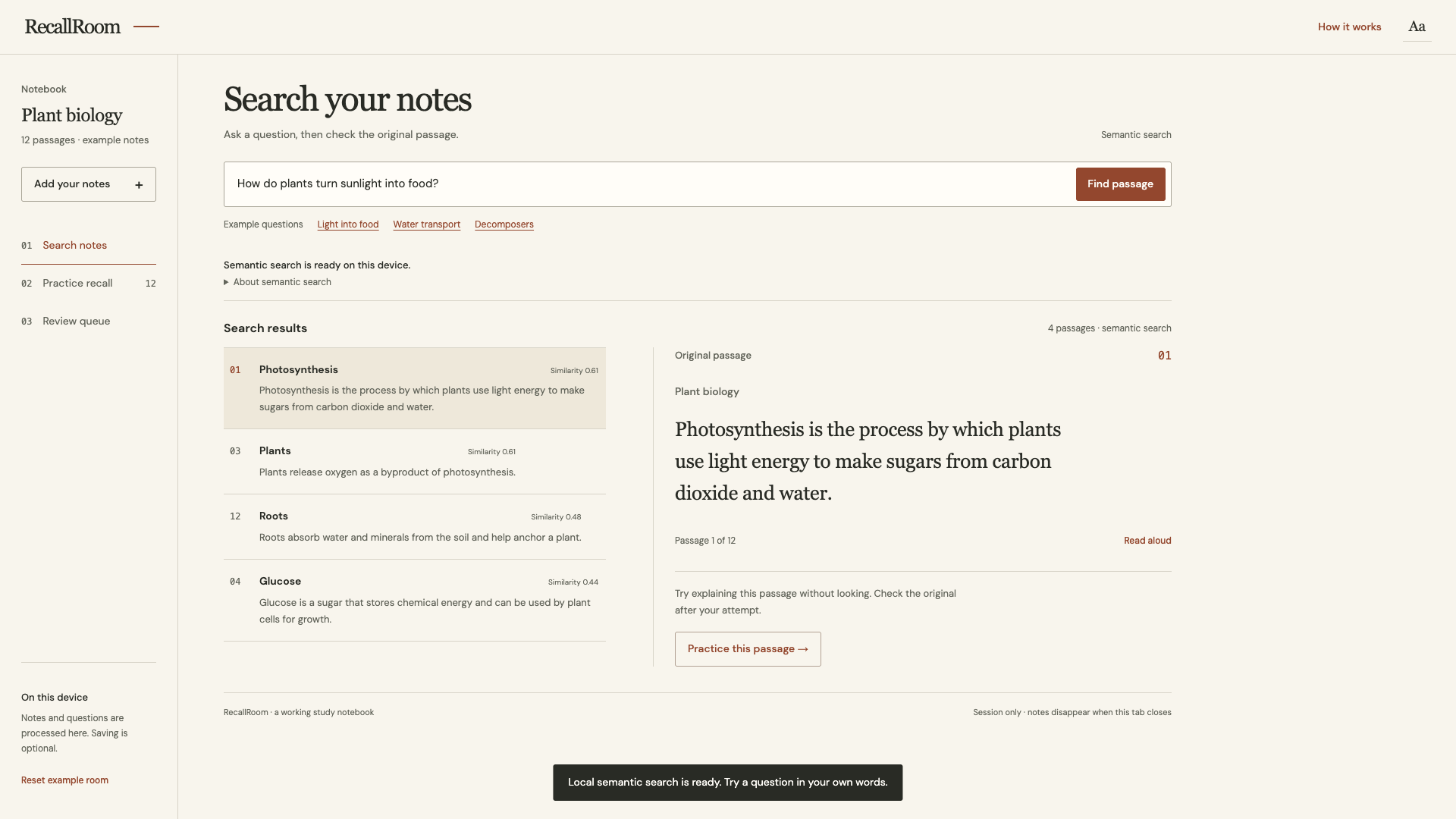
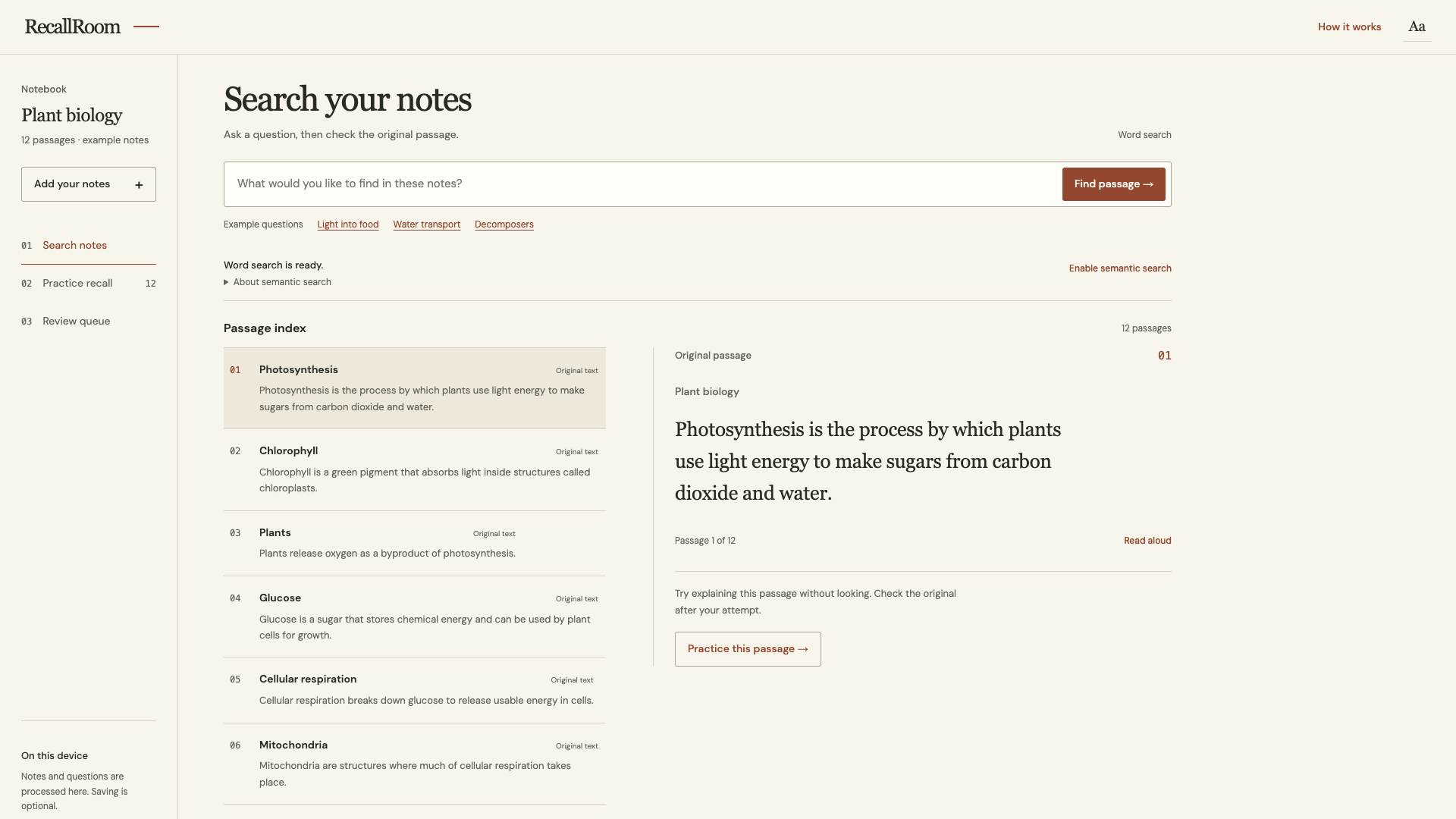
Students can paste their notes and browse every original passage. Word search works immediately. Optional on-device semantic search finds related meanings—for example, connecting “How do plants turn sunlight into food?” with a passage about photosynthesis.
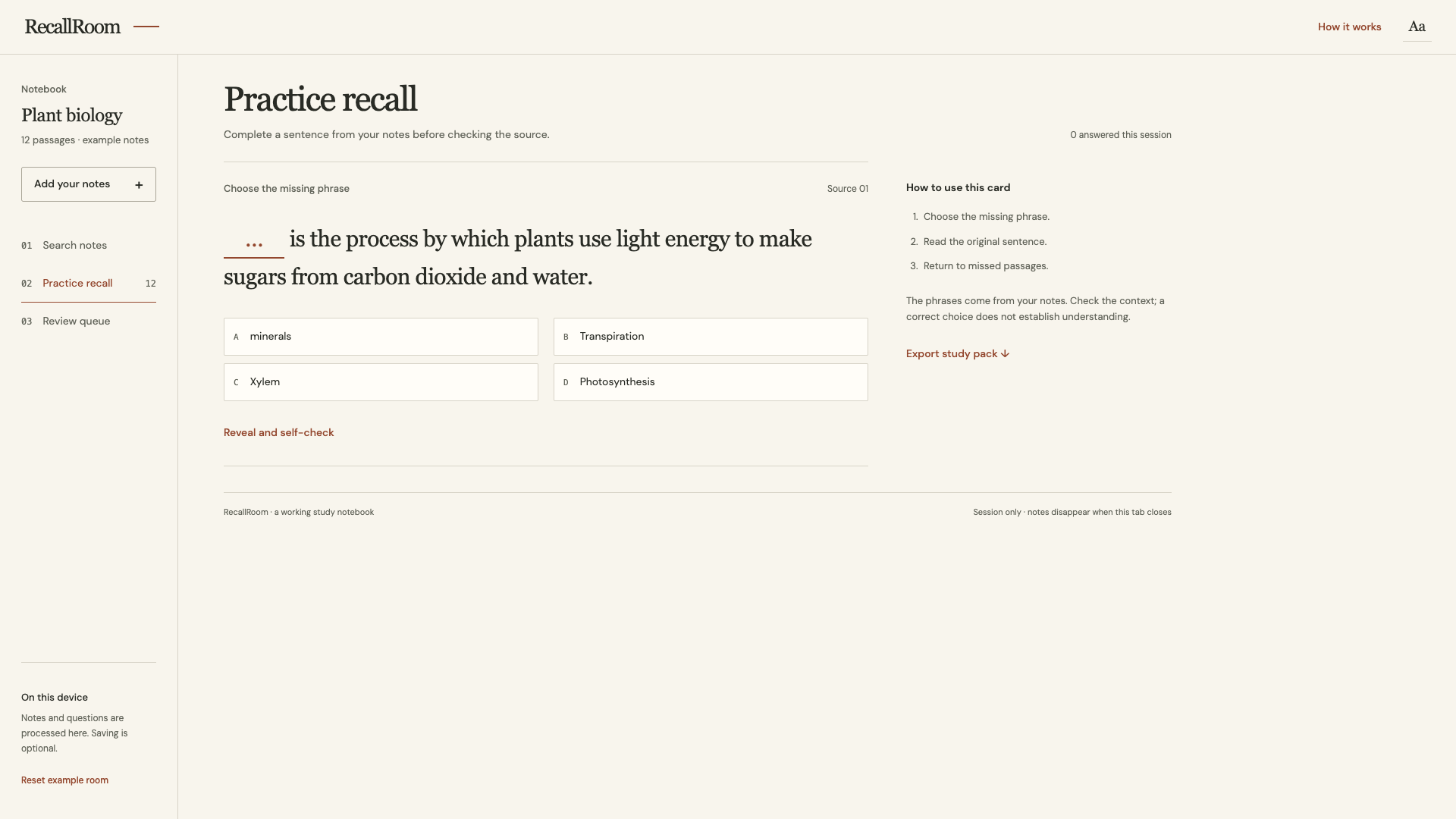
Each result preserves the exact source text and passage number. Practice cards hide a phrase from an original sentence and offer choices drawn from the same notes. After answering or self-checking, students can inspect the original context.
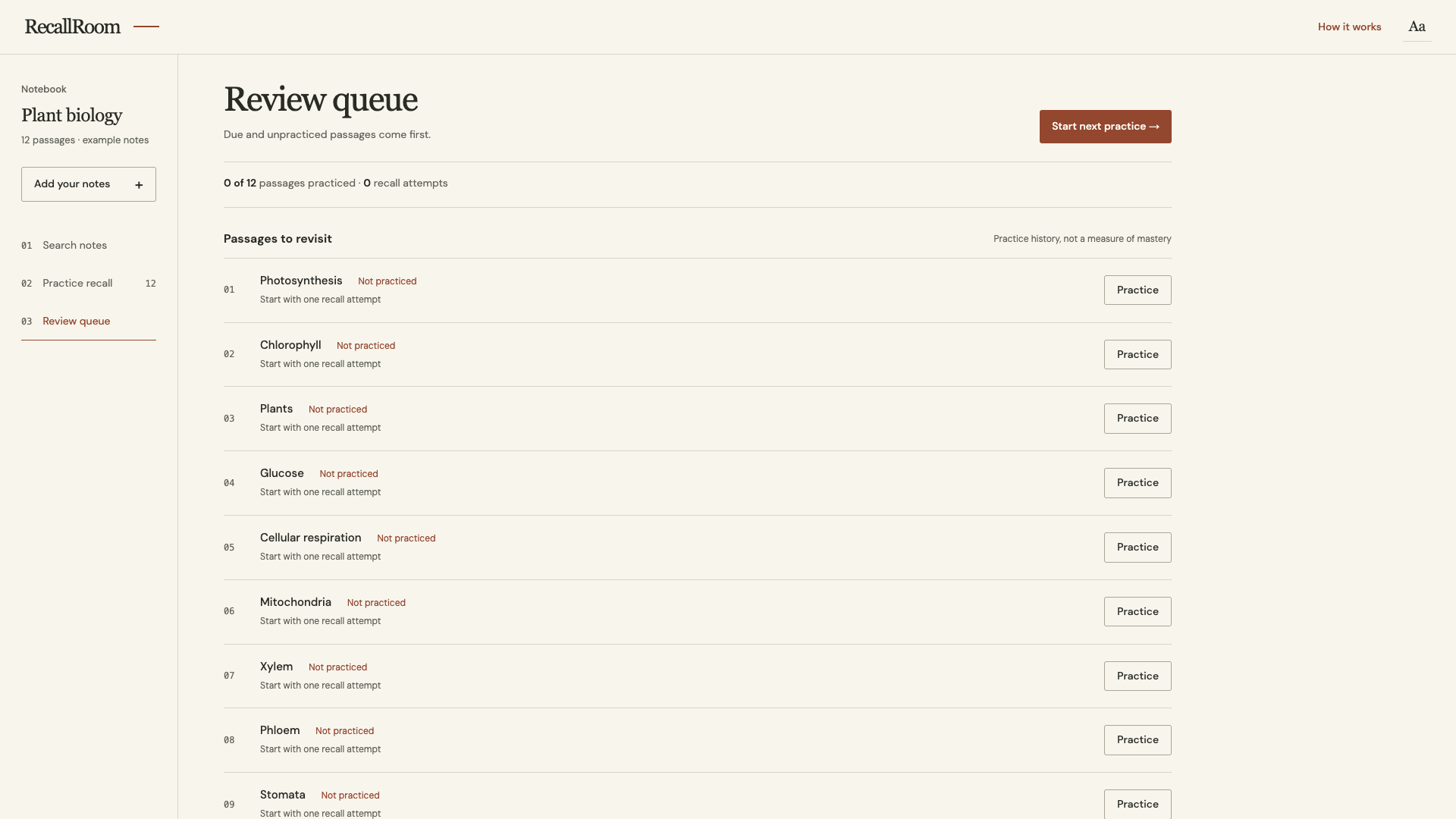
Correct and missed attempts update the review schedule. Additional features include optional device-local saving, study-pack export, larger text, and reading aloud through an available local system voice.
How it was built
The app uses HTML, CSS, and JavaScript. BM25 provides word search, while Transformers.js runs a quantized MiniLM model in a Web Worker for semantic search. Normalized sentence embeddings are ranked using cosine similarity.
Practice-card extraction and review scheduling are deterministic. Optional localStorage persistence saves notes and practice records in the current browser.
Study notes, questions, embeddings, and practice records are processed on the visitor’s device. Public model, library, and font assets are downloaded from external providers. No account or API key is required.
The interface follows a study-notebook design: readable serif passages, a numbered source index, restrained color, and an ordered review queue.
Challenges we faced
Semantic relevance and factual correctness are different problems. A related passage can still be the wrong answer, even when quoted exactly. RecallRoom therefore keeps the original context visible and labels similarity as a ranking signal.
Running a model in the browser also introduces download delays and performance constraints. A worker handles model processing, while word search remains available.
Sentence segmentation, long notes, safe display of pasted text, and phrase extraction required careful handling. Automatically extracted practice cards can still be awkward, especially with formulas, code, or complex prose.
Accomplishments
RecallRoom is a deployed prototype that completes the notes-to-search-to-practice-to-review workflow with real on-device model inference.
On ten authored questions over twelve original biology passages, semantic search found the intended source first in seven cases and within the first three in all ten. Word search found it first in six cases. This is a small demonstration set, not an independent benchmark or a general accuracy claim.
Checks covered source fidelity, unique correct choices, sentence parsing, unsupported questions, practice records, saved-note reload, custom notes, and safe display of literal markup. Desktop and 390-pixel layouts were also checked, including enlarged text.
What we learned
Preserving exact source wording prevents invented quotations, but it does not guarantee that retrieval selected the right passage. Source fidelity and relevance need separate checks.
We also learned that useful study practice can be built around a compact shared source model. Search results, practice cards, and review records use the same passage identifiers, keeping the original context close throughout the workflow.
What’s next
The next steps are to test the workflow with students, improve phrase extraction, evaluate retrieval on a larger held-out dataset, and complete native mobile-browser and assistive-technology testing.
English is the supported demo language. The prototype has not measured improvements in grades, retention, or other learning outcomes.
Build period and prior work
Project-specific code, interface design, and original example notes were created during the LovHack Season 3 build period. No finished pre-existing project was resubmitted.
OpenAI codex was utilized to host the demo websites
General-purpose libraries, pretrained MiniLM weights, fonts, and video tools existed before the event. Transformers.js and Xenova/all-MiniLM-L6-v2 use Apache-2.0 licenses; DM Sans uses the SIL Open Font License. Project-specific code is provided under an MIT license.

Log in or sign up for Devpost to join the conversation.