-
-
-
This image is currently processing. Please be patient...

Demo: https://recallrelay.onrender.com (hosted on Render; a scheduled ping keeps the free instance awake). The public demo runs against the PayPal sandbox with simulated orders; no real money moves.
A note about the video: we're Spanish speakers and our English isn't good enough yet to present this ourselves, so the narration uses an AI voice.
Inspiration
A recall notice tells people to stop using a product, but a merchant still has to find the affected orders, stop new sales, determine each buyer's remedy, and account for every payment. RecallRelay puts that chain in one reviewable workflow.
What it does
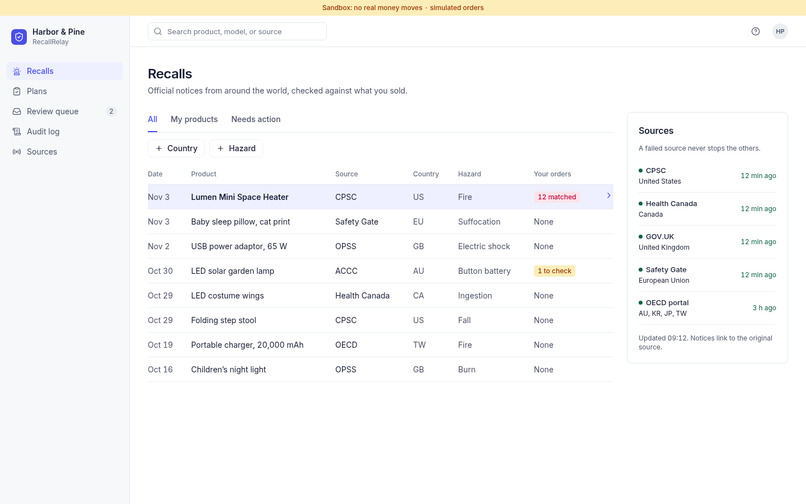
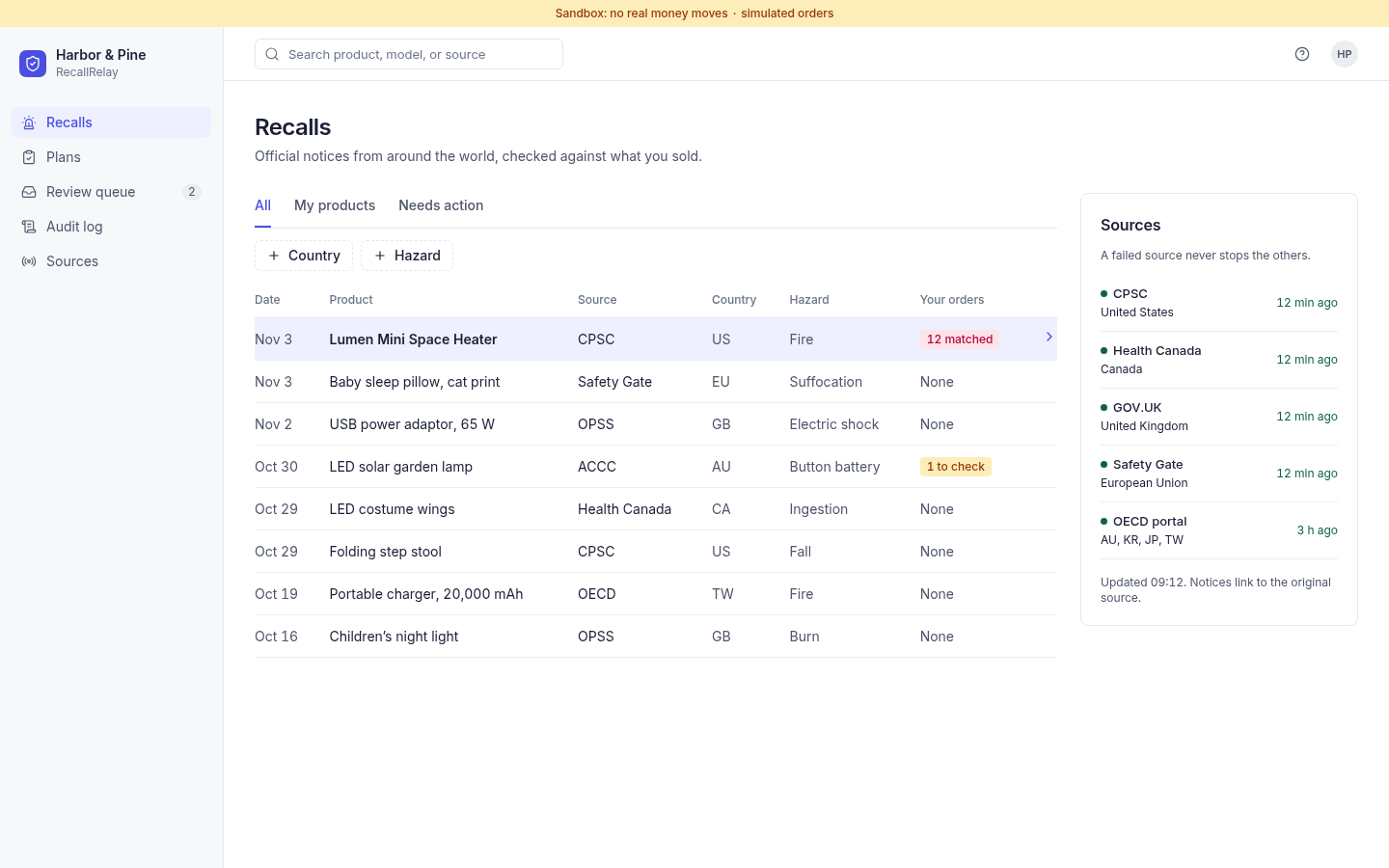
RecallRelay shows an official recall beside product evidence and merchant orders. It blocks checkout for a recalled SKU, identifies likely affected lines, and builds a plan with separate currency totals. A person approves the plan hash and budgets. The executor then performs eligible refunds, authorization voids, and payouts through PayPal, or leaves uncertain and ambiguous cases for review. Buyers can use a signed link to select a remedy. A checked notice can be sent, and a supplier reimbursement invoice requires a separate approval.
The keyless demo contains 12 fictional orders. Its run moves USD 258, CAD 358, GBP 99, and AUD 189; reserves EUR 208 pending buyer choice; and releases a JPY 12,800 authorization. These are simulated amounts from the demo, not customer results.
How we built it
The app uses a React dashboard and a Node/TypeScript Hono API. SQLite stores isolated sessions, plans, approvals, outbox entries, review cases, and an immutable audit trail. Deterministic policy code uses integer minor units to compute actions and amounts. Stable idempotency keys and PayPal status reads protect retries and reconciliation.
The settlement plan is an AG Grid (Community) table: sortable and filterable columns, a quick filter across orders, countries and rules, rows flagged when they need a person (a refund window about to close, a weak match, an order already shipped), per-currency totals pinned at the bottom so currencies are never added together, and a CSV export for the audit trail. The app ships as a Docker blueprint on Render.
PayPal's Orders API and checkout SDK support a sandbox store flow; Transaction Search can import order facts; Payments handles capture refunds and authorization voids; Payouts handles older buyer payments; Invoicing creates supplier invoices; webhook signature verification supports payment reconciliation. An optional OpenAI-compatible model extracts identifiers with verbatim source evidence and drafts buyer notices. A deterministic fake AI provider makes the demo run without credentials. AI never decides money.
Challenges
A payment timeout can happen after PayPal accepts a request, so blindly retrying could duplicate a refund or payout. RecallRelay reserves an outbox obligation first, uses a stable idempotency key, and keeps uncertain results open until PayPal confirms them. A refund with no returned PayPal ID requires manual review; an aggregate capture balance cannot prove which refund caused it. Product notices and transaction reports can omit identifiers or item details, so the workflow sends those cases to human review. Transaction Search returned 403 until the app was granted access. It now answers and returns item codes for this sandbox account.
Accomplishments
On the hosted demo, a real PayPal sandbox checkout was captured and then refunded through the same approved plan (capture 71548971N7998571T, refund 2CF057992G592873B). The prototype also demonstrates a complete simulated path from recall evidence and sale blocking through human approval, PayPal-style settlement, buyer choice, invoice approval, notice checking, and audit inspection. Automated tests exercise policy boundaries, signatures, sessions, idempotency, reconciliation, and the browser journey.
What we learned
The hard boundary is between interpreting a recall and moving money. AI is useful for extracting and drafting, while the payment decision needs explicit evidence, deterministic rules, a human approval, and a recoverable record of the external call.
What is next
Expand notice localization to more languages and recall agencies, and validate the workflow with real merchants before any production use.
