Inspiration
More context can make a coding agent worse when old decisions are stale. Coding agents can reason over conflicts when both sides of the conflict are in context. The handoff problem is earlier: under a budget, retrieval chooses what the next agent receives. If the newer decision that reversed an old policy is omitted, the stale instruction just looks like project policy.
RecallPack was built to make memory lifecycle first-class: remember useful project decisions, supersede stale ones while the evidence is still visible in the session stream, and recall only active memories that fit the current goal and budget.
The project is intentionally narrow: it is not a generic agent platform or a generic RAG layer. It focuses on one MemoryAgent problem for coding-agent handoffs: preventing agents from acting on superseded project memory.
Why coding agents still need RecallPack
Modern coding agents are good at resolving contradictions after both sides are in context. The failure RecallPack targets happens before that reasoning step: under a handoff budget, retrieval has already decided what the fresh agent sees. If the active reversal is omitted, the stale decision looks authoritative.
RecallPack makes that pre-reasoning selection safer by storing lifecycle state at write time. The next agent receives an active memory pack instead of raw history with stale decisions mixed in.
What It Does
RecallPack has two runtime paths:
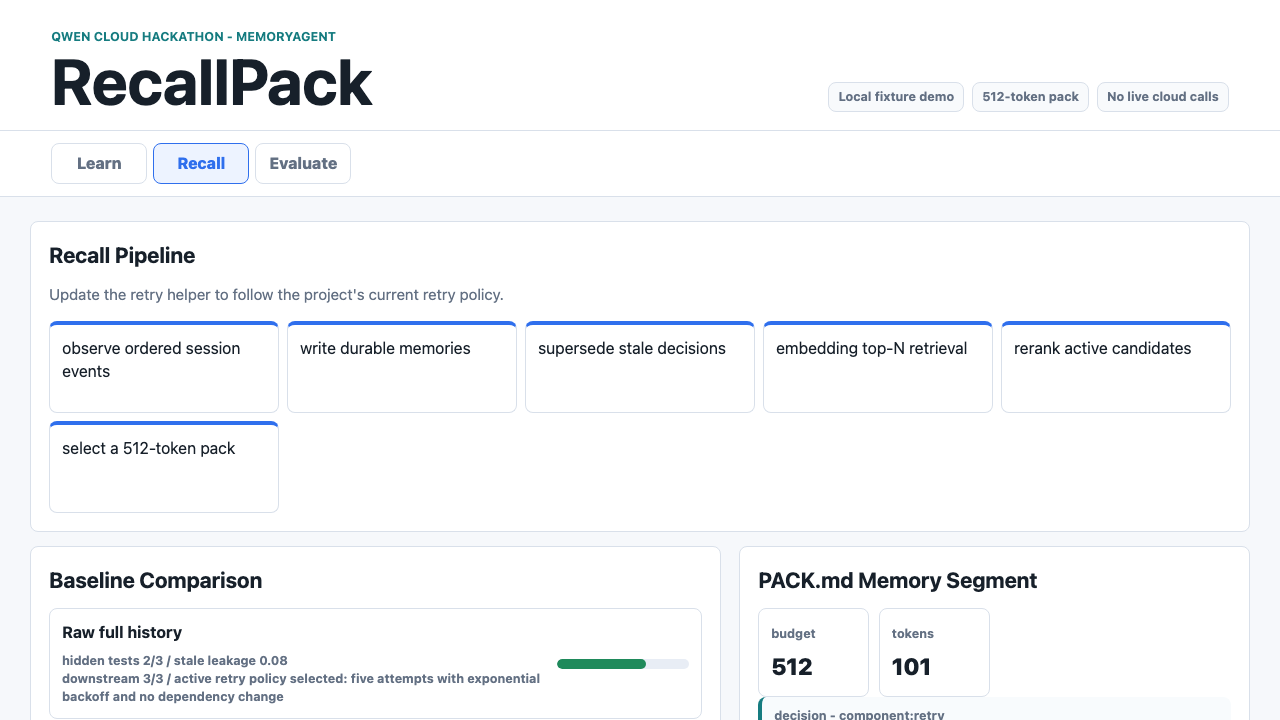
/observeingests ordered session events and writes durable memory records such as decisions, preferences, and lessons./compileretrieves active memory candidates for a goal, applies embedding top-N retrieval, reranks candidates, and selects a bounded handoff pack with provenance.
The demo shows three variants side by side:
- raw full-history reference: all 12 events, not budget-comparable;
- keyword-scored fake-embedding + rerank raw-history baseline: selected from raw event text and reranked before top-k selection; it is not source-picked from gold selected-source IDs, but its deterministic scoring terms are fixture-authored for local replay;
- RecallPack: active lifecycle-aware memory recall.
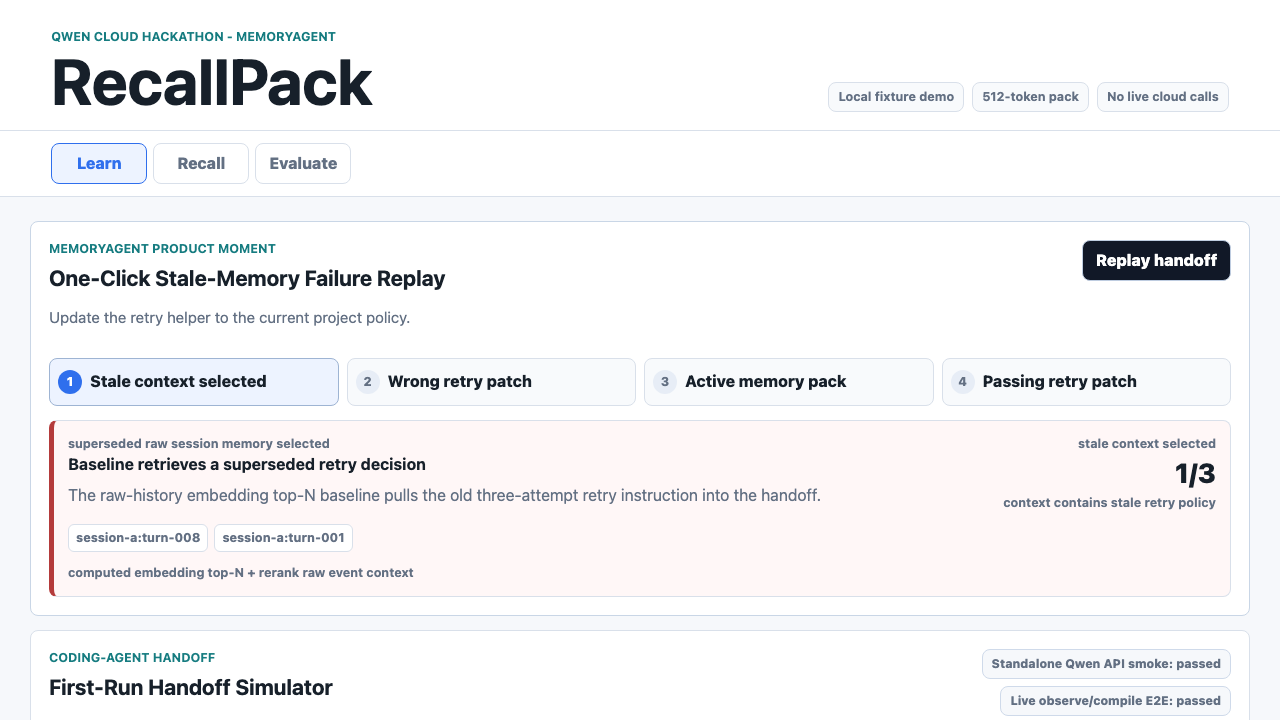
The first screen starts with the evidence boundary and a deterministic stale-memory failure replay: stale context is selected, the scripted local baseline writes the wrong retry patch, fixture tests show 1/3, RecallPack compiles the active memory pack, and the corrected patch passes 3/3. A first-run handoff simulator below it summarizes the same fresh-agent handoff. The replay is credential-free local evidence of a failure class, not a claim that live retrieval always picks the stale item.
In the hero proof, the local keyword-scored fake-embedding + rerank raw-history baseline recalls a superseded retry decision and produces the wrong retry patch. It passes 1/3 fixture downstream tests. RecallPack filters the stale decision, includes the active retry decision plus the dependency-free preference, and passes 3/3 fixture downstream tests. The live Qwen evidence is reported separately and disclosed first: two stored live raw-history embedding+rerank baseline runs selected the active retry decision and did not select the stale retry decision; stored live RecallPack runs held lifecycle filtering; and the downstream live patch-generation delta has one historical pass, one failed retry-policy rerun, and one passing ProjectOdyssey live run. In the latest ProjectOdyssey live trace, Qwen selected the required active sources, excluded the stale policy, and the RecallPack live-generated patch passed 3/3 fixture tests while the live raw-history baseline passed 1/3. This is source-backed fixture integration evidence, not statistical validation of live downstream performance.
The proof includes eight curated lifecycle regression fixtures: retry policy, config loader, cache policy, audit serializer, a non-isomorphic pagination fixture, a realistic API-client auth migration fixture, a source-backed AI provider auth-header fixture inspired by public gateway/provider header failures, and a source-backed ProjectOdyssey JIT fixture. They are designed to test stale-memory handling behaviors, not to act as a broad benchmark. In each fixture, keyword-scored fake-embedding + rerank raw-history context keeps a superseded decision and passes only 1/3 downstream fixture tests in the local deterministic replay environment. RecallPack selects active memory and passes 3/3 fixture tests with the same local temp-repo evaluator contract.
How It Uses Qwen Cloud
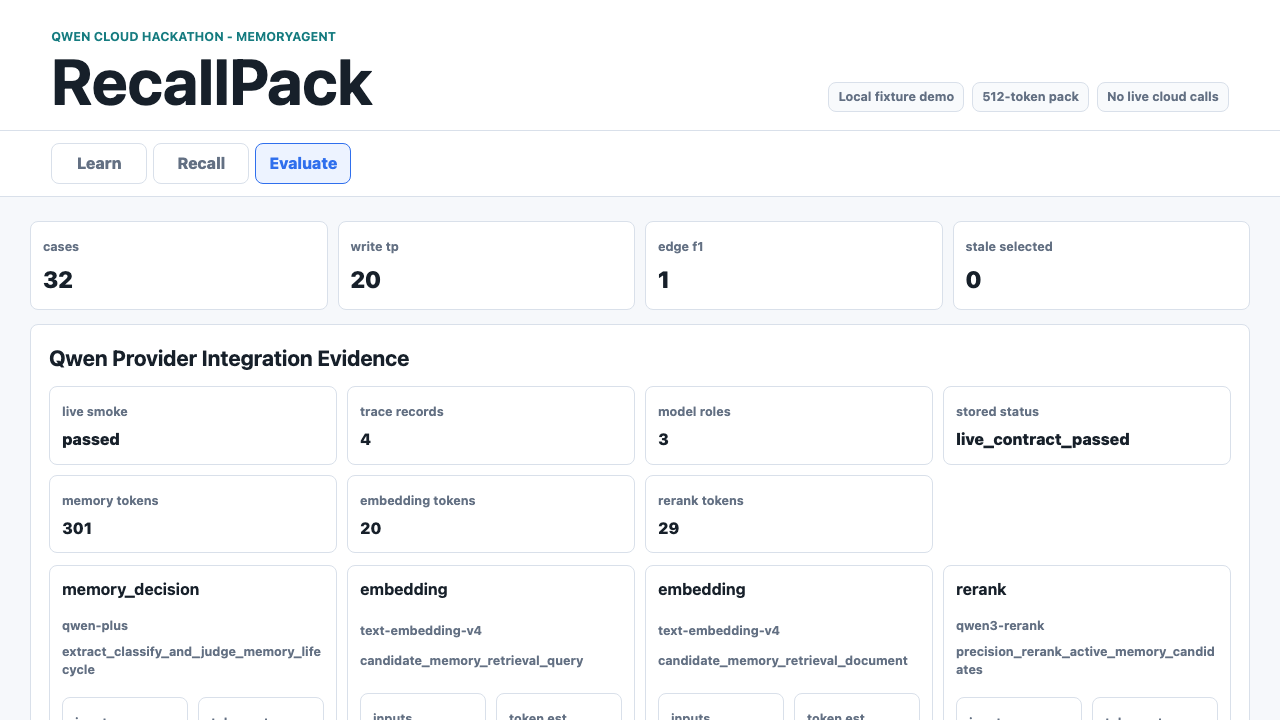
RecallPack includes Qwen Cloud provider integration evidence for the intended provider path:
- Qwen text model: memory extraction, type classification, duplicate detection, and supersession judgment.
- Current Qwen text adapter: OpenAI-compatible
tools/tool_choicecontract with default modelqwen3.7-plus-2026-05-26. text-embedding-v4: candidate memory retrieval in the stored live E2E trace and provider contract.qwen3-rerank: precision improvement over embedding top-N candidates.- Gated downstream patch generation uses the same Qwen text-provider
tools/tool_choicecontract; the checked-in sanitized traces record one historical provider-path run that completed successfully, one failed retry-policy rerun, and one passing ProjectOdyssey source-backed fixture run. Local tests remain credential-free.
Deterministic application code handles ordered event processing, lease/CAS storage behavior, lifecycle state writes, token budgeting, pack assembly, and fixture-backed local verification.
The local demo displays standalone live API smoke passed, meaning the repo contains a sanitized approved trace for memory_decision, embedding, and rerank. The checked-in demo and unit tests do not read credentials or make live Qwen calls.
How We Built It
RecallPack is a small Python standard-library backend with a static demo UI:
- SQLite-backed event and memory lifecycle storage.
- Provider adapters for fake/local testing and live Qwen contract checks.
- A deterministic lifecycle-regression fixture evaluator with a local context-keyed patch-generation provider. The provider receives goal, selected context, and allowed edit paths, then validates generated patches with fixture tests in a temporary repo. It does not read gold patch variants.
- A 32-event behavior contract fixture suite that checks memory-operation behavior and stale-selection risk.
- A sanitized public bundle builder that excludes internal execution notes, generated caches, local machine paths, and credentials.
- A Docker target for an Alibaba Cloud ECS-style runtime proof.
Challenges
The hardest part was making the comparison honest. Raw full history is useful
as a coverage reference, but it is not budget-comparable. The local baseline is
a keyword-scored fake-embedding + rerank raw-history path over raw events, and
its deterministic scoring terms are fixture-authored so the demo replay is
reproducible. RecallPack uses active memory lifecycle state before rerank and
budget selection. Both the baseline and RecallPack route through the same
local context-keyed patch provider, so the downstream proof no longer reads
gold patch variants. The live text-embedding-v4, qwen3-rerank, and Qwen
patch-generation evidence is the stored sanitized E2E trace, the failed
retry-policy rerun, and the passing ProjectOdyssey source-backed fixture rerun.
The stored live raw-history embedding+rerank baseline traces selected
the active retry decision on this small fixture, so RecallPack does not claim a
measured live baseline failure rate. The retry-policy rerun is recorded separately as
live-qwen-m98-rerun-trace.json; it completed the live observe/compile path
but the live patch-generation proof did not pass 3/3 for RecallPack. The
ProjectOdyssey rerun is recorded as
projectodyssey-live-qwen-e2e-trace.json; it selected both required active
sources, excluded the stale JIT policy, and RecallPack live patch generation
passed 3/3 fixture tests. The failed retry-policy trace remains stored as failed evidence
and is not presented as a passing rerun.
Another challenge was making Qwen Cloud provider evidence visible without making local tests fragile. The solution is a strict provider trace contract: fake providers emit the same sanitized trace shape as live providers, and the one approved live contract trace is stored without credentials, raw prompts, raw memories, or tool arguments.
For the public local backend, /compile uses deterministic keyword fake
embedding/rerank providers through that same contract. This keeps the demo
credential-free while avoiding zero-vector or identity-rerank smoke behavior.
We also added and ran a gated live Qwen E2E runner for the hero
observe/compile lifecycle. The stored live provider-path trace records
live_e2e_passed: Qwen handled memory decisions, text-embedding-v4 handled
retrieval, qwen3-rerank handled precision ranking, and the intended live
patch-generation path completed successfully once. No credentials, raw prompts,
raw memories, or tool arguments are recorded in that trace. The live runner now
reports baseline failure instead of requiring it for pass status, and the
raw-history baseline context is derived from embedding/rerank retrieval. The
fresh retry-policy rerun result is live_e2e_failed: lifecycle filtering held, but the
downstream pass-rate delta did not reproduce. The latest ProjectOdyssey live
run is live_e2e_passed: live Qwen selected
session-h-current:turn-006 and session-h-history:turn-004, excluded the
stale policy, and RecallPack live patch generation passed 3/3 ProjectOdyssey
fixture tests. The stored passing traces demonstrate provider-path integration;
the failed retry-policy rerun demonstrates that live downstream reproducibility still
needs careful fixture-by-fixture validation; and the live baseline traces show
retrieval can get the small retry fixture right without RecallPack.
What We Learned
Memory quality is not just retrieval quality. For coding agents, memory needs a lifecycle: active, superseded, and provenance-backed. A stale memory can be more harmful than no memory when it drives code edits.
Limits
- Broad coding benchmark improvement.
- Universal retrieval superiority.
- Guaranteed live Qwen downstream success.
- Replacement for coding-agent reasoning.
Judge Access
- Source code: https://github.com/cyq1017/recallpack
- The public demo is credential-free; it displays sanitized provider-path evidence and does not read credentials.
- The repository includes fresh-clone verification commands and the Alibaba Cloud ECS runtime proof.
Built With
- alibaba-cloud-ecs
- docker
- html
- javascript
- python
- qwen-cloud
- qwen-text-model
- qwen3-rerank
- sqlite
- text-embedding-v4


Log in or sign up for Devpost to join the conversation.