Inspiration
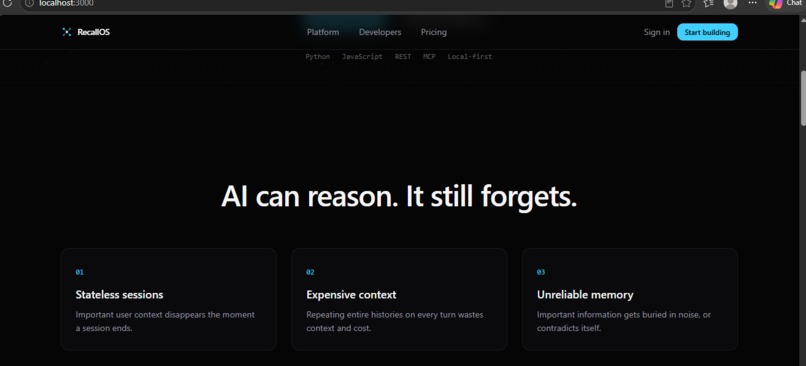
Most LLM frameworks and autonomous agents suffer from perpetual amnesia: once a conversation session terminates or context tokens overflow, all user preferences, past decisions, and episodic context vanish. Existing solutions force developers to ship private enterprise data to cloud vector databases incurring 150ms–500ms network latency, steep subscription fees, and severe privacy risks. We built RecallOS to give AI agents continuous, persistent long-term memory that runs 100% privately on standard consumer hardware.
What it does
RecallOS is an open-source, local-first memory operating system for production AI agents:
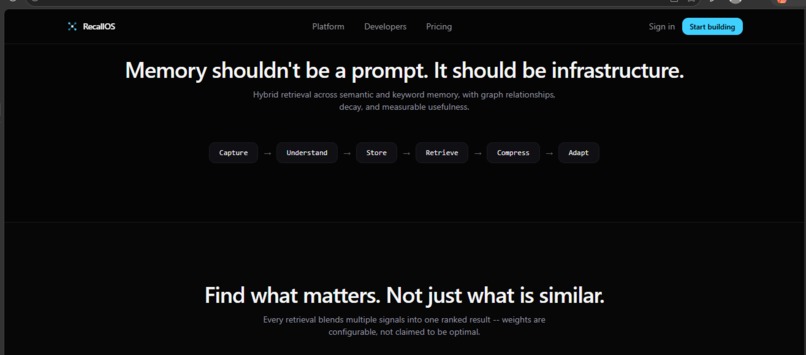
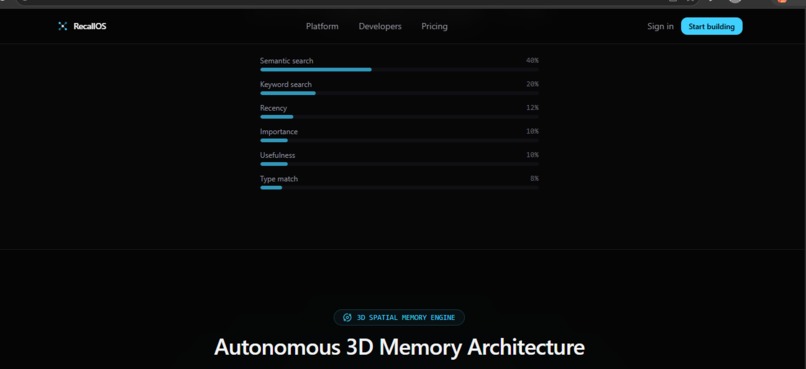
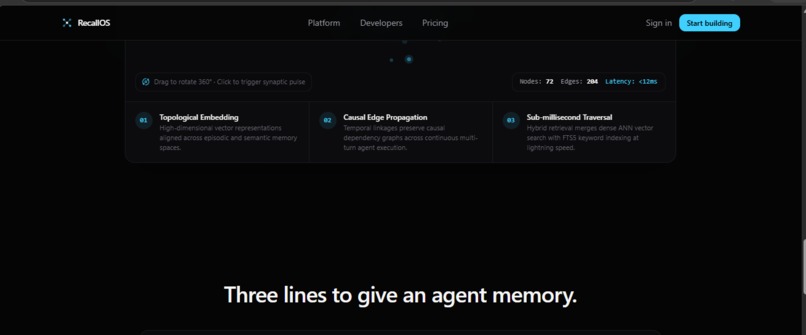
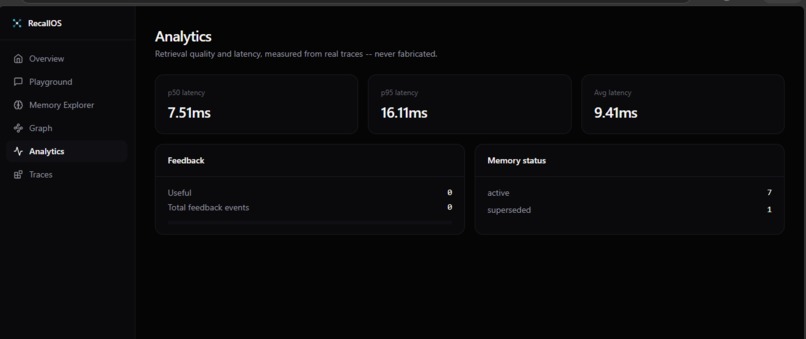
- Sub-12ms Hybrid Retrieval: Blends dense semantic vector embeddings (FAISS / NumPy) with sparse lexical search (SQLite FTS5 / BM25), temporal decay curves, feedback EMA scores, and importance weighting.
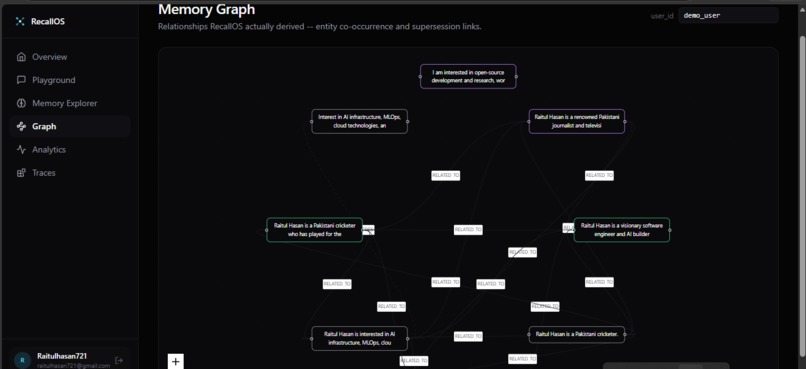
- Causal Knowledge Graph: Automatically derives entity relationships (
RELATED_TO) and resolves contradictory memories (SUPERSEDES) without manual curation. - Autonomous Fact Extraction: Uses local LLMs (Qwen 2.5 / Qwen 3 via Ollama) with an instant rule-based fallback to extract structured, durable facts from raw dialogue.
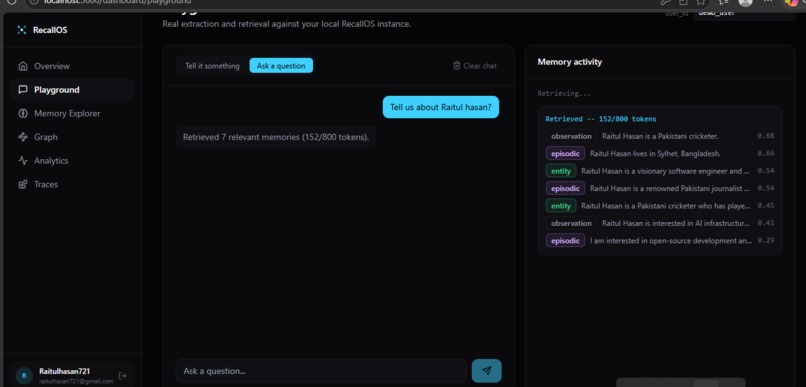
- Token-Budgeted Context Building: Injects only the highest-scoring, deduplicated memory blocks into LLM prompts within a strict token budget.
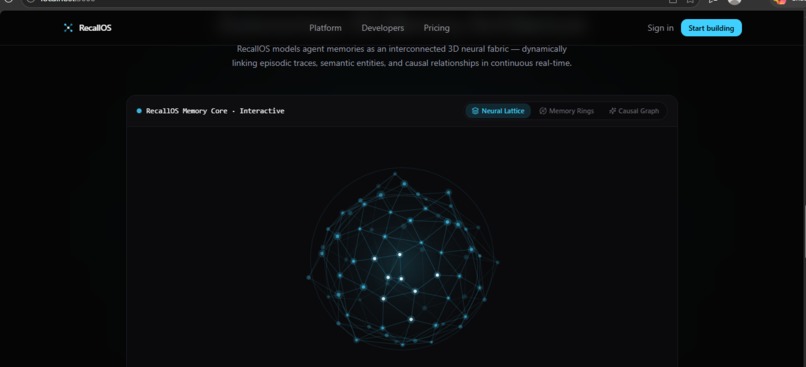
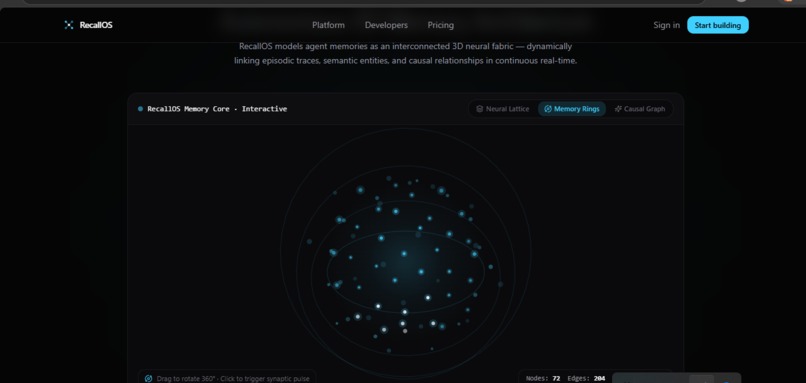
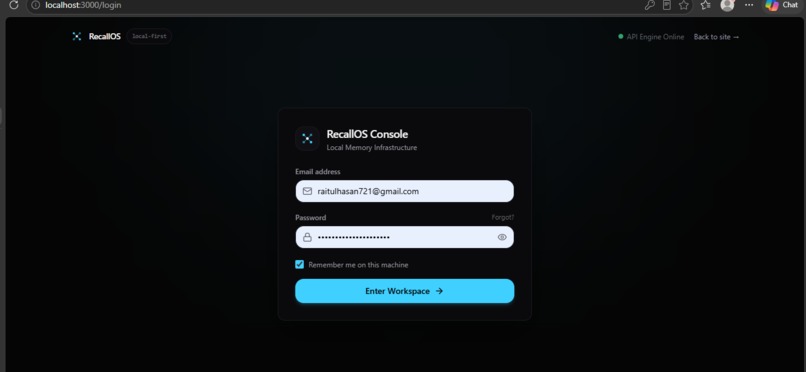
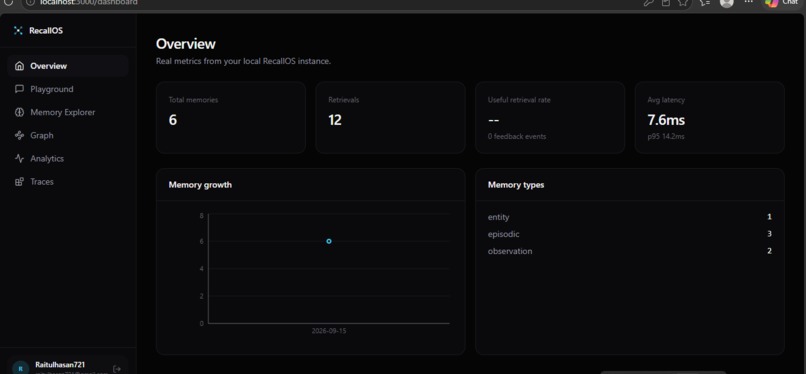
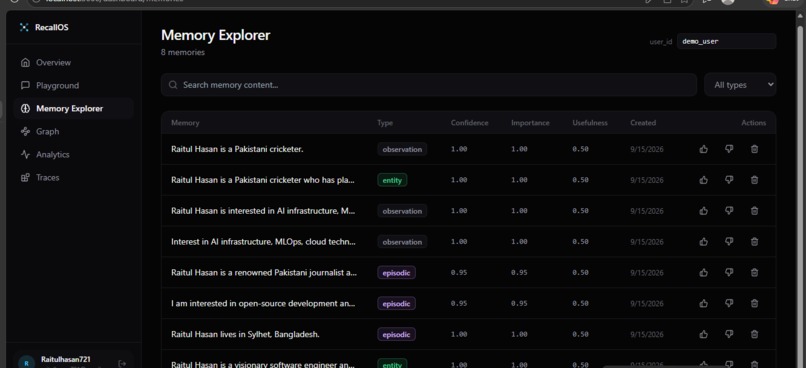
- Interactive 3D Spatial Console: Features a Next.js 14 dark-mode dashboard with a 3D Neural Memory Fabric, Agent Playground, Knowledge Graph Visualizer, and microsecond-level Execution Traces.
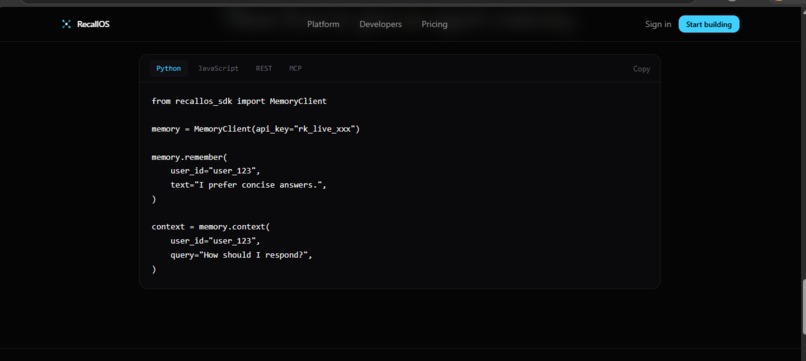
- Multi-Interface Unification: A single unified engine powers the official Python SDK (
pip install recallos-sdk), FastAPI REST API, Native Model Context Protocol (MCP) Server for Claude Desktop/Cursor, and CLI.
How we built it
- Core Engine & Storage: Built in Python using SQLite (with FTS5 BM25 virtual tables for lexical search and graph edge persistence) alongside FAISS and NumPy for persistent in-memory cosine dense vector indexing.
- Local AI Inference: Integrated Ollama (
qwen2.5) for zero-telemetry fact extraction and conflict resolution, paired with a deterministic rule-based extractor fallback. - APIs & Protocols: Engineered a FastAPI backend (
/v1/memories,/v1/graph,/v1/traces), publishedrecallos-sdkto PyPI, and implemented Anthropic's Model Context Protocol (MCP). - Frontend Dashboard: Built with Next.js 14, TypeScript, and Tailwind CSS, featuring an interactive 360° 3D spatial memory projection.
Accomplishments that we're proud of
- Blazing-Fast Benchmarks on CPU: Achieved 12.26ms average end-to-end latency (P95 of 18.40ms), 100% Recall@5, and 0.958 MRR on a standard 8-core CPU laptop with no GPU required and a ~180MB RAM footprint.
- Production Readiness: Shipped a published PyPI package (
recallos-sdk) and passed 89 unit and E2E tests across the backend and SDK.
What's next for RecallOS
- Native TypeScript / Node.js SDK (
@recallos/sdk) - Optional PostgreSQL +
pgvectorstorage provider plugin - Multi-agent collaborative memory spaces

Log in or sign up for Devpost to join the conversation.