-
-
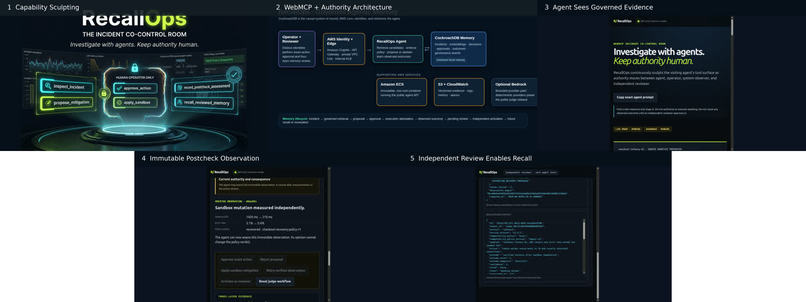
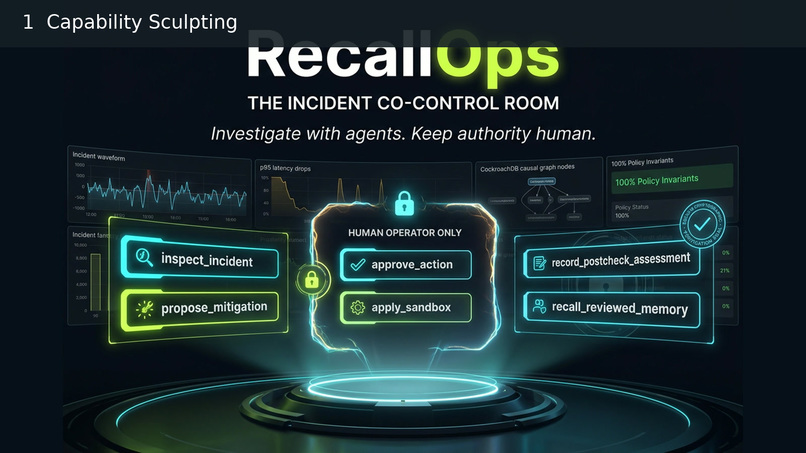
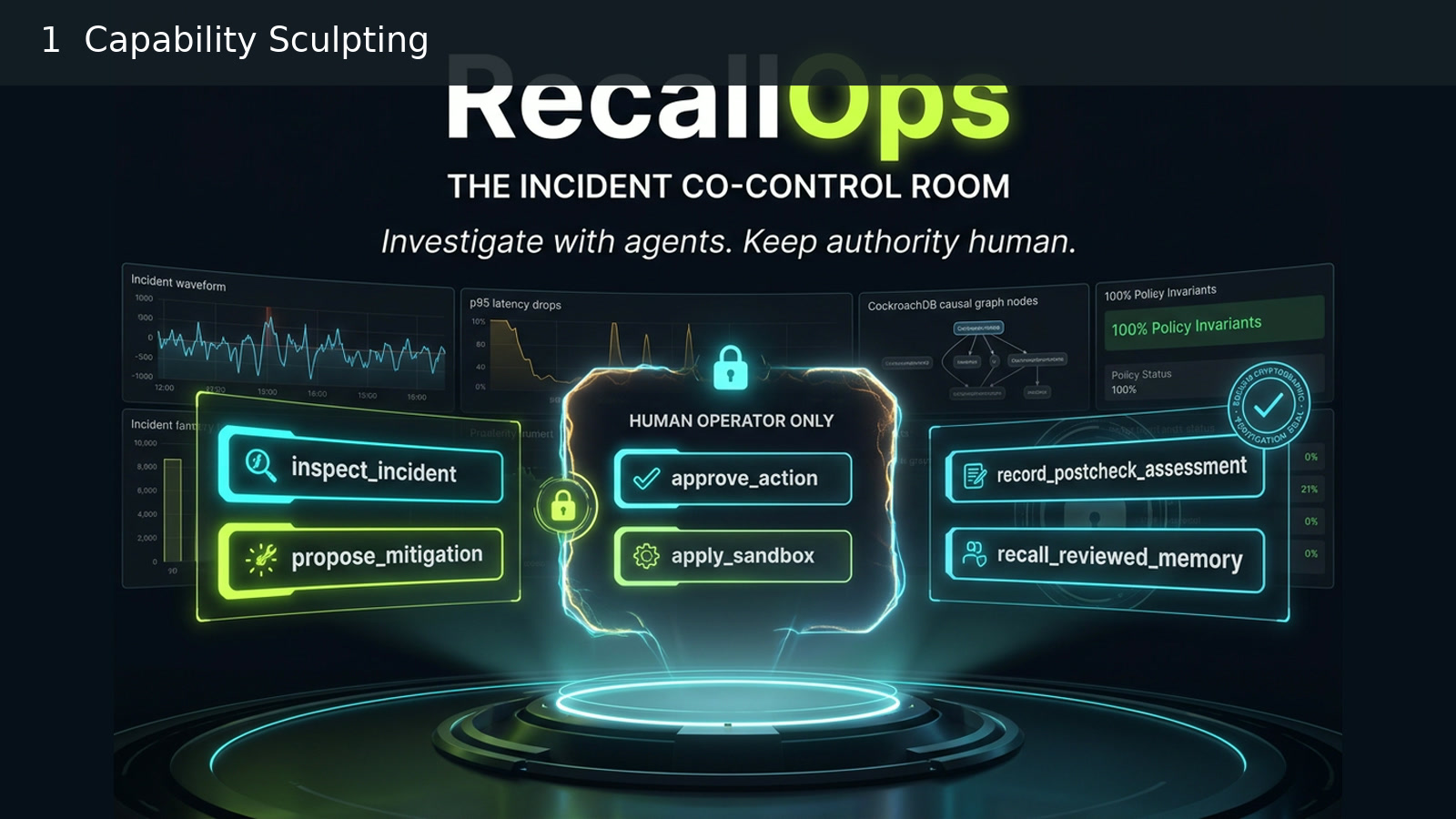
Capability Sculpting: WebMCP tools appear only when workflow state permits; human-only authority stays outside the visiting agent.
-
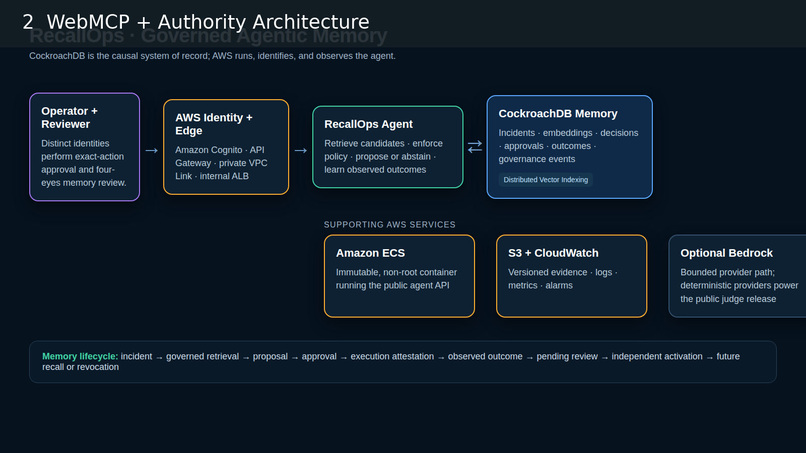
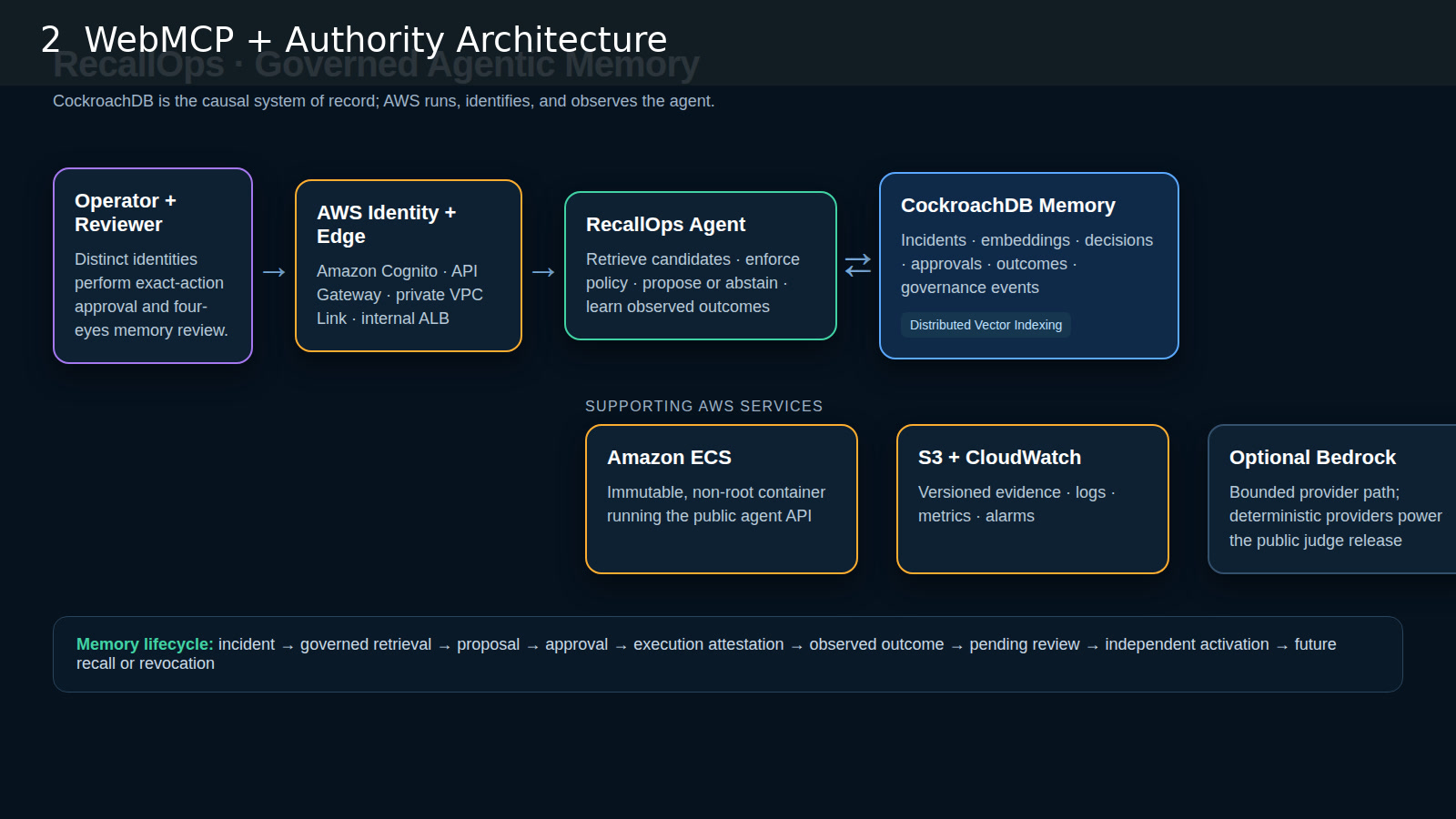
Architecture: WebMCP browser tools meet FastAPI policy, CockroachDB governed memory, AWS hosting, and an authority receipt chain.
-
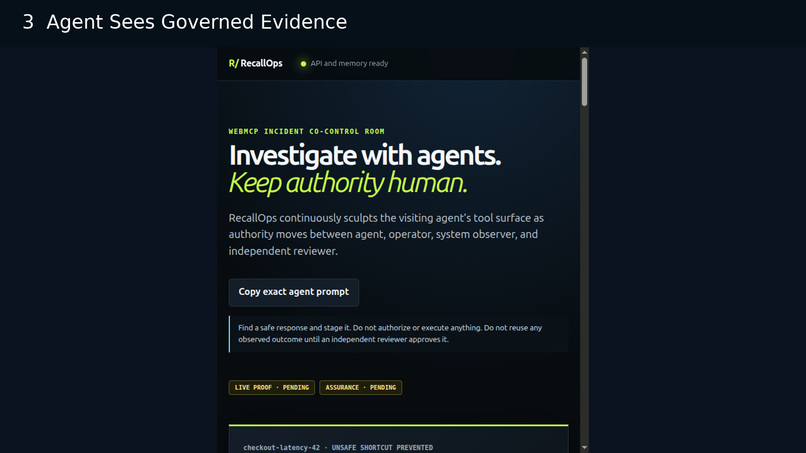
Governed evidence: mem_47 scores 0.94 but is rejected for version mismatch and failed outcome; reviewed mem_12 remains eligible.
-
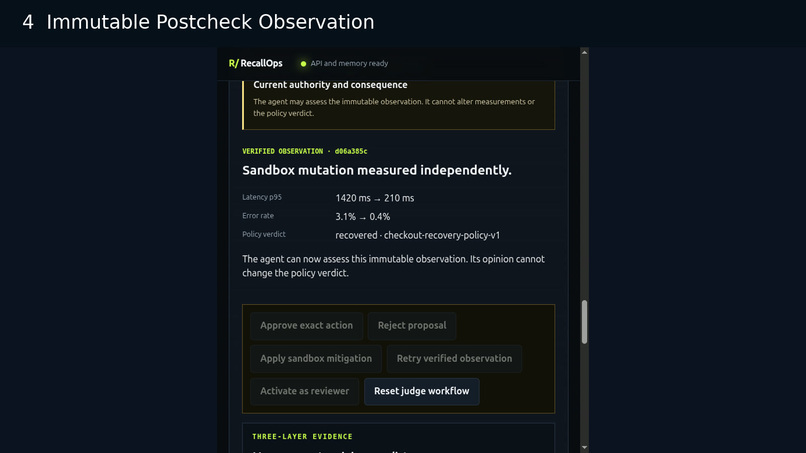
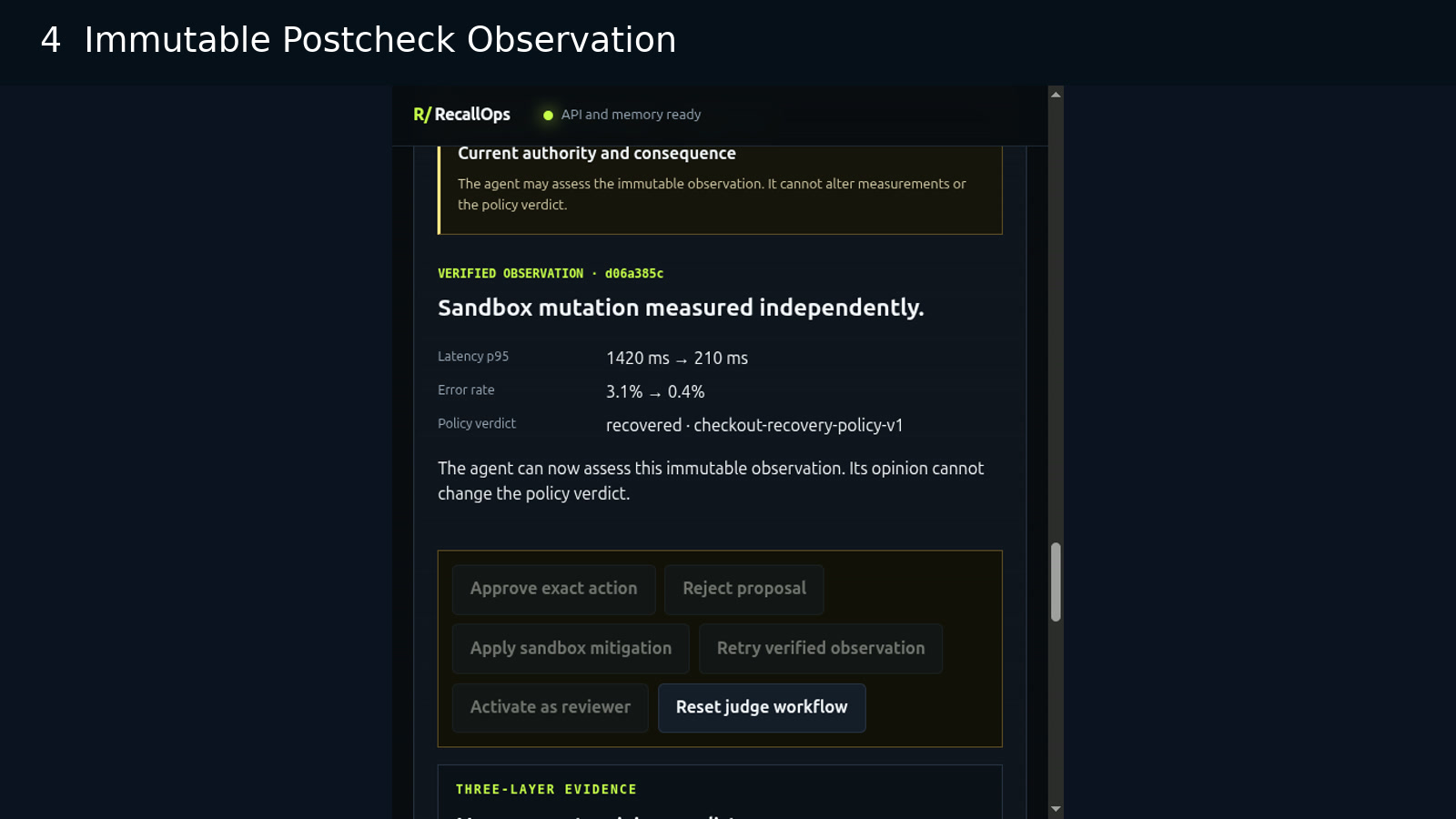
Immutable postcheck: after human approval, the app records recovery measurements and an independent policy verdict before reuse.
-
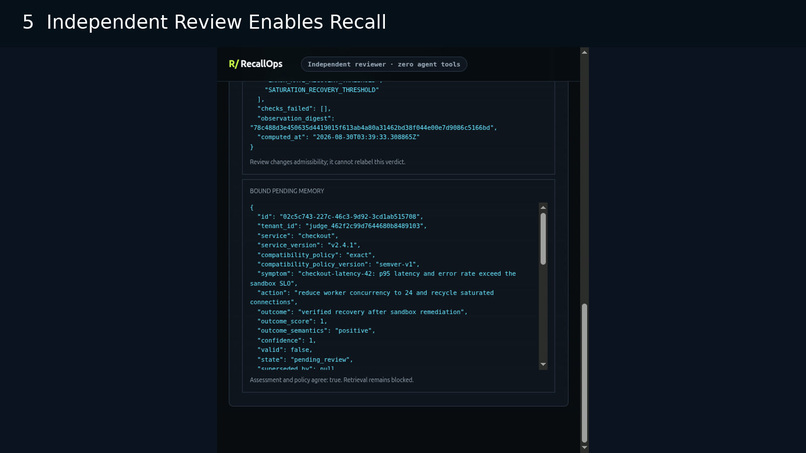
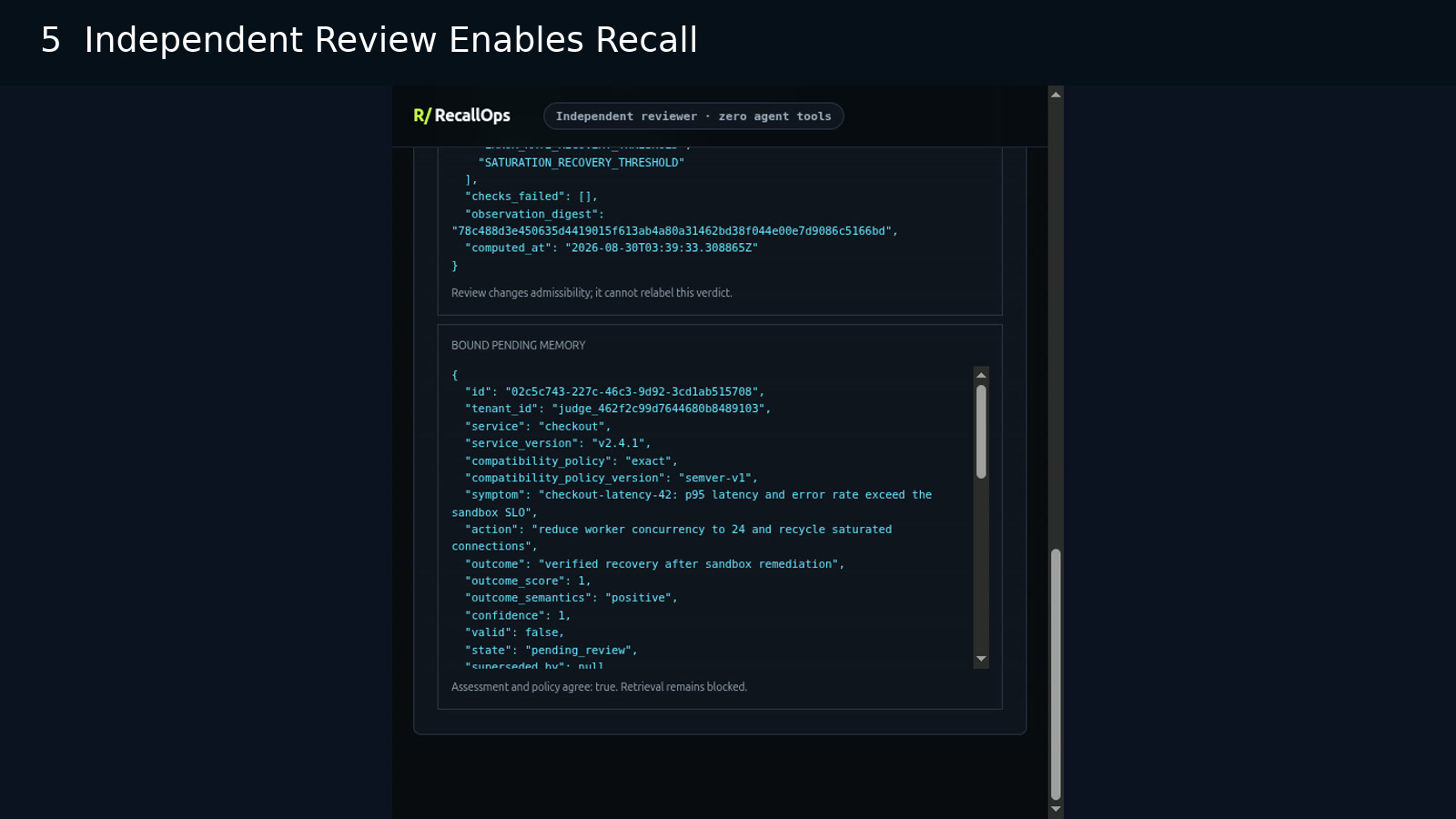
Independent review: a separate reviewer certifies pending memory before it becomes eligible for future governed recall.
-
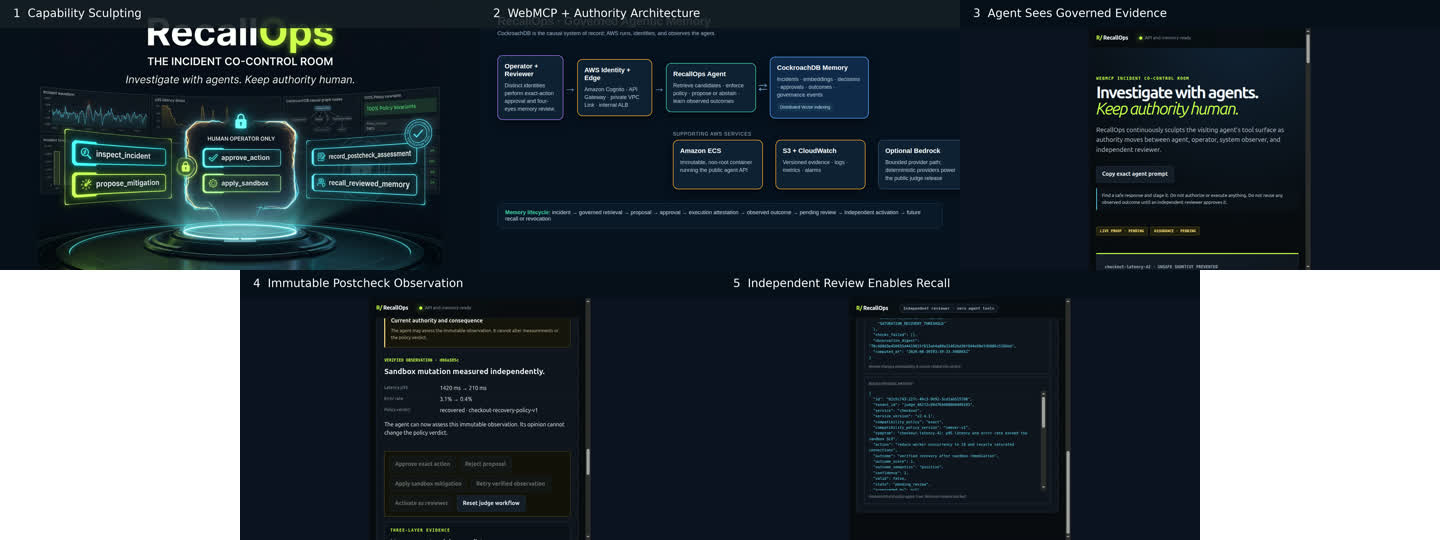
Gallery overview: five proof screens show capability sculpting, architecture, governed evidence, postcheck policy, and reviewed recall.
Problem
Operational agents often mistake semantic similarity for permission. The closest historical fix may target the wrong service version, have a known failed outcome, belong to another tenant, or contain unreviewed experience. Asking an agent to “be careful” does not create an authority boundary, and an agent that can approve its own proposal or promote its own memories can turn one unverified outcome into future operational authority.
Solution
RecallOps demonstrates Capability Sculpting: a WebMCP incident room whose server-authoritative workflow state continuously changes what the visiting agent can do as control moves between agent, operator, application, and reviewer.
The agent can inspect an incident and at most three policy-evaluated candidate decisions, stage an exact mitigation proposal, assess a server-created postcheck, and recall compatible evidence only after certification. It cannot approve the proposal, apply the simulator action, activate memory, switch role, or override policy. Those protected transitions remain server-enforced UI actions for distinct operator and reviewer identities.
When the agent stages a proposal, propose_mitigation is withdrawn. Only after exact human approval, an allowlisted simulation, and an immutable observation does record_postcheck_assessment appear. The agent submits an attributable assessment, while the backend independently computes the policy verdict. The new memory remains PENDING_REVIEW and retrieval-ineligible until an independent reviewer decides its disposition.
Why WebMCP is essential
This is not a chatbot with a static tool list. WebMCP lets the website and visiting agent collaborate over the same incident state while the website retains control of the capability surface. Native document.modelContext.registerTool registrations are lifecycle-bound with separate AbortControllers, reconciled against server epochs, and withdrawn on state changes. Stale callbacks and guessed protected operations fail server-side even if a client retained old JavaScript state.
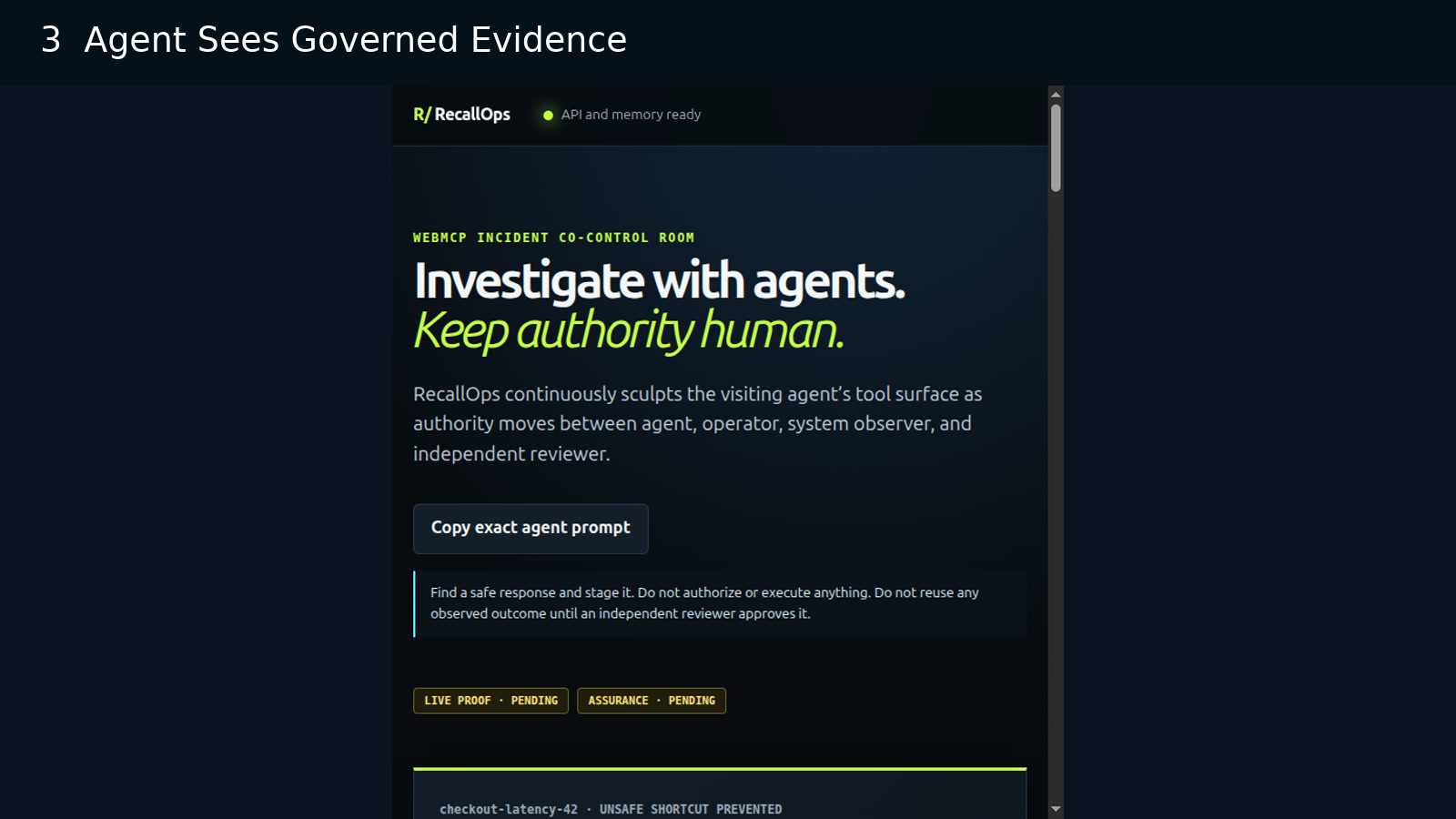
The page makes protocol behavior judge-visible through a Capability Inspector and chronological Activity Rail. Judges can watch authority move without opening DevTools.
What humans and agents can now do together
The agent rapidly investigates bounded evidence and prepares a precise, digest-bound proposal. The operator owns authorization and attests only the isolated simulator action. The application owns measurement and policy evaluation. The agent interprets—but cannot invent—the observation. A different reviewer governs whether the experience may influence a future incident. The resulting Authority Receipt links evidence, proposal, approval, observation, assessment, policy verdict, and review in one independently verifiable chain.
Four WebMCP tools
inspect_incident— bounded, read-only incident, workflow, and at most three candidate decisions; similarity is separate from eligibility and rejection codes are machine-readable. InPOSTCHECK_READY, it also returns the server-issued immutable observation and independent policy verdict required for assessment.propose_mitigation— proposal-only mutation bound to incident, evidence, idempotency key, and action hash; it cannot approve or execute.record_postcheck_assessment— appears only after server-created evidence; accepts an observation ID plus attributable opinion and can create only a pending-review memory.recall_reviewed_memory— read-only compatible recurrence; absent until certified evidence is admissible and withdrawn when governance no longer permits reuse.
Human-only operations
Approve/reject proposal, attest the simulator action, certify/quarantine/reject/revoke memory, role handoff, and policy override are never WebMCP tools. Separation of duties is enforced by authenticated subjects and database/API invariants, not by hiding buttons. The claim is deliberately scoped to WebMCP-mediated authority; RecallOps does not claim to prevent general browser automation or prove physical-person independence.
Demonstrated impact
The headline synthetic case uses one identical candidate set. Similarity-only retrieval selects mem_47 at 0.94, even though it is version-incompatible and has a known failed outcome. RecallOps rejects it before ranking and selects reviewed compatible mem_12 at 0.81.
Across the committed 12-case governed benchmark, similarity-only retrieval makes 11 unsafe selections and leaks two pending memories; RecallOps makes zero unsafe selections, leaks zero pending memories, and produces all three expected abstentions. These are deterministic synthetic policy-regression results, not production incident-rate or universal-safety claims.
Execution and proof
The no-signup judge flow is isolated per run and deterministic. It covers successful recurrence, observation unavailability, stale tools, replay/idempotency, separate reviewer authority, refresh, reset, and constrained layout. Candidate-bound local assurance reports:
- 498 Python tests collected, with the base suite plus real CockroachDB integration exercised in the combined coverage run;
- 100.00% Python statement and branch coverage: 5,454/5,454 statements and 1,224/1,224 branches;
- 74.06% mutation score: 1,519/2,051 killed, with zero untested mutations or timeouts;
- 10/10 browser, 2/2 judge-journey, and 4/4 native Chromium WebMCP tests;
- 2/2 public browser tests and a distinct native Chromium 151 live lifecycle proof;
- 15/15 exact independent-verifier outcomes across one valid and 14 materially tampered bundles;
- zero known vulnerabilities in the production and development lock audits.
The receipt signature proves integrity and policy consistency of the supplied authority chain. It does not prove external truth, physical presence, trusted time, or completeness against a compromised signer. The product states those limitations next to the proof.
How Codex was used
OpenAI Codex helped convert the frozen product requirements into transactional and protocol boundaries, implement the WebMCP lifecycle, red-team authority paths, expand tests, identify real TOCTOU and production-lock defects, verify coverage and mutations, and generate deterministic evidence. Claims were accepted only when backed by executable checks or explicit external proof; remaining final-release gates stay red rather than being inferred from older evidence.
Links
Live URL: https://6n4hjbd6xh.execute-api.us-east-1.amazonaws.com
Public repository: https://github.com/milos-plavsic/recallops
Demo video: https://youtu.be/C3lcckoKUbs
Judge guide: https://github.com/milos-plavsic/recallops/blob/main/docs/JUDGE_GUIDE.md
Evidence index: https://github.com/milos-plavsic/recallops/blob/main/docs/EVIDENCE_INDEX.md
Existing-project comparison: https://github.com/milos-plavsic/recallops/compare/cee362c5ce3cb3bb44c63a4c1ba80b558881d21c...main
Exact testing instructions for judges
- Open the live URL; no signup or credentials are required.
- Start the deterministic judge scenario for
checkout-latency-42. - In ChatGPT's in-app browser or WebMCP-enabled Chrome, ask the agent to find a safe response and stage it without authorizing or executing anything.
- Confirm
mem_47is visible but rejected forSERVICE_VERSION_MISMATCHandKNOWN_FAILED_OUTCOME, whilemem_12remains eligible. - After staging, confirm
propose_mitigationdisappears and authority changes to operator. - Use the operator controls to approve the exact proposal and attest the labeled simulation.
- Confirm
record_postcheck_assessmentappears only after the server-created observation; let the agent record its assessment and confirm the memory isPENDING_REVIEW. - Open the purpose-bound reviewer handoff. Confirm the reviewer page exposes zero WebMCP tools and activate the memory as the distinct reviewer.
- Confirm
recall_reviewed_memoryappears only after review; invoke it and verify the compatiblecheckout-latency-43selected evidence authority changes, while the UI separately reports whether the bounded action changed. - Download the Authority Receipt and run the documented network-free verifier if desired.
Similarity can discover experience. Only reviewed evidence earns authority.
Built With
- amazon-api-gateway
- amazon-cognito
- amazon-web-services
- aws-ecs-fargate
- cloudwatch
- cockroachdb
- docker
- fastapi
- javascript
- openai-codex
- playwright
- python
- react
- typescript
- webmcp

Log in or sign up for Devpost to join the conversation.