Inspiration
An agent that remembers across sessions has to put what it learned somewhere,
and in a multi-tenant product that store is one forgotten WHERE clause away
from serving one customer's memory to another.
The usual answer is to be careful in application code. I don't think careful is a security control. Every retrieval path, every background job, every debugging script someone writes at 2am has to remember the filter, forever, and the one that forgets is the one that ships.
So I wanted to move the boundary somewhere that cannot be forgotten, and then, more importantly, prove it held. Not assert it. Prove it, in a way that survives someone else checking the work after the cluster is gone.
What it does
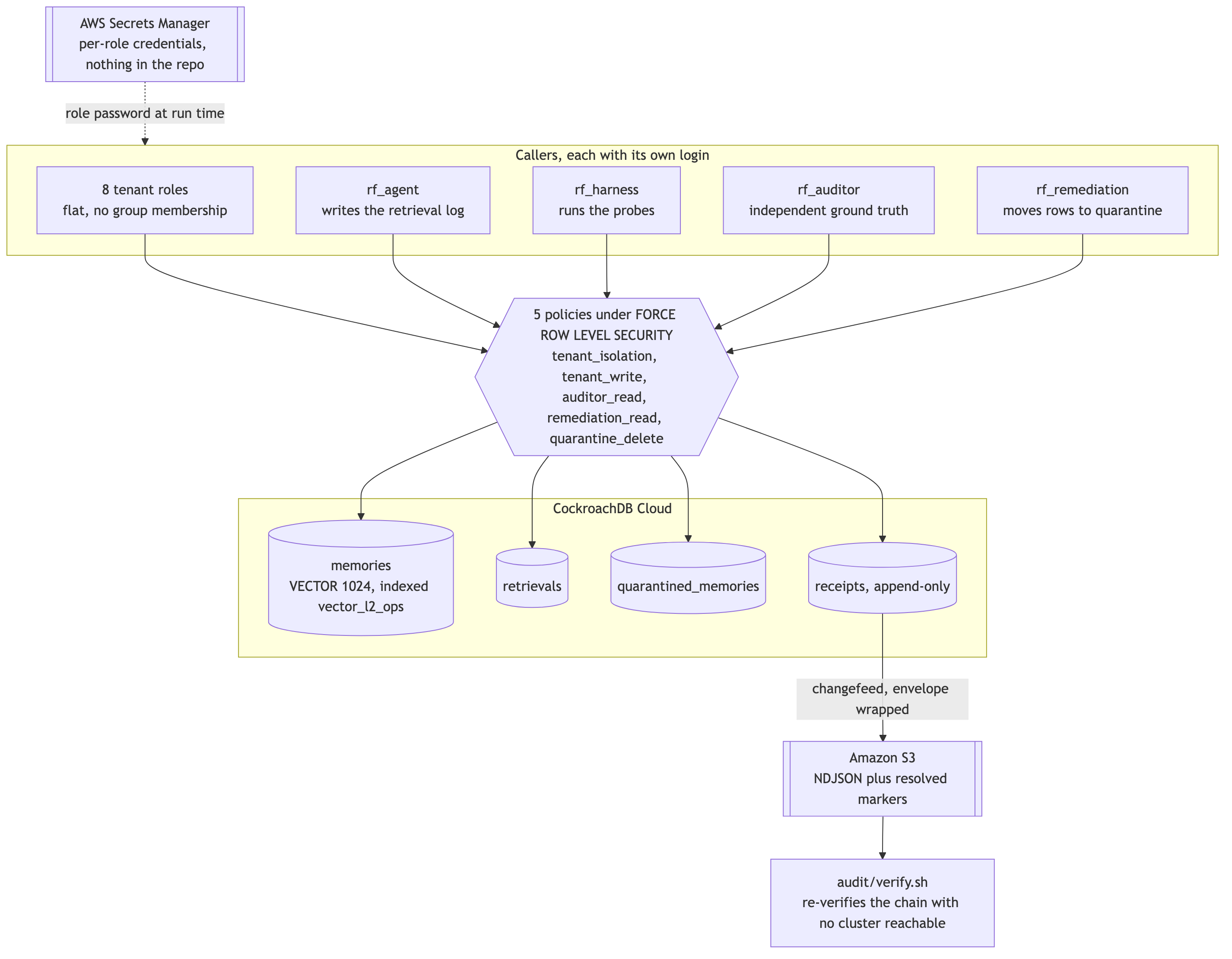
RecallFence stores agent memory in CockroachDB with row-level security doing the tenant isolation, then attacks itself and publishes the results.
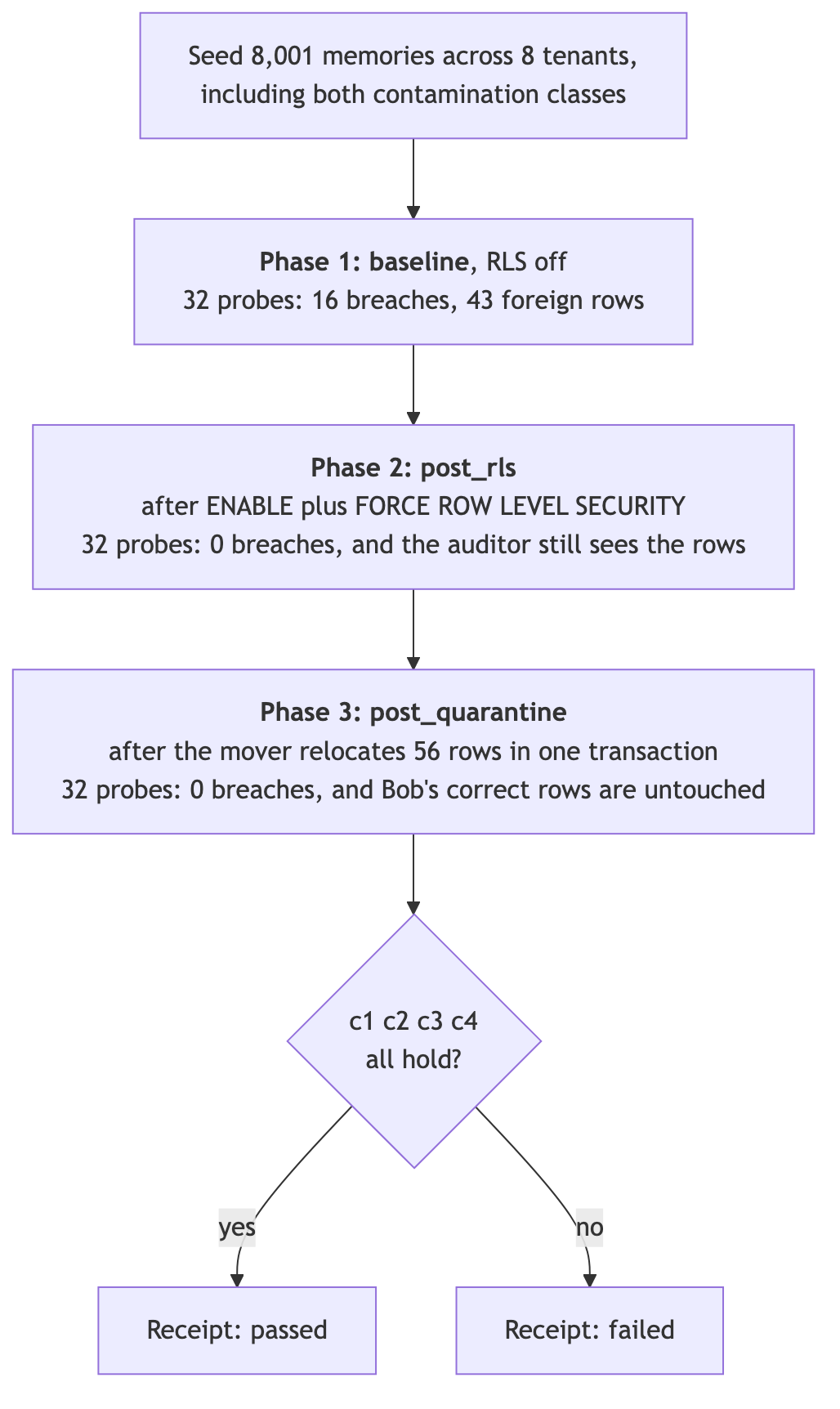
A deterministic harness runs four probe types under each of eight tenants' own logins: a direct lookup by ID, a semantic search with the tenant filter, the same search with the filter missing, and a side-channel read against the evidence tables. It runs all of it three times: once with the fence down, once with it up, and once after contaminated rows have been quarantined. That is 96 recorded results.
The measured outcome from the committed snapshot: 16 breaches and 43 foreign rows at baseline, zero after RLS, zero after quarantine.
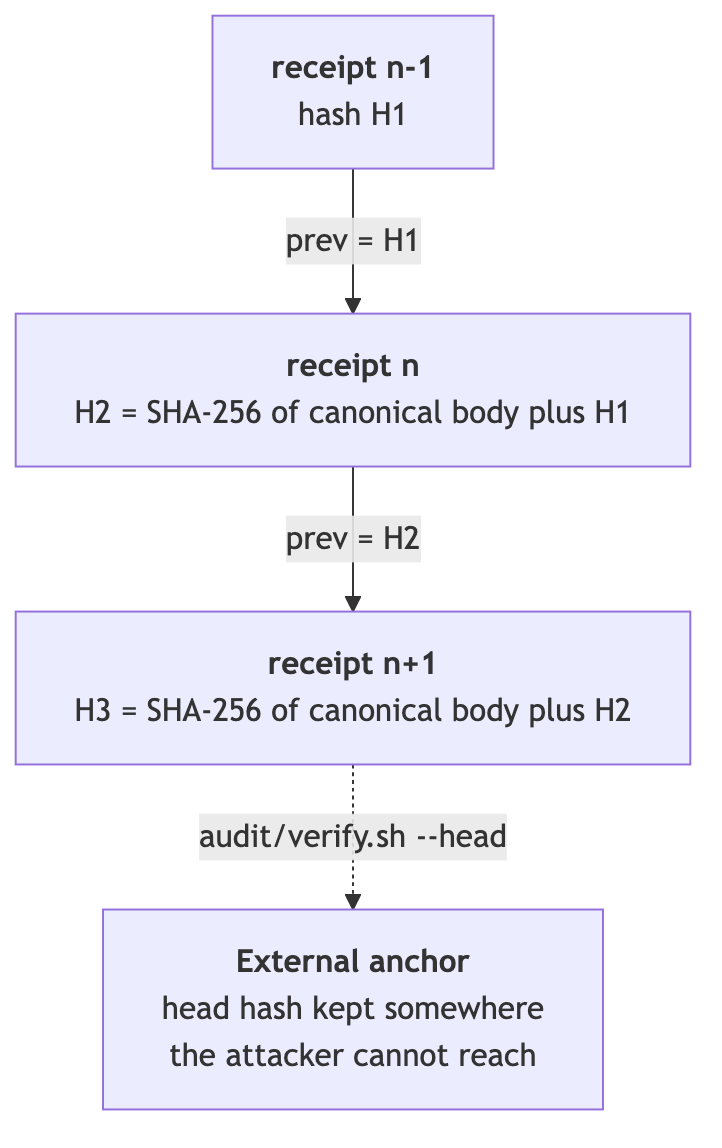
Then it writes a receipt. The receipt carries the full 96-row matrix, the exact
policy SQL that repaired the leak, the quarantined row IDs with reason codes, and
a SHA-256 chaining it to the receipt before it. A changefeed streams receipts to
S3, and audit/verify.sh re-verifies the whole chain straight from the bucket
with no cluster reachable at all.
The point of that last part: the artifact outlives the infrastructure. You can check my work after I have deleted the cluster.
What a pass actually requires
"No leaks after the fix" is a rubber stamp: a harness that errored silently and recorded nothing also produces no leaks.
A receipt passes only when four clauses hold:
- At least one breach at baseline. The failure has to be demonstrated before its absence means anything.
- Zero breaches after RLS and after quarantine, every principal, every probe.
- The auditor still saw the foreign rows at
post_rls. RLS hiding a row and something having deleted the row both return zero rows. Without independent ground truth, a receipt cannot tell a working boundary from an emptied table. - Every probe in every counted phase has
status = ok. An unexecuted probe is not a passed probe.
Clause 1 is the one people forget. Clause 3 is the one that makes the number mean anything.
How I built it
The schema order is load-bearing. Tables, then roles, then the fixture loader,
then policies. Under FORCE ROW LEVEL SECURITY
an operation with no applicable policy is denied for every role including the
table owner, so seeding after the fence goes up would need a policy that exists
only to let the seeder cheat. The apply script deliberately has no "do
everything" subcommand for that reason.
Tenant roles are flat, with no group memberships. That is what makes SET ROLE
fail and RESET ROLE leave the connection fenced. Tests connect over each role's
own credentials from Secrets Manager rather than switching roles inside a shared
admin session, because a session that can switch can also switch back.
Exposure and contamination are repaired separately. RLS fixes exposure, meaning rows that were readable and should not have been. Quarantine fixes contamination, meaning rows that are wrong: written under the wrong tenant, or derived by an agent that had just read a foreign row. Those are different defects and I kept them apart deliberately, which is why there are two reruns instead of one.
It also decides what quarantine refuses to touch. Bob's refund ceiling leaked at
baseline, but it is correct data correctly attributed to Bob. The defect was in
Alice's query path. Deleting Bob's memory to fix Alice's bug would be a worse bug
than the one being fixed, so exposure alone never triggers quarantine. The
committed bundle shows it: the two rows exposed at baseline stayed in memories,
while ten other rows attributed to Bob moved for provenance defects.
Challenges I ran into
The one that shaped every test in the repo: privileges and policies are separate
enforcement layers, and they answer in opposite ways. Missing a table privilege is
a hard error, SQLSTATE 42501. Holding the privilege but matching no policy affects
zero rows and raises nothing at all. So "I caught an exception" is not evidence of
being blocked, and a stray GRANT quietly converts a loud failure into a silent
one without touching a single policy. Every test here compares affected-row counts
against expectation instead of catching errors.
Then there was the detector that was lying to me. I first scored a breach on
canary phrases turning up in results, and it looked fine. It kept looking fine
right until I read the raw rows and found semantic_unfiltered returning 35 rows
belonging to other tenants at baseline, scored clean, because the fallback
embeddings produce arbitrary nearest neighbours that carry no marked phrase. The
definition is now "returned a row belonging to another tenant", with the canary
kept as corroboration. Nothing in the output had looked wrong, which is exactly
why a detector that scores itself clean is the dangerous kind.
A smaller version of the same disease: jsonb_array_elements(NULL) yields zero
rows, so a probe with null evidence scored as having no foreign rows. Fail-open,
in the one place you least want it. Null evidence counts as a breach now, and a
preflight check refuses to score a run whose probes did not all record evidence.
I also poisoned my own audit sink. A test for append-only behaviour inserted sentinel receipts, the changefeed dutifully shipped them to S3, and deleting the database row un-published exactly nothing. Chain verification started failing on junk my own test suite had written. The sink is append-only by design and its IAM principal is explicitly denied deletes, so there was no quiet cleanup available. The test now wraps its inserts in a transaction it rolls back, and the changefeed writes to a fresh prefix. The old objects are still there, permanently: an append-only sink does not make an exception for the person who wrote the junk.
The last one is a cost, not a bug. With a policy active, CockroachDB will not
filter an approximate vector result through RLS, because a row the policy rejects
would silently shorten the result set, so retrieval falls back to an exact full
scan. EXPLAIN at 8k rows shows the whole table scanned. It is the price of
putting the boundary in the database, it is measured rather than estimated, and
the next thing I want to know is how much of it a partial index buys back without
weakening the fence.
Accomplishments I'm proud of
The receipt verifies offline. Hand someone the S3 prefix and a head hash and they can confirm the entire history without my cluster, my credentials, or any trust in this repo. That was the whole point of building it.
The most important row in the results table is the one where nothing happens.
semantic_filtered reads clean even at baseline. The correctly scoped query was
never the problem, and this project exists because the filter on the line above it
gets forgotten. A matrix where every row failed would only prove the fixture was
broken, so the quiet row carries more weight than the dramatic ones.
Last, the tamper suite asserts something the design cannot do: a fully rewritten
chain is internally consistent and verifies clean. The chain catches an edited
body and a deleted receipt on its own; a wholesale rewrite is caught only by a
head hash pinned outside the system, which is what audit/verify.sh --head
checks. The test states that boundary rather than leaving a reader to assume the
chain does more than it does.
What I learned
Test the test. Nearly every real bug I found this build was in the thing doing the checking, not the thing being checked: a detector scoring a leak as clean, a verifier that sorted receipts by timestamp instead of following hash links, an assertion that only checked "it errored" and would have passed just as happily on a misspelled table name.
Also: two principals failing the same way is not an eliminated variable. I spent real time convinced a Bedrock problem was not permissions-related because a scoped IAM user failed exactly like the root account did. They were both blocked by the same missing thing. Identical failures are evidence of a shared cause.
What's next
The interesting direction is the cost side. With a policy active the vector index stops being usable and retrieval degrades to an exact full scan, which I measured rather than discovered in production. I want to know how much of that a partial index or a different policy shape buys back without weakening the boundary. That is a benchmark, not a guess, and this harness is already built to answer it.
Corpus embeddings currently use a deterministic local fallback rather than Titan. Reseeding with real embeddings is a rerun of the seed and harness pipeline, not a code change, and the isolation results do not move either way: a breach is scored on row ownership, not on what the vector search ranked.
Built With
- amazon-bedrock
- amazon-web-services
- cockroachdb
- javascript

Log in or sign up for Devpost to join the conversation.