-
-
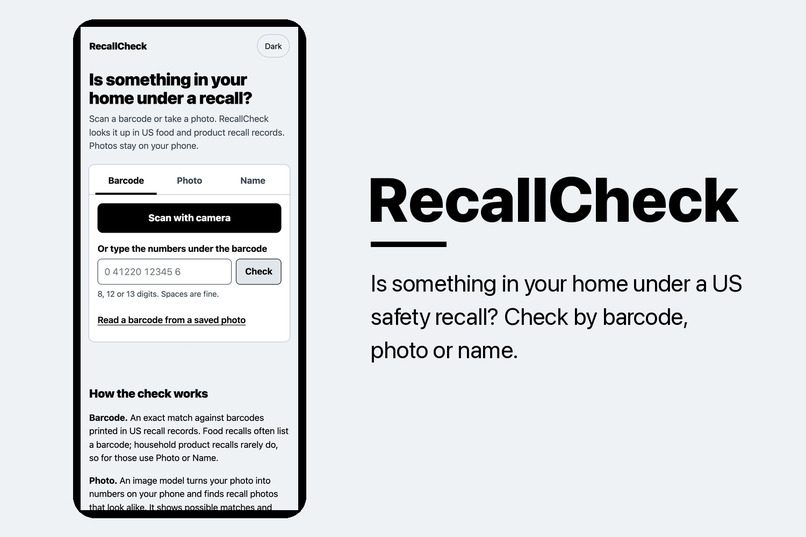
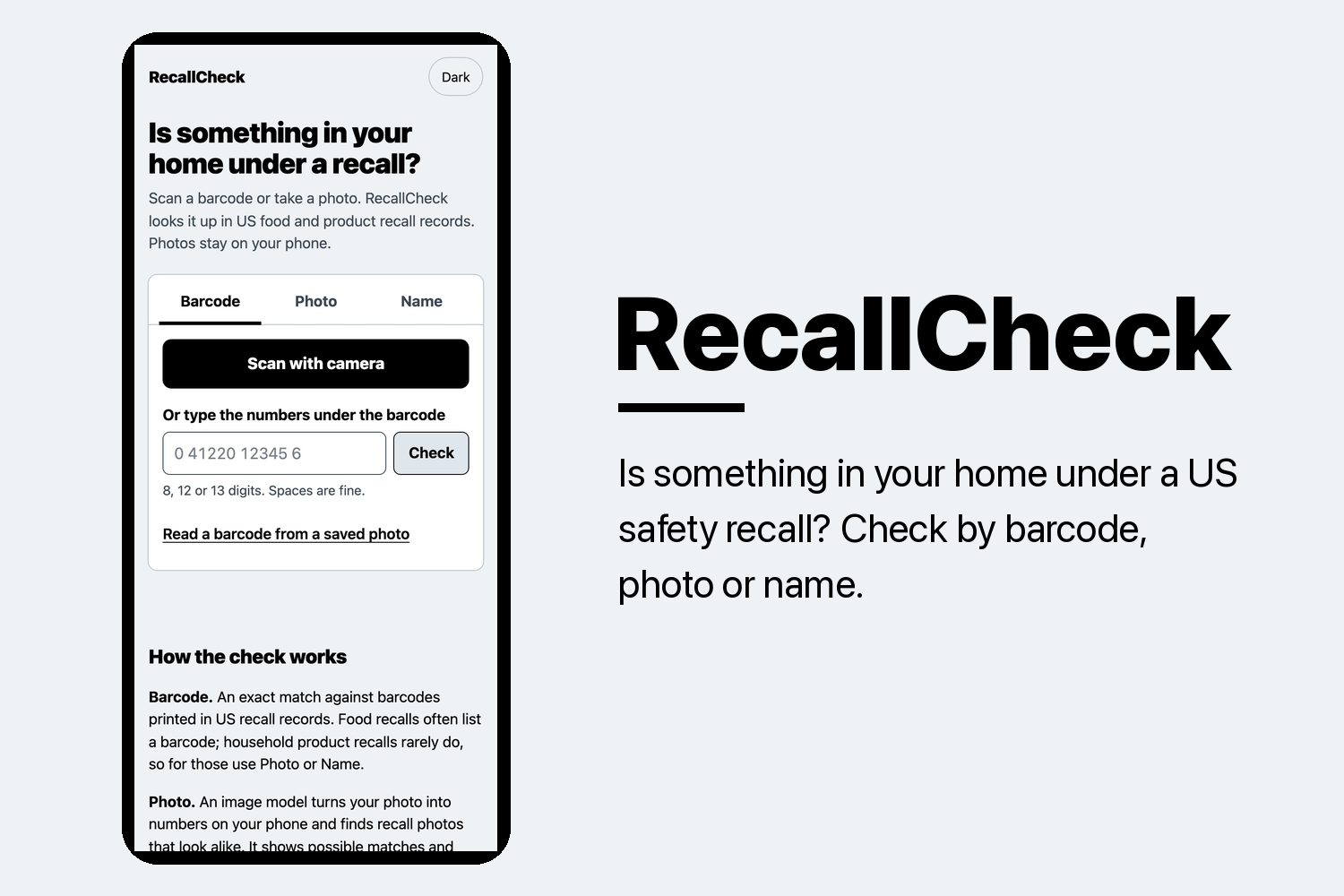
RecallCheck: check a food package or household product against US recall records by barcode, photo or name.
-
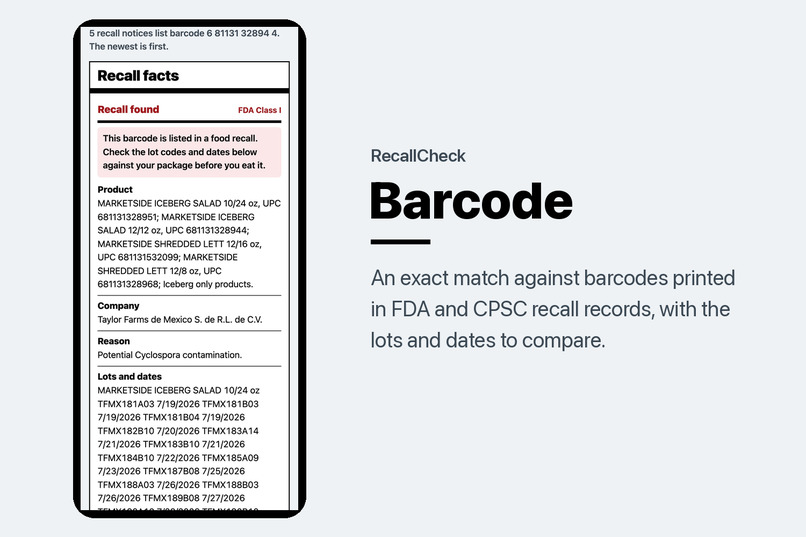
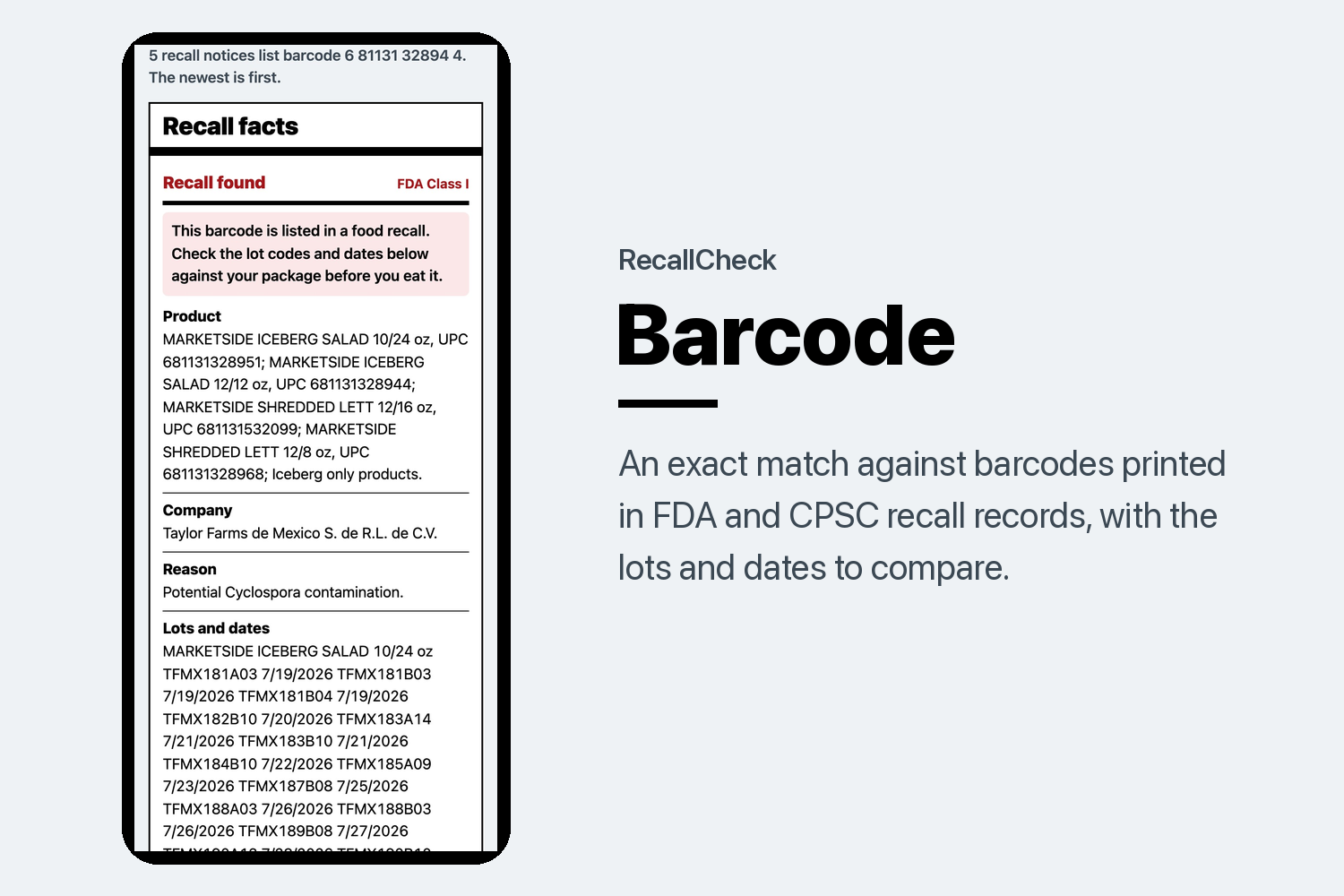
A barcode read from a saved photo matches five FDA recall reports. The newest shows the lots and dates to compare.
-
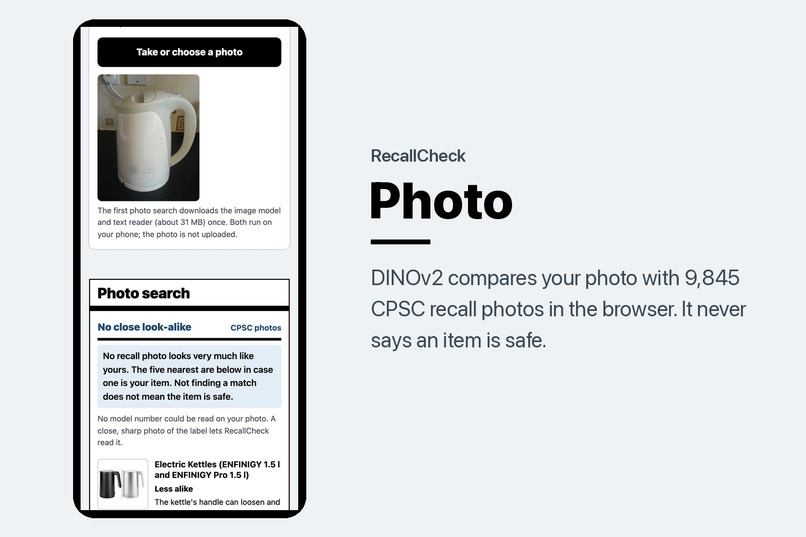
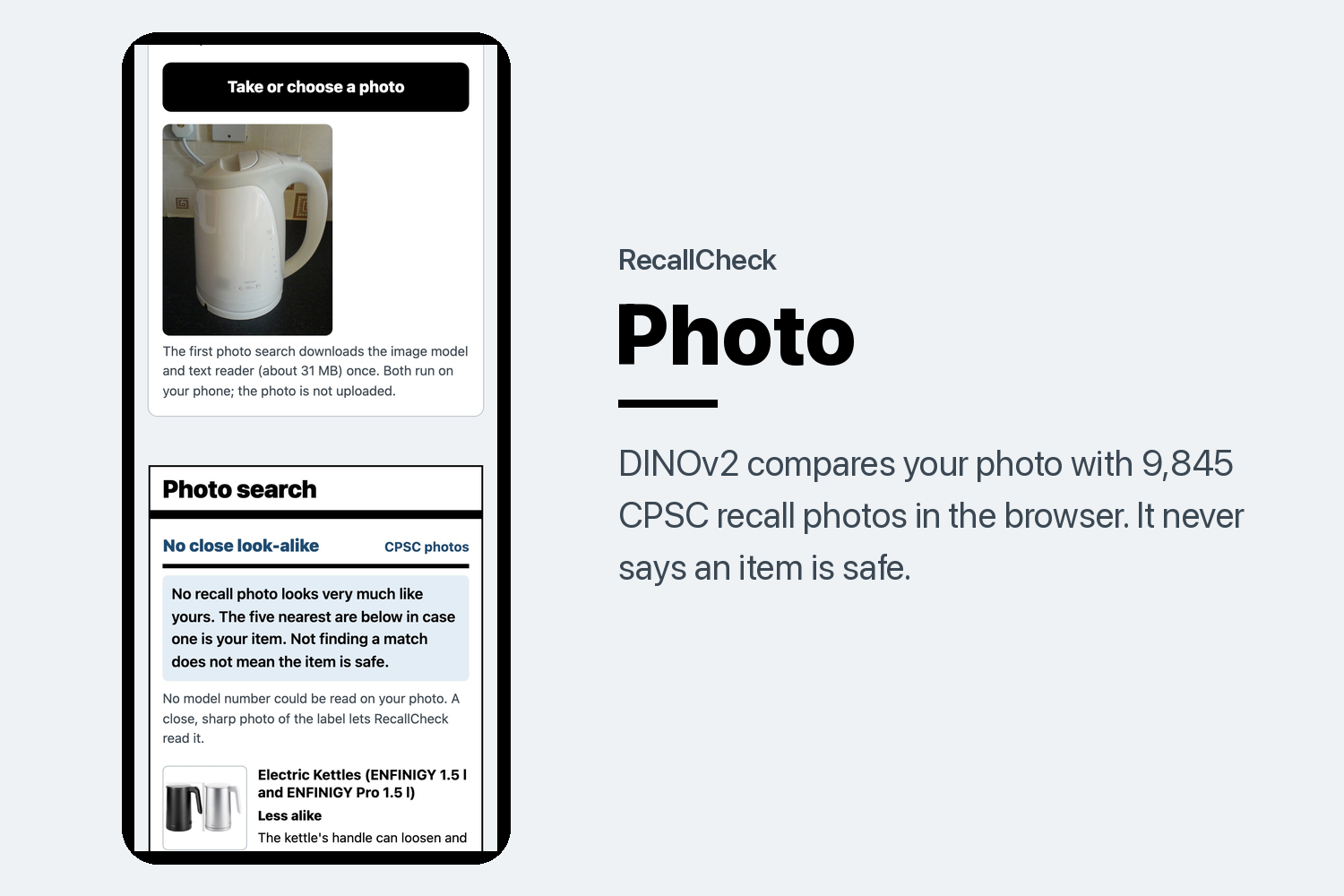
Photo search runs on the phone. This kettle has no close look-alike, so the page lists the five nearest recalls.
-
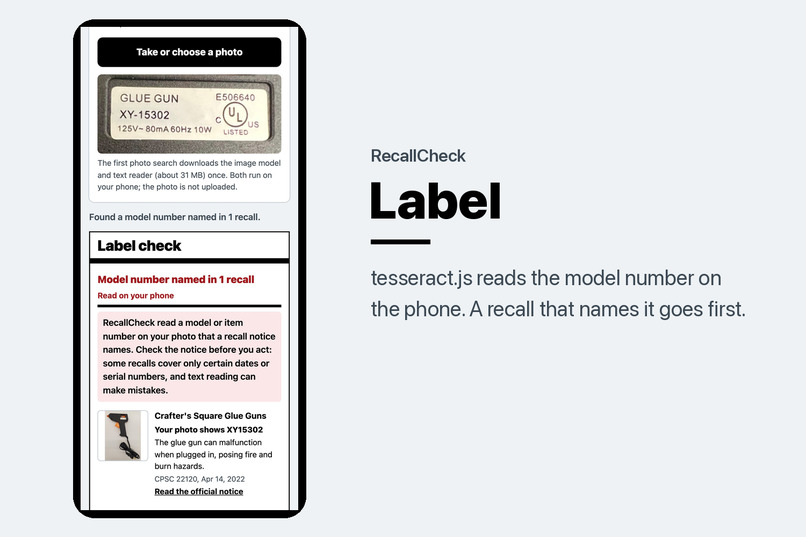
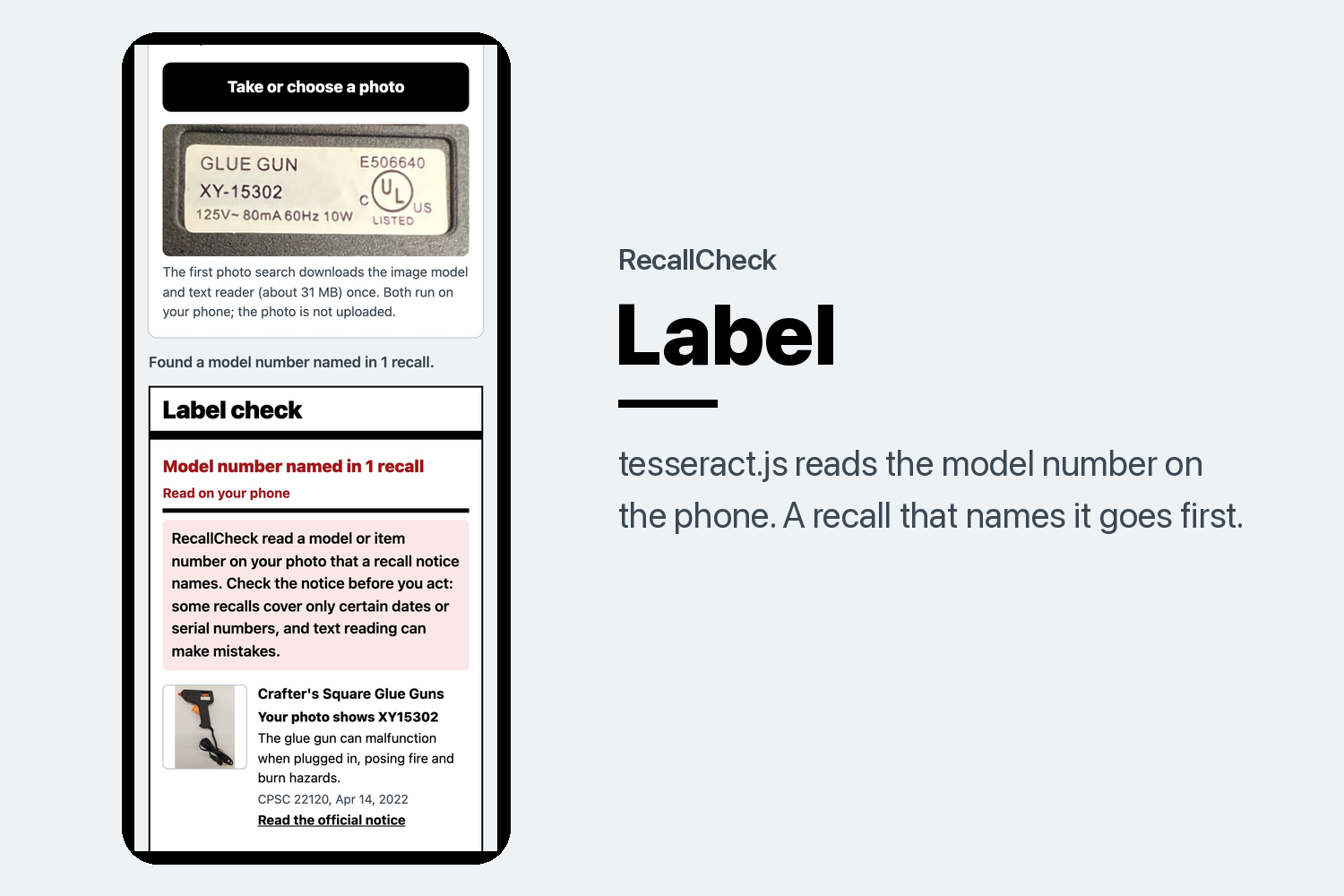
The label reader finds XY-15302, a model number a glue gun recall names, although the image match found nothing close.
-
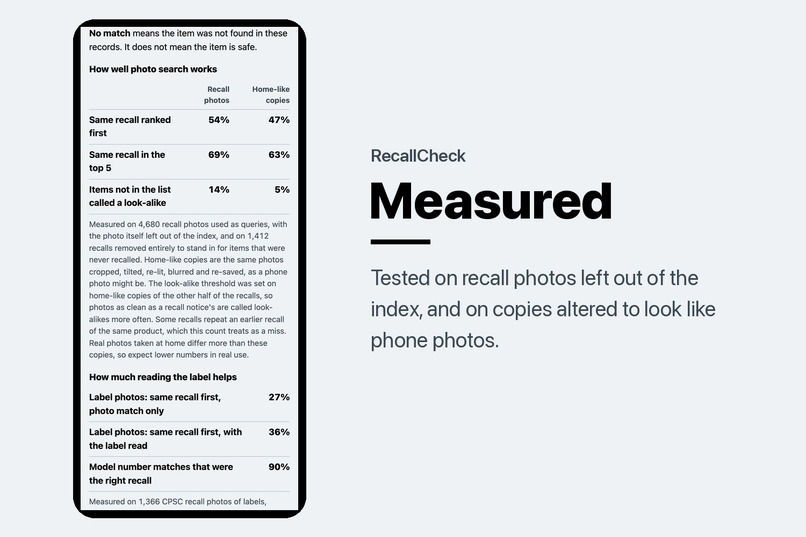
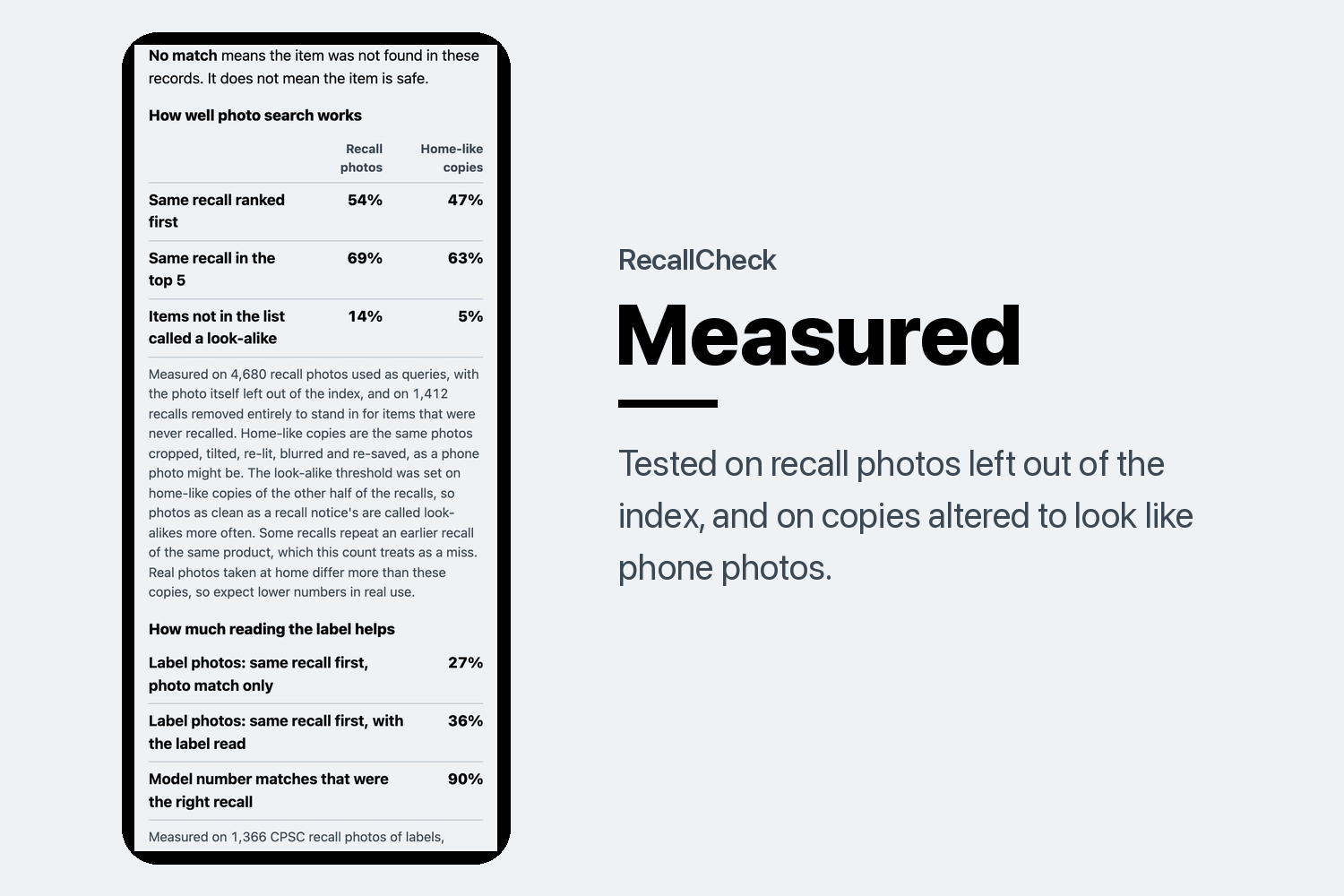
Held-out CPSC photos: right recall first 54% (47% on phone-like copies); reading the label lifts first place from 27% to 36%.
-
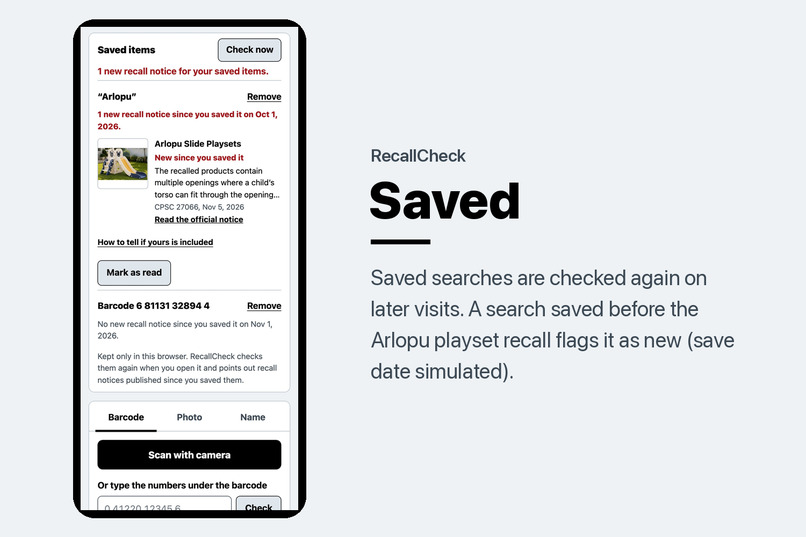
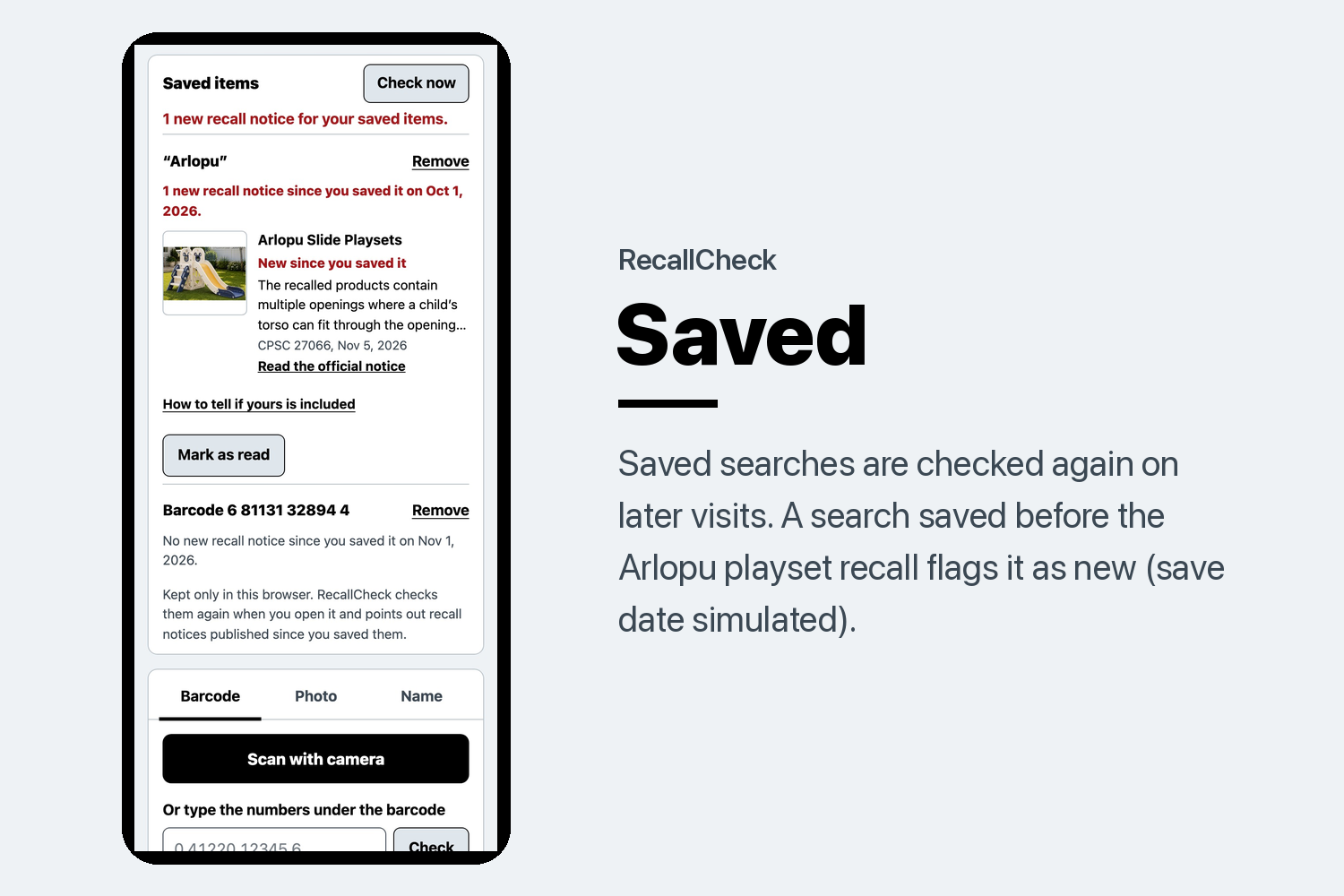
Saved items: a search saved before CPSC's Nov 5 Arlopu recall flags it as new on the next visit (save date simulated).
The problem
Recall notices are published, but they rarely reach the people who own the product. In a CPSC study of 21 recalls, on average 33 percent of the products sold to consumers were returned or repaired (CPSC, Report to Congress on Recall Notification Effectiveness, February 2016). Checking by hand means reading notices one by one and comparing model numbers and lot codes.
What it does
Try it: https://hyunsikparker.github.io/recallcheck/ (works on a phone; no sign-up). Code: https://github.com/HyunsikParker/recallcheck
- Barcode: an exact match against barcodes printed in 4,768 FDA food recall reports (2020 to Oct 28, 2026) and 171 CPSC product recalls that list one. When it matches, it shows the recalled lots and dates to compare with the package, the reason, the FDA classification and the recall status.
- Photo: for things without a barcode. An image model runs on the phone and compares the photo with 9,845 photos from 2,826 CPSC recalls since 2018. It lists the five closest recalls, labels how alike each one looks, and shows the notice's own description of how to identify the recalled product. It then reads any printed text on the photo; if a notice names a model number found there, that recall goes first. It never says an item is safe.
- Name: brand, product or model words across CPSC recalls (model numbers match without their dashes) and every openFDA food enforcement report.
- Saved items: save a barcode or a name search. RecallCheck repeats saved searches when you open it again (at most once every six hours) or when you tap Check now, and lists recall notices published since each one was saved. The list stays in the browser.
- Newer notices are fetched live from openFDA and the CPSC Recalls API on each search.
How the AI is used, and where it is not
- DINOv2-small (8-bit ONNX, 25 MB) runs in the browser with transformers.js. The photo never leaves the phone.
- The same model and precision embedded the recall photos offline. A browser embedding of a recall photo matched its stored index vector at cosine 0.98.
- We tried CLIP ViT-B/32 first. On the 2022-onward photos DINOv2-small ranked the right recall first more often (55% against 49%), and its image model is a 25 MB download against 89 MB for CLIP's, so it shipped.
- tesseract.js (English LSTM, about 7 MB with its data) reads text on the same photo, also on the phone. Only words shaped like model numbers are kept; dates, years and units are skipped.
- The model ranks; it does not decide. The "look-alike" threshold was set on half of the recalls, using copies altered to look like phone photos, and tested on the other half.
- Exact facts (barcodes, lots, dates, remedies) come from the agency records, not from a model.
Measured results
Photo search, tested on CPSC recall photos with the 8-bit index the app ships:
- Same recall ranked first: 53.9%; in the top 5: 68.5% (4,680 photo queries, each with its own photo left out of the index).
- The same photos cropped, tilted, re-lit, blurred and re-saved to look like phone photos: first 47.4%, top 5 63.5%.
- Items not in the index called a look-alike: 5.5% for the altered copies and 14.2% for clean recall photos (1,412 recalls removed from the index entirely).
- Our first threshold was set on clean recall photos. On the altered copies it marked only 0.2% of correct first-place results as look-alikes, so we set it again on altered copies of the other half of the recalls.
- Some recalls repeat an earlier recall of the same product, which this count scores as a miss, so the ranking numbers are lower bounds and the look-alike numbers are upper bounds.
- The altered copies keep the recall photo's background and framing, so real photos taken at home are likely to score lower still.
Label reading, tested on 1,366 CPSC recall photos of labels, model plates and tags:
- Same recall first: 27.4% with the photo match alone, 35.6% with the label read (top 5: 37.3% and 45.6%).
- When a model number on the photo matched a notice, it was the right recall 146 times out of 163 (90%). The rules that skip dates and round numbers were written while looking at these photos, so that figure may be a little high.
How it is built
HTML, CSS, JavaScript; transformers.js + ONNX Runtime Web; DINOv2; tesseract.js; zxing-wasm; openFDA; CPSC Recalls API; Python and Node build scripts. No backend, no paid service.
AI assistance
Claude (Anthropic), working through Claude Code, wrote the code, tests, evaluation scripts, documentation and this description, starting on November 7, 2026. The measured results come from the evaluation scripts in the repository, run on the index the app ships. The demo video's narration is a synthetic voice made with a local Qwen3-TTS model.
What's next
Drug and medical device recalls (openFDA has both); reminders that arrive without opening the page; reading lot codes and dates on food packages to narrow FDA matches.
