
Inspiration
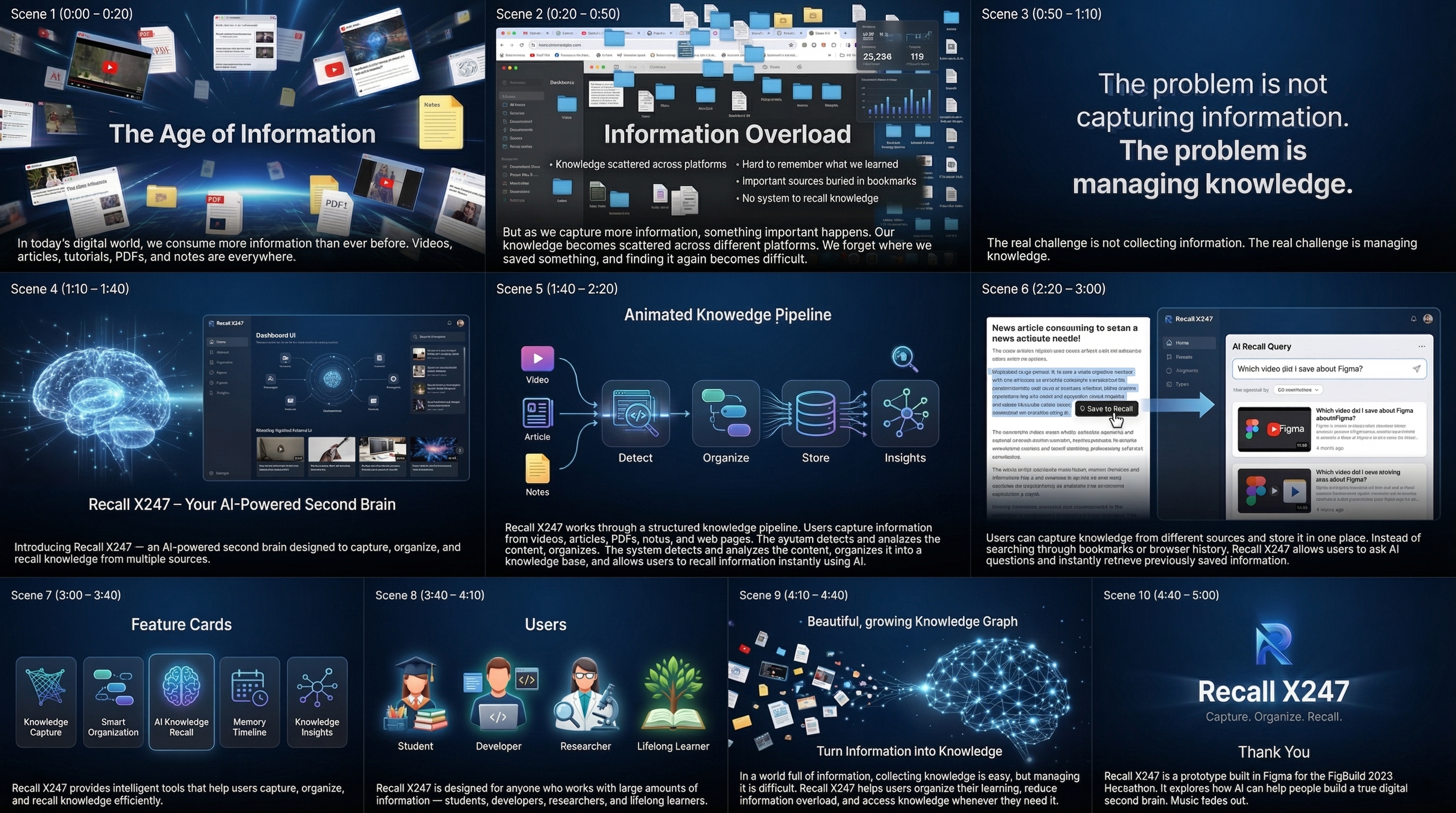
In today’s digital world, we consume a huge amount of information every day from videos, articles, tutorials, PDFs, and notes. However, most of this knowledge becomes scattered across different platforms such as bookmarks, browser tabs, note-taking apps, and document folders.
Over time, it becomes difficult to remember where we saved something or what we learned earlier. We realized that the real problem is not capturing information — it is managing knowledge effectively.
This inspired us to design Recall X247, a system that works like a “second brain” where users can capture, organize, and recall knowledge easily whenever they need it.
What it does
Recall X247 was designed and prototyped entirely using Figma for the FigBuild 2026 hackathon.
We used Figma Make to generate and experiment with interface ideas and quickly design the core user experience. The product interface includes multiple sections such as knowledge capture, AI recall, knowledge insights, and system workflow.
The project focuses on design thinking and product experience rather than full technical implementation. It demonstrates how an AI-powered knowledge system could work in the future.
How we built it
Recall X247 was designed and prototyped entirely using the Figma ecosystem for the FigBuild 2026 hackathon. We used Figma Make to quickly generate interface layouts, experiment with different design ideas, and build the core structure of the application.
The entire user experience was created using Figma’s design tools, including the dashboard, capture interface, knowledge pipeline, insights section, and feature flows. By combining Figma Make with manual design refinements, we were able to rapidly prototype the product concept and visualize how users interact with the system.
Instead of focusing on full backend development, this project emphasizes product design, interaction flow, and user experience. The prototype demonstrates how an AI-powered knowledge system like Recall X247 could function in the future to help users capture, organize, and recall knowledge efficiently.
Challenges we ran into
One of the biggest challenges was simplifying a complex idea into an easy-to-understand user experience. Managing knowledge across different sources can quickly become overwhelming, so we had to design a workflow that felt simple and intuitive.
Another challenge was aligning the concept with the hackathon theme of designing tools that help people perceive something that was previously invisible. We solved this by introducing the concept of Knowledge Awareness, where users can visualize their learning and knowledge patterns.
Designing the system pipeline and organizing the features into a clear flow also required several iterations.
Accomplishments that we're proud of
We are proud of turning a complex problem like information overload into a clear and thoughtful design solution.
Recall X247 demonstrates how scattered information can be transformed into an organized knowledge system. We successfully designed a structured pipeline that allows users to capture, organize, and recall knowledge smoothly.
Another accomplishment is building the entire prototype inside the Figma ecosystem using Figma Make and design tools.
What we learned
Through this project we learned how important problem definition and user experience design are when building new products.
We also learned how speculative design can help explore future possibilities, especially when designing tools that use AI to manage knowledge.
Most importantly, we realized that capturing information is easy, but organizing and recalling knowledge requires thoughtful design and intelligent systems.
What's next for Recall X 247
Recall X247 was designed and prototyped entirely using the Figma ecosystem for the FigBuild 2026 hackathon. We used Figma Make to quickly generate interface layouts, experiment with different design ideas, and build the core structure of the application.
The entire user experience was created using Figma’s design tools, including the dashboard, capture interface, knowledge pipeline, insights section, and feature flows. By combining Figma Make with manual design refinements, we were able to rapidly prototype the product concept and visualize how users interact with the system.
Instead of focusing on full backend development, this project emphasizes product design, interaction flow, and user experience. The prototype demonstrates how an AI-powered knowledge system like Recall X247 could function in the future to help users capture, organize, and recall knowledge efficiently.
Login Credentials
Email - [email protected] Password - Admin@0007
Built With
- claude
- figma


Log in or sign up for Devpost to join the conversation.