-
-
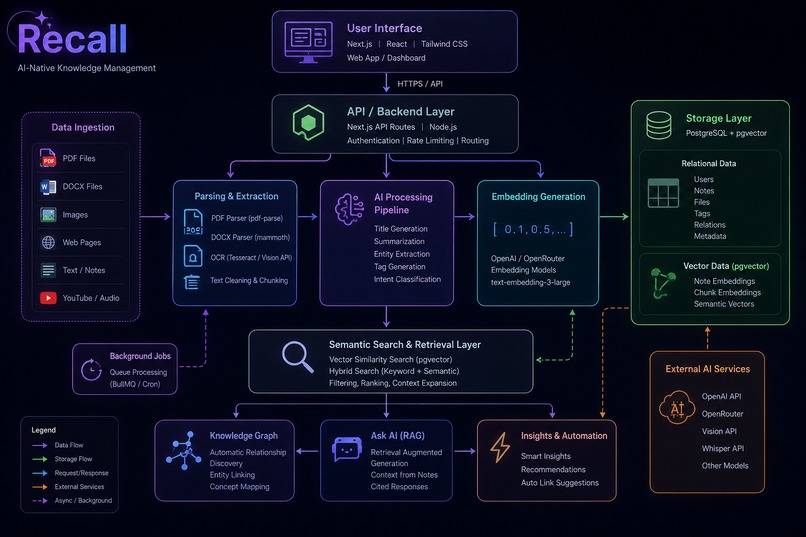
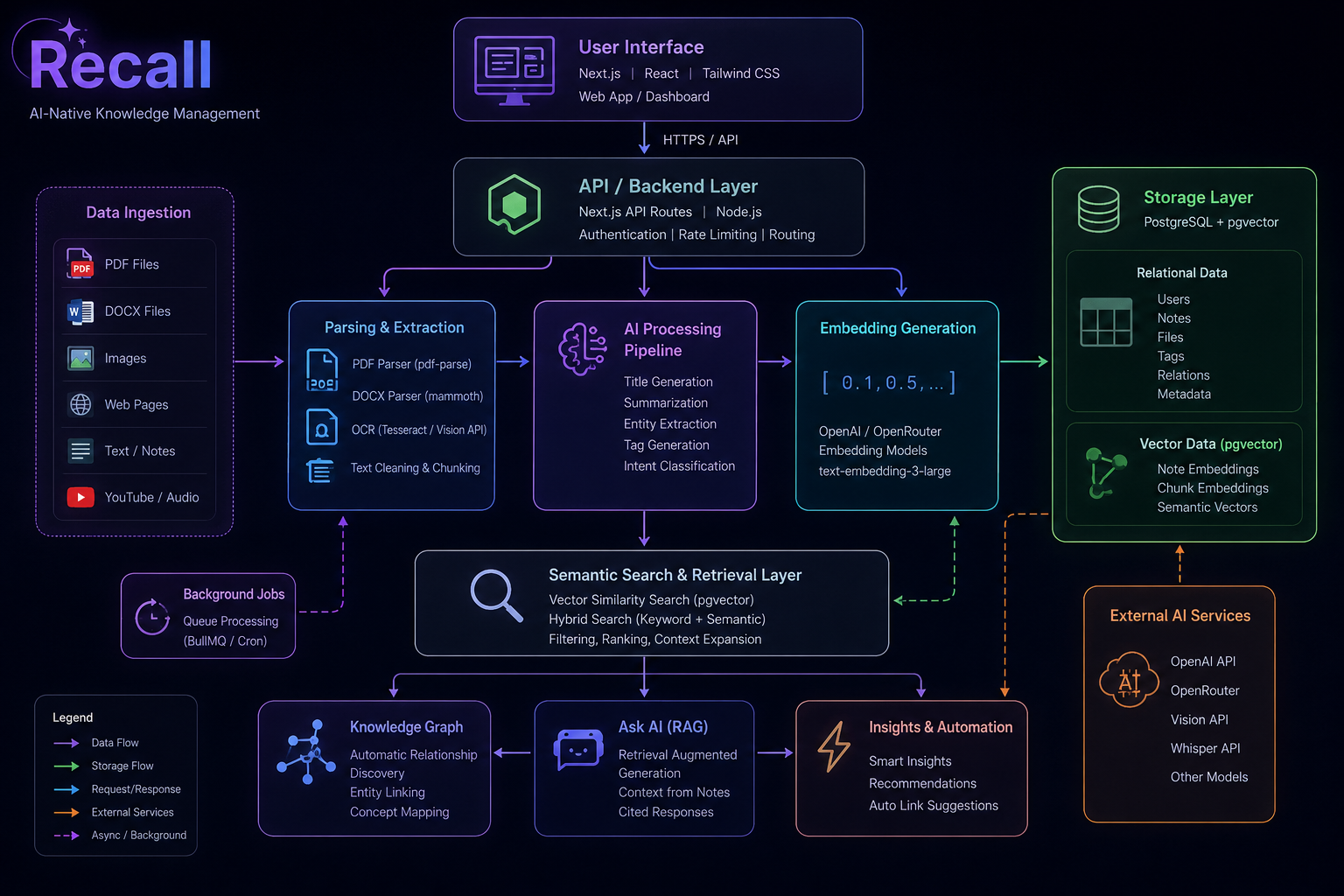
Architecture Design
-
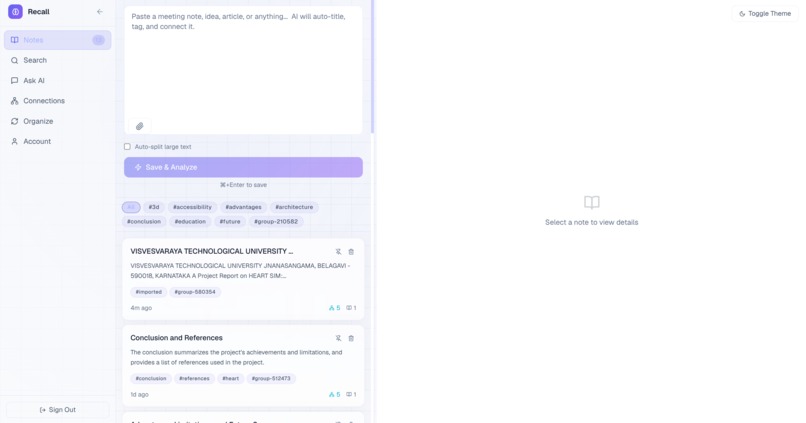
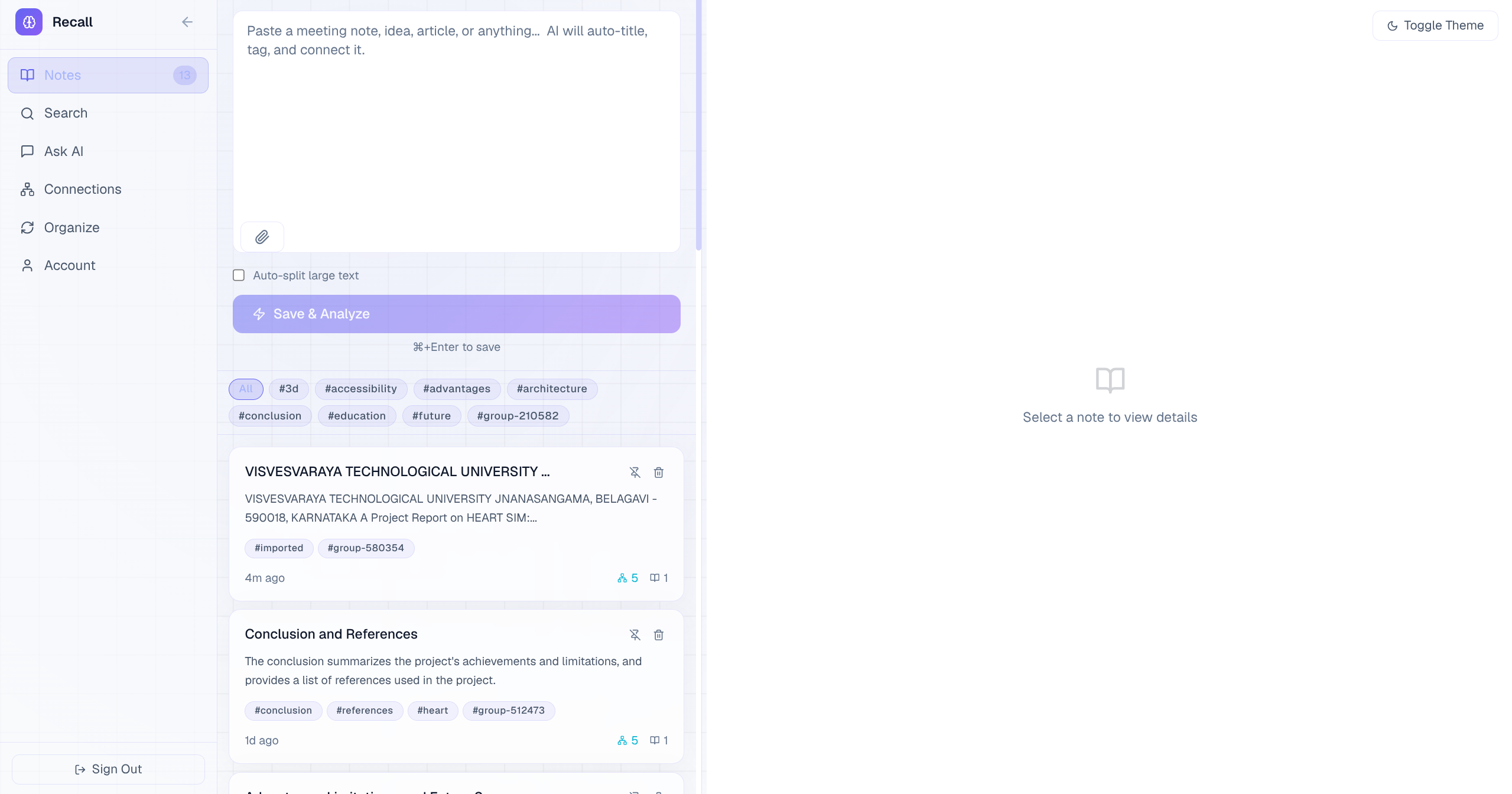
Notes
-
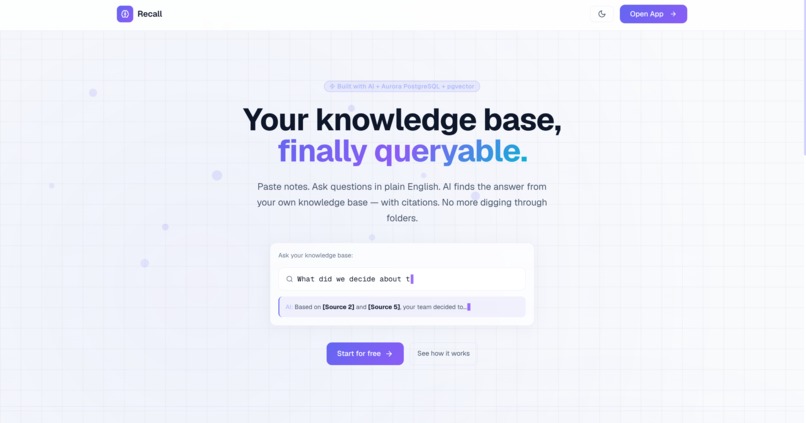
Dashboard
-
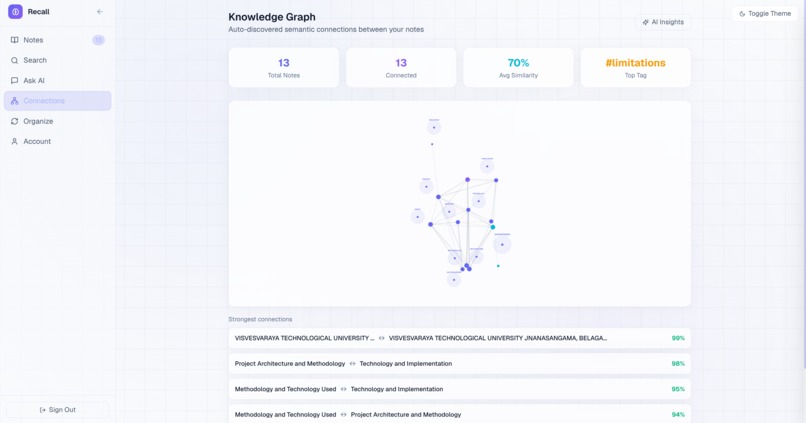
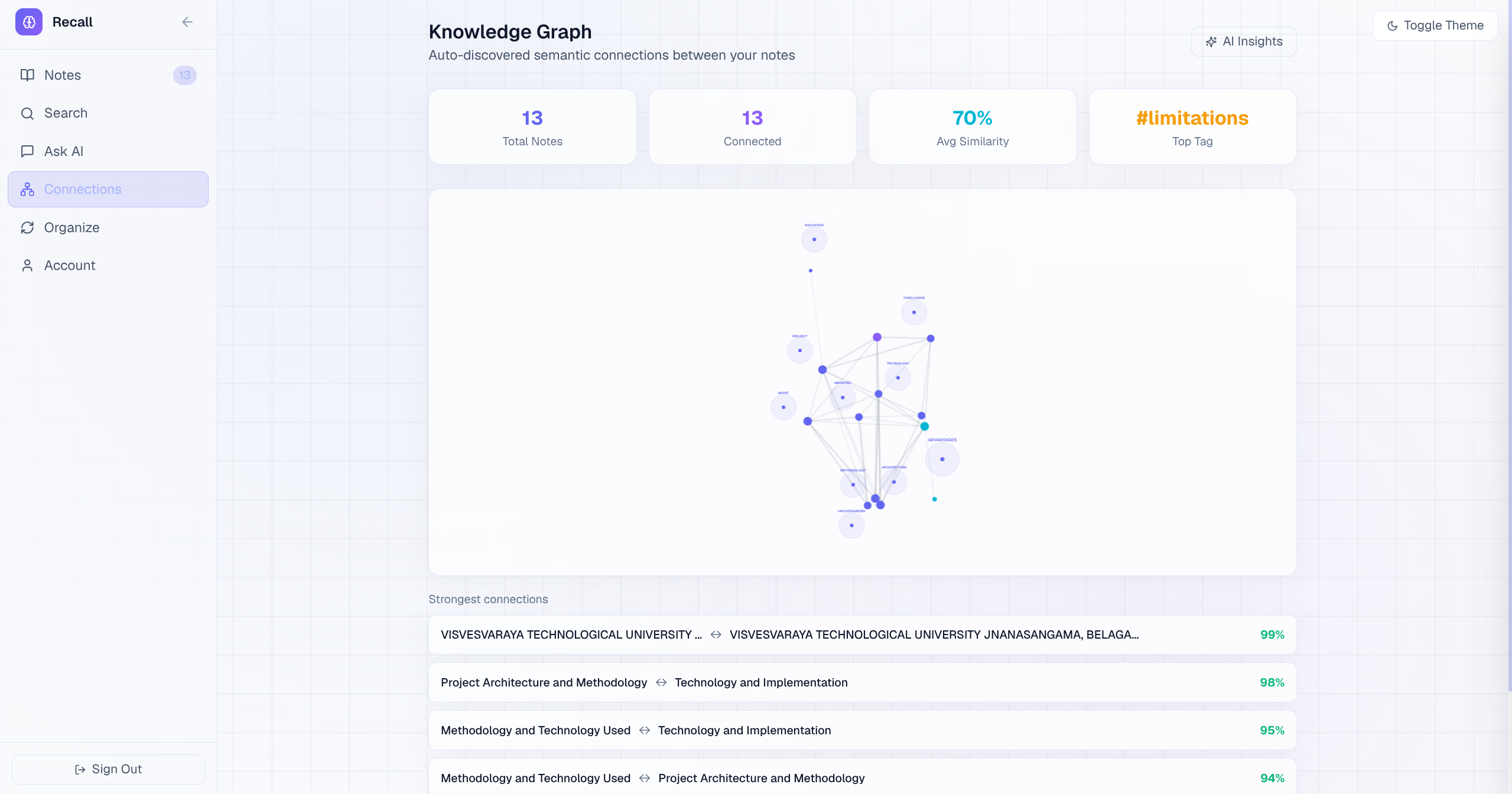
Knowledge Graph
-
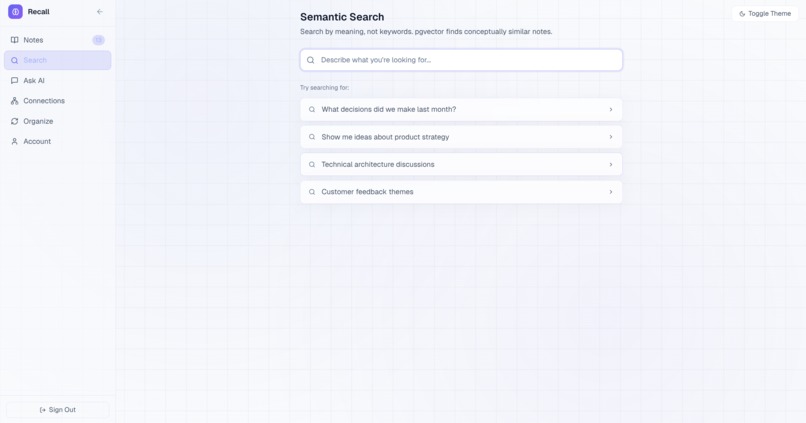
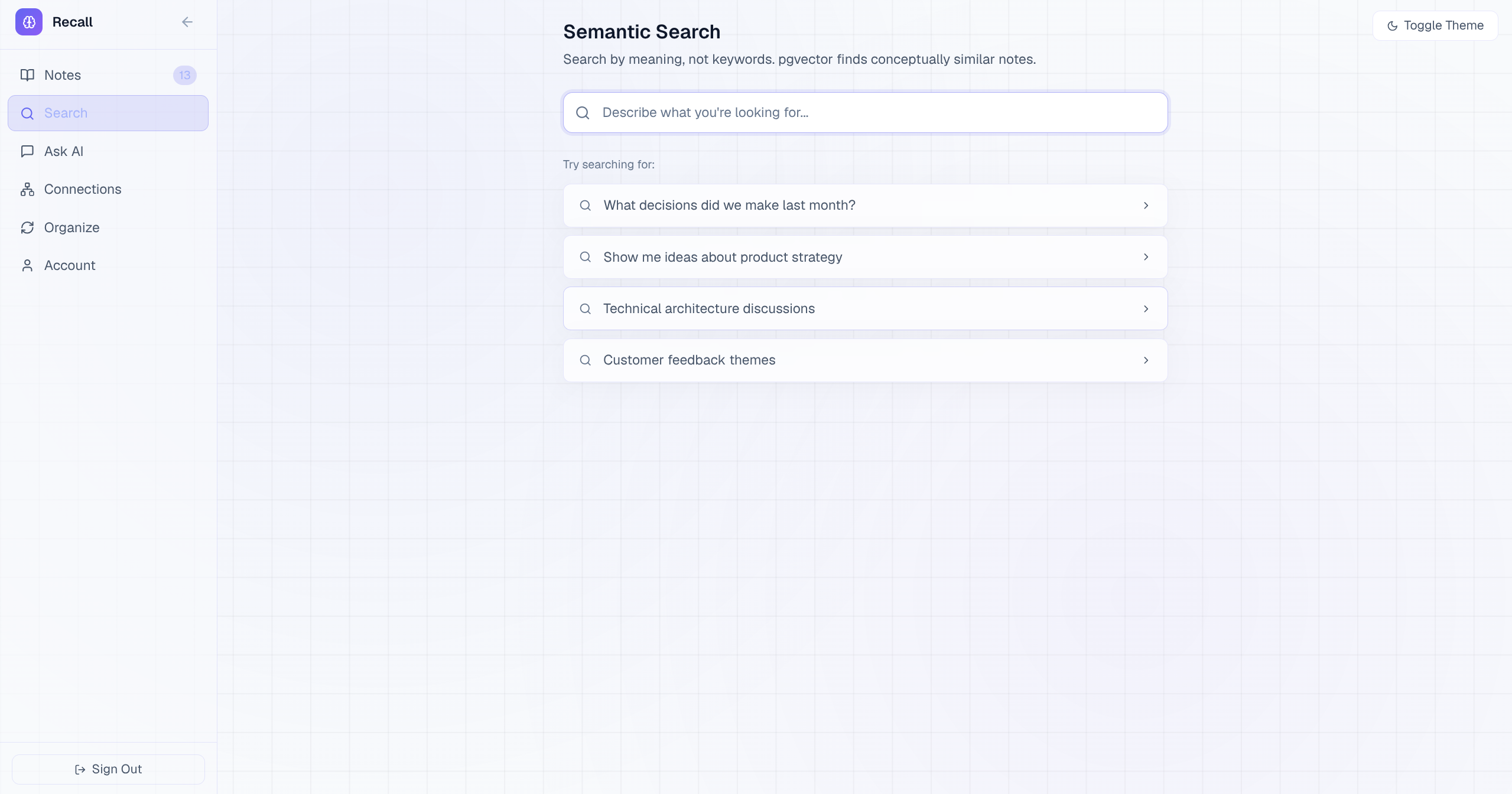
AI and search
Additional Details
Education Technology
Inspiration
Students often collect notes from lectures, textbooks, websites, and videos, but revising them later can be difficult. Notes may be long, unstructured, and filled with complex terminology. Finding one important concept in a large collection of notes can also take unnecessary time.
We built Recall to make note-taking more useful after the note has been saved. Instead of only storing information, Recall uses AI to simplify complex notes into clearer, easier-to-understand content. The goal is to help users save their notes, understand them better, and recall important information with ease.
What it does
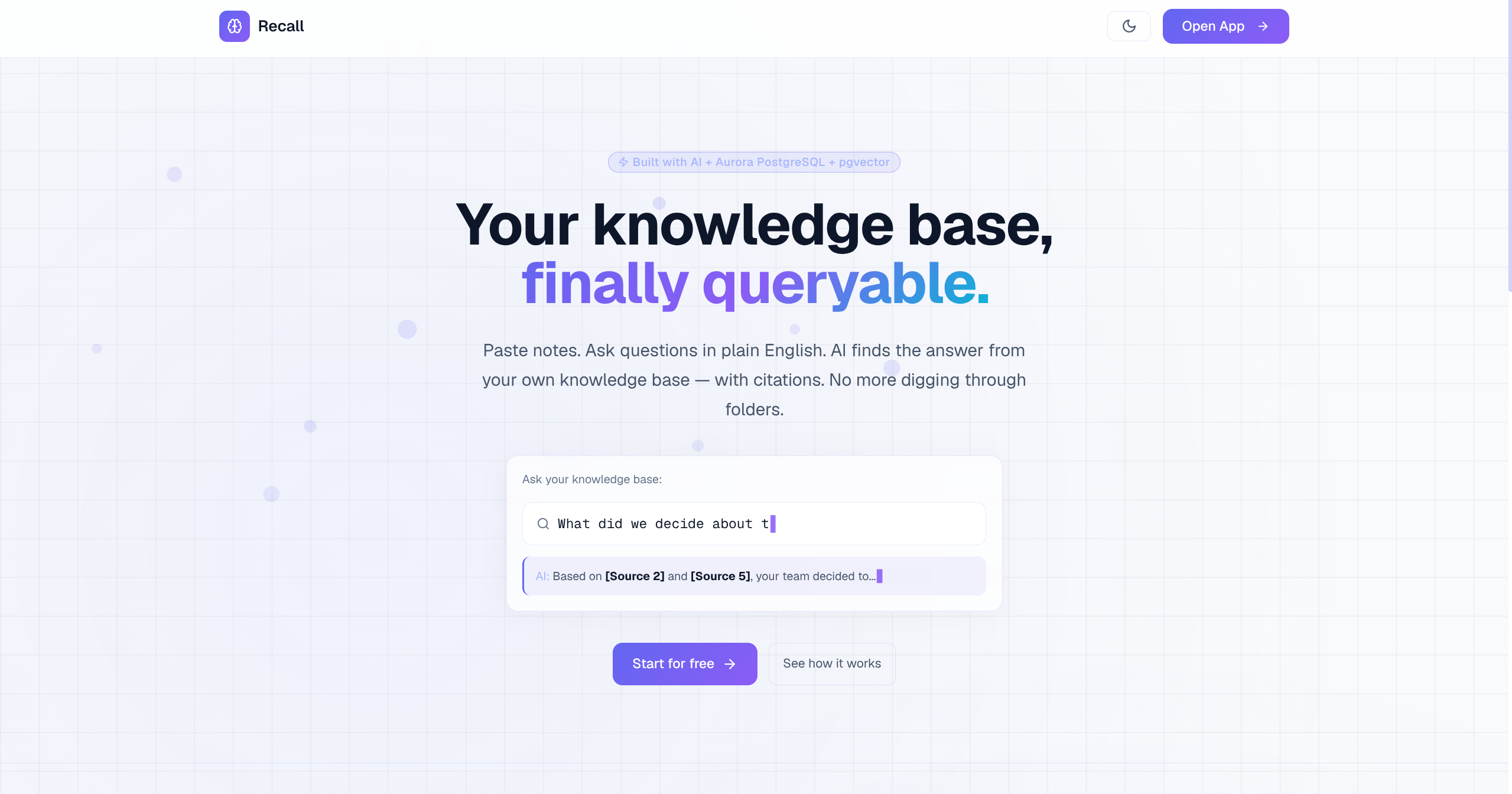
Recall is a next-generation, AI-first knowledge base that acts as a user's second brain. It helps users create, save, and organize notes and documents in one place.
Instead of requiring users to manually create tags, folders, or links between every piece of information, Recall automatically processes, categorizes, and connects notes and documents using AI. Through vector semantics, Recall understands the meaning of stored content rather than relying only on exact keyword matches.
This allows users to search or query their saved knowledge naturally and quickly retrieve relevant information from their notes and documents.
Recall helps users:
- Create and organize notes in one place.
- Simplify complex note content using AI.
- Convert lengthy information into clearer and more understandable explanations.
- Automatically categorize notes and identify related information.
- Connect related notes and documents without manual tagging or linking.
- Search saved knowledge based on meaning, not only exact words.
- Access important information whenever it is needed.
- Improve learning and revision by reducing the effort required to understand notes.
Our guiding idea is:
Save your notes. Simplify your learning. Recall with ease.
How we built it
We designed Recall around three main parts:
Note and document management
Users can create, save, edit, and organize their notes and documents in one centralized space.AI-powered simplification
When a user provides complex content, the AI processes it and produces a simpler explanation while preserving the main meaning and important concepts.Automatic organization and connection
Recall automatically processes stored content, identifies topics and concepts, categorizes notes, and connects related information. This reduces the need for users to manually maintain tags and links across their knowledge base.Semantic knowledge retrieval
Recall uses vector semantics to represent the meaning of notes and documents. This allows users to query their knowledge base in natural language and retrieve relevant information even when their search does not use the exact words from the original note.
We focused on keeping the interface simple so that users can spend more time learning and less time managing their notes.
Challenges we faced
One of the main challenges was ensuring that AI simplification did not remove important information. A summary that is too short may lose essential details, while an explanation that is too detailed may not actually make the content easier to understand. We had to find a balance between clarity, accuracy, and simplicity.
Another challenge was designing a smooth workflow between writing notes and simplifying them. The AI feature needed to feel like a natural part of the note-taking process rather than a separate and complicated tool.
We also had to think carefully about how notes should be structured and displayed so that users could easily return to them later.
Another challenge was working within limited AI API tokens. Recall uses AI for note simplification, concept extraction, categorization, and question answering, so each request consumes tokens. During development, we used around 14,000 Grok API tokens while only about 3,000 were available at a time. This required us to keep prompts efficient, avoid unnecessary API calls, and prioritize the most important AI features.
What we learned
Through Recall, we learned how AI can be used to improve learning experiences rather than simply generate text. We learned the importance of writing effective prompts, handling user-provided content, and presenting AI-generated output in a clear and useful format.
We also learned that a good learning tool must prioritize simplicity. The purpose of Recall is not only to store information, but to reduce the gap between saving information and actually understanding it.
What's next for Recall
In the future, we want to expand Recall with features such as:
- AI-generated summaries at different levels of detail.
- Flashcards generated from notes.
- Quizzes for self-assessment.
- Smart search for finding notes by meaning, not only exact words.
- Related-note recommendations.
Recall will continue to evolve into a platform that helps users not only save knowledge but understand and retain it.
Built With
- css
- groq
- next.js
- nextauth.js
- node.js
- openai
- openrouter
- pgvector
- postgresql
- react
- supabase
- tailwind
- typescript
- vercel


Log in or sign up for Devpost to join the conversation.