Inspiration
When a food contamination report lands, safety teams ask one question: which shelves have product from this lot, right now? Today they answer by hand — reconciling spreadsheets, supplier EDI, and warehouse exports — and it takes hours to days while contaminated product stays on shelves. FSMA-204, the FDA Food Traceability Final Rule, makes precise traceback a legal deadline: records to the FDA within 24 hours, enforced beginning 2028. The buyer is named, dated, and budgeted: a VP of Food Safety about to be on the hook. We wanted to collapse that 24-hour scramble into one query.
## What it does
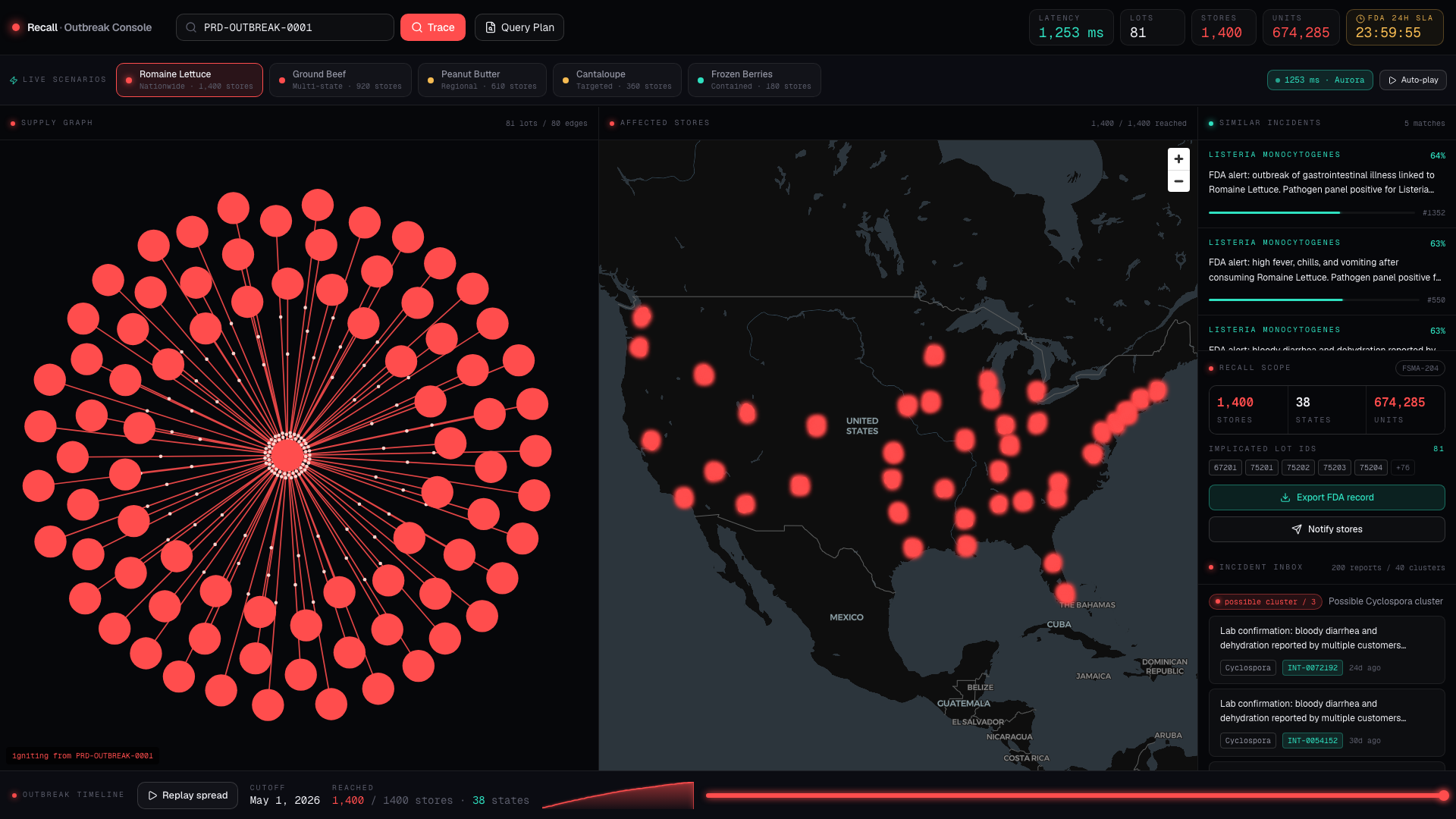
Paste a contaminated Traceability Lot Code and, in one SQL statement, Recall:
- Traces the lot through a foreign-key-constrained supply DAG to every downstream lot,
- Maps every affected store with recalled-unit counts, and
- Surfaces semantically-similar past incidents by vector similarity.
The demo lot PRD-OUTBREAK-0001 (Romaine Lettuce) reaches 1,400 affected stores across 38 states, 674,285 units, 81 contaminated lots / 80 edges — in ~300ms
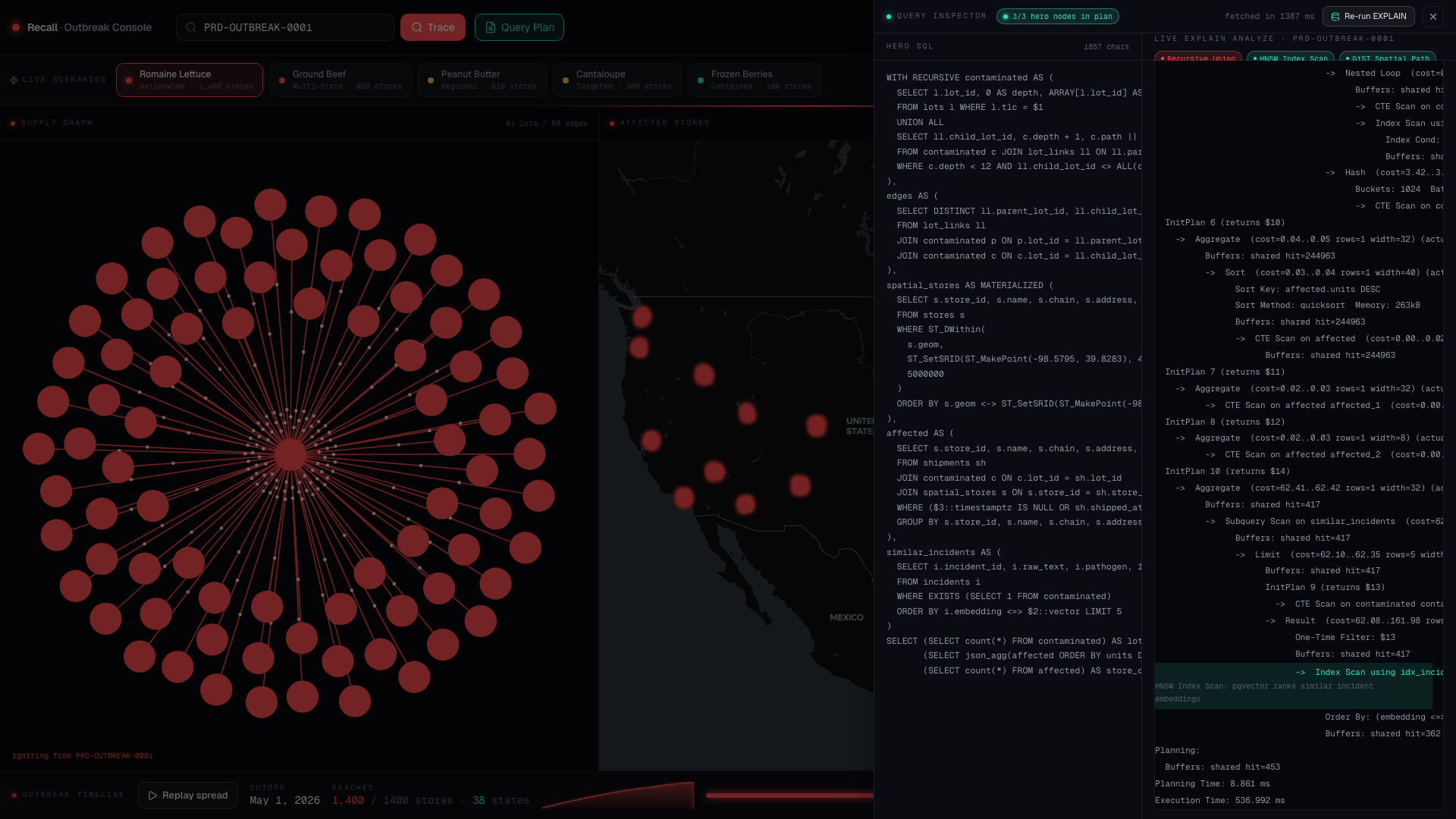
over 580,000 rows. An Outbreak Time-Travel scrubber replays the spreading blast radius by shipment time, and a Query Inspector shows the live
EXPLAIN plan. Every visible pixel is a query result.
## How we built it
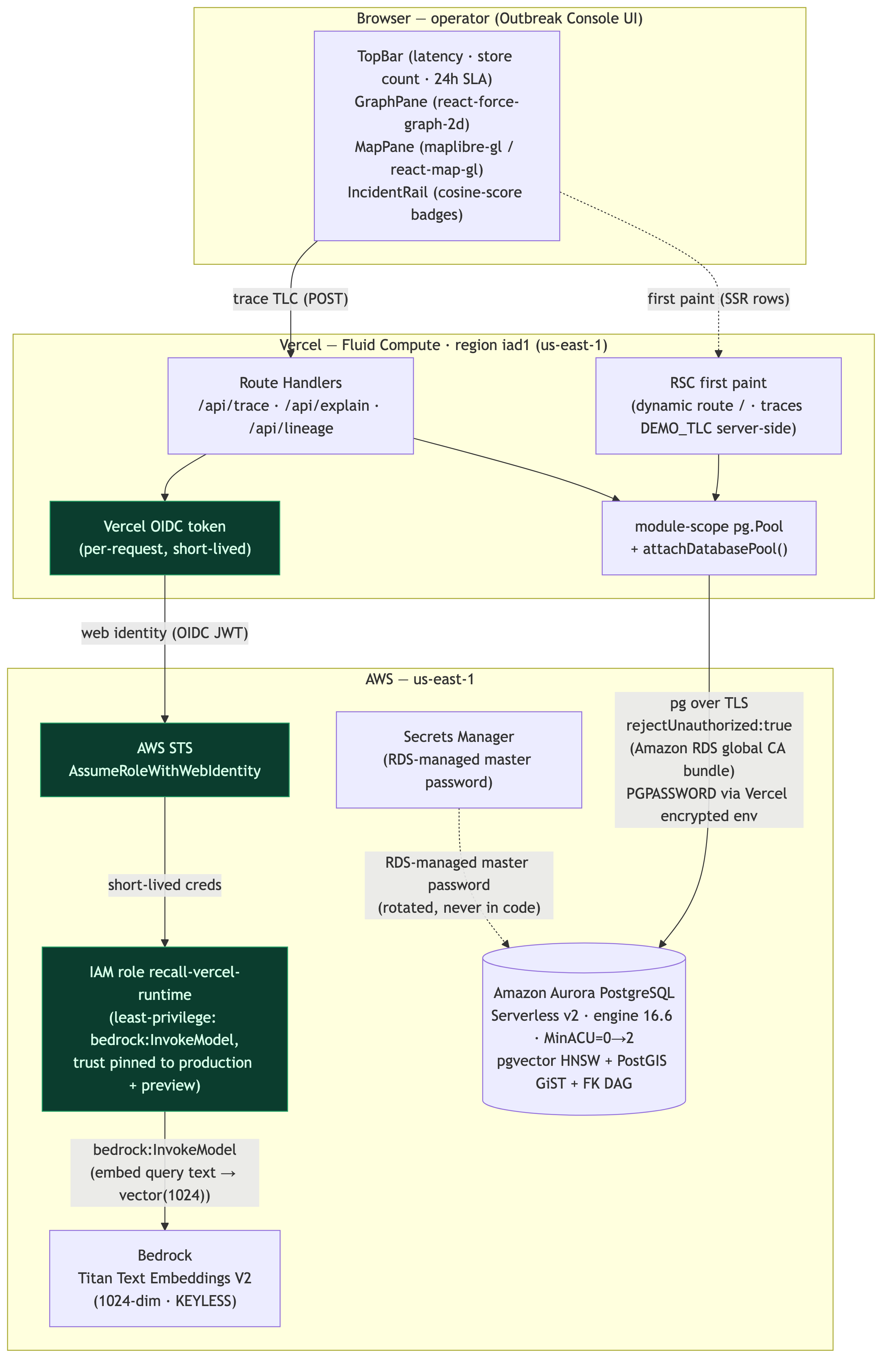
- Database: Amazon Aurora PostgreSQL (Serverless v2, engine 16.6,
us-east-1, scale-to-zero) with pgvector HNSW + PostGIS GiST. - The hero query is one
SERIALIZABLEWITH RECURSIVEstatement fusing three index paths: a Recursive Union over thelot_linksDAG, a GiST geography join for the map, and an HNSW cosine search for similar incidents. - Frontend: Next.js 16 App Router on Vercel Fluid Compute (
iad1, co-located with Aurora), Tailwind v4 + shadcn/ui, MapLibre, react-force-graph. - DB access:
pgmodule-scope pool +attachDatabasePool, raw parameterized SQL, TLS verified against the Amazon RDS CA bundle. - Keyless AWS: Bedrock Titan Text Embeddings V2 called with no long-lived keys — Vercel OIDC → AWS STS
AssumeRoleWithWebIdentity→ least-privilege IAM role. The DB password is RDS-managed in Secrets Manager.
## Challenges we ran into
- Getting the planner to use HNSW at demo volume — at a few thousand incidents Postgres prefers a seq scan; transaction-scoped
SET LOCAL random_page_cost = 1.1/enable_seqscan = off(which also reflects Aurora's real distributed-storage I/O profile) keeps the index paths engaged. - Keyless OIDC — pinning the STS trust policy to production + preview without a wildcard.
- Serverless connection churn — module-scope pool +
attachDatabasePoolso idle clients release before the function suspends. - Recursion safety — a
pathvisited-set anddepth < 12guard so a 250k-edge graph can't cycle or go quadratic. - Serializable correctness — a bounded
40001retry loop so an ingest mid-trace can't corrupt the recall scope.
## Accomplishments that we're proud of
- Three fundamentally different index paths — recursive graph, geospatial, and vector — fused in one ~300ms serializable query over 580k rows, with the live
EXPLAINas proof. - Outbreak Time-Travel replay via an
asOfcutoff on the same recursive trace. - Fully keyless AWS access; scale-to-zero verified at 0.0 ACU (~$0) idle on CloudWatch.
- A provably non-interchangeable database choice — the app literally cannot run on DynamoDB or DSQL.
## What we learned
- The database can be the product, not just storage — the right data model plus extensions turn a recall into one correct statement instead of orchestration code.
- Aurora's distributed storage makes index access genuinely cheaper than on-prem cost defaults assume.
- The Vercel OIDC → STS pattern removes long-lived cloud keys entirely — production-shaped security with less plumbing than key rotation.
- Seeding at real volume (580k rows) is what makes an
EXPLAINhonest.
## What's next for Recall
- Upstream (source) trace — flip the recursion to find the originating supplier/ingredient.
- Live shipment ingest via Vercel Cron / SQS, exercising the serializable retry path.
- One-click FDA-ready traceability export plus store shelf-pull notifications.
- Multi-tenant Recall-as-a-Service, billed per facility.
Built With
- amazon-aurora-postgresql
- amazon-bedrock
- aws-iam
- aws-secrets-manager
- maplibre-gl
- next.js
- node-postgres
- node.js
- pgvector
- playwright
- postgis
- react-force-graph
- shadcn/ui
- tailwind-css
- typescript
- vercel
- vitest
- zod


Log in or sign up for Devpost to join the conversation.