-
-
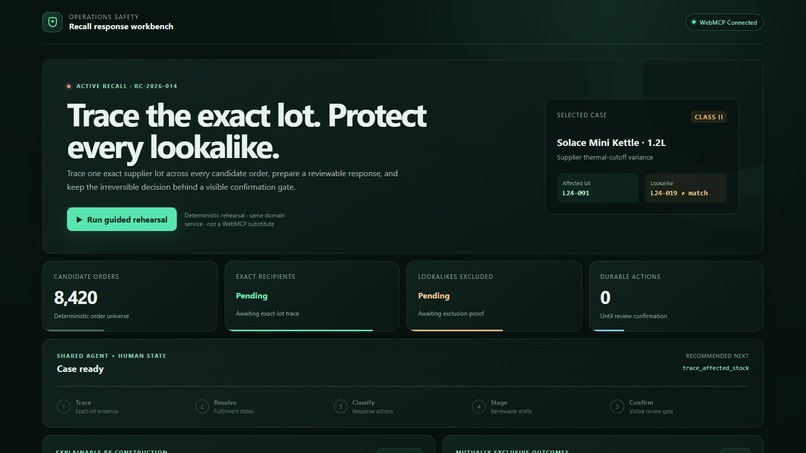
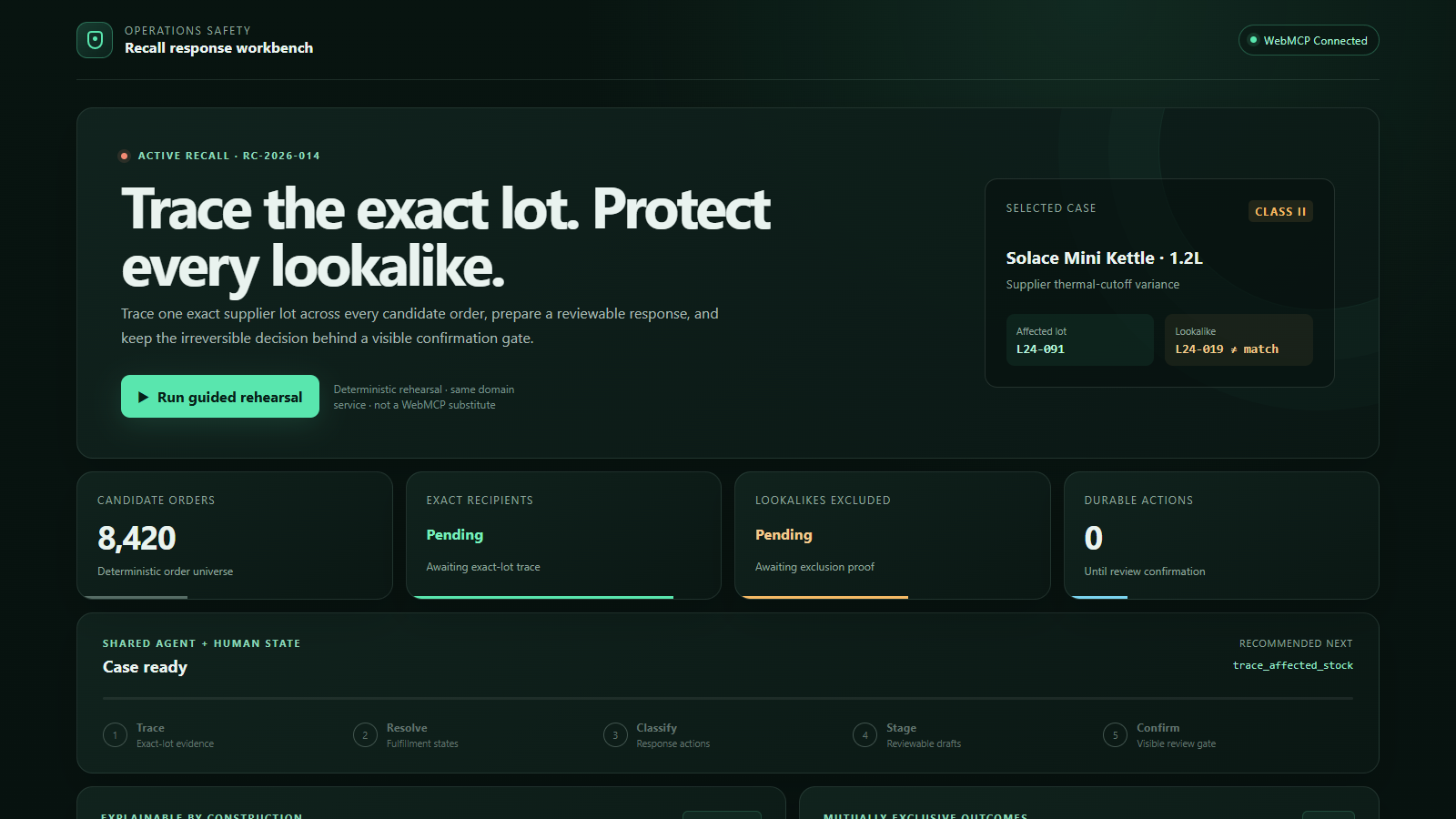
Overview: trace one exact supplier lot across 8,420 synthetic orders.
-
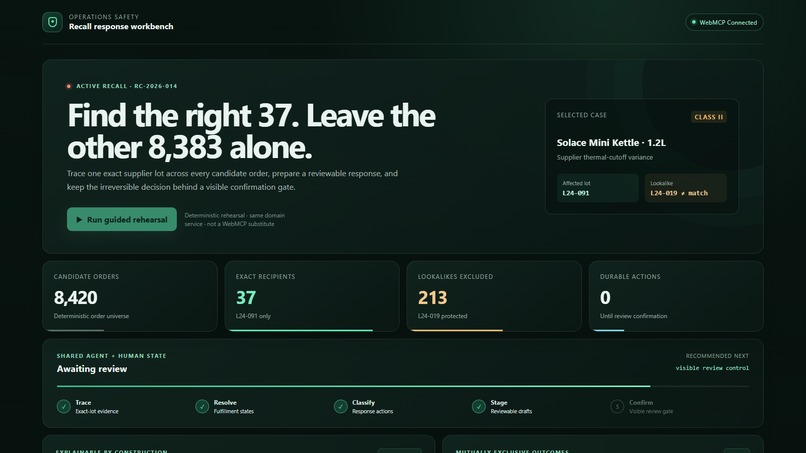
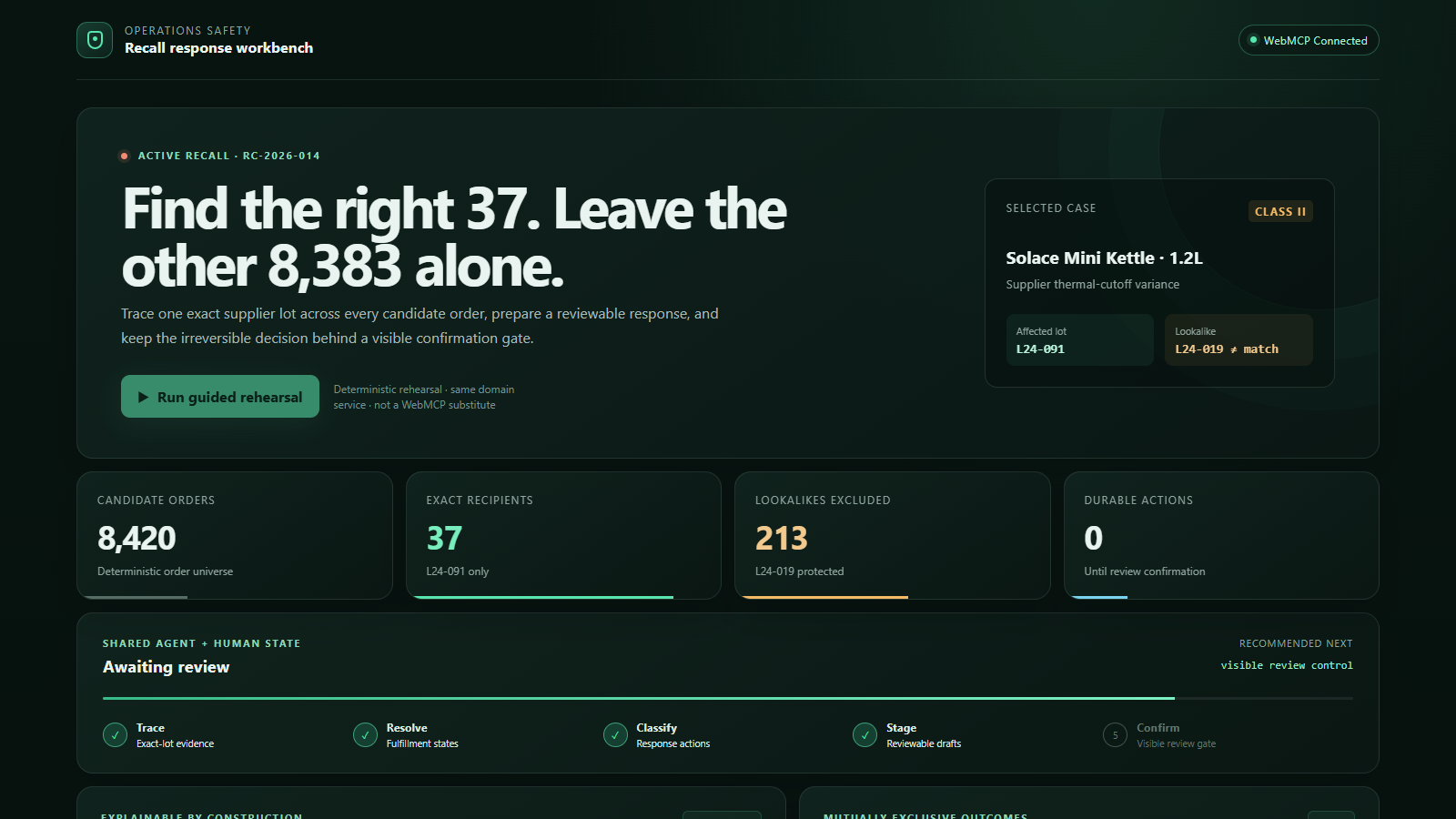
Staged review: 37 exact matches, 213 lookalikes excluded, zero simulated commits before confirmation.
-
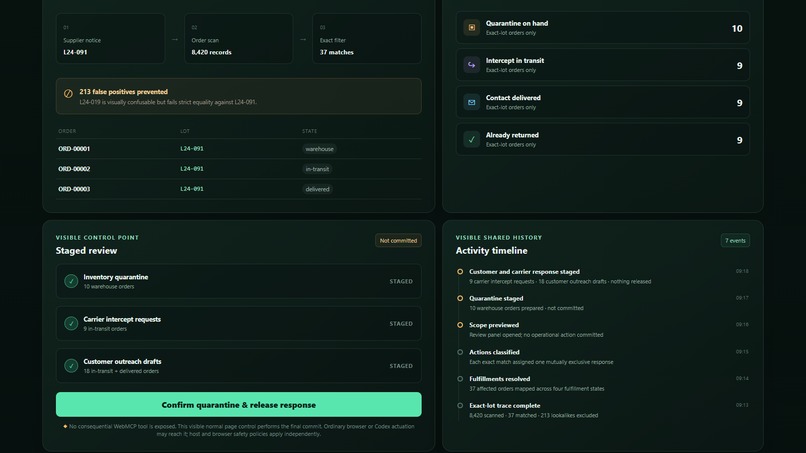
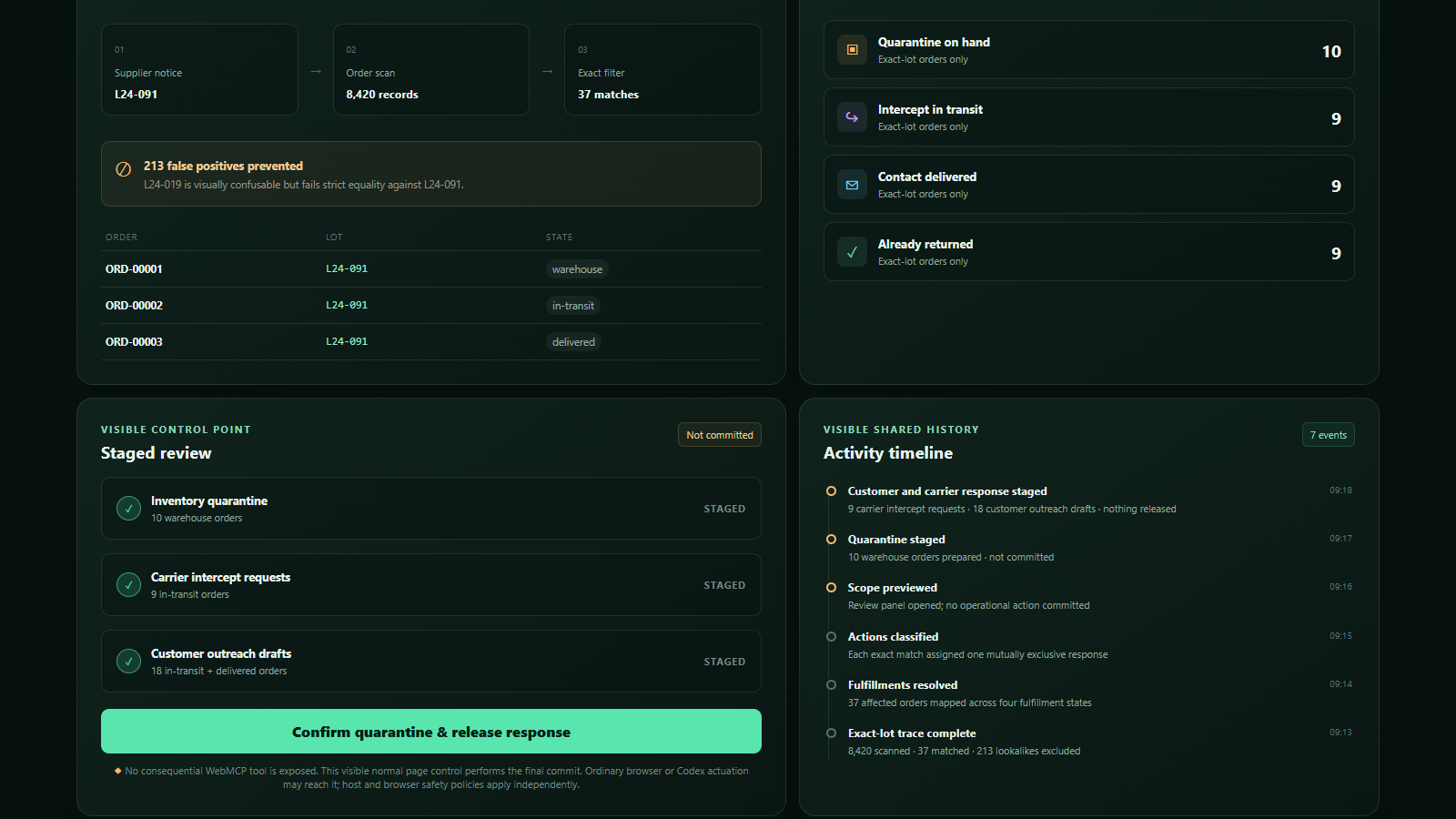
Visible confirmation gate: review 10 quarantines, 9 intercepts, and 18 outreach drafts before committing.
-
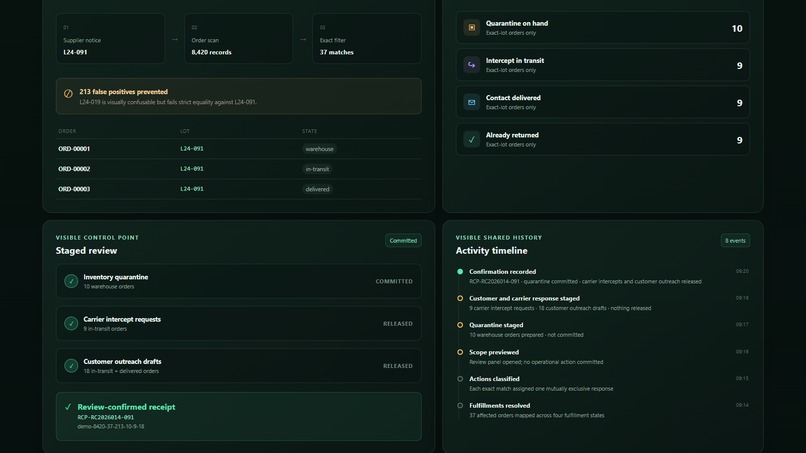
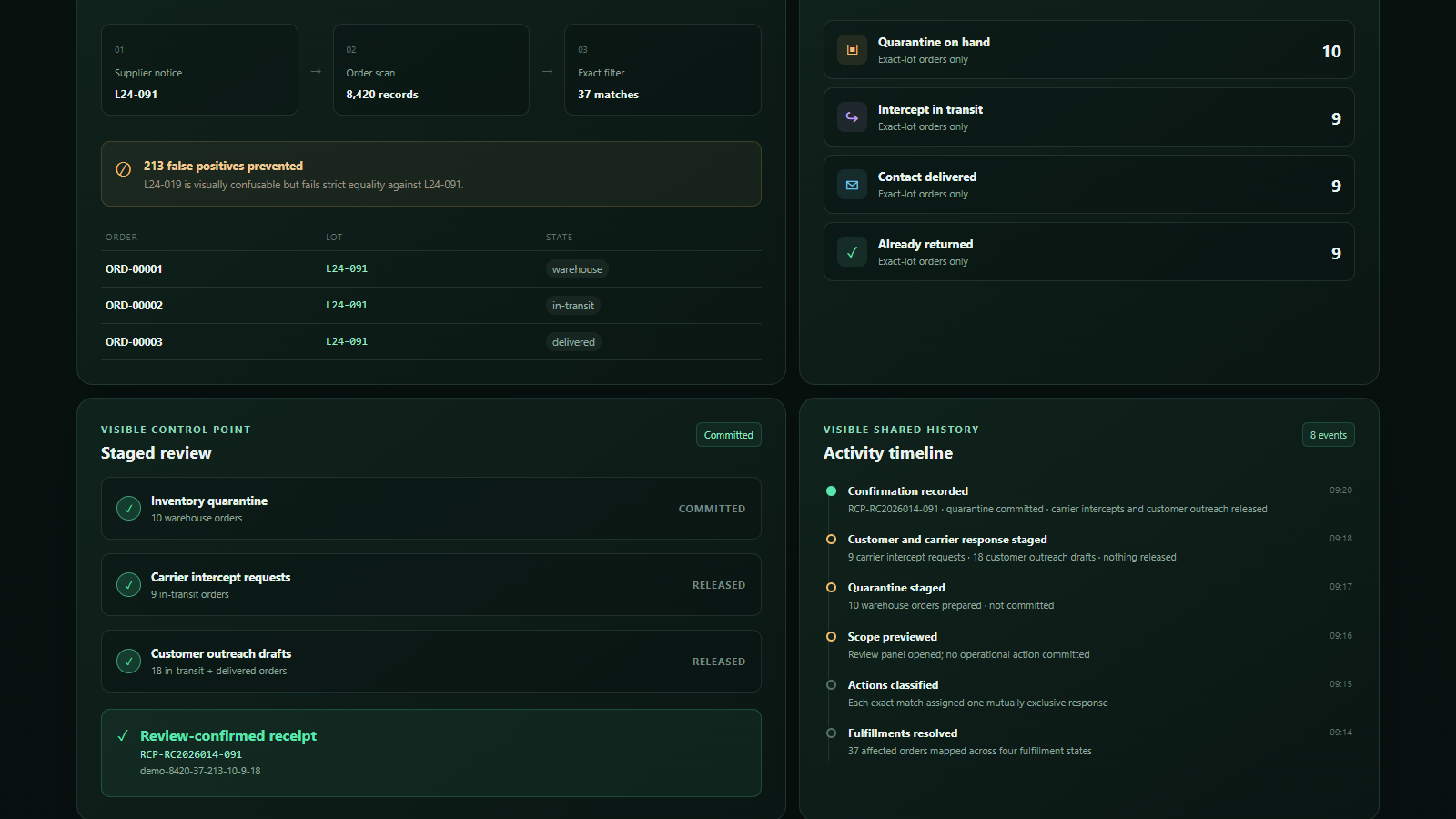
Confirmed rehearsal receipt: synthetic actions recorded in memory; no real messages or operational changes.
Why is this a strong fit for WebMCP?
Product recalls are ideal structured-agent work: many precise, auditable steps happen inside a UI, but the final operational decision should remain with an accountable person. WebMCP lets the page expose exact business operations instead of asking an agent to scrape tables or guess which controls to click. The tool set follows the recall lifecycle—read, trace, resolve, classify, preview, and stage—while the visible page stays synchronized after every call.
The demo makes WebMCP’s value concrete. It searches 8,420 generated orders, returns exactly 37 orders for lot L24-091, and explicitly proves that 213 orders from the confusable L24-019 lot were excluded.
How is the user experience better?
The user receives a reviewable answer, not an opaque automation result. Exact-match evidence, fulfillment states, action classifications, staging status, and activity history are visible in one responsive workbench. Agents can do the repetitive reconciliation, while final commit occurs through a visible normal page control. The complete atomic tool set is registered once, and domain preconditions reject out-of-order actions with corrective errors.
The product also works immediately in demos: a clearly labeled deterministic rehearsal invokes the same domain service when WebMCP is unavailable and still stops at the visible review gate.
What can humans and agents now do together?
An agent can read the selected recall, trace an exact supplier lot, find affected fulfillments, classify a response for every match, preview the scope, and stage 10 warehouse quarantines, 9 carrier intercept requests, and 18 customer outreach drafts. Classifications remain mutually exclusive: each in-transit order is an intercept, while its response package also includes a customer notice. A reviewer can inspect the evidence, verify the 37 exact recipients and 213 exclusions, cancel drafts, or activate the visible final control. Ordinary browser or Codex actuation may also reach that control. Any host or browser safety policies apply independently; the app’s safety claim is specifically that no consequential WebMCP tool exists. After confirmation, the agent can read—never create through WebMCP—the current rehearsal receipt.
How was it implemented?
The submission is a static Vite + React + TypeScript app with plain CSS and deterministic in-memory data. Imperative WebMCP tools are registered atomically in the top-level document through document.modelContext, with a legacy navigator.modelContext fallback. All registrations are initiated together; when any failure is observed, the lifecycle rolls back its successfully registered tools and aborts pending work. An AbortController manages registration lifetime; callbacks accept optional execution options for older previews and polyfills, validate input in code, and define the synchronous domain transition as the mutation commit point before paint synchronization.
Read-only and mutation annotations are accurate. Mutating tools commit through a synchronous React flushSync boundary and do not yield to paint hooks after state mutation. The app does not expose a confirm, commit, release, or send WebMCP tool. Vitest covers exact counts, carrier/customer staging, ephemeral receipt reset, confusable-lot rejection, one-time registration, asynchronous cleanup, duplicate protection, and synchronous visible mutation.
Impact
This prototype demonstrates how explicit browser tools can reduce brittle UI automation and make a high-consequence workflow easier to audit. It does not claim measured production savings or regulatory approval. Its grounded claim is narrower: for the included deterministic scenario, every one of 8,420 orders is evaluated, all 37 affected orders are identified, all 213 confusable-lot orders are excluded, and zero durable actions occur before review confirmation.
AI and Codex usage
Built with OpenAI Codex using the WebMCP skill from webmaxru/web-ai-agent-skills. An external AI client interprets the operator's request and invokes the page's structured WebMCP tools. The app itself has no embedded LLM backend: matching, classification, staging, and receipts are deterministic TypeScript operations.
The project was tested using GPT-5.6 Sol in Codex with the in-app browser and Site Tools. The documented demo discovers the tools, performs the seven staging steps, pauses for the visible review control, and reads the receipt afterward.
Known limitations
This is a deterministic prototype using synthetic data. No real warehouse quarantine, carrier intercept, or customer message occurs, even after confirmation. All state, including the confirmed receipt and the UI's simulated commit counter, is held in memory and resets on reload. The demo checksum is not cryptographic or a durable audit record. The visible control is not an enforced human-only authorization boundary: ordinary browser actuation may reach it. WebMCP availability depends on the client, and the guided rehearsal is not a substitute for testing agent discovery and invocation.
Hackathon scope
This is a new project for the challenge. The recall domain model, UI, WebMCP surface, tests, and documentation are the hackathon work.
Built With
- css
- github
- openai-codex
- react
- typescript
- vite
- vitest
- webmcp