-
-
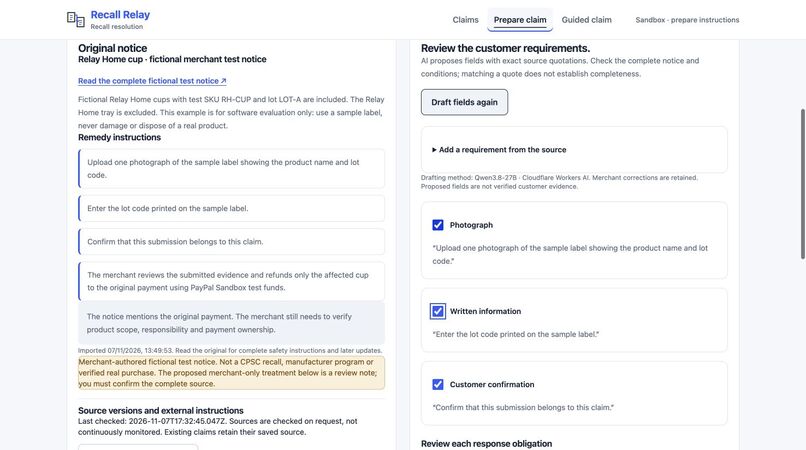
Hosted AI draft: proposed requirements linked to exact source quotations.
-
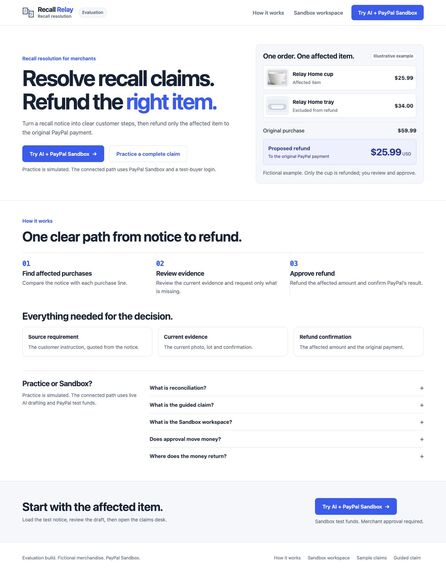
Homepage: connected AI + PayPal workflow and no-login examples.
-
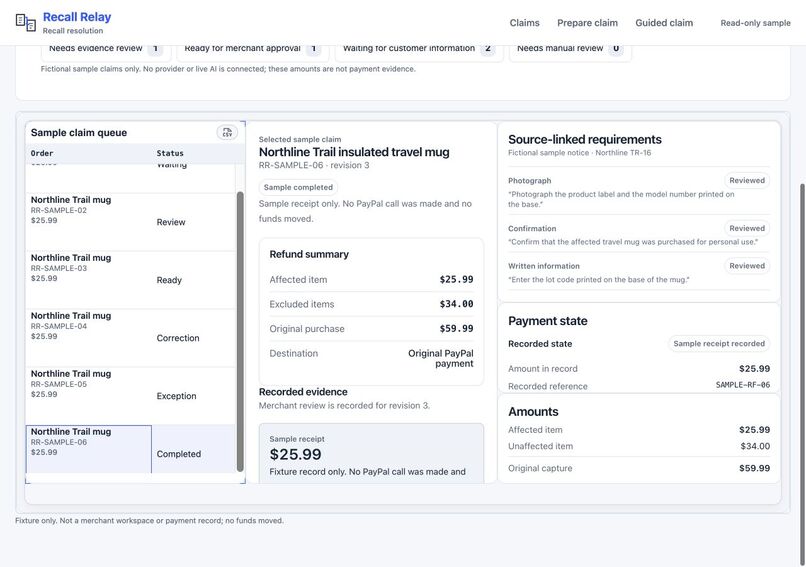
AG Studio read-only sample: linked claim review and context widgets. Fictional example.
Inspiration
A recall notice is only the beginning. A merchant still has to work out which purchase lines are affected, ask the customer for the right evidence and refund the correct item without returning the rest of the order. Those decisions often live in separate documents, messages and payment screens.
We built Recall Relay to connect the official instruction, the purchase line, the customer's current evidence and the original payment in one merchant workflow.
What it does
Find the affected purchase. Resolve the evidence. Refund the right item.
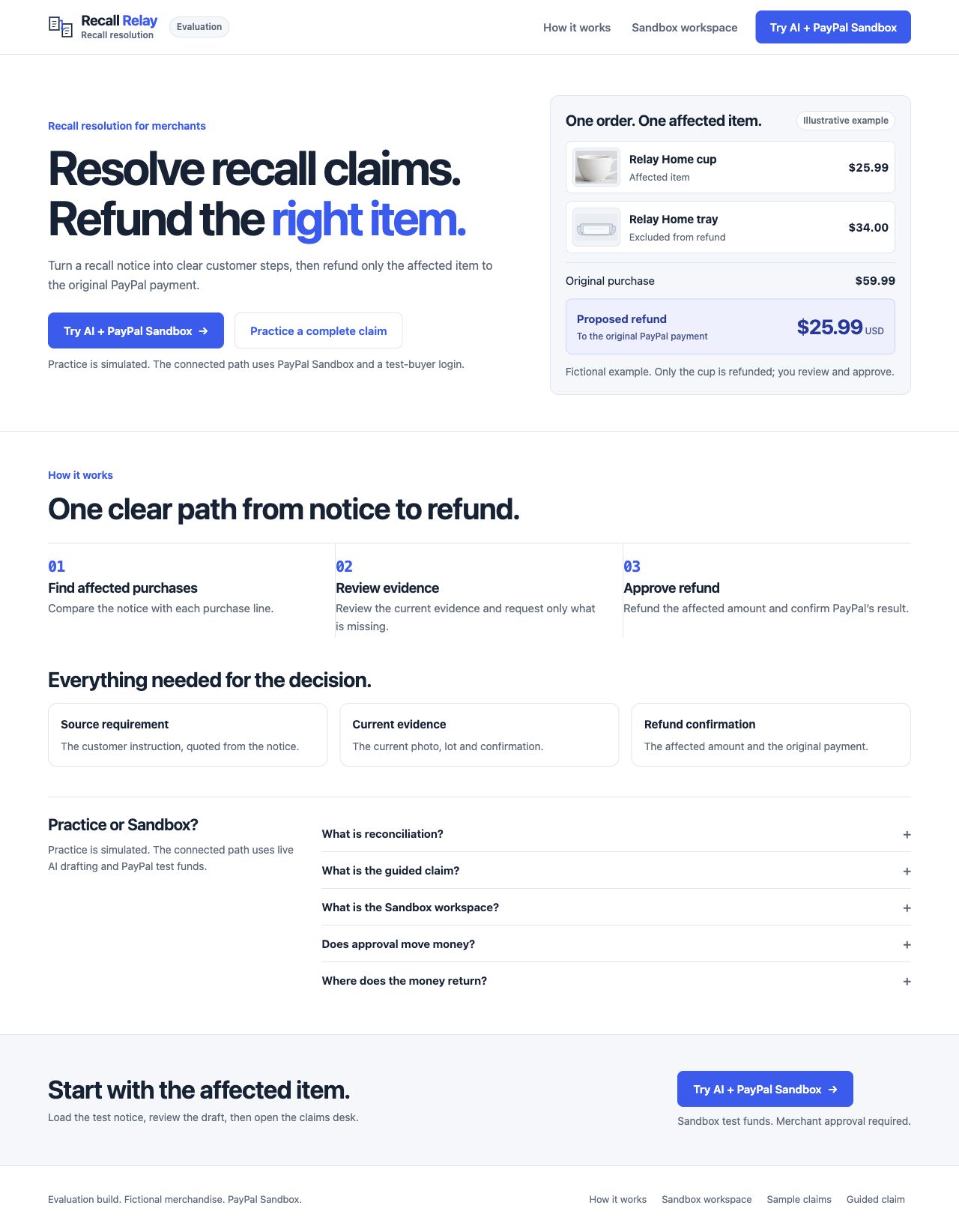
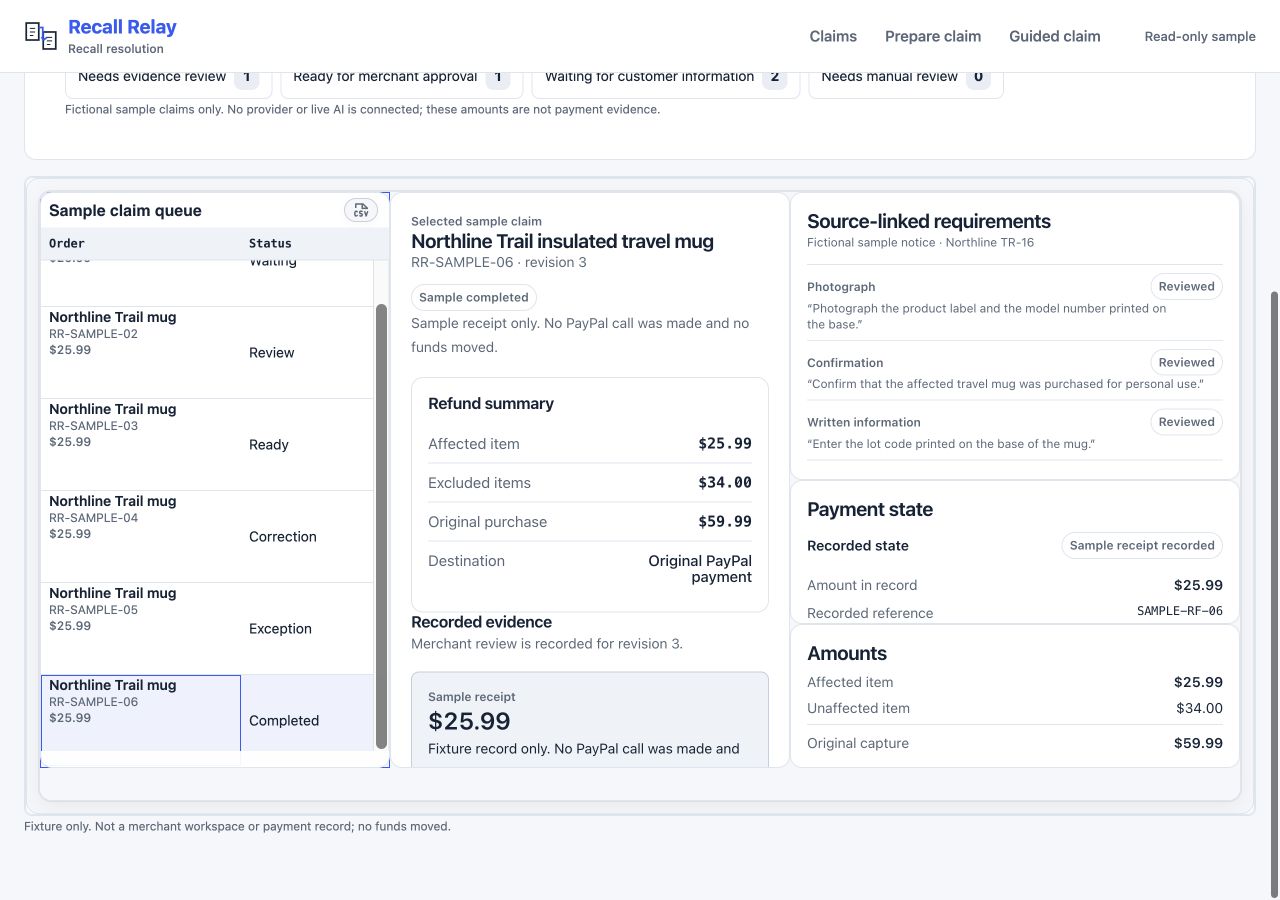
Recall Relay is a recall-resolution desk for merchants and customer-support teams. A merchant reviews a notice, prepares a source-linked customer form and reconciles purchase records against the reviewed product and lot. Affected, excluded and unknown lines remain distinct. A planning total is never presented as a verified refundable balance.
For example, a $72.75 order can contain a $38.75 affected cup and a $34 unaffected item. The aim is to resolve the cup claim while leaving the other item alone.
The customer supplies a photograph, lot code and confirmations through a private page. The merchant reviews the evidence and can request a correction on that same page. Requesting a correction clears the earlier review; replacement evidence needs a fresh review before payment approval.
The merchant explicitly approves the affected amount. PayPal Sandbox returns the refund to the original capture, and Recall Relay checks the provider's status, amount, currency and capture linkage before displaying a completed receipt. The customer returns to the same private page to see the result.
How we built it
The interface uses React and AG Studio. Cloudflare Pages serves the app, with a service binding to a Worker and SQLite-backed Durable Objects for isolated workspaces, claim state, evidence revisions and durable refund reservations.
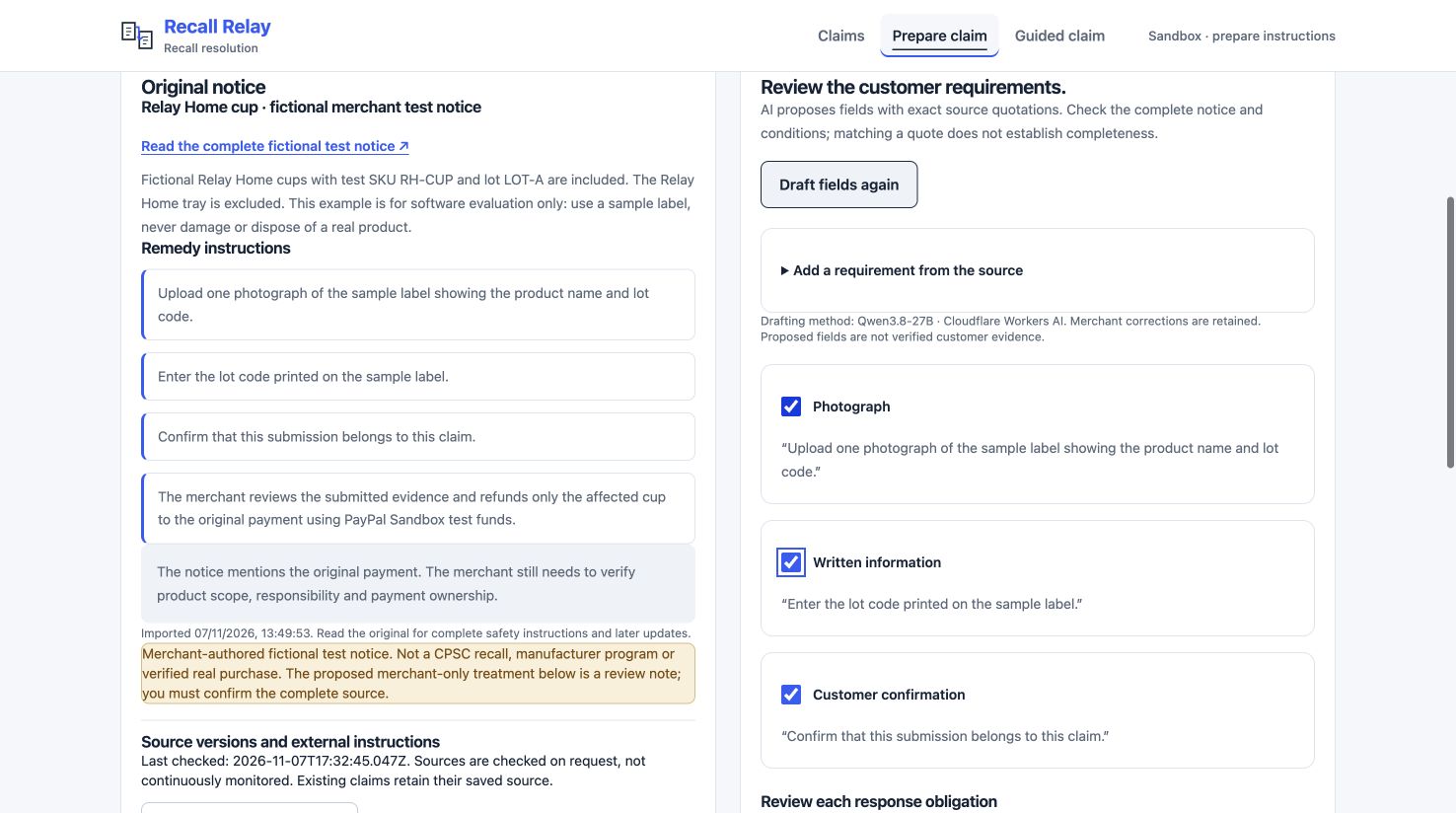
AI prepares source-linked instructions. Qwen3.8-27B through Cloudflare Workers AI selects source sentence IDs for proposed claim fields. The server reconstructs the complete quotations; the merchant compares them with the full notice, resolves missing requirements and publishes. A separate gpt-oss-120b advisory helps interpret cited source clauses. Invalid or unsupported output is withheld.
AG Studio makes the case reviewable. Linked custom widgets bring together the queue, selected claim, source requirements, evidence gaps, recorded brief and payment amounts. Selecting a case updates its context. The Studio Agent Framework connects the Claim guide to constrained read-only tools for case briefs, requirements, evidence gaps and views. Ordinary controls remain available while Studio loads and on mobile.
PayPal closes the money loop. Orders v2 creates and captures buyer-approved itemized Sandbox purchases. Payments v2 supplies capture details, capture refunds and refund readback. Saved item allocation determines the affected amount. A durable reservation protects refund dispatch, while evidence revisions bind the merchant's decision to what was actually reviewed. An uncertain provider result remains unresolved rather than becoming a completed receipt.
Reconciliation accepts bounded CSV/JSON ledgers and saved workspace purchases. Exact saved capture, allocation, source and item matches can open an existing claim. A pasted capture ID or imported declaration cannot create refund authority.
Challenges we ran into
An exact quotation can still omit a second obligation in the same sentence. We moved to sentence IDs, added compound-requirement and source-condition checks, and retained full-source merchant review. Referenced external instructions require reviewed excerpts; unsupported remedies remain manual.
Money movement also demanded explicit recovery states. We separated approval, dispatch and provider confirmation, retained revision history, and kept ambiguous outcomes open for reconciliation.
Finally, the full Studio download could delay the desk on slow connections. We split the desktop module so ordinary review controls can appear independently, then checked the desktop and narrow-screen journeys.
Accomplishments that we're proud of
The project connects recall-to-purchase reconciliation, a source-linked form, a private customer correction loop, fresh evidence review and an original-payment partial refund. The payment safety rules remain enforced by application state and provider checks rather than by a model's confidence.
We have exercised hosted PayPal Sandbox purchase, capture and partial-refund workflows, alongside separate actual-model diagnostics and automated tests. The public repository includes application source, build/run instructions and an MIT license.
What we learned
The useful AI boundary is concrete: reduce the work of translating and navigating instructions, while keeping the source, current case facts and payment authority explicit. A correction must change the decision state, not just the text on the screen. A receipt must mean the payment provider confirmed the refund.
What's next for Recall Relay
Evaluate the workflow with merchant-support teams, extend supported order allocations and remedies, and develop authenticated merchant onboarding. This hackathon build uses fictional merchandise and PayPal Sandbox test funds. AI drafts and advises; the merchant reviews evidence and approves payment.
Built With
- ag-studio
- cloudflare
- paypal
- react

