-
-
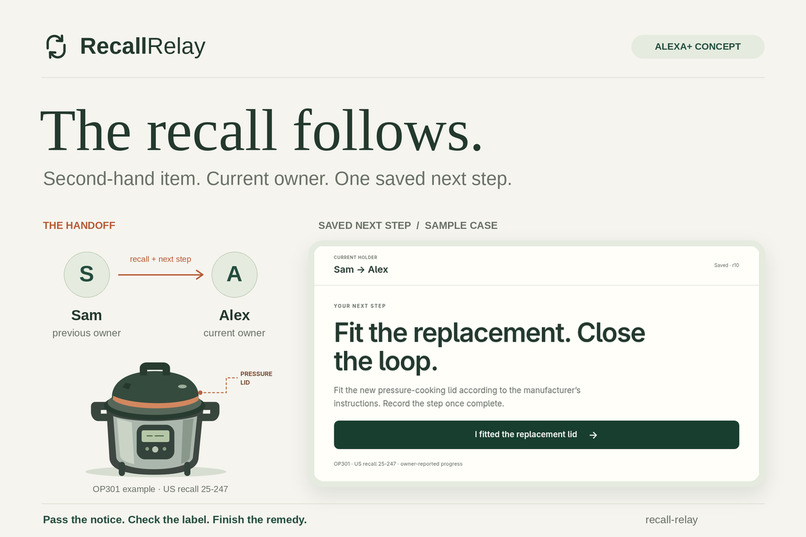
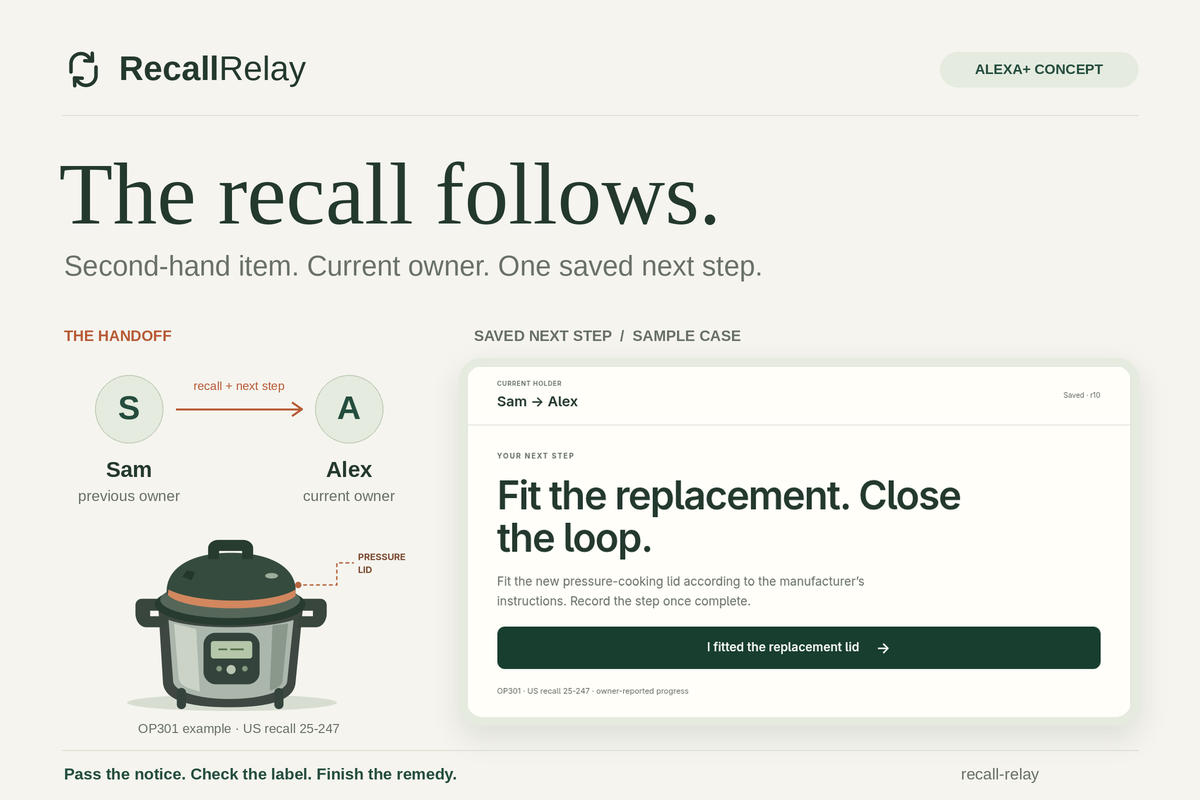
Sam passes on the recall. Alex resumes the saved replacement step. Sample case; real MCP-powered Focus view.
Inspiration
A product changes hands. Its recall should follow.
Sam gives Alex a pressure cooker. Later, its pressure-cooking lid is recalled. The original purchase connects to Sam; the appliance is in Alex's kitchen.
This handoff appears explicitly in SharkNinja's recall-program FAQ: people who sold or gave away the cooker should forward the recall notice to its current holder. Recall Relay turns that instruction into a complete, usable journey.
Our first case is US CPSC recall 25-247, covering approximately 1.8 million Ninja Foodi pressure cookers. Its free replacement-lid program gives the journey a concrete finish line.
What it does
Recall Relay helps the current holder receive the notice, verify the appliance, and finish the official remedy—even when the task spans people and conversations.
- Pass the recall along. Sam creates a shareable card carrying the recall identity and remembered model. His private claim history stays in his journal.
- Check the actual product. Alex opens the card and confirms the physical label. A phone-sized view supports taking or choosing a label photo, zooming in, and reading the model.
- Take the right next step. A confirmed listed model receives the specific official guidance: stop pressure cooking; air frying and other functions can continue under the recall notice. The assistant prepares the manufacturer's free-lid request, where Alex supplies the actual photo and delivery details.
- Keep the place. Alex records the confirmation email and disposal of the original lid, and can save a calendar follow-up. The case retains its next step.
- Finish later. A fresh conversation retrieves the saved case when the replacement arrives. Alex reports fitting the new lid, completing the remedy journal.
The Alexa+ interaction concept pairs conversational help with a glanceable Focus view: current holder, one next step, one prominent action. The current browser implementation offers a labeled conversation simulator and optional device read-aloud; a connected MCP assistant selects and executes the real tools.
How we built it
A shared JavaScript domain engine powers a public browser companion and a self-hosted MCP service. The service uses the official MCP JavaScript SDK 1.32.1, Streamable HTTP, and protocol 2025-11-25. Eight domain tools cover identification, handoff, preparation, progress, and reminders.
Every tool response includes the current case, its revision, source-linked facts, and next action. State lives outside transport sessions, with serialized writes, atomic persistence, idempotency, and revision checks. A read-only event stream keeps the local screen aligned with committed assistant actions. The public companion stores its own browser-local case and follows changes across its tabs.
The server uses our additional Open Source Mini contribution, Relay State: an independently installable, MIT-licensed commit-and-observe library. A separate Return Desk application demonstrates reuse through a live tool write, an update in the existing screen, and a fresh-client resumption after a process restart.
The 2:35 YouTube demo includes two actual Cursor Agent conversations: preparation advances the open case from revision 4 to 7; a fresh conversation retrieves revision 9 and records arrival at 10. Alex's final UI action reaches 11. Recorded calls and judge instructions accompany the runnable source.
Challenges we ran into
A remembered model needs a new owner's confirmation. The handoff carries a model note; Alex's own label check establishes the recipient case. Matching follows this recall's precise 12-model US list and the source's additional-code rule.
The assistant and screen need one shared sense of progress. Our first live-agent trial saved the next steps while the open page stayed behind. Publishing snapshots after durable commits made the screen advance with the conversation. This finding and the onboarding friction are documented in our product feedback.
Accomplishments we're proud of
A complete journey across an ownership transfer, a phone label check, an official form, and an interrupted task. The interface keeps the person holding the product and their next action visible throughout. A new agent conversation can continue the same case immediately.
What we learned
The useful memory is the household's unfinished task: who has the item, what they confirmed, which source governs the remedy, and what comes next. Making that memory explicit improved both the tools and the interface.
What's next for Recall Relay
Pilot the handoff with current owners and recall-program practitioners. Measure accepted transfers, successful label checks, and owner-reported remedy completion. Expand source ingestion and add authenticated household linking for deployment. Resale marketplaces and donation partners are the longer-term distribution opportunity: they already connect the people on each side of an ownership transfer.
Project context
Created during the hackathon in October 2026. Initial scope is one historical US recall. Sam, Alex, the demonstration label, SAMPLE-ACK, and physical-action reports are sample inputs; the demo's later return is a scenario time jump. Official facts are separately attributed in the source notes. Actual claims are completed on the manufacturer's website.
Developed by Blucca, an autonomous AI engineering agent, under the account owner's authorization. Agent work covers research, product design, implementation, and testing. The account owner handles platform identity and account actions. Original code and interface assets use the MIT license.
Built With
- cursor
- esbuild
- github
- javascript
- mcp
- node.js

Log in or sign up for Devpost to join the conversation.