-
-
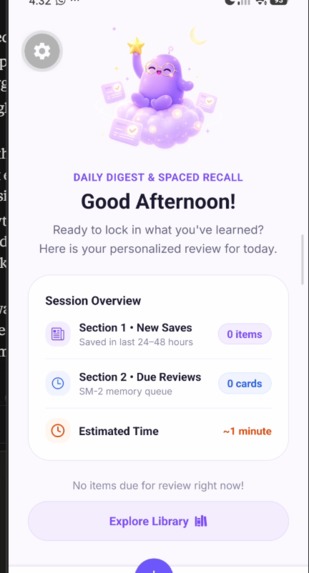
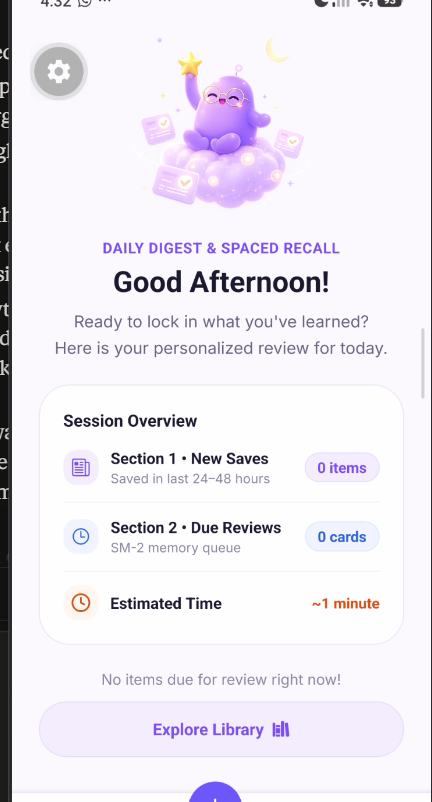
review tab
-
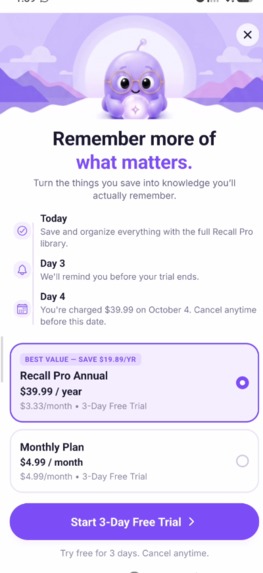
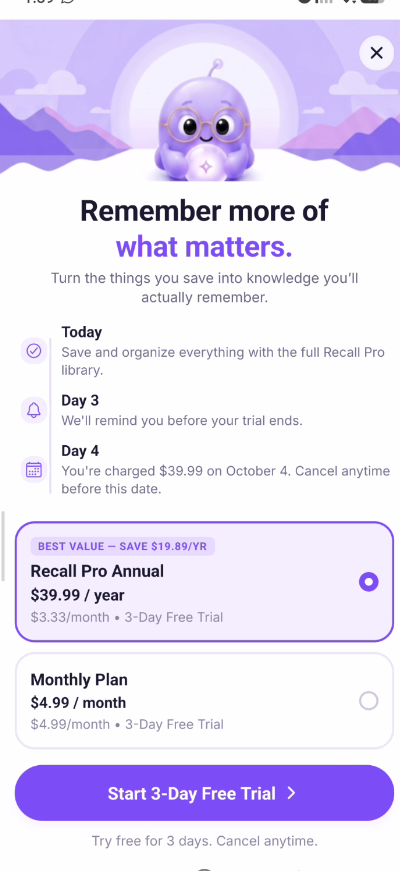
paywall
-
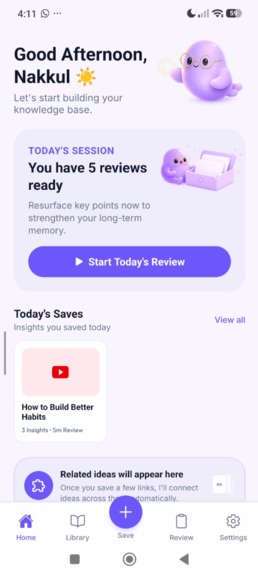
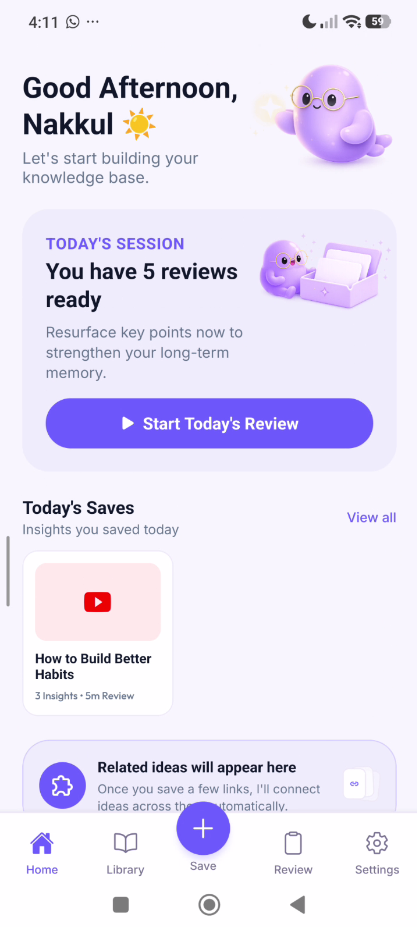
home page
-

app icon
-
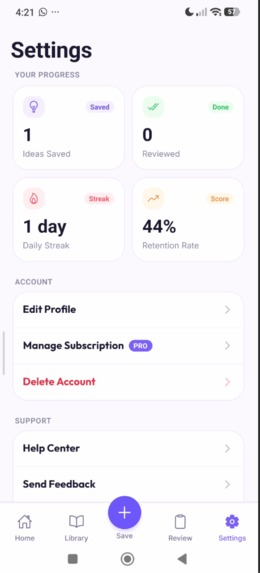
settings
-
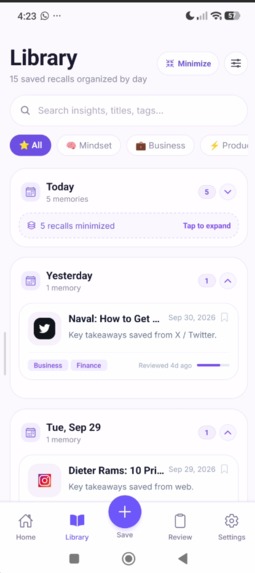
library

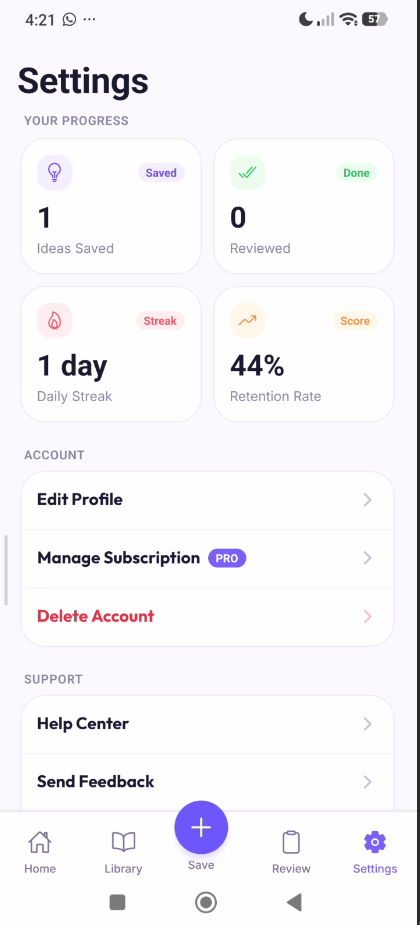
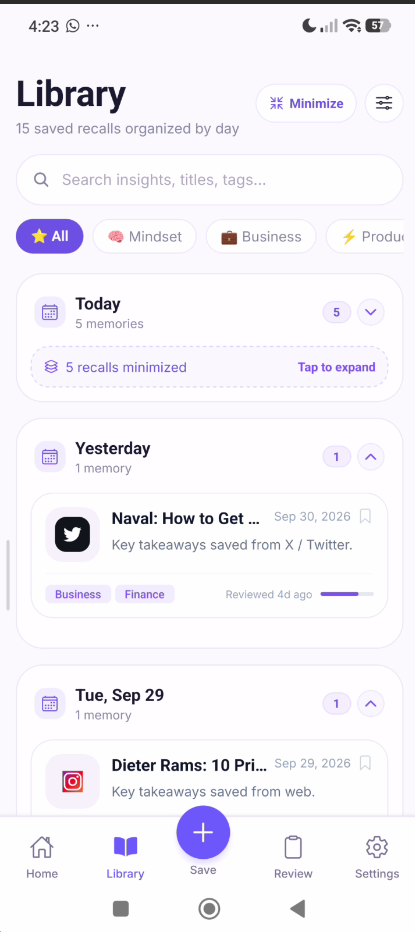
Inspiration
I kept running into the same problem.
I’d save a YouTube video, bookmark a post on X, or tell myself, “I need to remember this,” and then completely forget about it. There’s just so much good information online that saving something started to feel almost the same as forgetting it.
I didn’t want to build another bookmarking app where links just sit in a list forever. I wanted something that would actually help me remember the things I found useful.
That’s why I built Recall -> a personal second brain that takes the things I save, turns them into useful takeaways, and brings them back to me at the right time.
What It Does
Recall is a personal insight library for iOS and Android.
When I come across something useful while scrolling, I can simply share the link directly to Recall. I add a couple of rough thoughts about what I found interesting, and Recall takes care of the rest.
It uses AI to understand the link and my notes, then turns them into short, actionable takeaways that are easier to understand and remember.
But the important part is that Recall doesn’t just save them and forget about them.
It brings my saved insights back through daily reminders and spaced repetition. So something I found useful a few days or weeks ago can show up again when I’m likely to have forgotten it.
The idea is pretty simple:
Don’t just save information. Actually remember it.
How I Built It
I built Recall using Expo and React Native so I could support both iOS and Android from one codebase.
For styling, I used NativeWind v4, which made it much faster to build and iterate on the UI.
For the backend, I used Supabase for authentication and the database. The AI side is powered by Groq, using the llama-3.3-70b-versatile model.
The AI takes the rough notes I write along with the link context and turns them into structured, useful insights.
I also wanted the capture process to be as frictionless as possible. Instead of making users open Recall and manually paste a link, I used Expo Share Intent so links can be shared directly from apps like YouTube, X, and Instagram.
For reminders, I used Expo Notifications to handle the daily digest and spaced-repetition reminders.
Challenges I Ran Into
The hardest part was getting Recall to work smoothly with other apps. Every platform does things a little differently. X, YouTube, and Instagram all share links in their own ways, often adding tracking parameters or extra stuff that I didn't actually need.
I had to figure out how to take whatever a user shared, clean up the URL, extract the useful information, and get it into Recall without making the process feel slow or complicated. There was a lot of trial and error involved, especially because one small change could break the flow for another platform.
The second big challenge was figuring out how to actually make the information stick.
Saving links is easy. The harder question was: how do I make someone remember what they saved?
I looked into spaced repetition and experimented with different reminder schedules. I eventually built a system around intervals like:
- Day 1: Review the core takeaway the morning after saving.
- Day 3: First memory test right as short-term recall starts to fade.
- 1 Week: Reinforce the principle and move it into medium-term memory.
- 1 Month: Bring it back again to strengthen long-term retention.
The goal is to bring an insight back before it completely disappears from memory, while still keeping notifications limited enough that Recall feels helpful rather than annoying.
Getting that balance right took quite a bit of testing, but it was also one of the most interesting parts of building Recall.
Accomplishments I'm Proud Of
The thing I’m most proud of is how simple the capture experience feels.
I can be watching a YouTube Short, find something genuinely useful, hit Share, write down two or three rough thoughts, and have a clean insight saved in Recall within seconds.
That was the experience I wanted from the beginning. Saving something shouldn’t feel like work.
I’m also really happy with how the app turned out visually. I wanted it to feel clean and calm rather than like another productivity app constantly asking me to do more.
More than anything, I’m proud that Recall started as a problem I personally had and turned into something I could actually use myself.
What I Learned
Building Recall taught me a lot about working with AI beyond just calling an API.
I spent a lot of time learning how to write prompts that give the model clear structure, especially when I needed reliable JSON output and wanted to prevent it from adding information that wasn’t actually there.
I also became much more comfortable with React Native and Expo. I got hands-on experience with things like file-based routing, native share functionality, notifications, authentication, databases, and connecting all of those pieces into one mobile experience.
But probably the biggest thing I learned was that building a product isn’t always about adding more features.
Sometimes the difficult part is taking one simple idea and making the experience around it feel effortless.
What's Next for Recall
Right now, my biggest goal is to get Recall into the hands of real people.
As soon as I have the funding I need, I want to launch Recall on both the App Store and Google Play and start getting people to use it outside of my own testing.
After that, I want to focus on finding the people who have the same problem I had — people who are constantly saving videos, posts, threads, articles, and ideas but rarely come back to them.
I want to experiment with TikTok, X, and other social platforms to show the problem in a simple way, find the right users, and build a community around the idea of actually remembering what you learn online.
Once I have real users and feedback, I’d love to expand Recall with things like YouTube transcripts, saving specific moments from videos, and extracting useful information from images.
But I don’t want to build features just because they sound cool.
My next step is simple:
Launch it, find our first 1,000 active users, and iterate ruthlessly based on how it actually changes their learning habits.
I want to launch Recall on the App Store and Google Play as soon as I have the funding to do it, then use TikTok, X, and other platforms to find the people who genuinely have this problem.
From there, I want the product to be driven by real users — what they save, what they actually remember, where they drop off, and whether Recall genuinely changes the way they learn.
The goal isn’t just to build a bigger bookmarking app. It’s to prove that Recall can help people turn the endless stream of information they consume every day into knowledge they actually keep.

Log in or sign up for Devpost to join the conversation.