Inspiration
Product recalls are important, but finding out whether a recall affects a specific product and understanding what to do next can be confusing. We wanted to make this process simpler through a conversational assistant that connects recall information with clear, actionable steps.
What it does
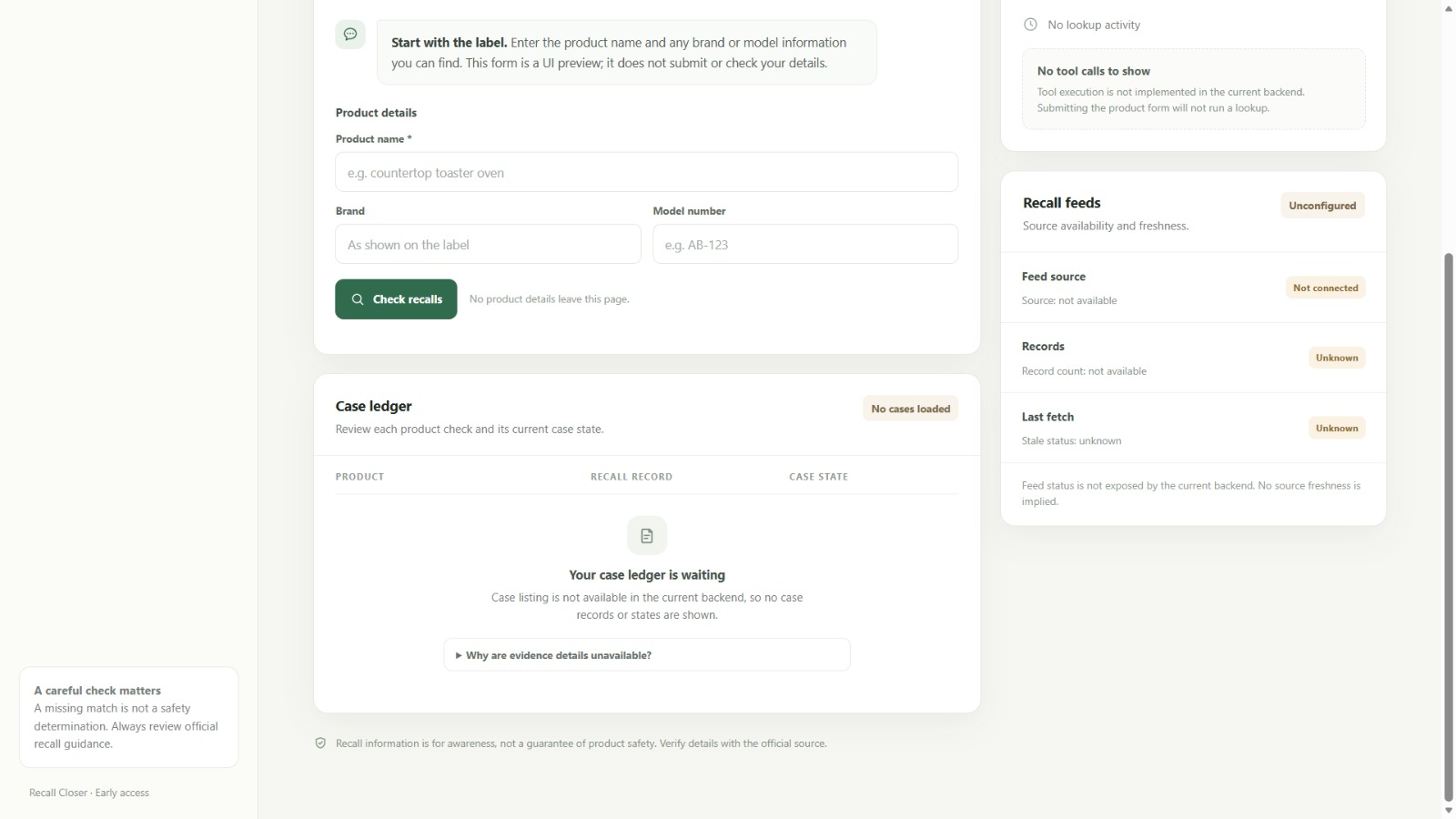
Recall Closer helps users check household products against available recall records and track what happens next.
- Register products using details such as brand, product type, and model.
- Check recalls using deterministic matching logic.
- Review evidence behind potential matches and recall results.
- Track resolution through evidence-based case updates.
- Maintain an audit trail of case changes and rejected actions.
- Use fallback data when the live recall feed is unavailable.
The goal is not just to find a recall, but to help users move from uncertainty to informed action.
How we built it
We built Recall Closer using Python, FastAPI, and SQLite. A deterministic engine handles product matching, case transitions, and audit logging, while the feed integration normalizes available CPSC recall data and stores it in a persistent cache.
We also implemented an offline snapshot fallback, duplicate-safe database synchronization, and tools for product registration, recall checks, case management, and feed status. The prototype includes an MCP endpoint and a simulated Alexa+-style conversational interface.
Challenges we ran into
One of our biggest challenges was making the system useful without allowing AI-generated responses to determine safety-critical outcomes. We addressed this by keeping matching and case transitions in deterministic application logic and requiring evidence for important decisions.
We also had to handle unreliable network access, prevent duplicate recall records during synchronization, and ensure that rejected case transitions were recorded for traceability.
Accomplishments that we're proud of
We built a working foundation that connects recall data, product matching, and resolution tracking in one workflow.
We are particularly proud of the evidence-based state machine, persistent recall caching, offline fallback, and audit trail. Our reported automated test suite passed all 21 tests covering feed handling, matching behavior, and case transitions.
What we learned
We learned that a useful AI assistant needs more than natural conversation. It needs reliable underlying logic, traceable evidence, clear limitations, and a practical path from information to action.
We also learned the importance of designing for failure: when a live data source is unavailable, the system should communicate that limitation rather than present outdated information as current.
What's next for Recall Closer
Next, we plan to expand recall-source coverage, improve product identification, strengthen end-to-end testing, and deploy the application for broader evaluation. We also aim to explore integration with supported voice-assistant services so users can check products and follow resolution steps through natural conversation.
Our long-term vision is simple: make product recall information easier to understand and easier to act on.
Built With
- cpsc
- css
- fastapi
- google-gemini-api
- html
- javascript
- mcp
- python
- recall
- sqlite

Log in or sign up for Devpost to join the conversation.