Recall
Ask your Ring cameras "Where was Dad last seen?" and get one answer with proof. Recall remembers, flags a broken routine, and warns when a camera went dark, so silence is never mistaken for safety.
Tracks and challenges entered
- Ring (primary), caretaking
- AWS Builder mini challenge
- Open Source mini challenge
- Alexa+, an MCP server is included as an integration surface (not entered as a separate track project)
Links
- Code: https://github.com/Garinmckayl/recall (public, MIT license)
- Try it live: https://recall.arcumet.com
- Product feedback:
PRODUCT_FEEDBACK.md· Friction log:FRICTION_LOG.md
Judge quickstart: 3 clicks, no login
Live: https://recall.arcumet.com
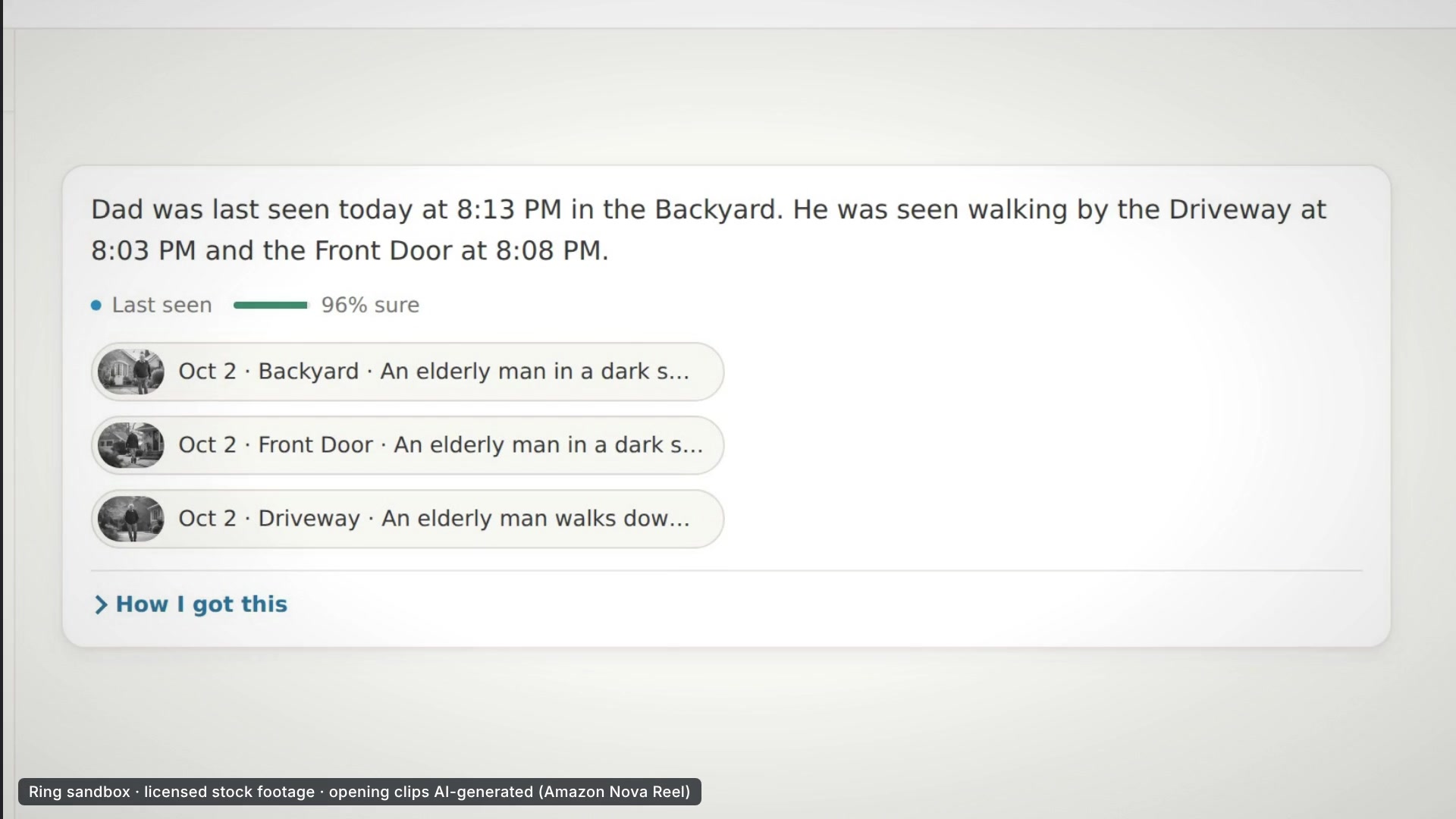
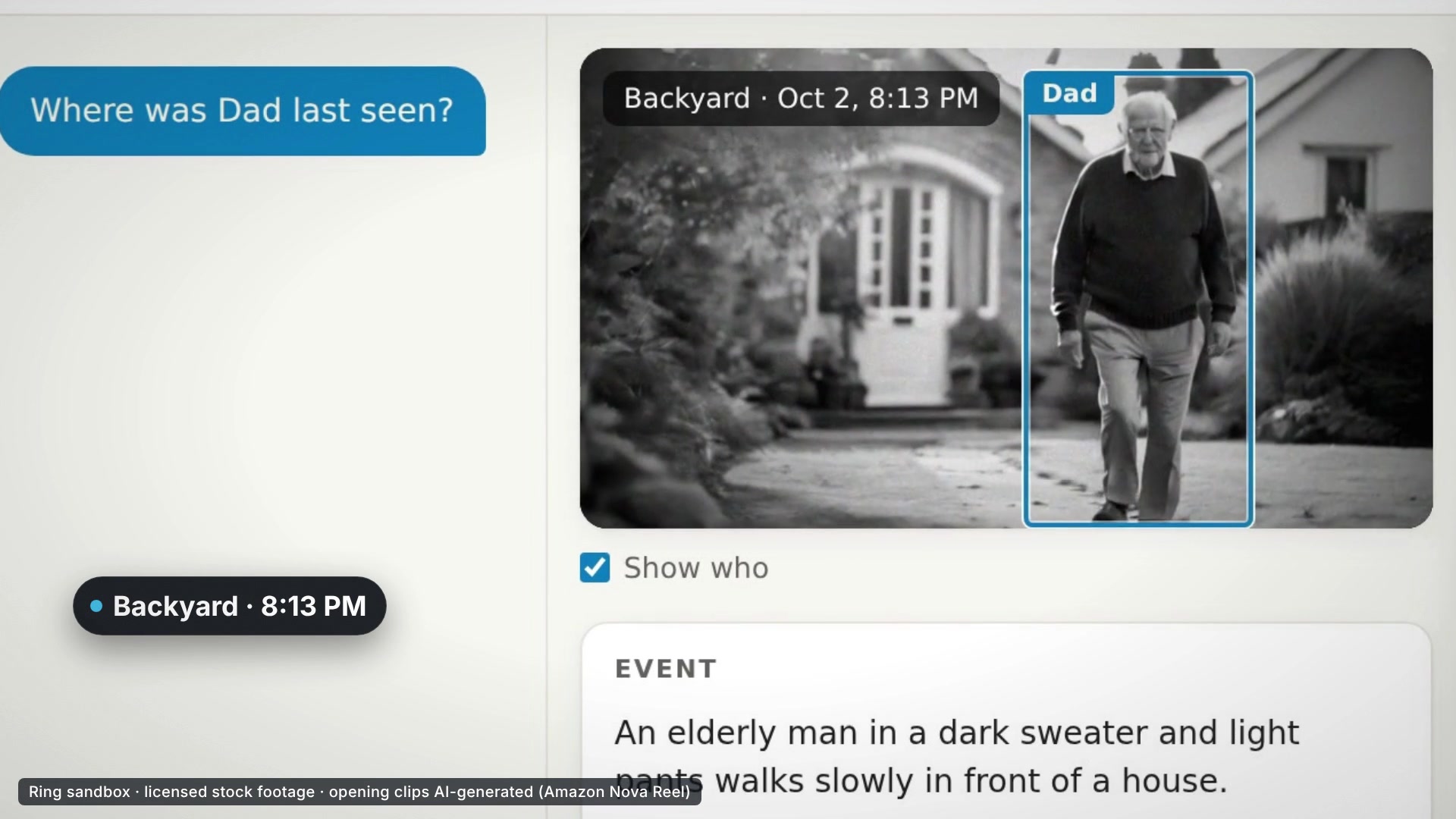
- Ask "Where was Dad last seen?" One answer, a three-camera path, a box on him in every clip. https://recall.arcumet.com/?step=1
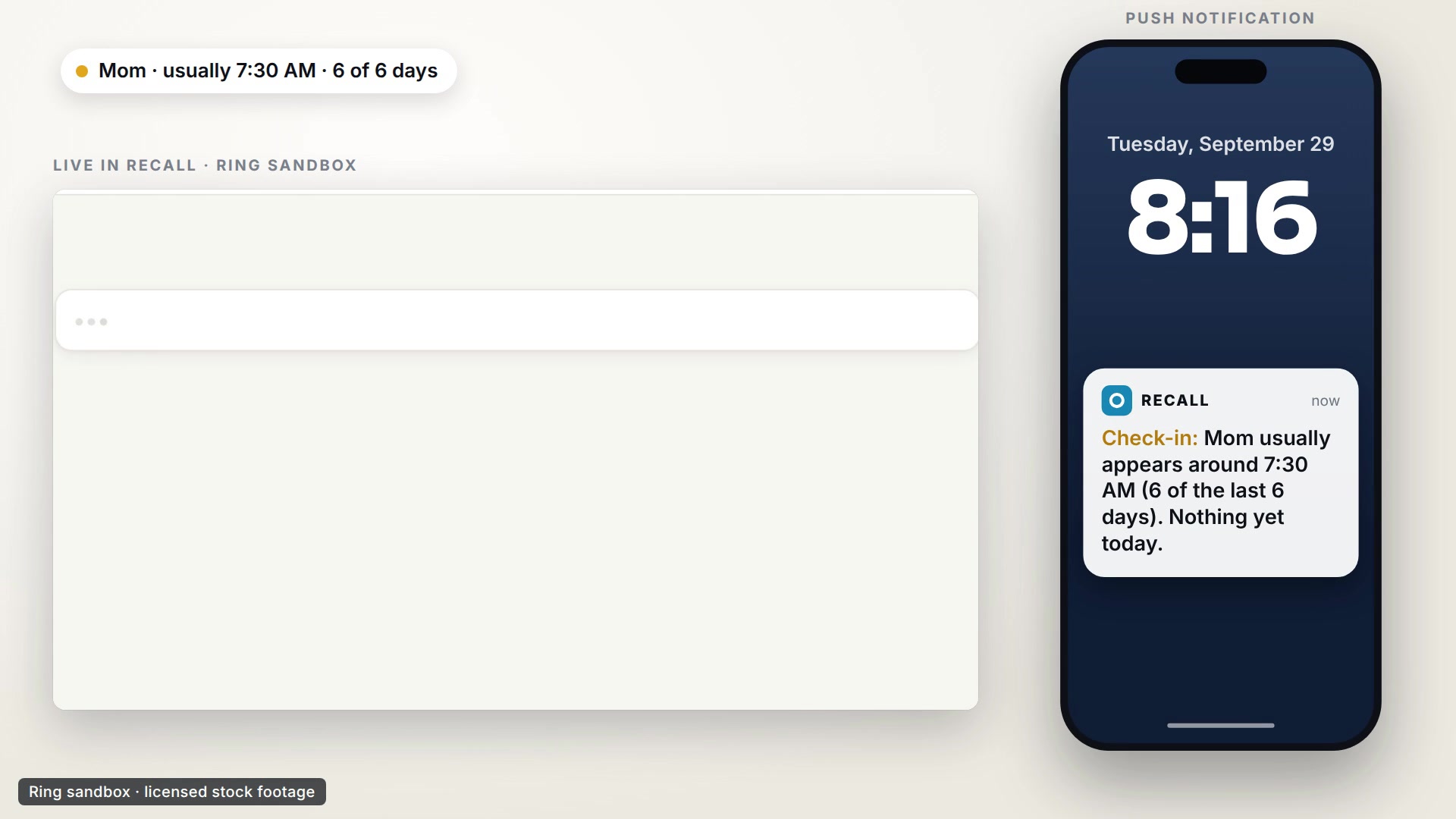
- Ask "Is Mom's day normal today?" The routine engine notices what didn't happen. https://recall.arcumet.com/?step=2
- Emit Ring event. A signed Ring webhook is ingested live and answerable seconds later. https://recall.arcumet.com/?step=3
- Bonus: send device_offline for the Backyard, then redo step 1. Recall now refuses to say "nothing happened" for a camera Ring says was dark.
Inspiration
It's 8:20 PM. Your father is 81 and lives alone. He isn't answering his phone.
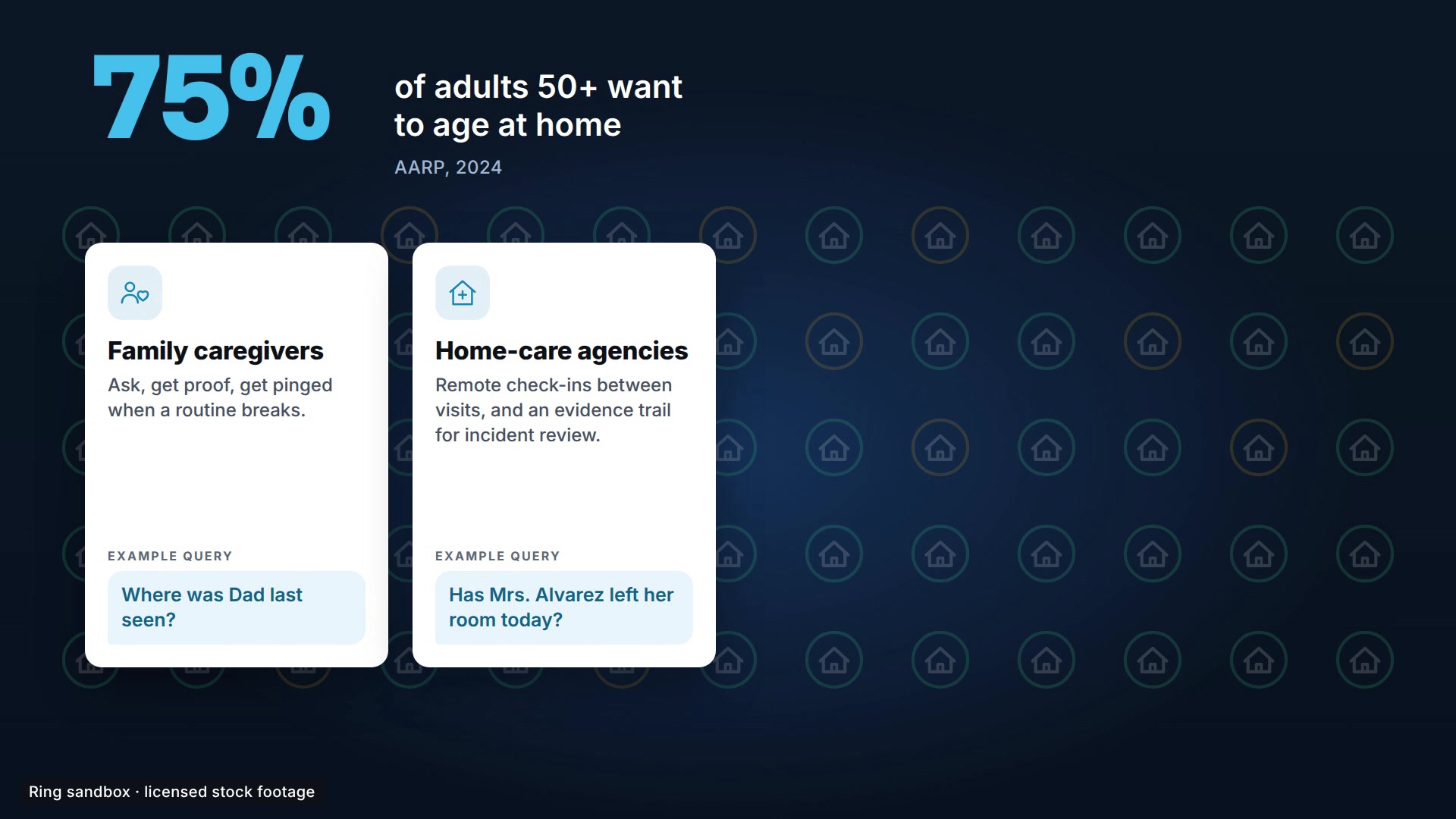
The cameras have already seen everything. But today you still have to know where to look, and scrub through hours of clips while your pulse climbs. Three out of four adults over 50 want to stay in their own homes as they age (AARP, 2024). One in four older adults falls every year, over 14 million people (CDC), and in a cohort of people over 90, 30% of those who fell lay on the floor for an hour or more, which was strongly associated with serious injury, hospital admission and moves into long-term care (BMJ, 2008). Even Ring's own help page says video search may not return results for "specific people or characteristics" or "searches phrased as questions" (Ring), exactly how a worried family member asks. A camera shows you a video. A caregiver needs an answer.
What it does
Not security AI. Not video search. Not facial recognition. Persistent visual memory for caretaking and safety.
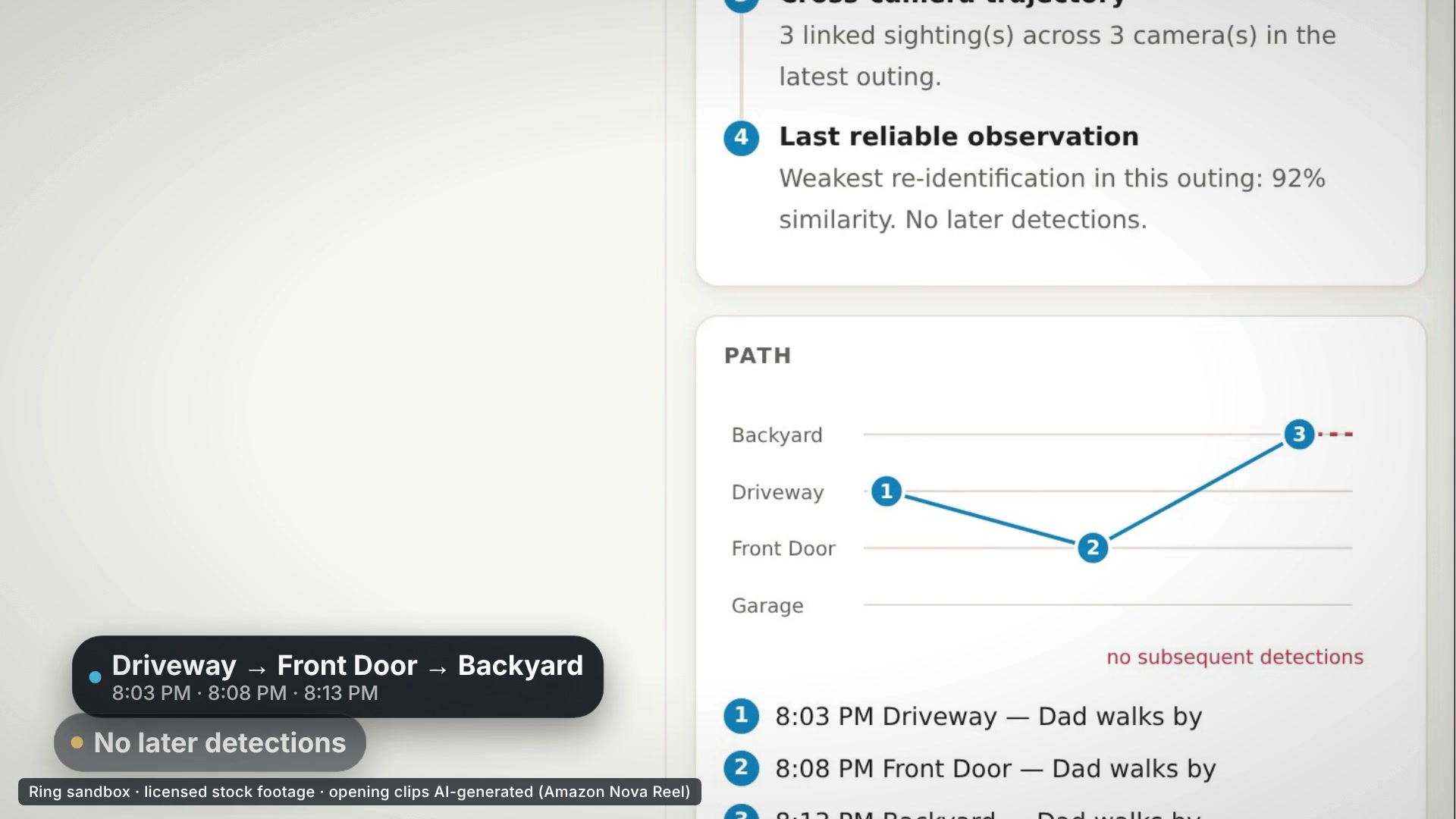
Ask "Where was Dad last seen?" and instead of "3 matching videos" Recall gives one reconstructed answer: Dad was last seen today at 8:13 PM in the Backyard, with the path (Driveway 8:03 → Front Door 8:08 → Backyard 8:13), a box on him in every clip, the exact second to jump to, and a plain "no later detections."
- It reasons across cameras and time. The same person is recognised across cameras and days; each answer is assembled from many events, and every step (who, when, where, how sure) is shown.
- It doesn't wait to be asked. Recall learns each named person's routine from their own history and pushes a check-in when the day breaks pattern: "Mom usually appears around 7:30 AM (6 of the last 6 days). Nothing yet today." It notices what didn't happen.
- It watches on request. "Tell me next time this person comes" creates a standing rule; every new Ring event is checked and a match sends a push notification.
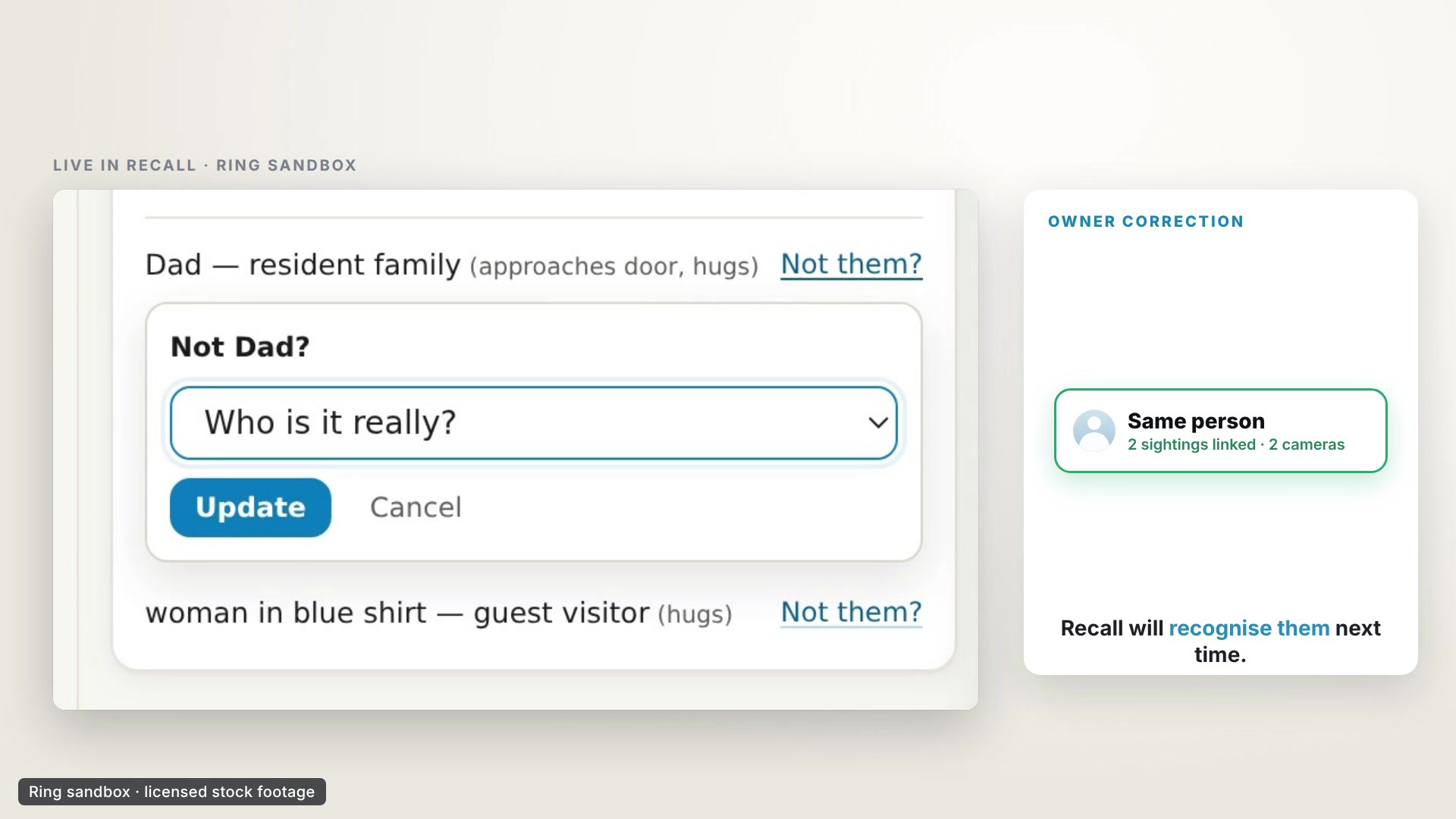
- You stay in control. "That's not him", move a sighting, split a person, merge two, and identity improves. Safety observations are always labelled unverified; the clip is the ground truth. Recall does no face recognition and keeps no face templates.
- Agents can use it. An MCP server (Streamable HTTP, spec 2025-11-25) exposes
ask_home,last_seen,get_timeline,list_peopleandwatch_for, so Alexa+ and any MCP agent can ask a home a question.
The same memory answers "which guy is the delivery guy?" or "who knocked six days ago?", but caretaking is the point.
How we built it
Ring event → Perceive → Decide → Re-identify → Memory graph → Reason → Answer + evidence → Watch
- Ring (called at runtime, in an original way):
ring_api.pyis written to the published Ring Partner API: OAuth refresh-token rotation, JSON:API device discovery with camera-module ids,history-eventswith cursor pagination, video download (200/206/redirects) and snapshot download (303 to a pre-signed URL), 429 backoff./ring/webhookverifiesX-Signature(HMAC-SHA256 over the raw body), de-duplicates onmeta.request_idand on camera plus time, and acknowledges immediately. Lifecycle webhooks (device_offline/device_online) feed a coverage log, so a "last seen" answer knows whether any camera was dark afterwards and says so instead of claiming "no later detections". With credentials the client talks to the live platform; without them, toring_sim.py, a sandbox that speaks the same documented wire formats and sends signed webhooks. One code path either way. - Amazon Bedrock (AWS Builder): Amazon Nova Pro reads six keyframes per clip in one Converse call and returns a structured event record (actors, appearance, carried objects, actions, interactions, a body box per keyframe, hedged safety observations). Amazon Nova Lite extracts query slots and narrates strictly from evidence. Amazon Titan embeddings (body-crop images and appearance text) drive person re-identification and semantic event retrieval. Integration details, what worked and what needs work are in
PRODUCT_FEEDBACK.md. - Decisions: every classification, an actor's role and concern, the question's reasoning operator, the subject, the watch-rule type, is a typed, calibrated choice from TypeSafe's Jev model through the Decisions API. Generative models observe and narrate; they never decide.
- Reasoning: deterministic operators over a SQLite memory graph (identify a role, find events, last seen, trajectory, after-departure, security incident, routine check, count, watch). Dates are resolved by code, not a model. A routine engine (median ± MAD) learns usual times; a background loop pushes check-ins.
- UI: a single-file light interface, timeline, chat, evidence panel with video overlays, reasoning steps, People, and a "Needs attention" digest.
- Quality and safety: 44 offline tests; a rehearsal tool that checks staged clips will support their demo question; rate limits and an admin token for public deployment.
Challenges we ran into
- Real Ring access. The live platform needs early-access credentials, an ID check and a device. We built a faithful sandbox and kept one client code path for both. The client implements the published wire formats (OAuth refresh, JSON:API discovery, history pagination, media 200/206/303, Webhook v1.1, lifecycle events) and is tested against mocked transports; it has not been run against the live platform.
- Re-identification without faces. Generic image embeddings leak background and framing. We blend image, text and attribute similarity and keep exemplar sets that can be rebuilt after owner corrections.
- Honest answers. An early version narrated "Yes" while its own facts said "no entry recorded". A computed verdict is now the first sentence of every answer, with tests to keep it that way.
- Trust. No accusatory language for safety events; they are flagged as unverified observations.
Accomplishments that we're proud of
- A hero answer that reads like a person and comes with proof you can click, a three-camera path with a box on the person in every clip.
- A real memory: the same person recognised across cameras and days in seconds.
- A working live loop: signed webhook → ingest → re-identify → rule fires → push notification.
- Coverage-aware answers: Ring's own device status turns "no detections" from a guess into a claim that is only made when someone was watching.
- Proactive caretaking: Recall pushes a check-in when a routine breaks, the case no clip search can find, because nothing happened.
What we learned
Search finds videos; memory answers questions. The biggest gains came from separating what a model sees from what the system decides, storing small structured records instead of re-watching video, and making every number traceable to stored evidence.
What's next
Live event history and subscriptions on real Ring accounts, multi-site dashboards for care teams, an incident-report export, tighter re-identification with owner feedback at scale, and Alexa+ voice: "Alexa, where was Dad last seen?"
Business value
The need is the same whether one family or a thousand residents are involved: know that someone is safe without putting a human in front of a screen.
- Family caregivers: the everyday product, ask, get proof, get pinged when a routine breaks.
- Home-care agencies: remote check-ins between visits, an evidence trail for incident review, fewer unnecessary welfare visits.
- Senior-living operators: the same memory across many cameras and sites, "has anyone been in the east wing after 9 PM?" answered in a sentence.
- Insurers and claims: timestamped, clip-backed evidence for aging-in-place programs and incident reports.
Structured event records mean reasoning over rows instead of re-processing video, so answers are fast and cheap. Ingestion is signed and idempotent, safety flags are human-in-the-loop, corrections are owner-controlled, there is no face recognition, and it can be deployed in the customer's own AWS account. (These are use cases we designed for, not customers or pilots.)
Built with
Ring Partner API (client, signed webhooks, sandbox) · Amazon Bedrock (Nova Pro, Nova Lite, Nova Reel, Titan embeddings) · TypeSafe Jev (Decisions API via OpenRouter) · Model Context Protocol (Alexa+) · Python · FastAPI · SQLite · ffmpeg · Playwright · HyperFrames · ElevenLabs
Track-specific evidence (for reviewers)
- Ring: the repository calls Ring technology at runtime,
ring_api.RingClient(devices, event history, clip and snapshot download), the/ring/webhookreceiver with HMAC verification, andpipeline.sync(). The demo video shows Recall running on the Ring sandbox (same endpoints, signed webhooks), labelled on screen. Priority area: caretaking. - AWS Builder: Amazon Bedrock, Nova Pro (perception, Converse multi-image), Nova Lite (slot extraction and narration), Titan image and text embeddings (re-identification, retrieval), and Nova Reel 1.1 (generated the older-man footage in the demo's opening, via S3 and the async API;
video/generate_reel.py). The integrations, what worked and what needs work are documented inPRODUCT_FEEDBACK.md. - Open Source: new project, MIT licensed. Repository: https://github.com/Garinmckayl/recall · GitHub username: Garinmckayl · Contribution: a complete, documented memory layer for Ring events, signed-webhook ingestion, a Ring Partner API client and sandbox, person re-identification without faces, routine learning and proactive check-ins, an MCP server, 44 tests, deploy scripts and the demo-video source.
- Alexa+:
POST /mcp, Streamable HTTP, JSON-RPC 2.0, protocol 2025-11-25; toolsask_home,last_seen,get_timeline,list_people,watch_for. Validated with raw JSON-RPC (no Alexa+ device harness was available, see the friction log).
Testing instructions
- Live: https://recall.arcumet.com, open it, click Where was Dad last seen?, then Is Mom's day normal today?, then Demo → Emit Ring event, or just use the three quickstart buttons at the top of the page. No login required. (Rate-limited to protect the demo.)
- Locally:
pip install -r requirements.txt,cp .env.example .env(OpenRouter key; AWS credentials with Bedrock access),python3 -m uvicorn server:app,python3 seed.py. The 44 tests run offline withpython3 -m pytest tests -q. A 3-minute tour is in the README.
What was built during the submission period
Everything in the repository was built between Aug 31 and Oct 23, 2026. The project grew from an earlier prototype ("HomeGuard", docs in docs/v1/) started in the same period; Recall replaced its analysis pipeline with the memory graph, Ring client and sandbox, re-identification, reasoning operators, routines and check-ins, corrections, the MCP server, deployment scripts and the demo-video source.
Notes for reviewers
- The video opens and closes with a short dramatization (labelled on screen). Everything else is the real product running on the Ring sandbox. The footage is licensed stock (Mixkit Free License) plus AI-generated clips of an older man made with Amazon Nova Reel (used for "Dad" in the opening and in the default demo data), labelled on screen and on the end card. No real household footage or personal data is used.
- Statistics in the video carry their sources on screen; the "412 clips this month" counter is captioned illustrative; business examples are tagged as example queries.
Built With
- amazon-web-services
- bedrock
- ring

Log in or sign up for Devpost to join the conversation.