-

logo
-
-

Inspiration
I was tired of losing track of work over time and wished I could consult a unified memory about my past activities.
What it does
Recall remembers what you did on your computer, so you and your AI agents can ask about it later.
You pick the apps. Recall reads their text on your PC (no screenshots, no keystrokes), removes secrets and sends it to your own private cloud memory. Then you ask in plain words, from any device: "What did I do on my laptop yesterday?", "Which sponsor did we pick?", "How long was I in VS Code today?"
What you can do
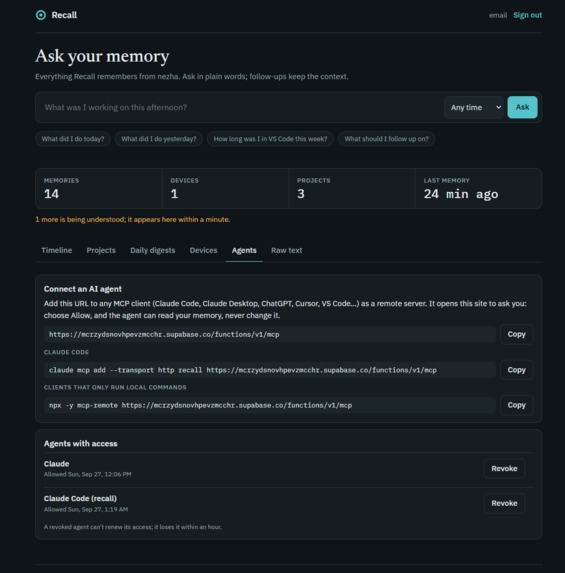
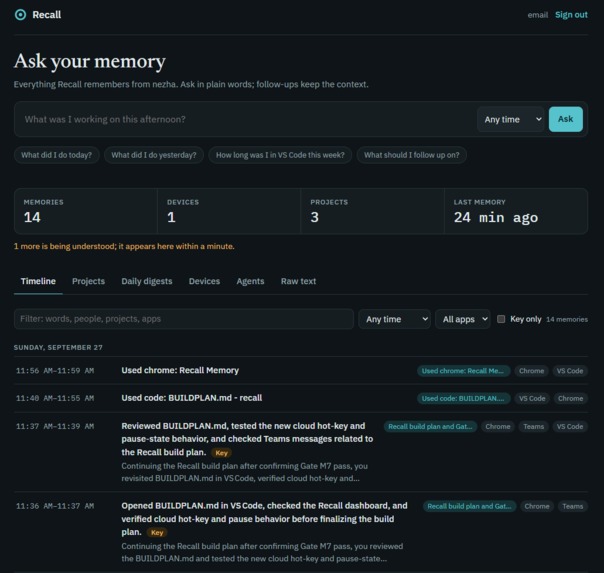
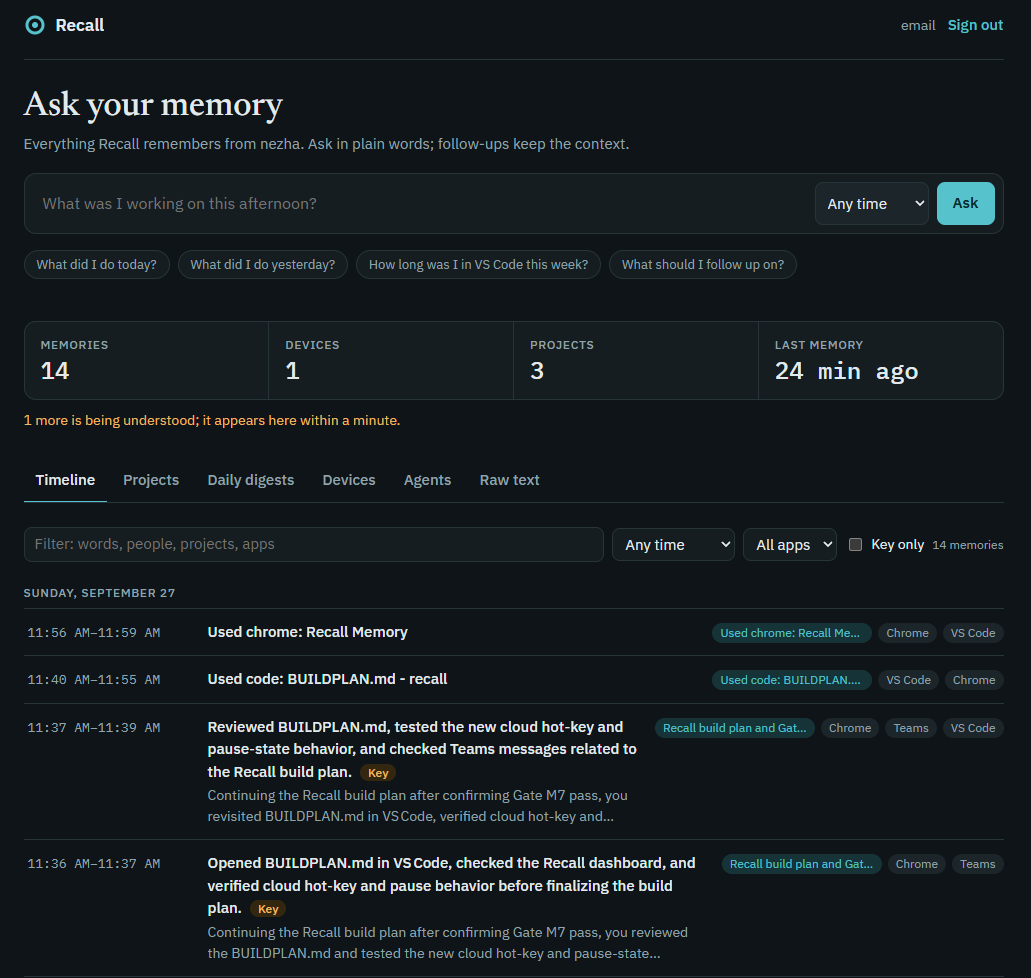
- Ask your memory at https://recall-memory-yxxtries.vercel.app. Answers are in plain words, cover all your devices and show the memories they came from. Follow-up questions work, the ask box stays at the top while you browse, and each cited memory opens in the timeline or its project.
- See what it remembers. Each memory shows its summary, its project and a Key badge when it matters; filter the timeline by words, period, device or app.
- Search from anywhere on your PC with
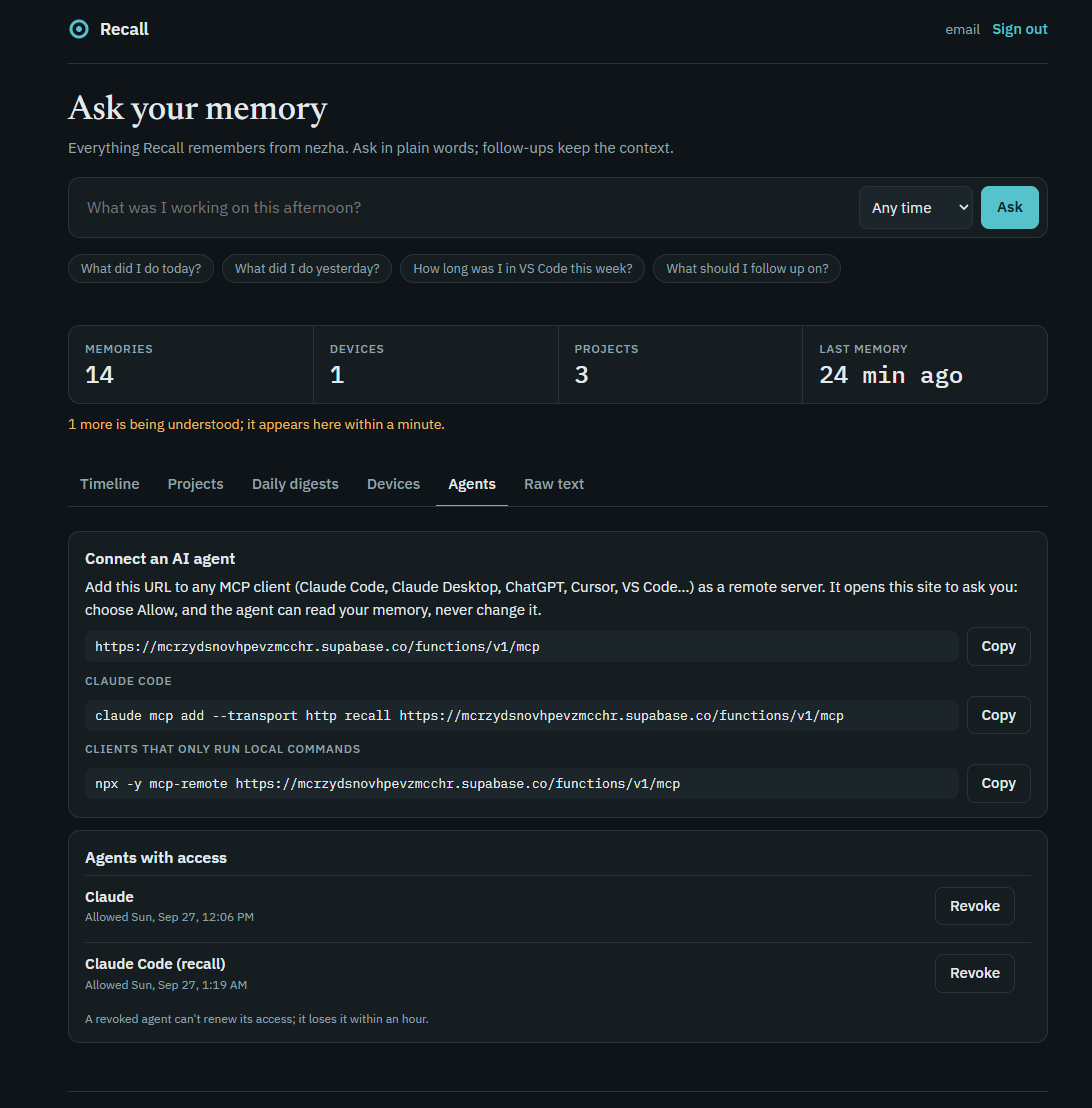
Ctrl+Shift+Space. - Give your AI agents a memory. Claude Code, ChatGPT, Cursor or any other MCP client can read it, read-only, once you allow it.
- Keep it private. Only the apps you tick are read, secrets are removed on your PC, and no one else can see your memory.
Recall has three parts:
- Device agent (
recall/): one Python process on Windows. It captures text, keeps a local keyword index, cuts activity into episodes, redacts secrets and uploads. - Cloud (
supabase/): Postgres with pgvector, pgmq, pg_cron and pg_net, plus five Deno Edge Functions. It turns episodes into structured memory and serves it. - Dashboard (
web/index.html): one static page on Vercel.
Challenges we ran into
Performance overhead at each stage was the most important problem to tackle. The hardest obstacles were reading information on device without performance overhead and then storing this information without losing its context.
Accomplishments that we're proud of
Recall is close to free while you work: in a 30-minute run of light use (31 text reads), the whole process averaged 0.01% of total CPU, peaked at 0.59%, and used 128–138 MB of RAM on a mid-tier laptop. Every stage runs only when something changes, on a below-normal-priority thread, and the heavy work (the LLM and embeddings) happens in the cloud.
Built With
- javascript
- mcp
- postgresql
- python
- supabase

Log in or sign up for Devpost to join the conversation.