-
-
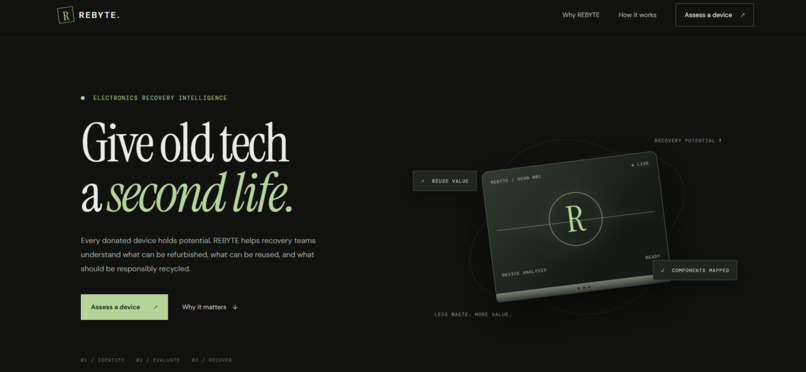
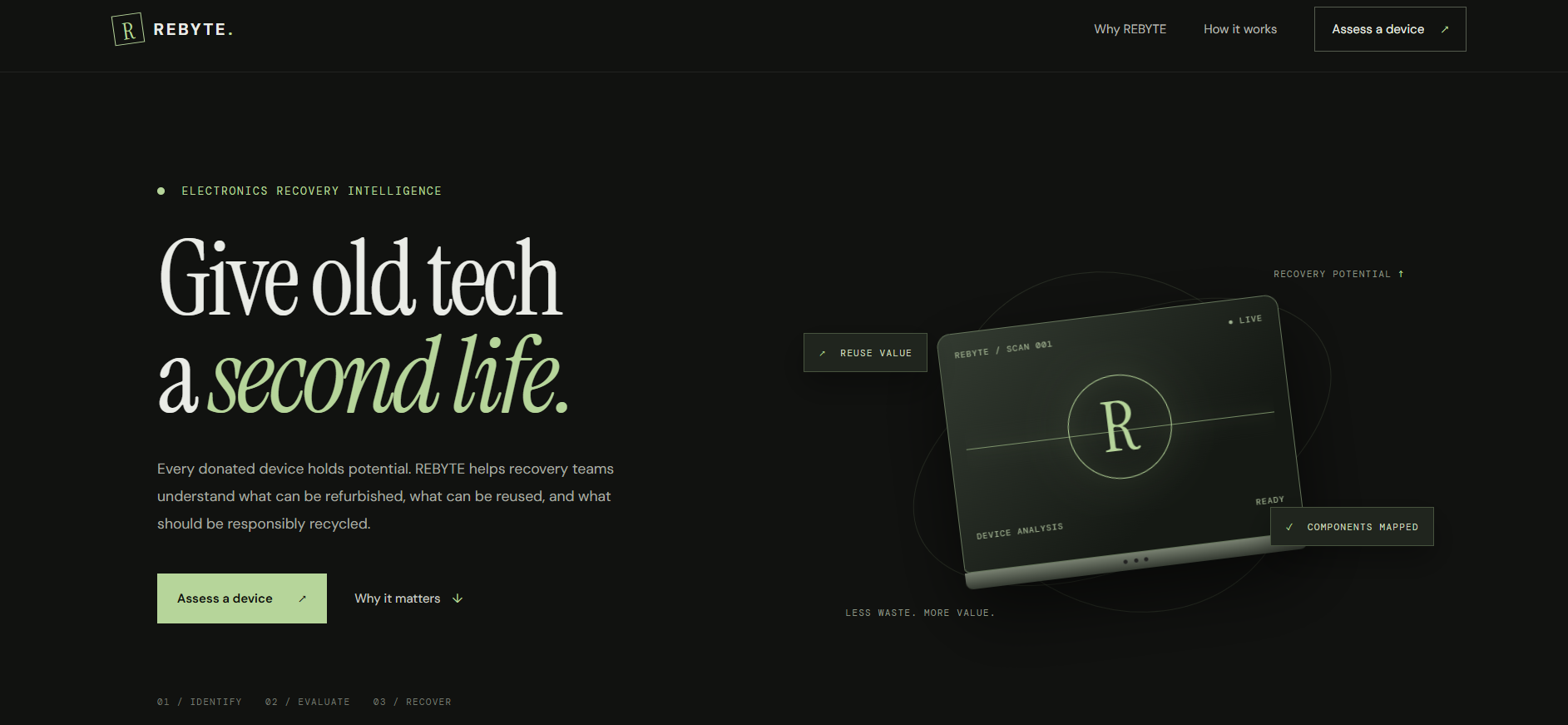
Our real homepage showing what our website actually does
-
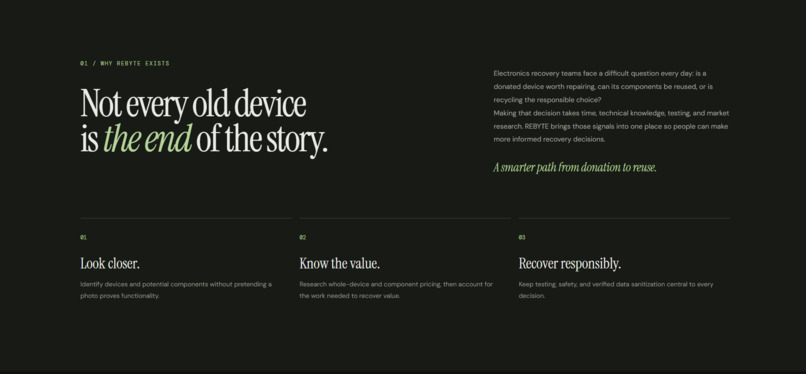
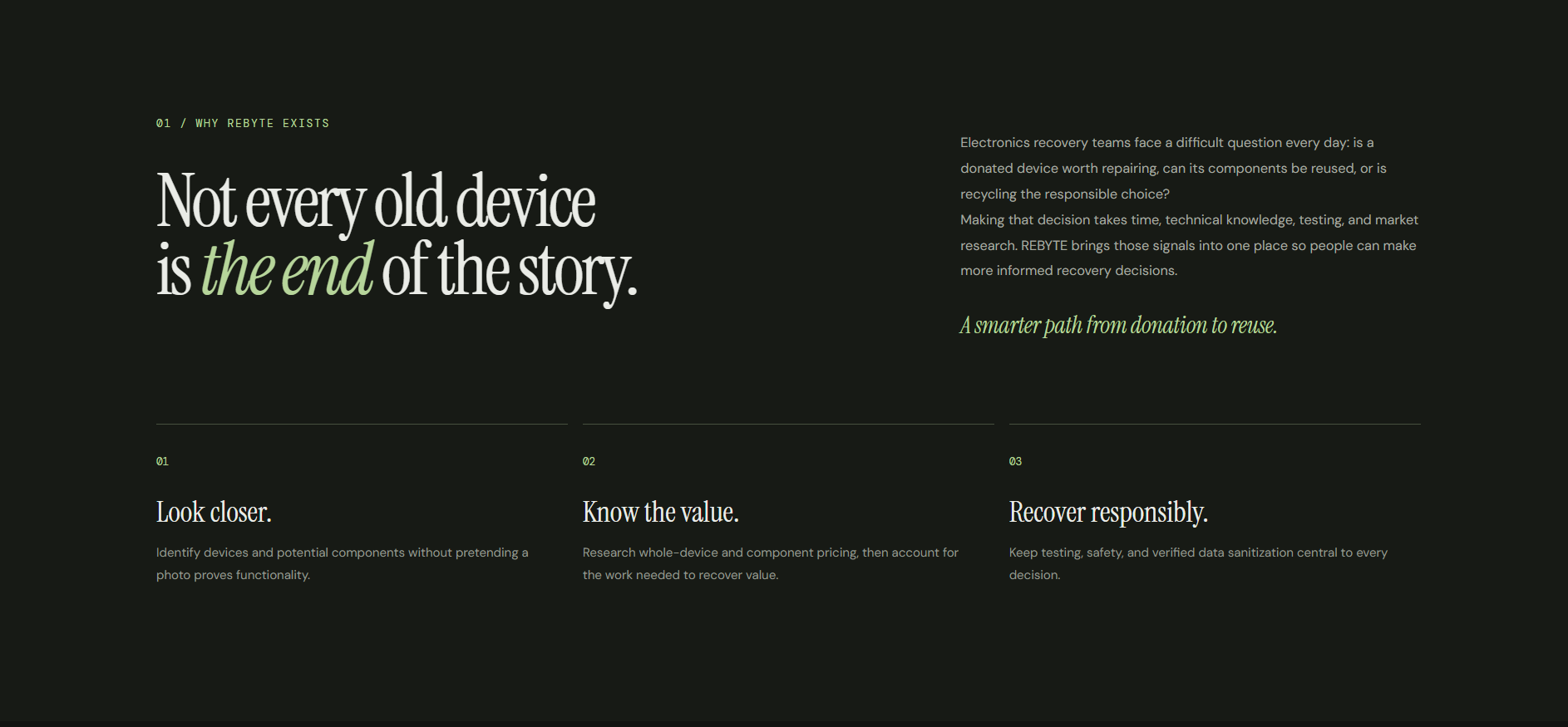
The problem and why this is very important
Inspiration
A computer can stop working without losing all of its value. Sometimes, the most valuable parts are still waiting to be discovered.
We were inspired by the story of Dylan Zajac, who started refurbishing computers as a high school student. While negotiating the price of a refurbished laptop with a father whose son needed one for school, Dylan realized he was making a 200% profit. Instead of completing the sale, he decided to give the computer away. That experience helped inspire him to create Computers 4 People, a nonprofit that refurbishes and donates computers to people in need.
His story made us think about a different side of electronic waste. A device that someone considers outdated or unusable might still contain valuable components, have a second life, or help someone who needs affordable technology.
For organizations like Free Geek, however, deciding what to do with donated electronics involves more than simply checking whether a device turns on. Each device may require inspection, testing, repairs, price research, and careful decisions about whether recovering it is worth the effort.
We saw an opportunity to make that process easier and more informed.
What if organizations could understand not only what a device contains, but also what it could be worth recovering?
That SIMPLE question became the heart of REBYTE.
What it does
Every donated electronic device represents a decision: repair it, recover its components, investigate it further, or recycle it. REBYTE helps make that decision more informed.
REBYTE is an AI-assisted electronics assessment and recovery platform designed to help organizations evaluate donated devices and understand their potential financial value.
Users can enter a device's brand, model, specifications, and condition, as well as upload an image for additional context. REBYTE then generates a structured assessment with four possible recommendations:
(some features)
RECOVER: Identify components that may have reuse or resale potential.
INVESTIGATE: Recommend additional inspection or testing when important information is missing.
HOLD: Delay the decision until uncertainties are resolved.
RECYCLE: Recommend responsible recycling when recovery is not practical.
What makes REBYTE different is its FINANCIAL analysis.
Rather than stopping at hardware identification, REBYTE researches potential resale prices for complete devices and individual components. It also considers labor, parts, and testing costs to estimate potential net profit.
This allows users to compare different recovery possibilities and consider whether refurbishing an entire device or recovering selected components makes more financial sense.
The goal is simple: help organizations make better decisions about the technology they already have.
How we built it
built REBYTE around two connected parts of the electronics recovery process: technical assessment and financial decision-making.
The frontend uses React, TypeScript, Vite, and Tailwind CSS. The backend uses Express and TypeScript to process assessments and connect external services.
I integrated OpenAI to analyze device information, assist with component identification, and generate structured recovery recommendations.
For financial research, I integrated Tavily to search for market information and supporting sources. The platform uses this information to estimate potential resale ranges for complete devices and individual components.
We also developed a financial analysis system that considers estimated resale value alongside labor, parts, and testing costs. It distinguishes between asking-price claims and completed-sale claims when the available source evidence supports that distinction.
To make the platform easier to use, I added local assessment history so users can revisit previous evaluations without creating an account.
One important design decision was to make uncertainty visible. An image can help identify a device, but it cannot prove that its components function. REBYTE therefore needs additional testing information before a component can be treated as confirmed working hardware.
Challenges we ran into
One of the biggest challenges was understanding that identifying a component and determining its actual value are two very different problems.
A computer might contain an expensive processor, memory module, or storage drive. However, that does not mean the component works, is compatible with another device, or can actually be sold for its listed price.
This made financial research especially challenging. Online listings often show what sellers are asking, not necessarily what buyers are paying. Using those prices without considering their limitations could create misleading profit estimates.
To address this, I built the financial analysis around source-based research, price comparisons, entered refurbishment costs, and clear distinctions between different types of price evidence.
Another challenge was connecting technical recommendations with financial decisions. A device might be difficult or expensive to repair as a whole while still containing components worth recovering.
I wanted REBYTE to recognize those possibilities rather than automatically treating a damaged device as electronic waste.
These challenges shaped one of the platform's most important principles: when information is incomplete, a system should acknowledge uncertainty instead of pretending to know the answer.
Accomplishments that we're proud of
Our biggest accomplishment is building a working prototype that brings technical electronics assessment and financial analysis into one platform.
We are especially proud of developing the financial analysis feature. Instead of simply identifying hardware, REBYTE explores the potential value of both complete devices and individual components.
We also developed four distinct recovery recommendations, giving users more options than the usual choice between repairing a device and recycling it.
Another accomplishment is the platform's focus on transparency. REBYTE presents supporting research and makes room for uncertainty rather than treating every AI-generated recommendation as a confirmed fact.
Most importantly, we turned an idea into an actual application with a working interface, AI integration, financial research, and an assessment history.
We are proud that the result addresses a practical problem rather than using AI simply because it is available.
What we learned
Building REBYTE changed how we think about electronic waste.
At first, it might seem like a simple problem: identify an old device, determine whether it works, and decide what to do with it. In reality, each device creates several smaller decisions involving hardware, testing, compatibility, market demand, repair costs, and data security.
We learned that the most useful AI systems are not necessarily the ones that give the fastest answers. They are the ones that help people understand their options and recognize what they still do not know.
We also learned that financial estimates require careful research. A high resale listing does not guarantee a sale, and a component's potential value does not guarantee that recovering it will be profitable.
Most importantly, we learned that sustainability and financial practicality can support each other. Better decisions may help organizations recover more value while keeping usable electronics out of the waste stream.
What's next for REBYTE
A working prototype is only the beginning. Our next step is to understand how REBYTE performs outside a development environment and how it could become part of a real electronics recovery process.
One of our biggest future goals is to explore a partnership with Free Geek itself. Working directly with its team would give us the opportunity to understand its intake, inspection, testing, refurbishment, and recycling processes. Their experience could help us improve REBYTE's recommendations and shape the platform around the challenges organizations actually face.
We also want to explore integrating physical scanning sensors into future versions of REBYTE. Instead of relying primarily on images and manually entered information, these sensors could collect additional information about a device and its components. Combined with AI, this could give the platform a more complete understanding of the hardware being evaluated and help produce more informed assessments.
Beyond that, we plan to improve market research, expand component identification, incorporate more verified testing information, and make financial estimates more reliable. Data security will also remain a priority. Before a storage device can be safely reused, its data must be securely erased and that process verified. We want future versions of REBYTE to account for this as part of the recovery process.
Our long-term vision is to help electronics recovery organizations make better decisions, recover more usable technology, and reduce unnecessary electronic waste. We want REBYTE to help people see potential where others might only see discarded electronics.
REBYTE is built on a simple belief: the end of a device's first life should not have to mean the end of its usefulness.
Built With
- artificial-intelligence
- component-recovery
- e-waste-management
- electronics-recycling
- environmental
- express.js
- financial-analysis
- full-stack-development
- hardware-assessment
- machine-learning
- node.js
- openai
- react
- rest-api
- sustainable-technology
- tailwind-css
- tavily
- typescript
- vite
- zod


Log in or sign up for Devpost to join the conversation.