-
-
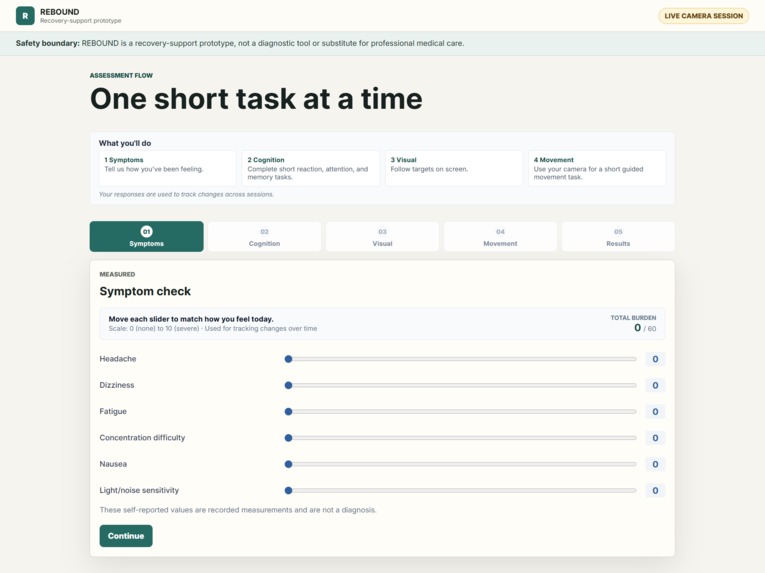
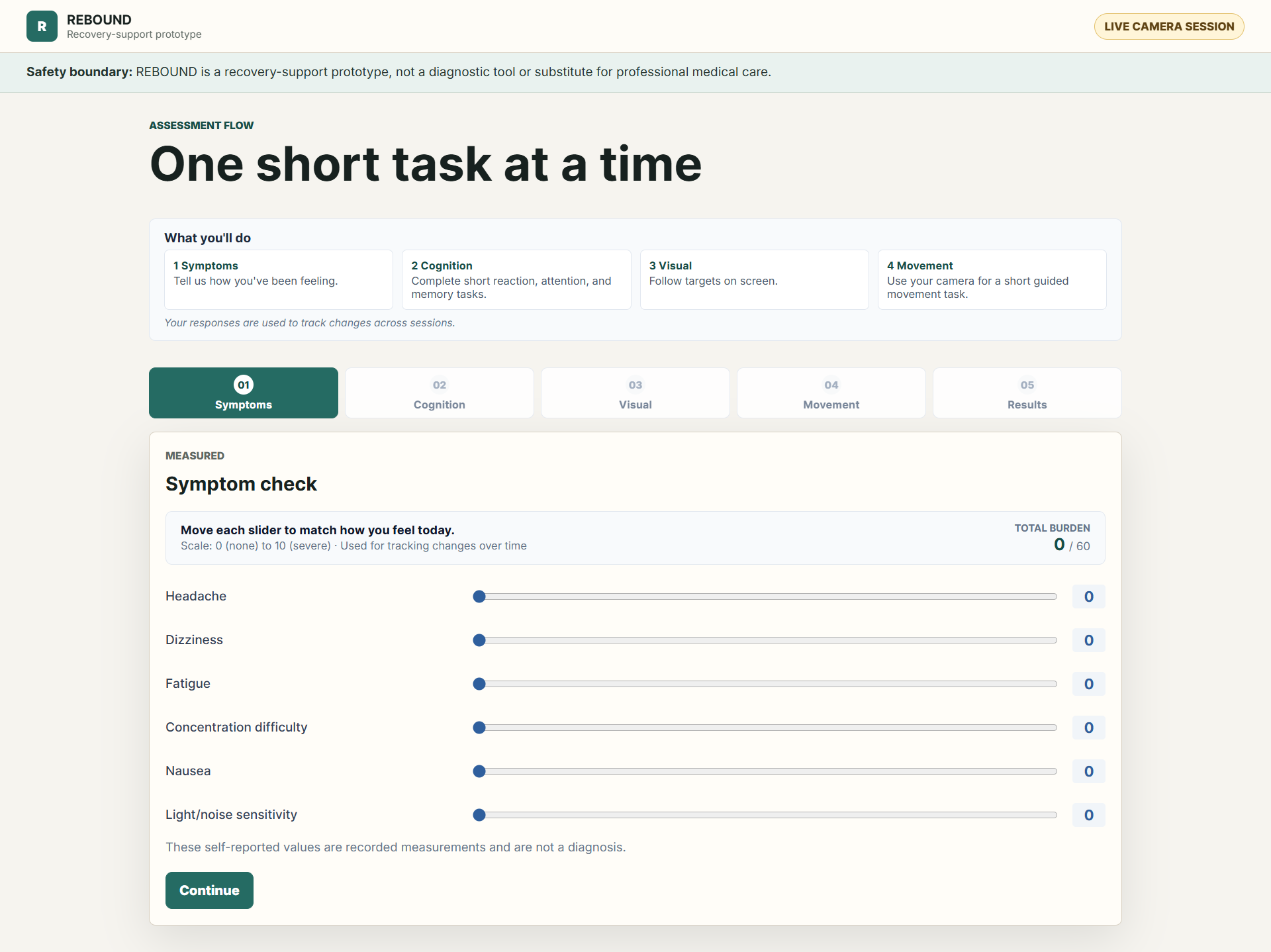
Symptom Check-in Users record six recovery-related symptoms on a 0–10 scale to track changes across sessions.
-
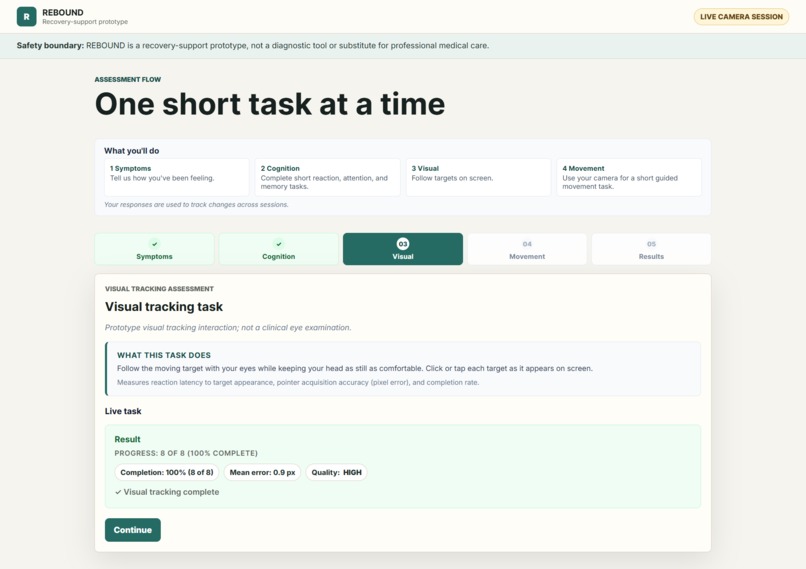
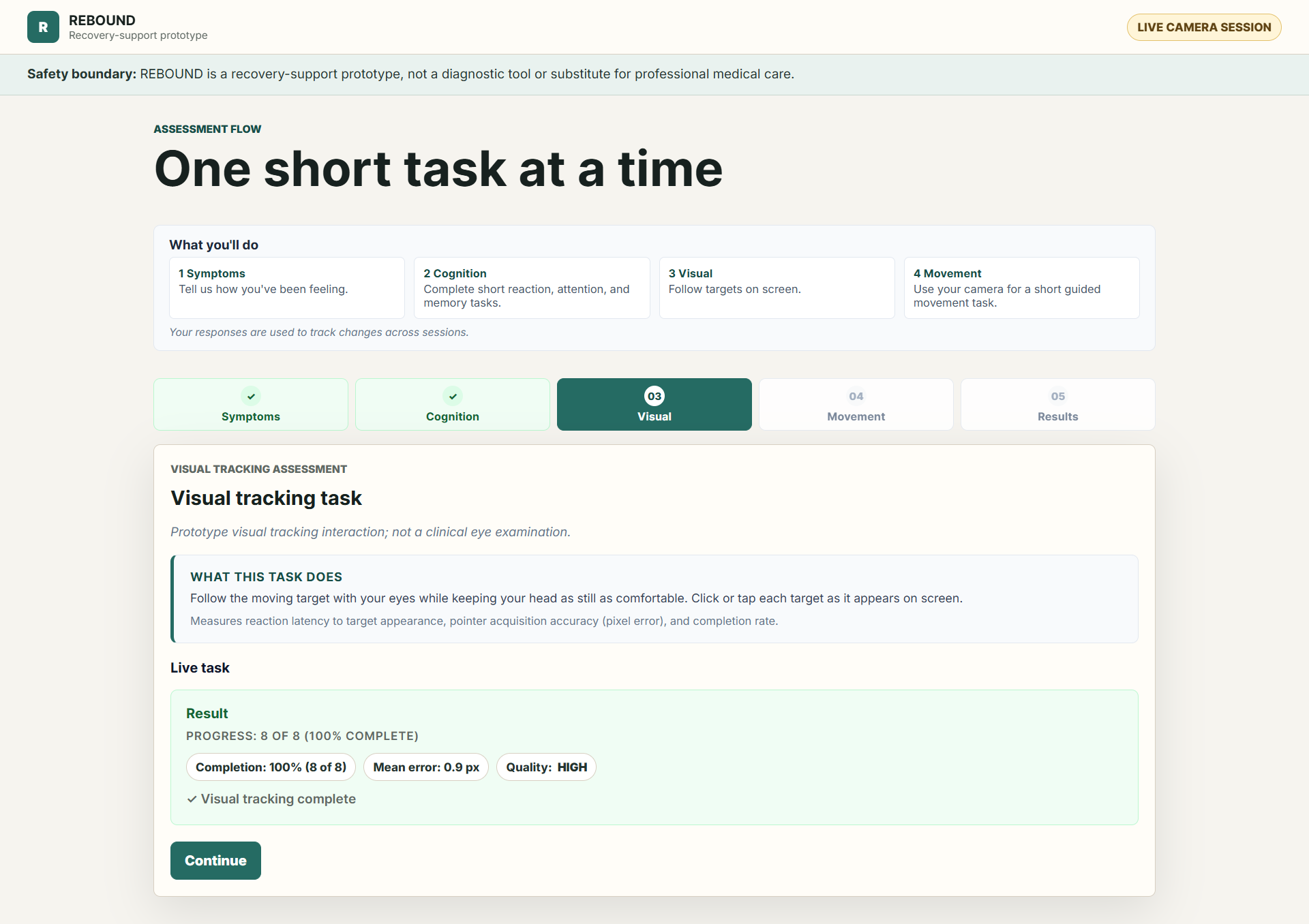
Visual Tracking Results The completed task reports target completion, mean error, and data quality for comparison across sessions.
-
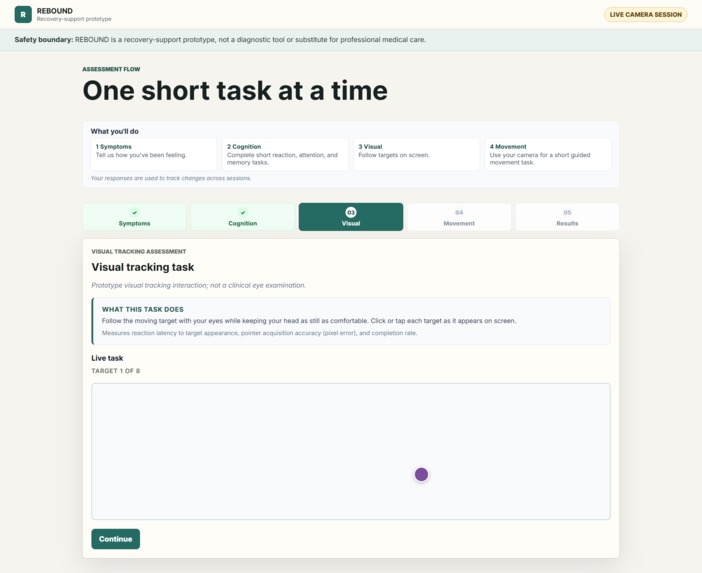
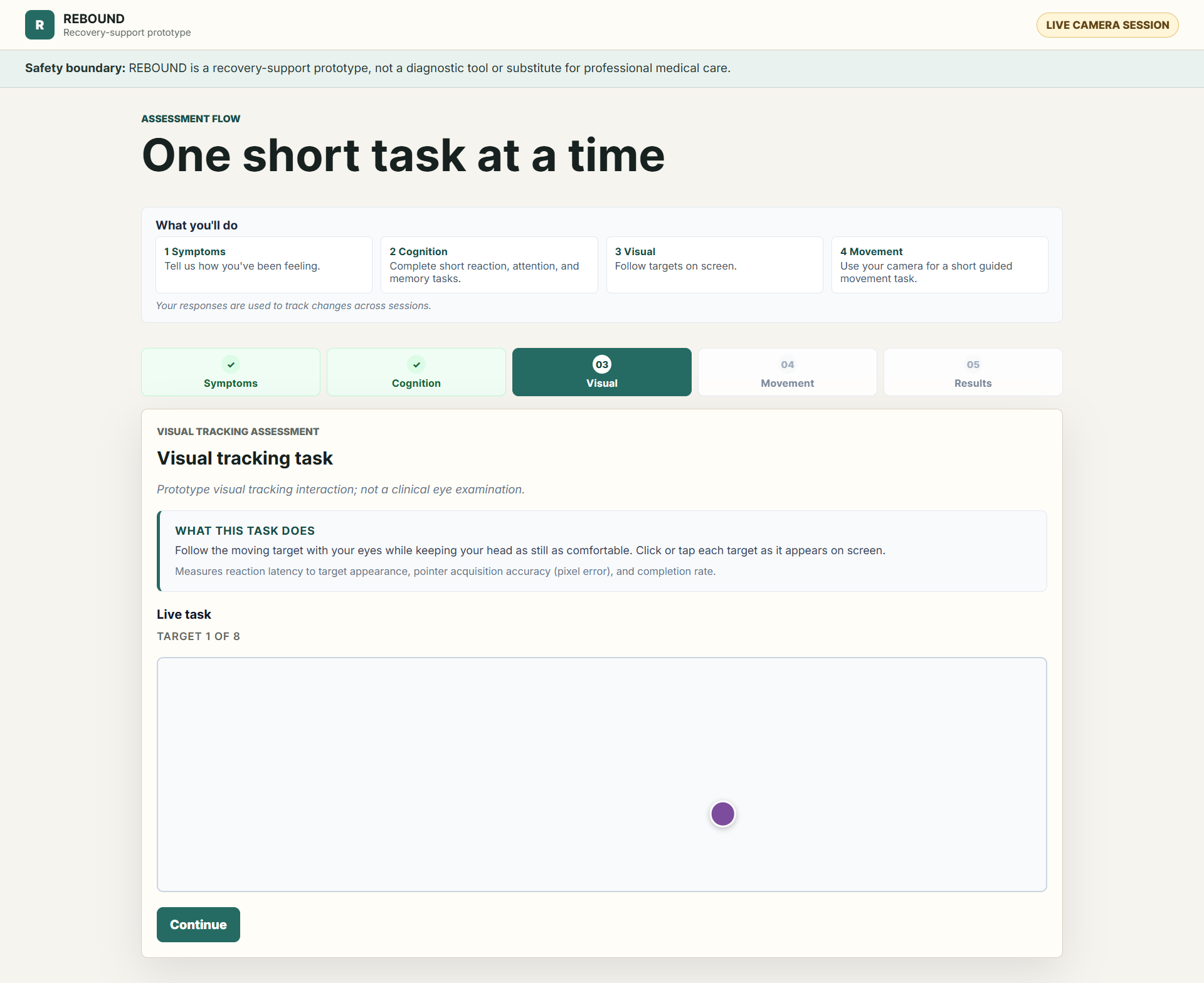
Visual Tracking Assessment Users follow and select moving targets while REBOUND records completion, latency, and targeting accuracy.
-
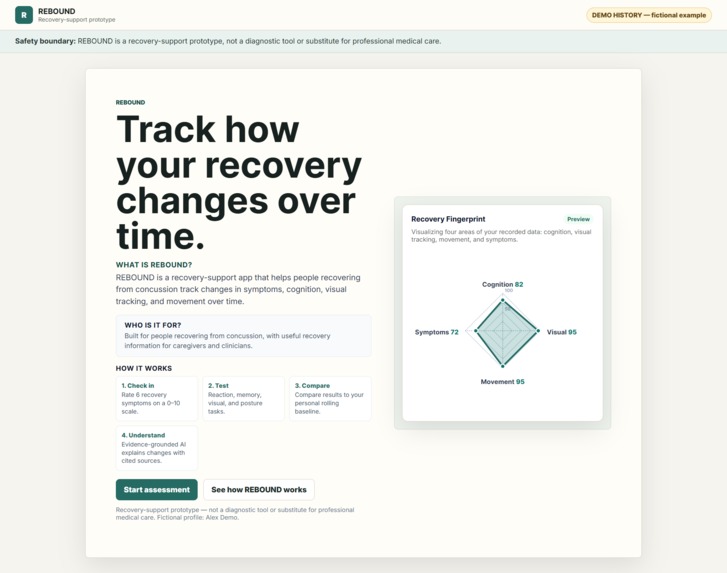
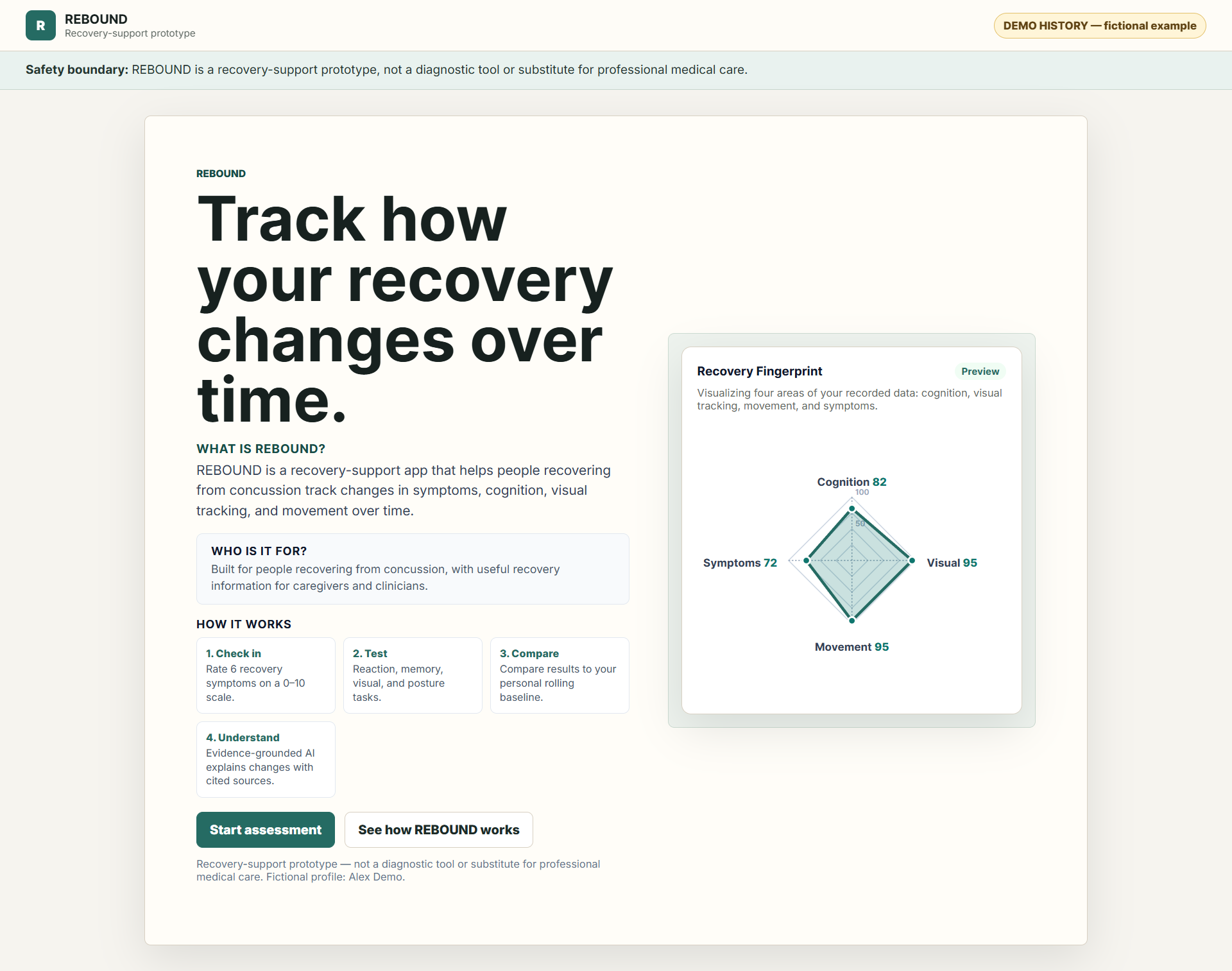
Landing Page for REBOUND - Evidence-grounded concussion recovery support
-
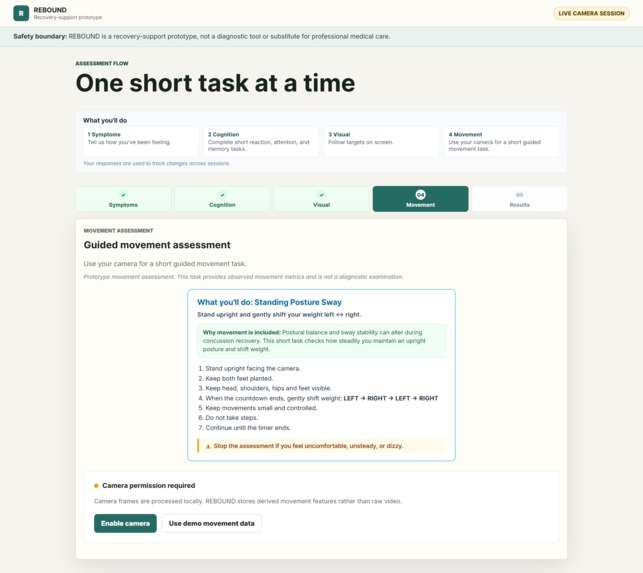
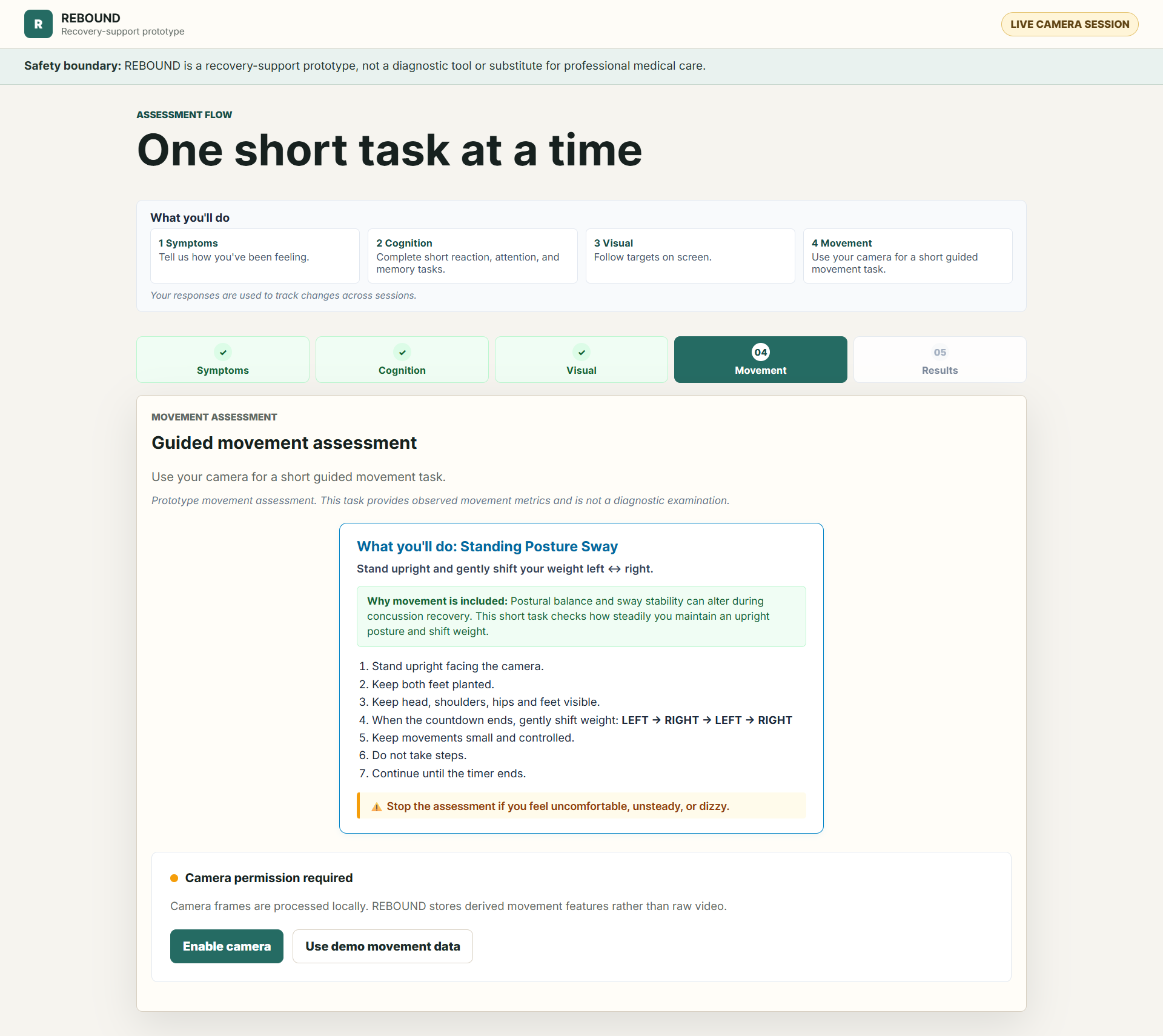
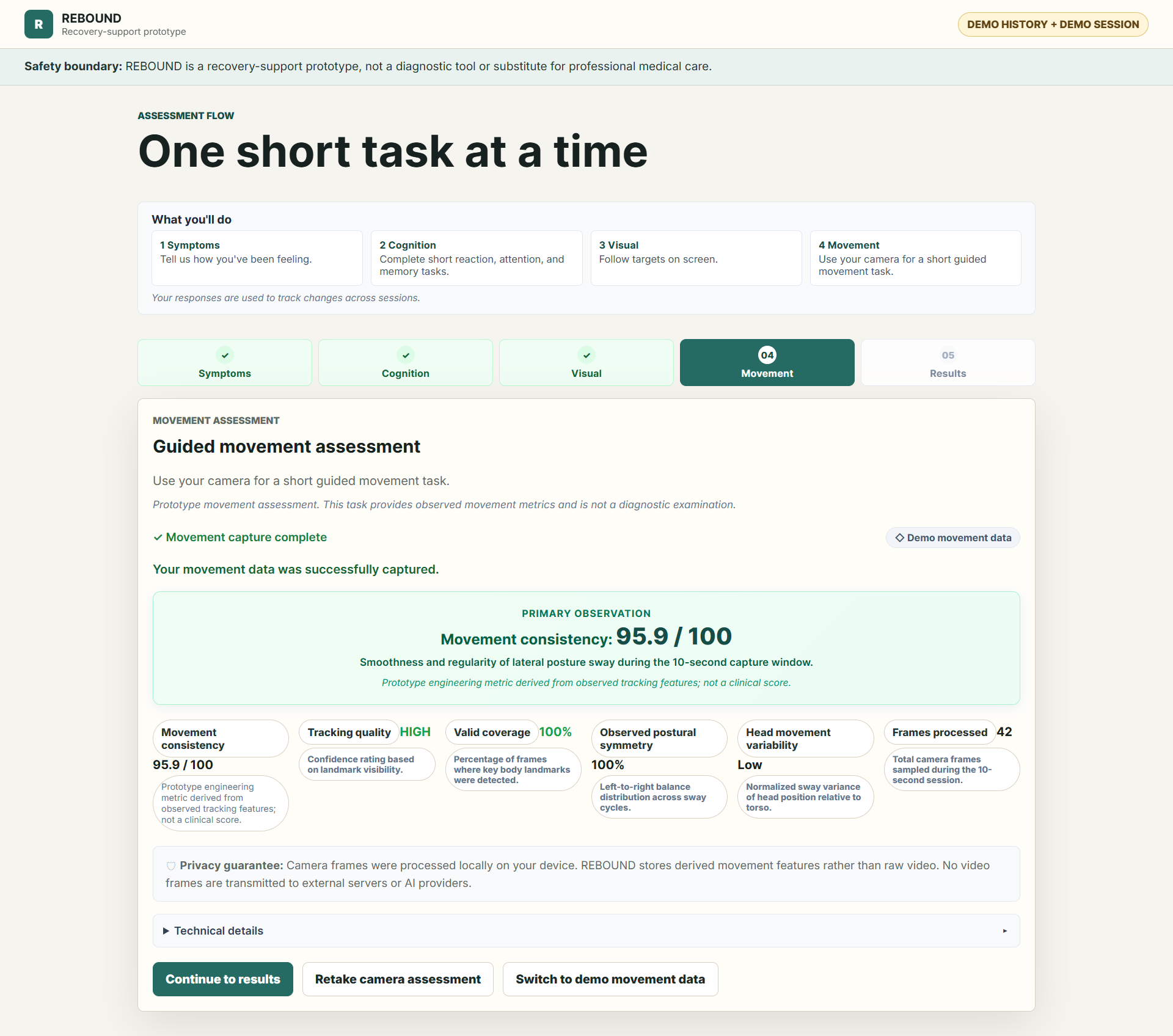
Camera-Based Movement Assessment A guided Standing Posture Sway task uses browser-based computer vision to prepare & vali. the mov. capture
-
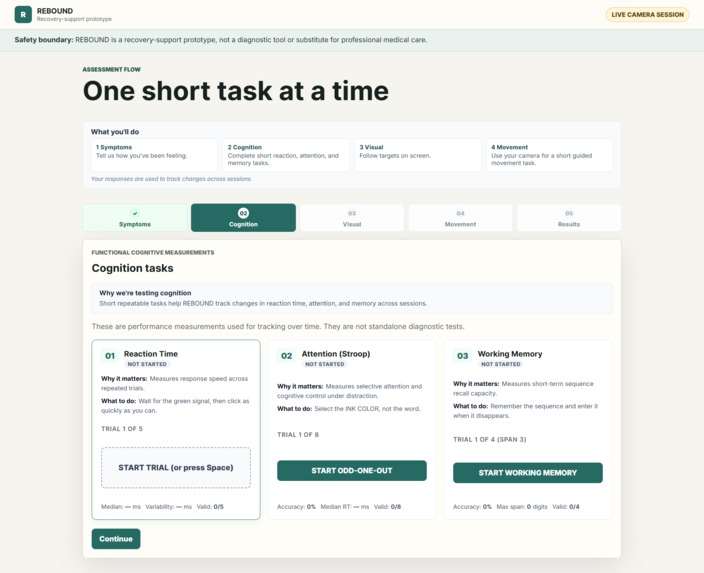
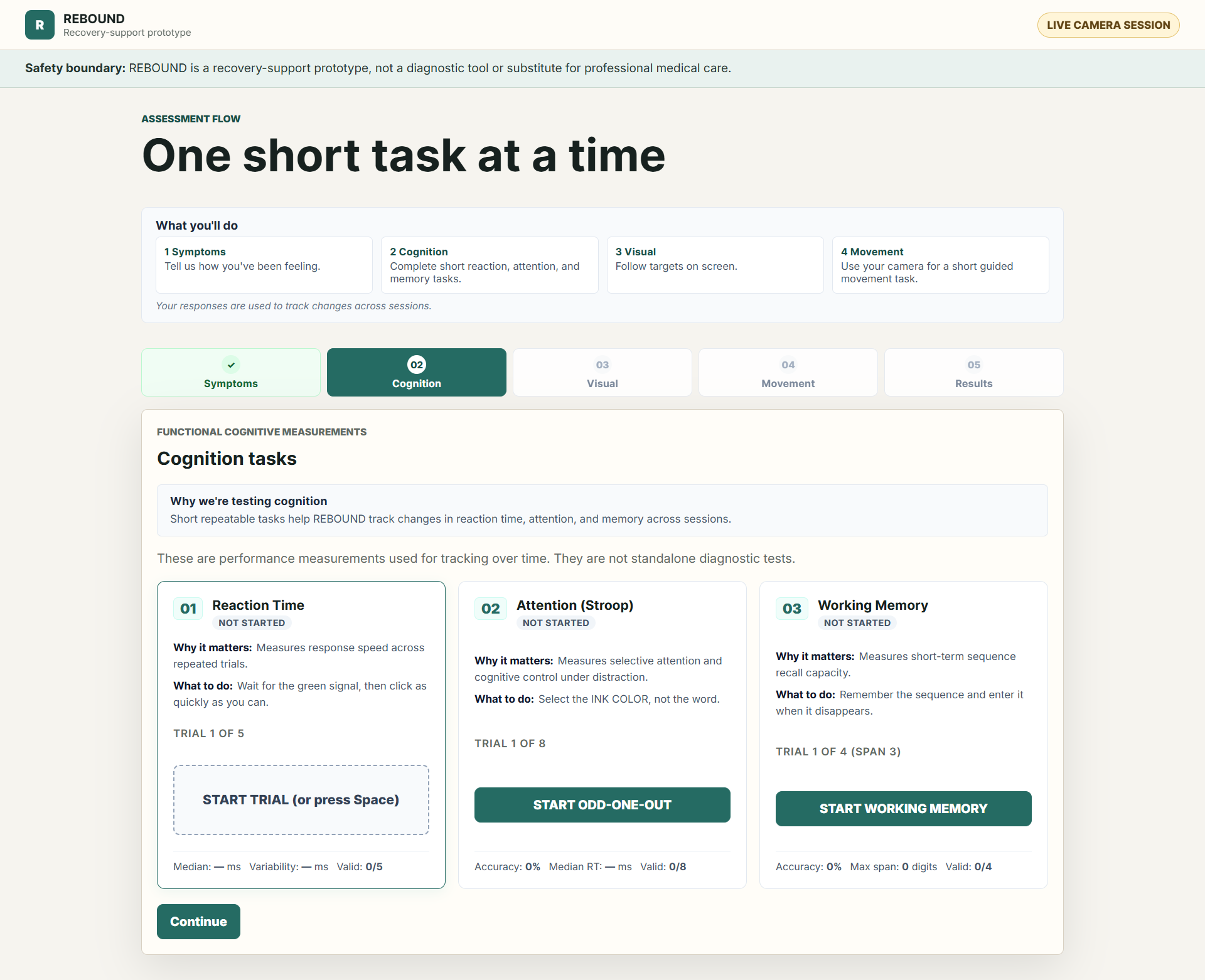
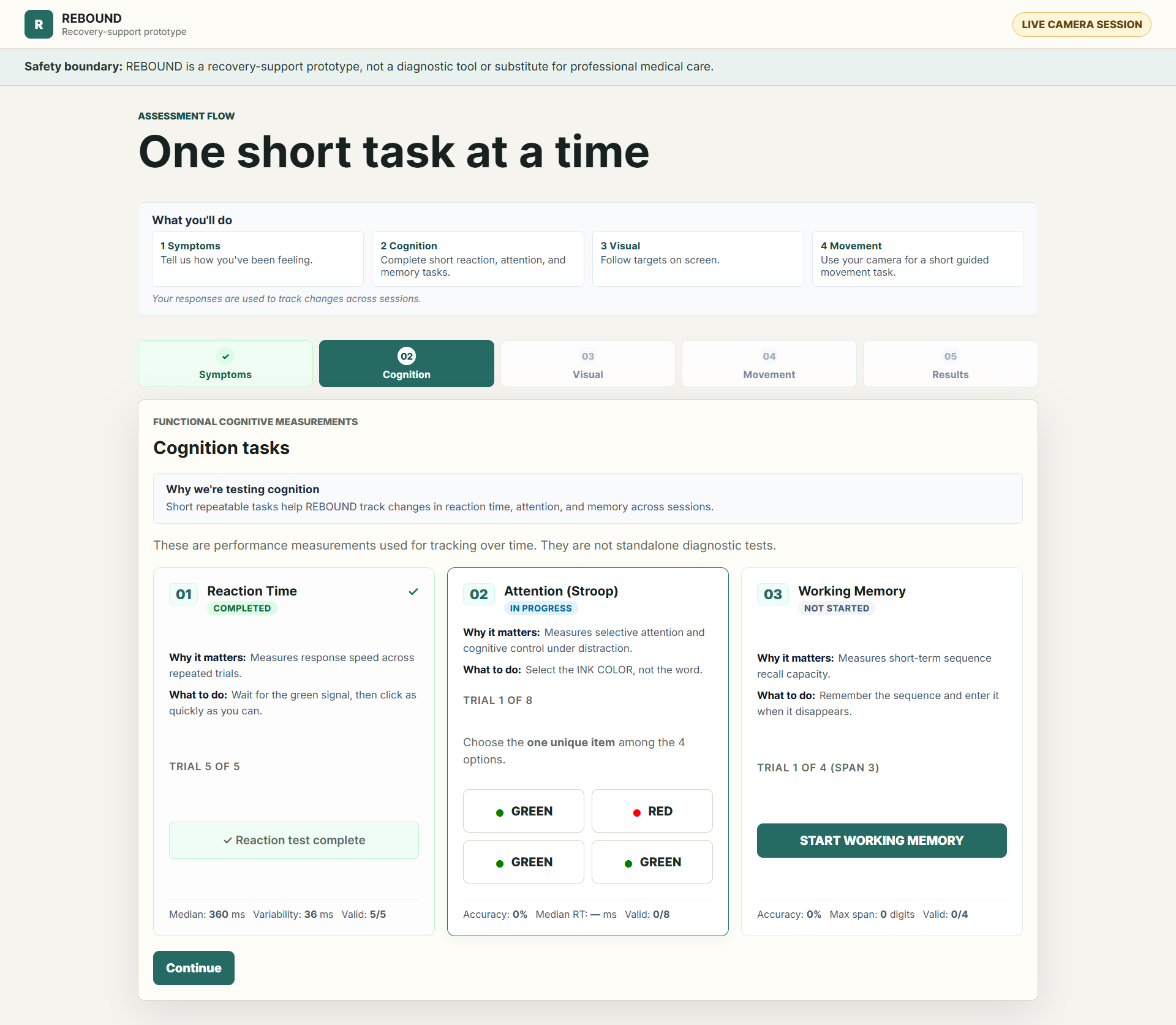
Reaction Time & Attention Tasks Interactive cognitive tests capture response speed and selective attention.
-
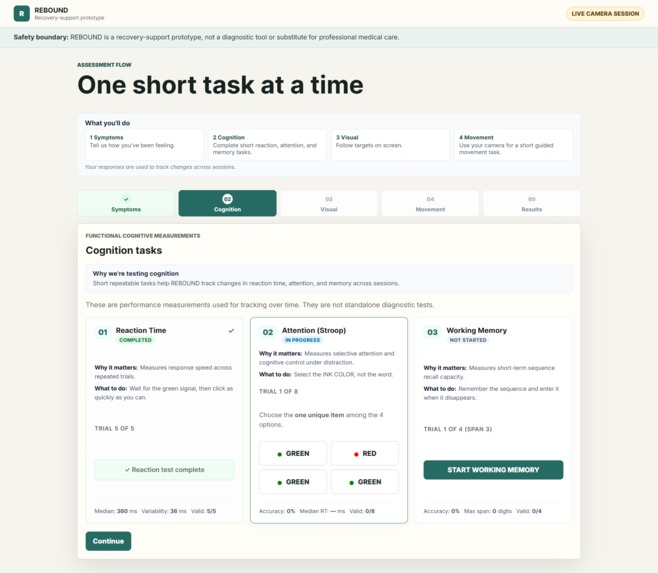
Cognitive Assessment Battery Short, repeatable tasks measure reaction time, attention, and working memory for longitudinal tracking.
-
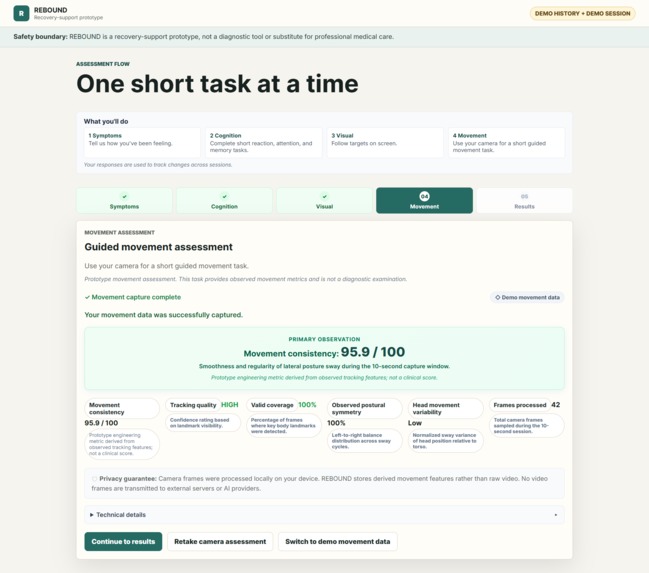
Real-Time CV Movement Analysis MediaPipe Pose Landmarker extracts movement features locally, including tracking quality, valid coverage etc
-
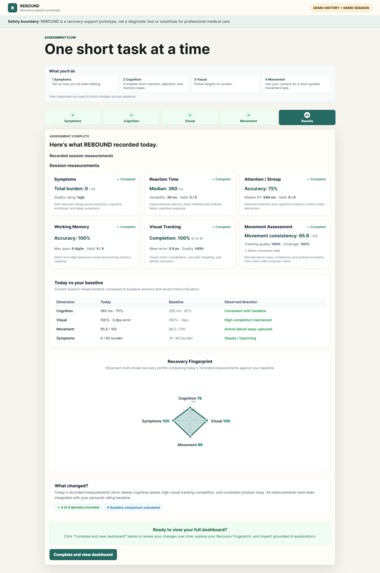
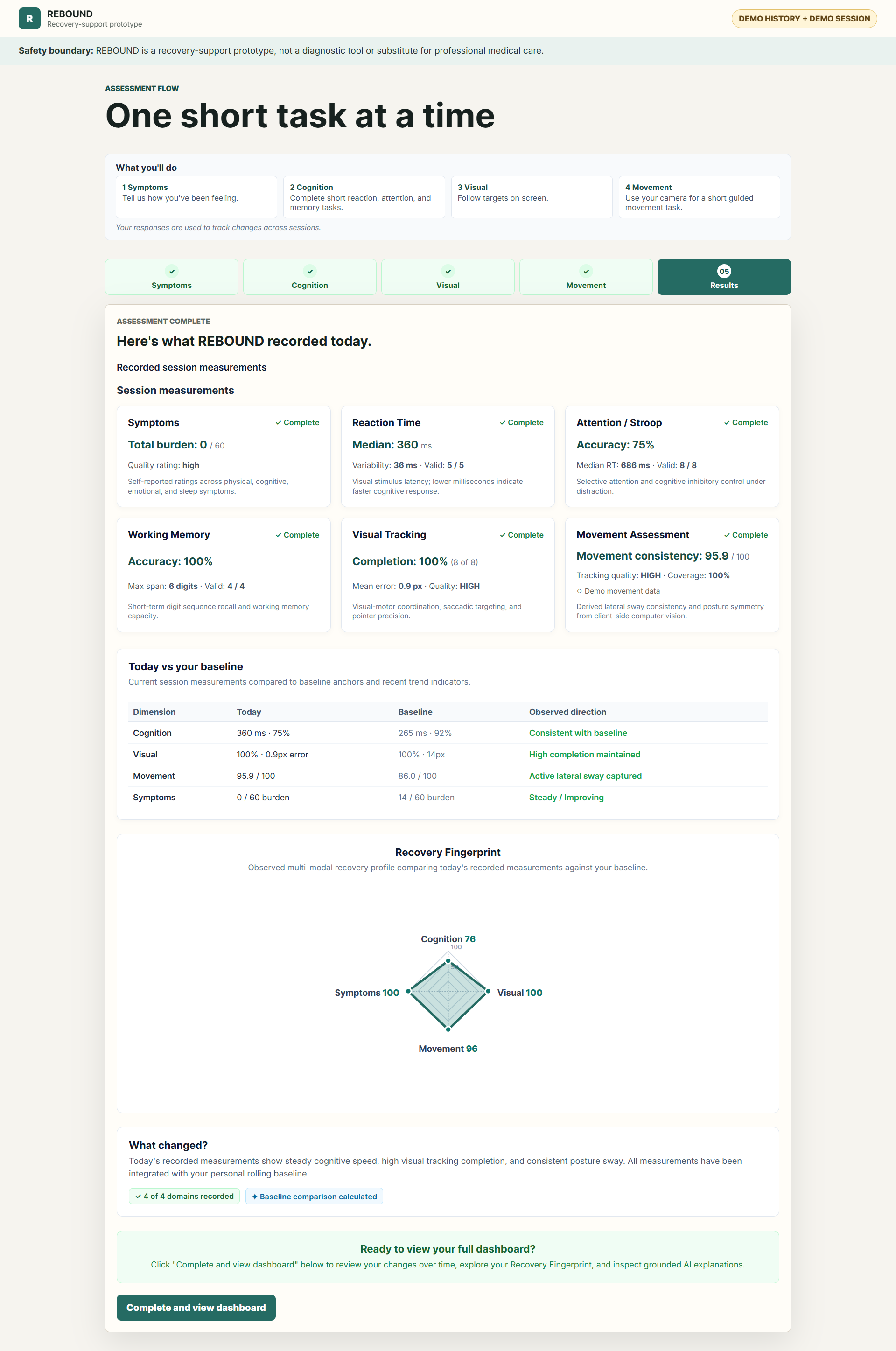
Multi-Modal Assessment Results Symptoms, cognition, visual tracking, & movement are brought together & compared with the users personal base
-
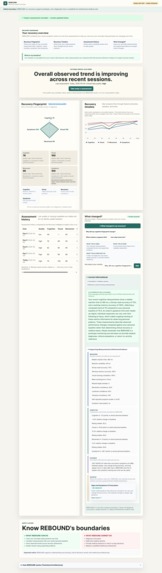
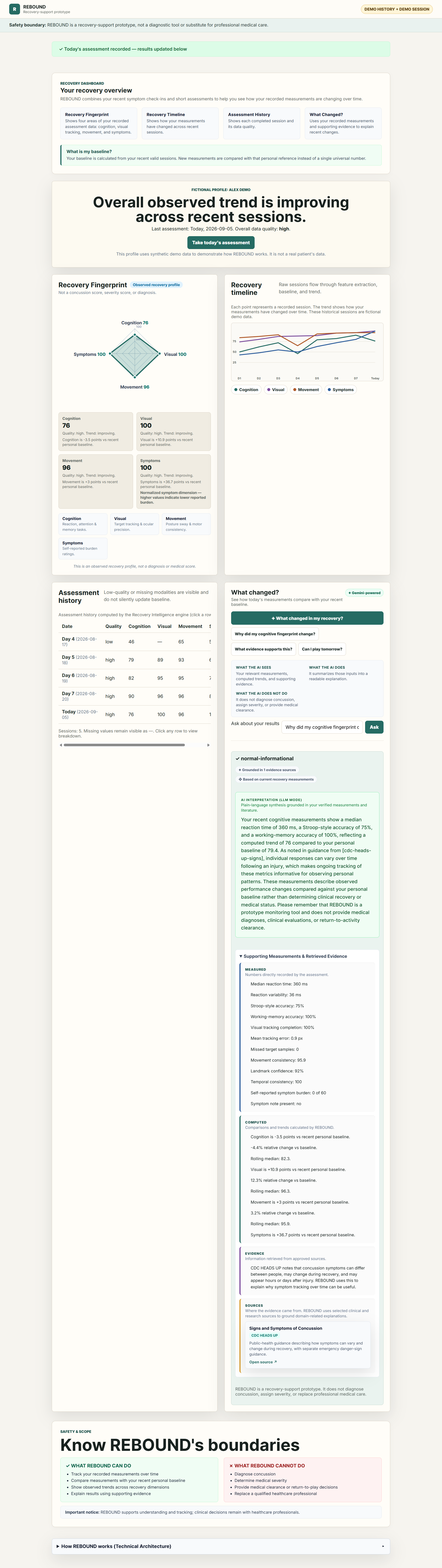
Recovery Intelligence Dashboard combines longitudinal trends, the Recovery Fingerprint, evidence retrieval, and Gemini-powered explanations
-
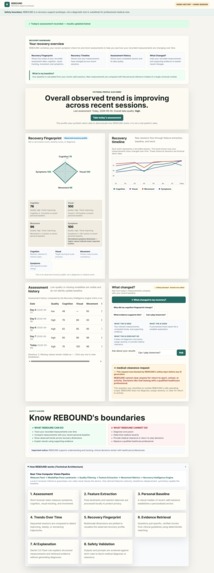
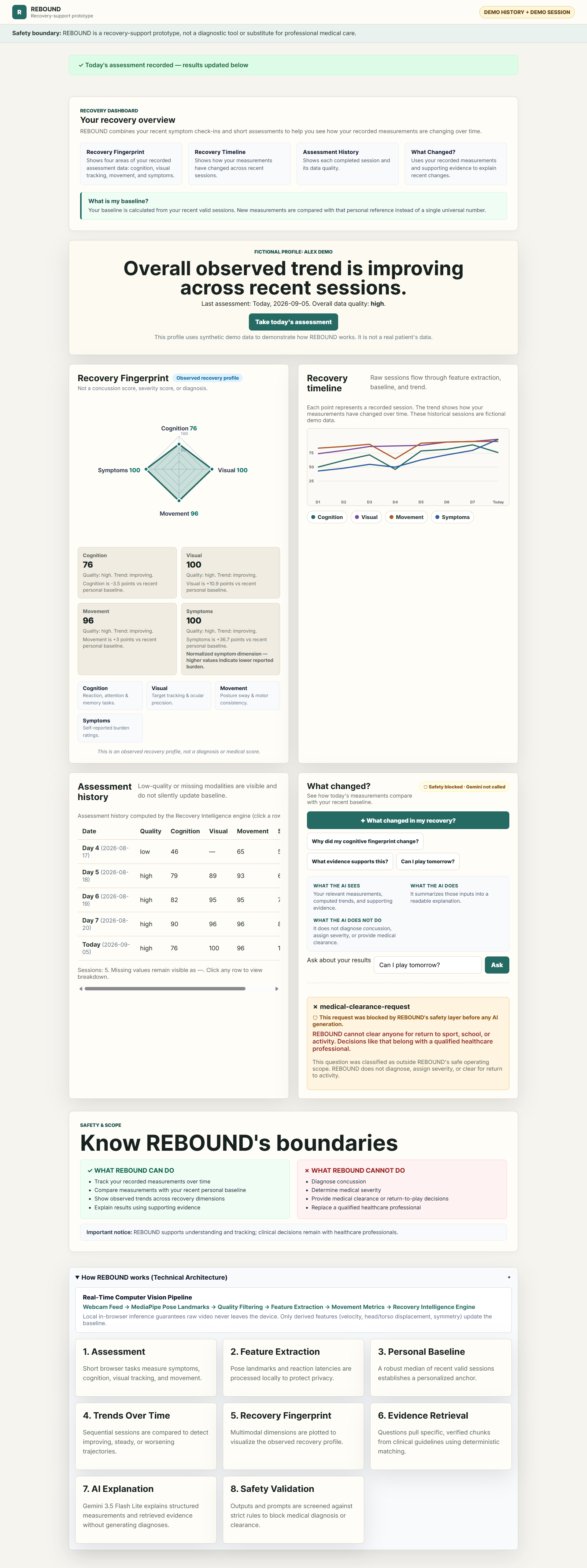
Safety-First AI Architecture Safety controls, evidence retrieval, structured data, and val. keep REBOUND focused on recovery-not diagnosis.
Inspiration
Recovering from a concussion is not a single moment or a single number. Symptoms can change from day to day, and cognitive, visual, and movement performance can fluctuate as well. We wanted to build a way to make those changes easier to track and understand without turning them into a diagnosis or a misleading "recovery score."
That led us to REBOUND — a recovery-support prototype focused on the trajectory of recorded measurements over time.
What we built
REBOUND combines four types of recovery-related information:
- Symptoms — quick self-reported check-ins
- Cognition — reaction time, attention/Stroop, and working-memory tasks
- Visual tracking — browser-based target tracking
- Movement — real-time webcam pose tracking using MediaPipe
Instead of comparing someone against a single universal number, REBOUND builds a personal baseline from recent valid sessions and looks at how new measurements change relative to that reference.
These signals feed a Recovery Fingerprint, which provides an observed profile across cognition, visual tracking, movement, and symptoms, together with a longitudinal timeline.
Where AI fits
The AI is not the source of medical truth.
When a user asks something like "What changed in my recovery?", REBOUND first runs deterministic safety checks, retrieves relevant information from an approved evidence corpus, and then gives Gemini the structured measurements, computed trends, and retrieved evidence as context.
The response is then checked by an output-safety layer before it reaches the user.
This creates a clear pipeline:
Measured → Computed → Evidence → AI Interpretation → Sources
The AI explains the recorded data in plain language; it does not diagnose concussion, assign medical severity, or provide return-to-play clearance.
Computer vision
The movement assessment uses MediaPipe Pose Landmarker directly in the browser. The system tracks body landmarks during a short guided posture-sway task and derives observable movement features such as frame validity, movement consistency, head-motion variability, and left/right symmetry.
Camera processing is performed locally, and REBOUND stores derived movement features rather than raw video.
What we learned
One of our biggest lessons was that healthcare AI needs boundaries just as much as it needs intelligence.
We deliberately separated:
- measurements from interpretation
- computation from generation
- evidence from model output
- safety rules from the LLM
We also learned that longitudinal context matters. A single measurement can be noisy; a sequence of measurements against a person's own baseline provides a much more useful way to understand change.
Challenges
The hardest parts were making browser-based assessments reliable, handling missing or low-quality data honestly, building real-time webcam tracking, and preventing the LLM from turning an explanation into an unsupported medical conclusion.
We built deterministic fallbacks so the prototype remains usable even without an API key or when the Gemini provider is unavailable.
What's next
REBOUND is currently a prototype using synthetic longitudinal demo data and browser-based assessments. The next steps would be broader validation, richer longitudinal datasets, more robust computer-vision feature engineering, and evaluation with appropriate clinical and research partners.
REBOUND is a recovery-support prototype, not a diagnostic tool or substitute for professional medical care.
Built With
- ai
- api
- augmented
- computer
- data
- engineering
- gemini
- generation
- generative
- javascript
- mediapipe
- node.js
- npm
- prompt
- rag
- react
- retrieval
- typescript
- vision
- visualization
- vite
- webassembly
- webgl


Log in or sign up for Devpost to join the conversation.