-
-
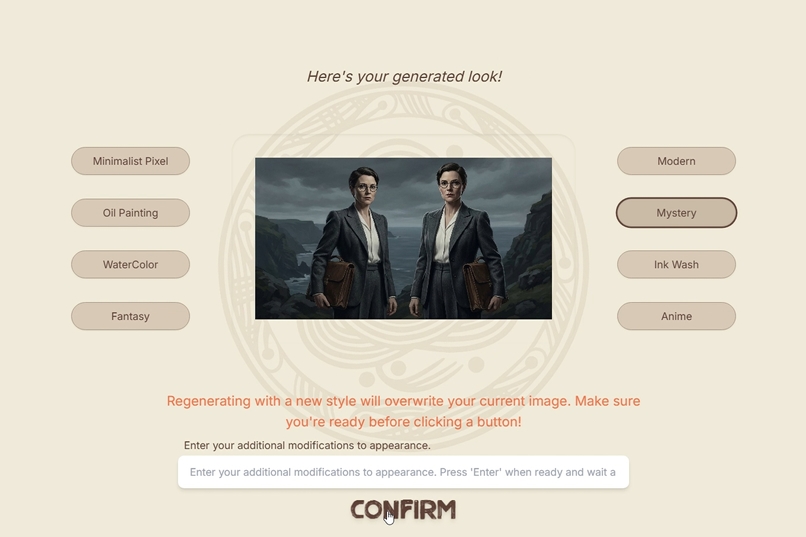
oc image customization
-
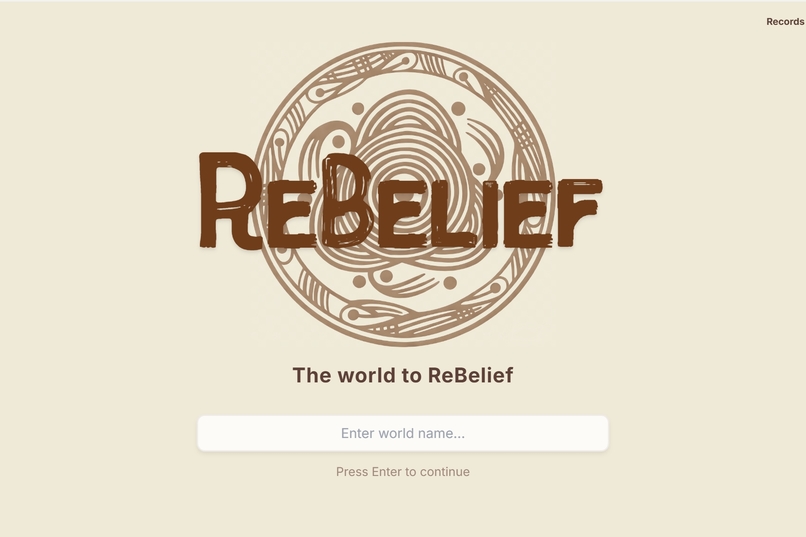
front page
-
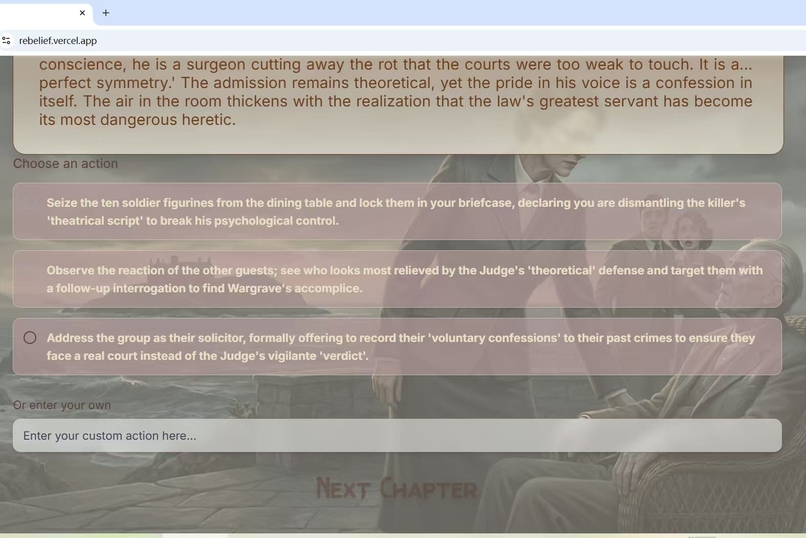
game process

Project Story: ReBelief - Rebel. Rebuild. Re-believe.
Inspiration
Ever been frustrated by a story’s ending? That “what if?” feeling is universal. What if the hero chose differently? What if a beloved character didn’t have to die? Readers often feel a strong urge to challenge tragic fates, outdated tropes, or fixed ideologies inside the worlds they love—we call this narrative itch.
Until now, scratching that itch meant passive imagination or static fan fiction. Existing tools can generate alternate endings, but they don’t reason about consequences, adapt to a user’s beliefs, or show how a world logically changes after a rebellion.
We built ReBelief to turn “what if” into “what happens next.” ReBelief lets users actively intervene at critical moments in a story—through a new character or a changed choice—and uses AI to simulate how the world, its power structures, and its characters respond over time.
ReBelief transforms storytelling from passive consumption into active, belief-driven exploration.
What it does
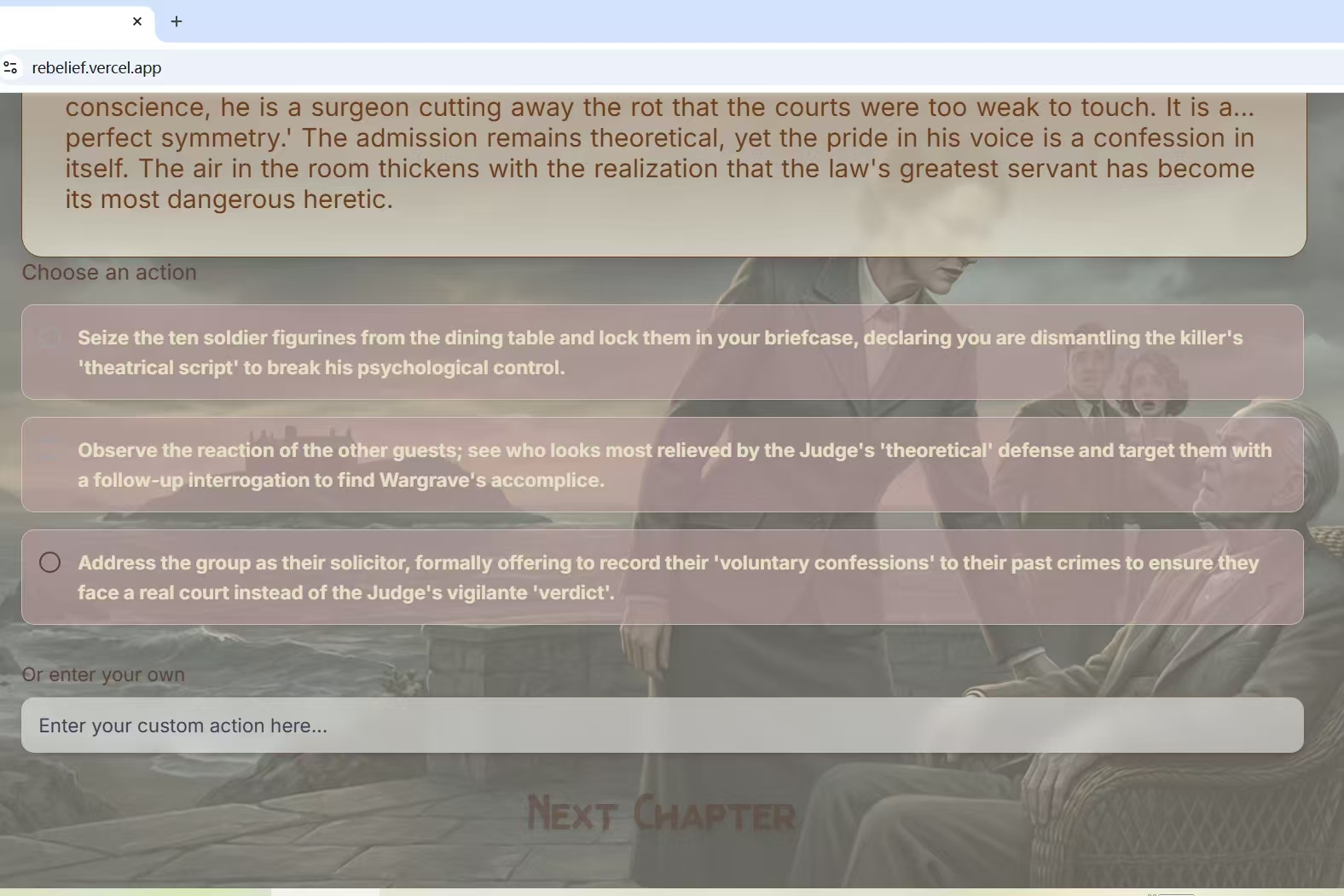
ReBelief is an AI-powered narrative playground where users move beyond passive reading to actively reshape a story’s direction. By turning creative frustration into agency, the platform allows for deep, belief-driven exploration of favorite fictional worlds.
Key Features:
- The Act of Rebellion: Users enter as an Original Character with a disruptive perspective or seize control of a Canon Character at a pivotal "what if" moment.
- AI Storyteller: Leveraging Gemini to reason about consequences, the system dynamically generates events based on user actions rather than preset branches.
- Logic Lock: This layer ensures every intervention remains grounded in the world’s original rules, enforcing consistency across character behavior and cause-and-effect.
- Visual Engine: Users truly "see" their impact through AI-generated portraits and scene imagery that evolve alongside the narrative, making the rewritten IP world tangible.
How we built it
ReBelief is a full-stack web application built with Next.js and Supabase, leveraging Google Gemini 3 Pro as its core reasoning engine.
Our Technical Stack:
- Narrative Reasoning: We utilize the Gemini API to access Gemini 3 Pro. By utilizing its advanced Thinking Levels, we enable the model to perform "System 2" reasoning, allowing it to evaluate complex consequences and maintain a persistent world state across the narrative.
- The "Logic Lock": To ensure narrative integrity, we implemented schema-based constraints. These validation checks occur before and after Gemini calls to prevent contradictions and maintain character consistency within the IP's rules.
- Multimodal Visualization: We integrated Nano Banana via the Gemini API to turn narrative beats into high-fidelity visuals. Nano Banana’s specific strengths in character identity preservation allow the user’s "Original Character" to remain visually consistent as the story evolves.
- State Management: User interventions and world metadata are stored in Supabase, enabling session persistence and ensuring that every "rebellion" has a lasting, logical impact on the story's memory.
Challenges we ran into
- Entity Repetition: Early tests with Gemini 3 Pro showed repetitive reasoning when validating characters. We resolved this by fine-tuning temperature, top-k, and top-p parameters, successfully boosting output diversity while maintaining logical consistency.
- Latency vs. Depth: Extensive world-state tracking caused response delays. We solved this by decoupling our architecture: separating lightweight validation from full narrative generation and caching stable state data in Supabase.
- UX Complexity: Designing an interface for complex branching logic was difficult. We used progressive disclosure to reveal choices only as needed, ensuring the UI stayed immersive rather than overwhelming.
Accomplishments & What we learned
- Coherence Under Pressure: We successfully shipped a multi-turn reasoning engine that maintains narrative integrity despite disruptive user interventions. Our "Logic Lock" differentiates ReBelief by ensuring consistent cause-and-effect where simpler models fail.
- Mastering Model Control: Beyond just calling an API, we mastered Gemini 3 Pro parameter tuning. Learning to balance temperature and top-p allowed us to suppress hallucinations while maintaining the creative "spark" needed for storytelling.
- Structured Prompting at Scale: We learned that long-context reasoning requires rigorous schema-based constraints to translate abstract story logic into a reliable, playable system.
What’s Next
Our next step is evolving from linear narrative rewrites into a persistent world simulation. By leveraging long-context reasoning and future multimodal models from Google’s AI ecosystem, we aim to simulate living story worlds where characters, factions, and environments continue to evolve over time—even when the user is not actively intervening. A single act of rebellion would ripple across politics, culture, and relationships throughout the entire IP.
We also plan to introduce a collaborative narrative sandbox, enabling multiple users to enter the same rewritten timeline. Participants could co-author outcomes, negotiate conflicts, or introduce competing ideologies, allowing emergent stories to form through shared decision-making.
Finally, we intend to validate ReBelief in real-world settings—starting with small creator communities and educational pilots—to test engagement, scalability, and the value of AI-driven critical storytelling at scale.
Built With
- gemini
- javascript
- next.js
- supabase


Log in or sign up for Devpost to join the conversation.