-
-
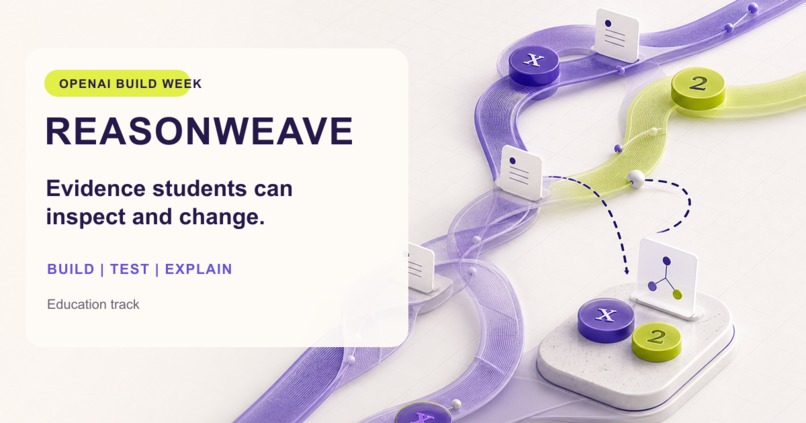
Reasonweave
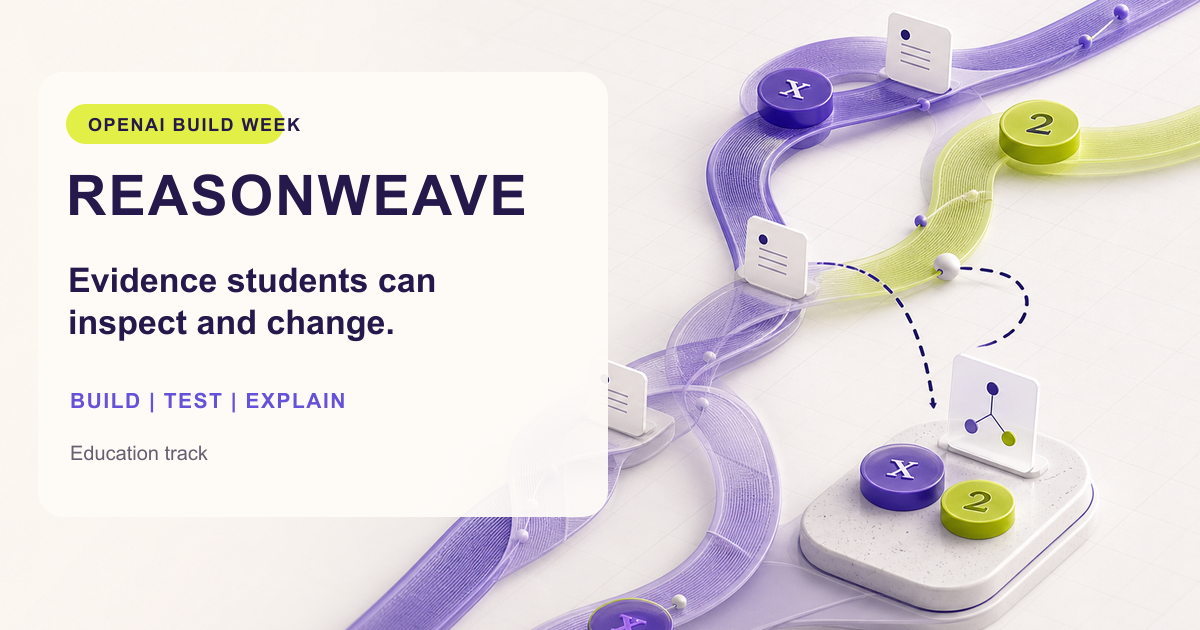
What it does
ReasonWeave is a student-controlled adaptive learning workspace for middle-school algebra. Instead of assigning a fixed “learning style,” it builds testable hypotheses from each learner’s work. Students construct an expression with visual tokens, test the result, explain their reasoning, and save the attempt as evidence.
Every adaptation remains visible. A hypothesis can be supported, uncertain, or still being tested; it expires unless later work confirms it. Students can say when the model does not match them, and teachers can inspect the evidence and override the next learning programme.
Why it is different
Most adaptive learning products personalize behind the scenes. ReasonWeave treats personalization as a falsifiable claim rather than a permanent label. The learner is a participant in the model, not its subject.
The first module demonstrates this with algebraic distribution through a tactile Build → Test → Explain loop. The same evidence architecture can expand across middle-school mathematics.
How it was built
The working responsive application was designed and implemented with Codex using GPT-5.6. Codex accelerated visual exploration, implementation, database-schema design, interaction testing, responsive QA, and deployment. The result includes a learner workspace, journey view, educator console, persistent evidence API, and learning-hypothesis data model.
Try it
Open the live app and complete the three token groups. Test the expression, select the reasoning behind it, then save the evidence. Open the educator console to inspect the resulting learner profile and programme recommendation.
Built With
- cloudflare-d1
- codex
- drizzle-orm
- gpt-5.6
- next.js
- react
- typescript
