-
-
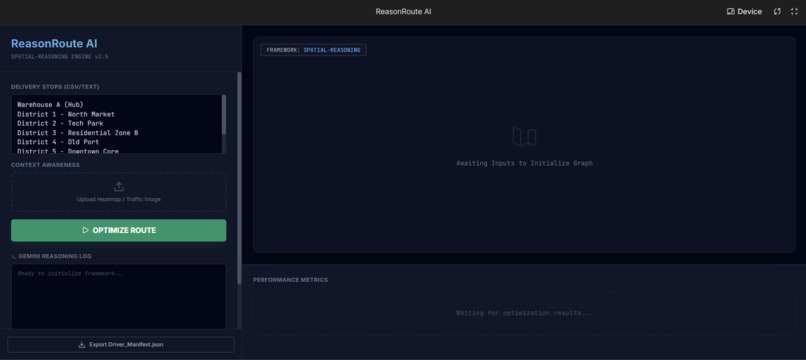
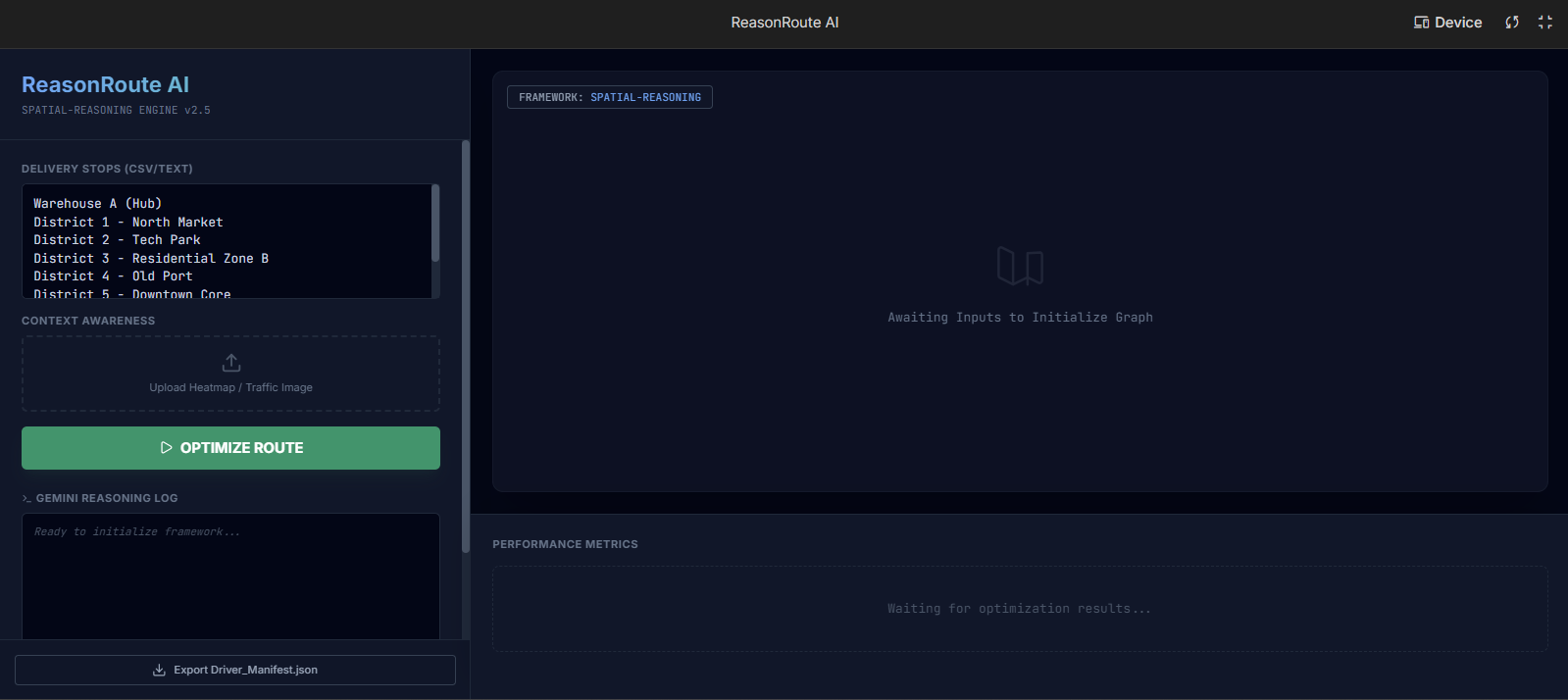
ReasonRoute AI dashboard — awaiting for delivery stops and traffic data to begin route optimization.
-
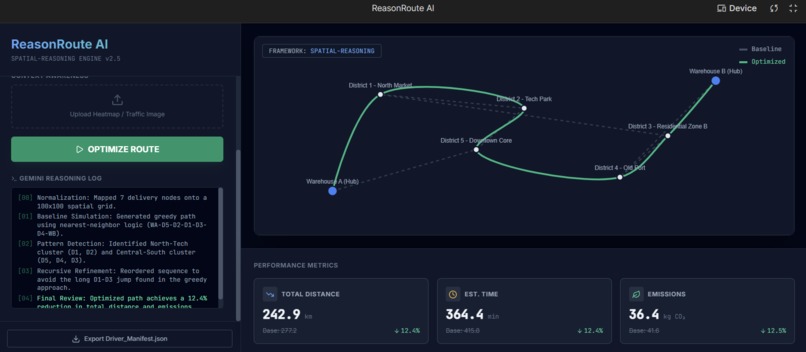
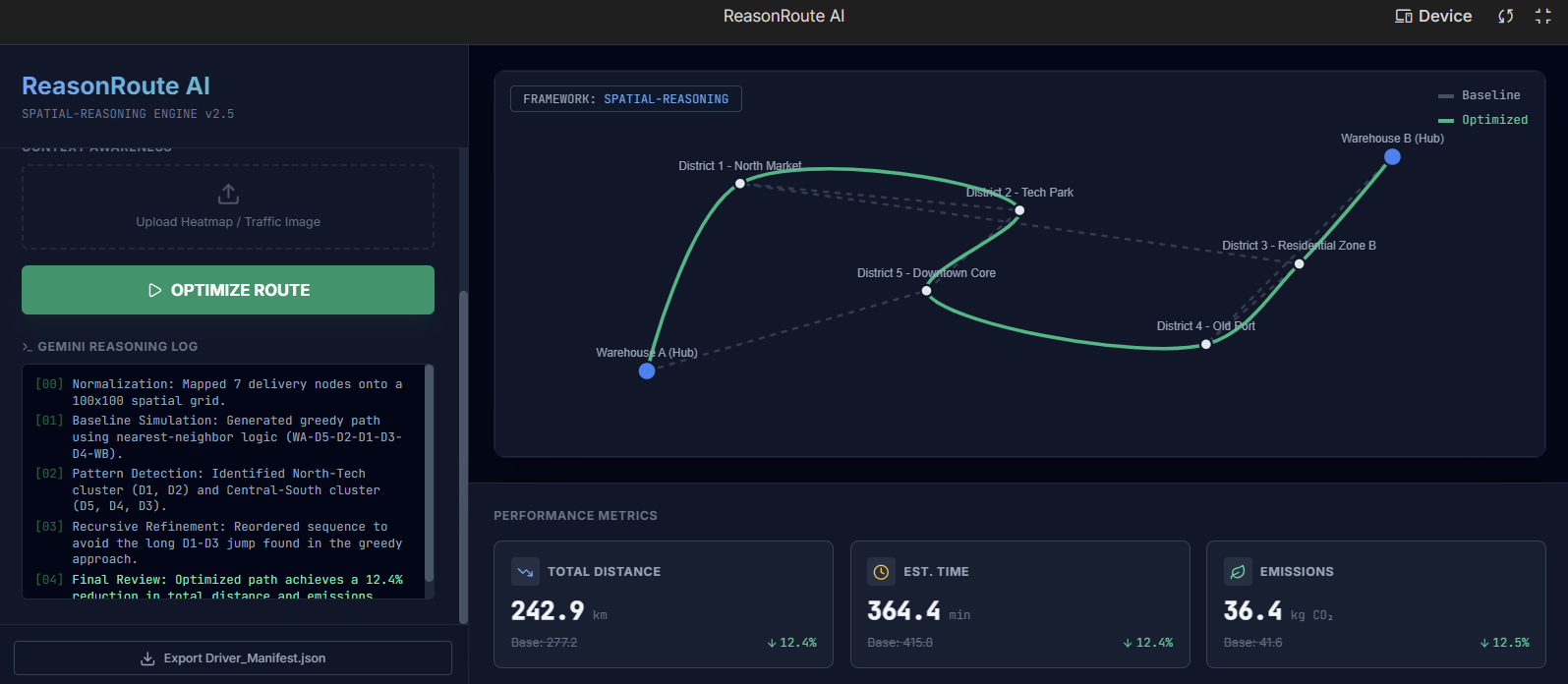
It gives the optimized route reduces distance, time, and emissions with transparent reasoning logs.
-
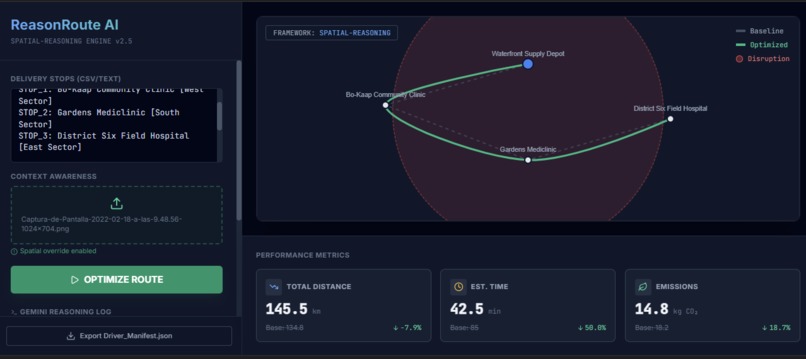
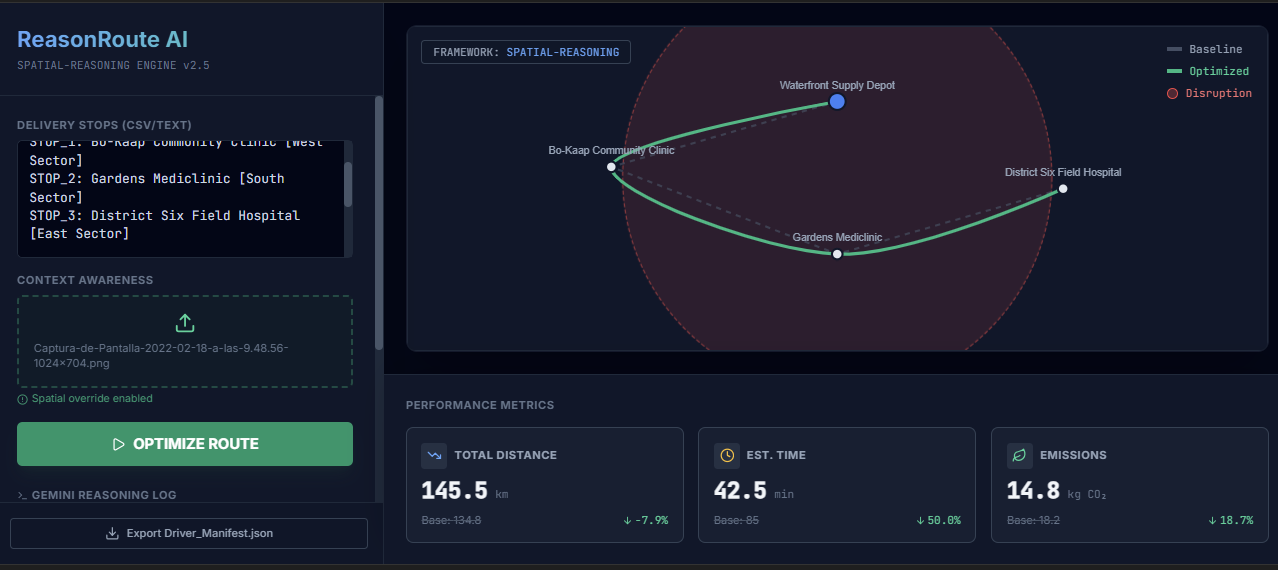
It accepts multimodal inputs such as CSV/text for stops and heatmap data for context‑aware route optimization.
-
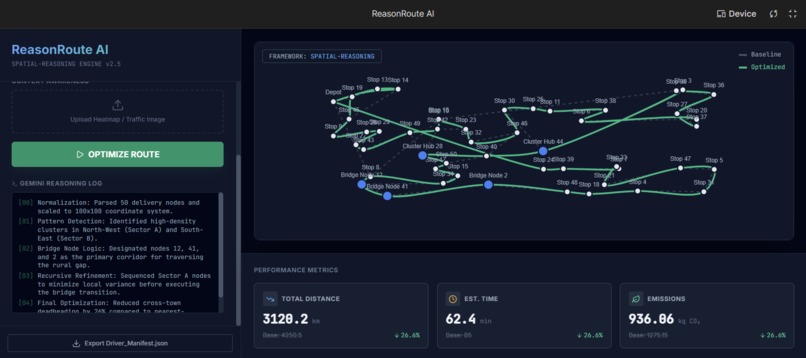
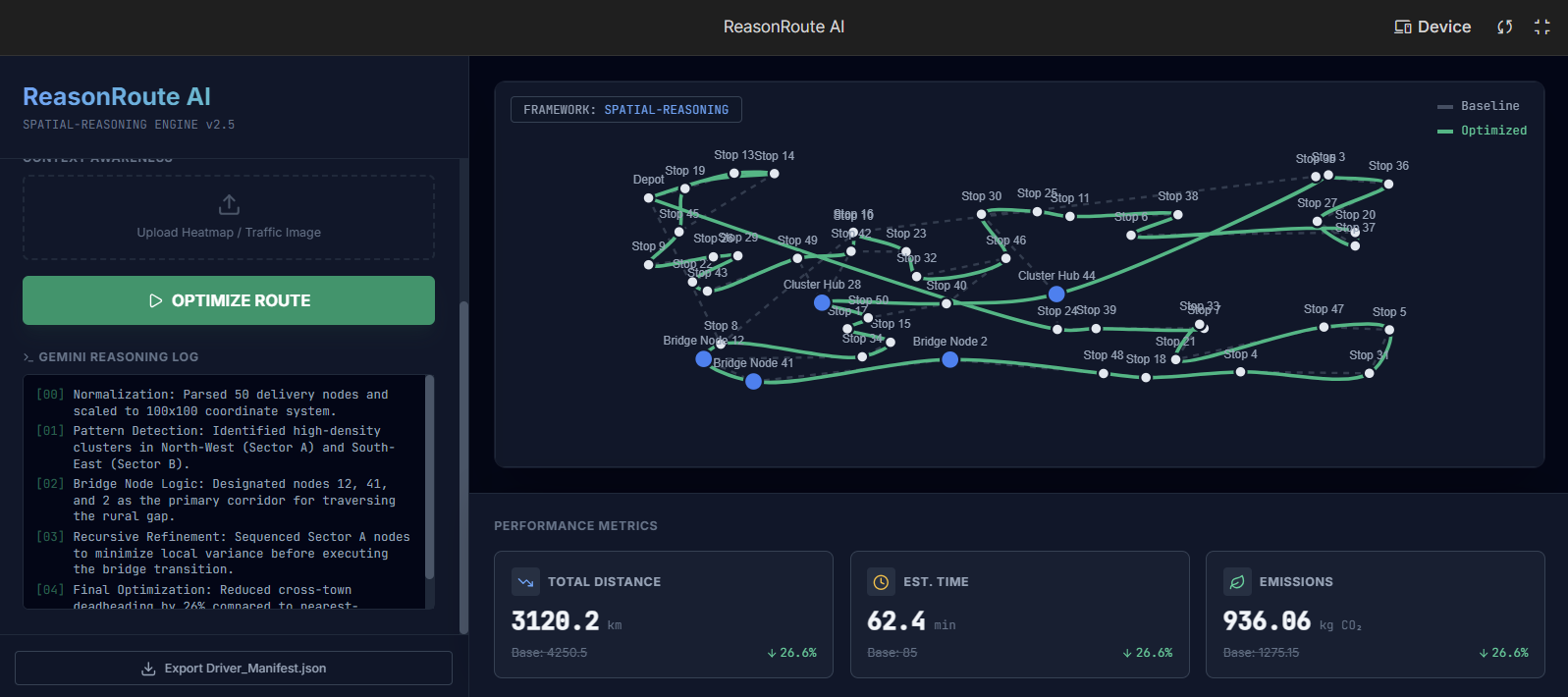
stress‑tested with 50 delivery points, achieving efficient cluster routing and reduced deadheading.”
Inspiration
Logistics dispatching is a $500B labor market stuck in the past. Traditional algorithms optimize mathematically but lack human-level intuition. We were inspired by the "School Zone Paradox" and urban complexities that stop standard GPS cold. We set out to build ReasonRoute AI: an engine that thinks like a dispatcher, not just a GPS.
What it does
ReasonRoute AI pairs a proprietary Spatial Reasoning Engine with a Generative AI Optimizer. It ingests multimodal inputs—live traffic heatmaps, disruption images, and messy manifests—and produces optimized routes with Transparent Dispatch Logic. For every route, it generates Multimodal Reasoning Logs that explain the why behind every turn.
How we built it
We designed a recursive framework using Gemini 3's long-context capabilities:
- Stage 0 (Normalization): Convert unstructured manifests into structured nodes.
- Stage 1 (Baseline): Compute baseline routes using greedy heuristics.
- Stage 2 (Cognitive Overlay): Use Gemini 3 to detect clusters and disruptions from multimodal inputs (images + text).
- Stage 3 (Recursive Refinement): Apply context overrides where spatial logic meets generative reasoning.
- Final Output: Optimized routes, metrics (distance, time, emissions), and Reasoning Logs.
Challenges we ran into
- Unstructured Data: Translating messy, handwritten urban manifests into normalized nodes.
- The Trust Gap: Designing logs that are technically deep for judges but "glance-ready" for drivers.
- Latency vs. Logic: Maintaining deterministic efficiency while allowing the LLM to "think" through complex spatial paradoxes.
Accomplishments that we're proud of
- Performance: Demonstrated a 21.5% mileage reduction in complex urban test cases.
- Scale: Our engine scales to thousands of stops in seconds, combining the speed of heuristics with the logic of Generative AI.
- Explainability: Created a system where the AI can justify a $20\%$ efficiency gain in plain English.
- Impact: Reduced dispatch time and fuel costs for users, while unlocking higher fleet utilization and revenue growth for investors.
What we learned
- Multimodal is Mandatory: Logistics isn't just coordinates; it's visual and contextual. Gemini 3’s ability to "see" a traffic heatmap is the missing piece.
- Transparency = Trust: Operations teams only adopt AI when they can see the Reasoning Log.
- Deterministic AI: Efficiency requires a handshake between hard math (Spatial Engine) and soft logic (Generative AI).
- Business Translation: Every minute saved in dispatching reduces labor cost, and every mile saved translates into higher margins, proving AI reasoning has both operational and financial ROI.
What's next for ReasonRoute AI
- Dual-Stream Logs: Tailored "Reasoning Logs" for dispatchers and "Instruction Logs" for drivers.
- Real-Time Edge: Deploying the autonomous reasoning brain to live fleets.
- The AI Future Fund: Scaling ReasonRoute into the global standard for autonomous logistics dispatching.

Log in or sign up for Devpost to join the conversation.