-
-
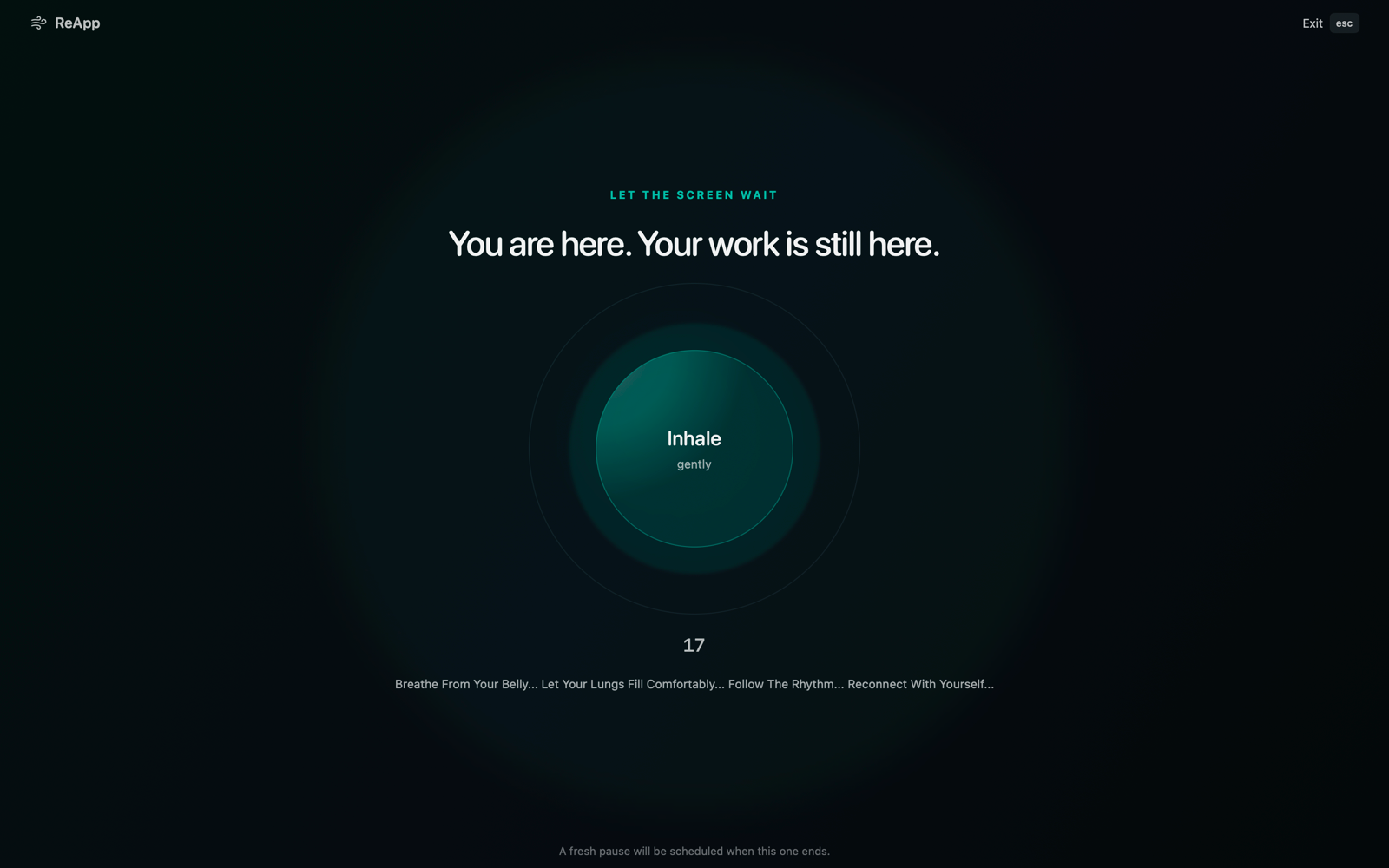
Breathe Screen
-
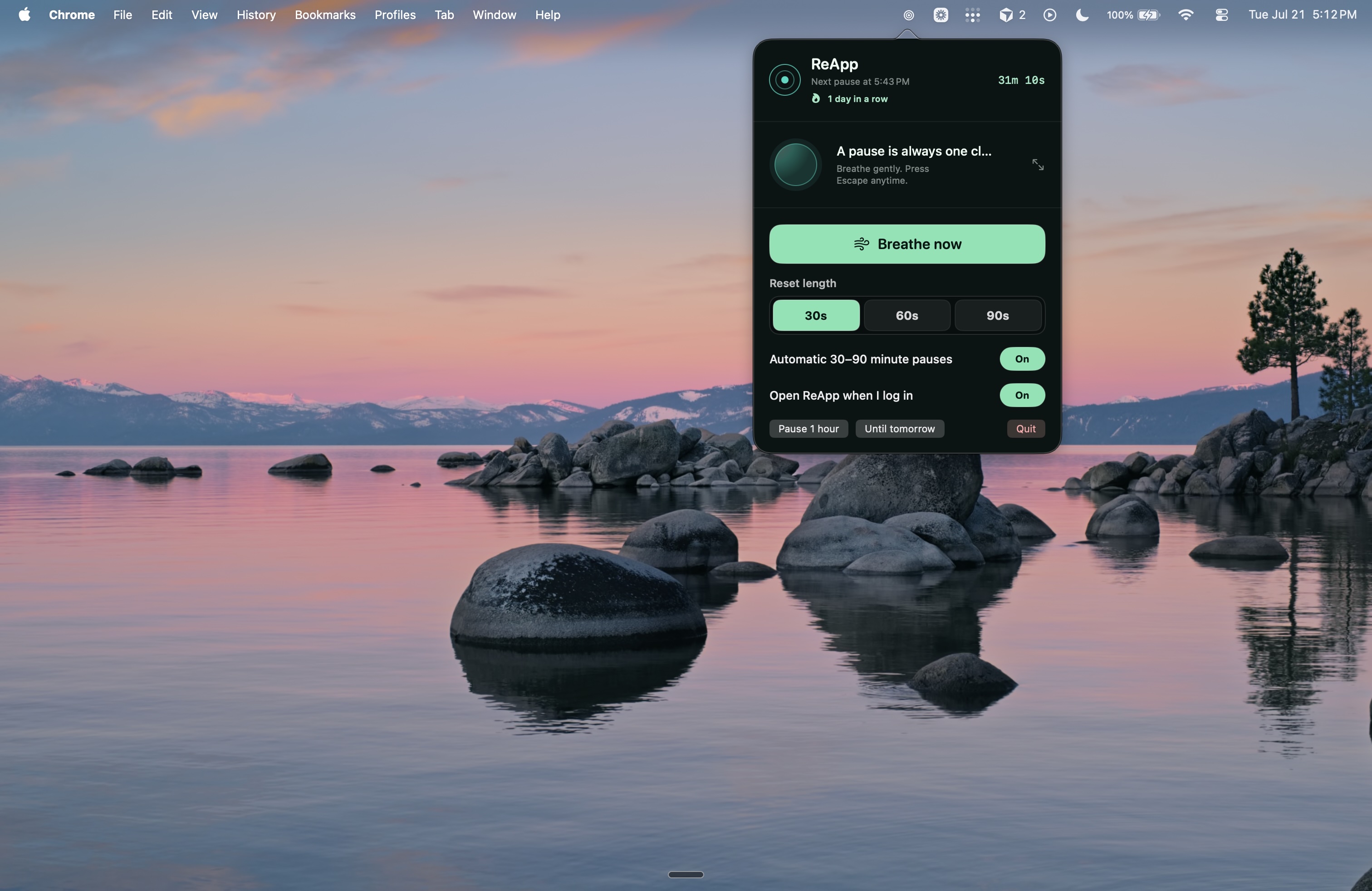
Mac bar Menu
-
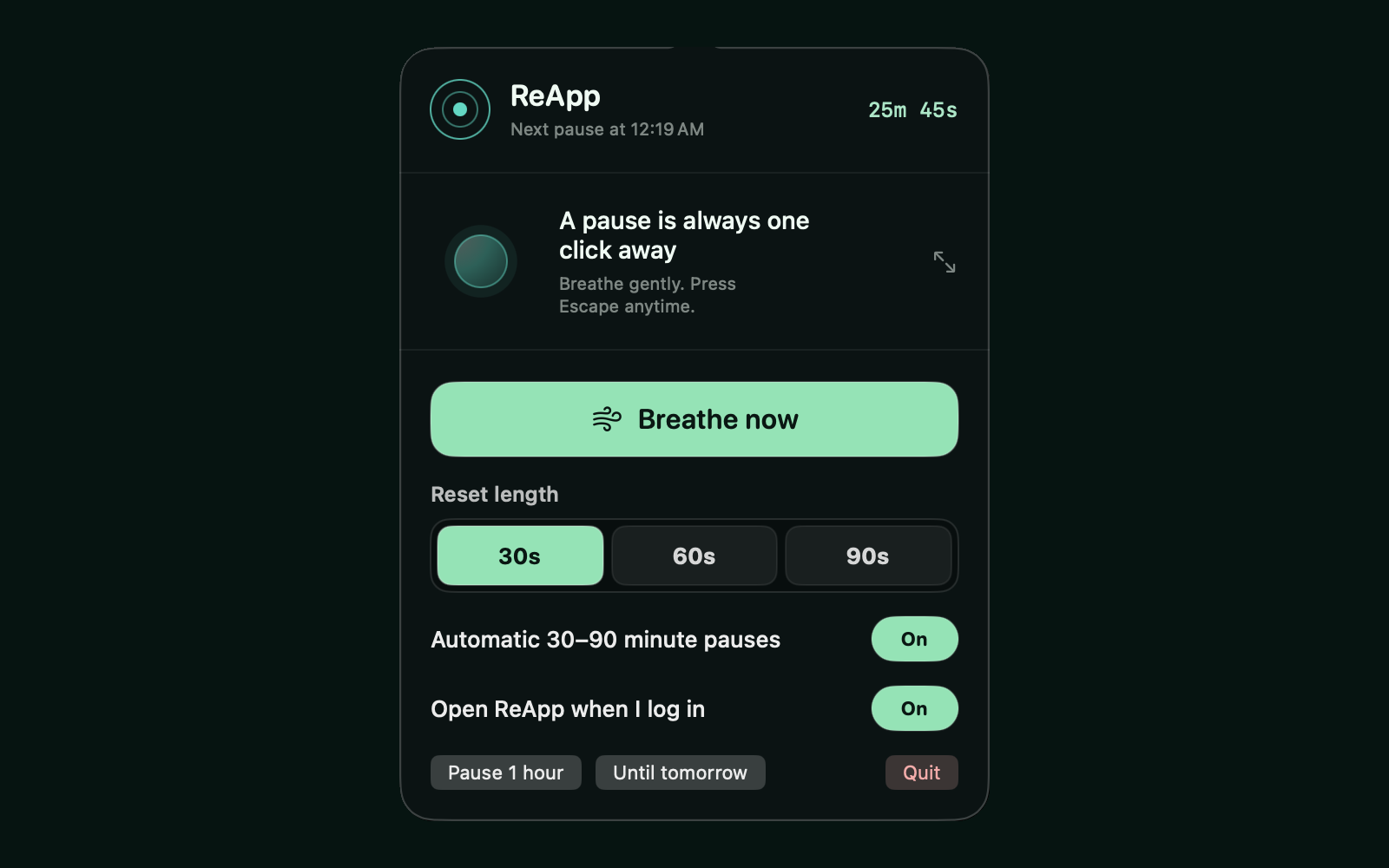
Menu Bar Menu
-
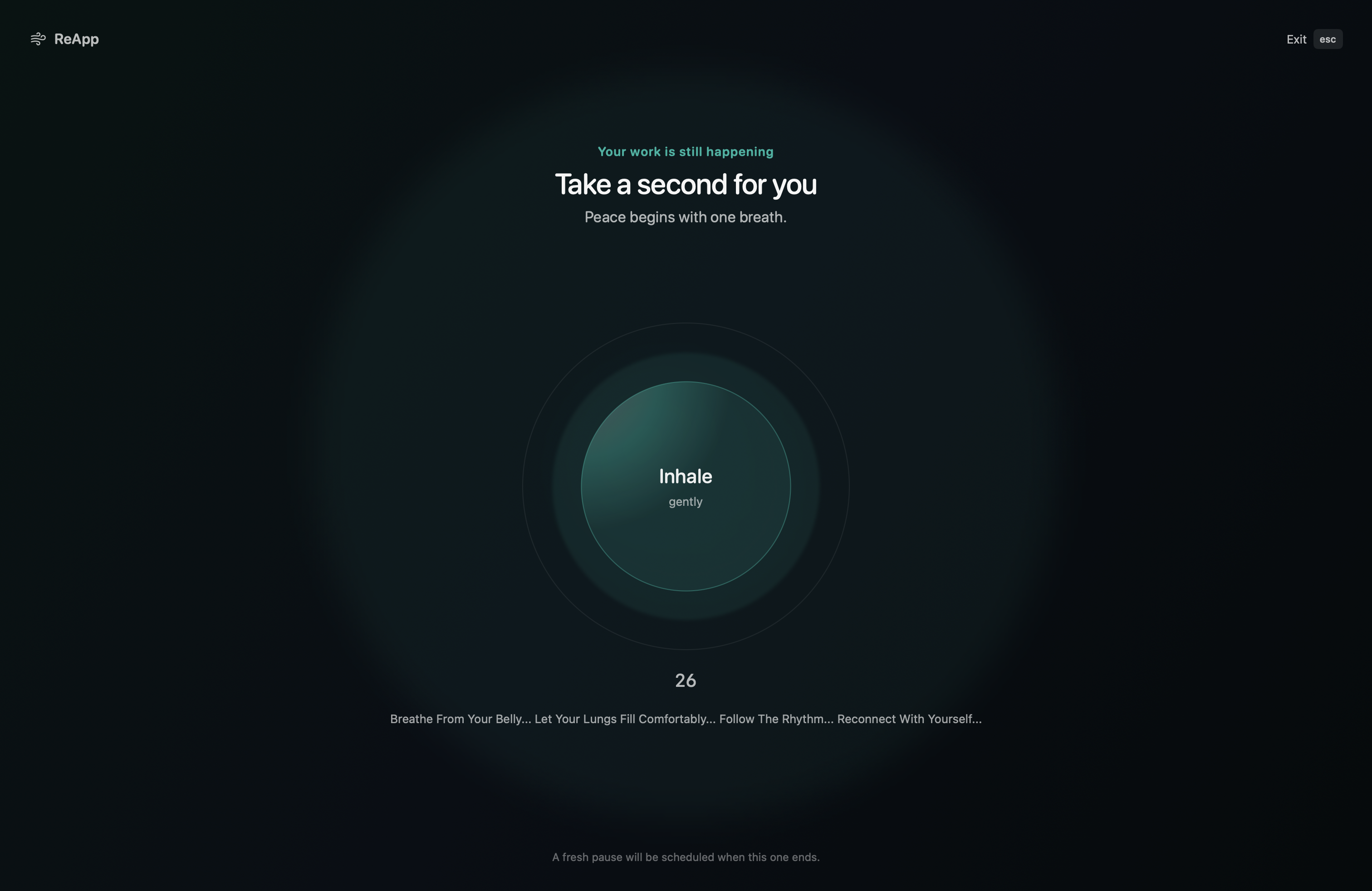
Full Screen
ReApp — Pause without losing your AI workflow
Inspiration
AI-assisted development makes it possible to work faster and stay inside a coding session longer—but that speed has a hidden cost.
Developers hand a task to Codex or ChatGPT, then continue staring at the screen, checking progress, switching tabs, or immediately starting something else. Hours can pass without standing up, taking a full breath, or mentally stepping away from the work.
ReApp began with a simple question:
What if handing work to AI also created permission to connect back to yourself?
ReApp gives developers/users/and humanity a brief, intentional breathing reset without forcing them to abandon their workflow. The goal is not to interrupt productive work. It is to help developers return to it calmer, clearer, and more connected to what they are doing.
What it does
ReApp creates short, user-controlled breathing pauses during computer work.
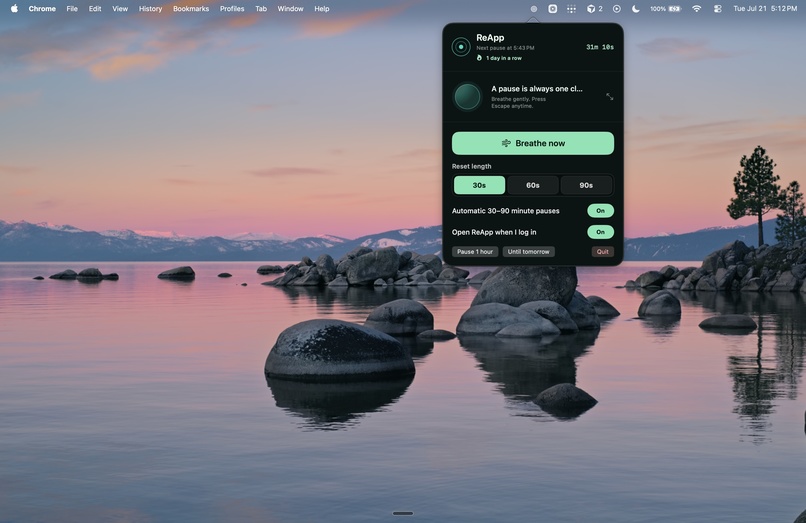
Inside ChatGPT and Codex (submitted for review), users can request a 30, 60, or 90-second reset. The main function is a Mac Bar App that is light but powerful.
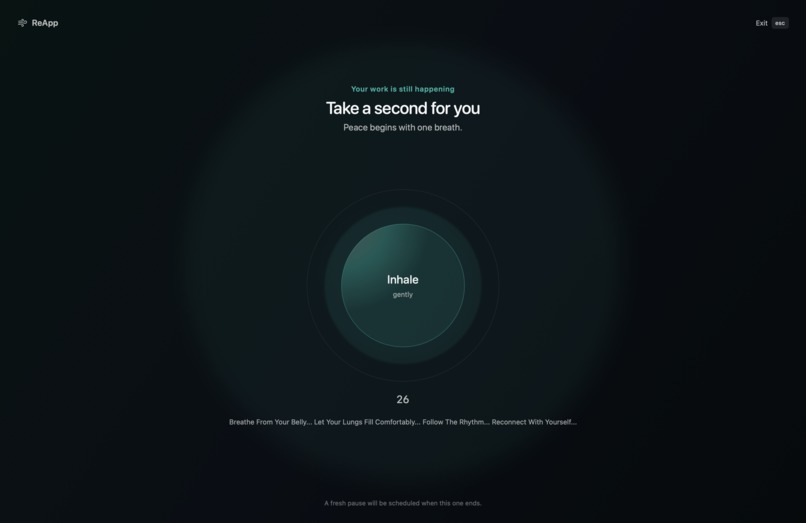
ReApp opens an interactive visual breathing pacer with:
- A fixed five-second inhale and five-second exhale rhythm
- 30, 60, and 90-second duration choices
- Pause and resume controls
- An immediate early-exit option
- Reduced-motion support
- A completion message that helps the user transition back to work
- Optional GPT-5.6-generated motivational and calming cue language
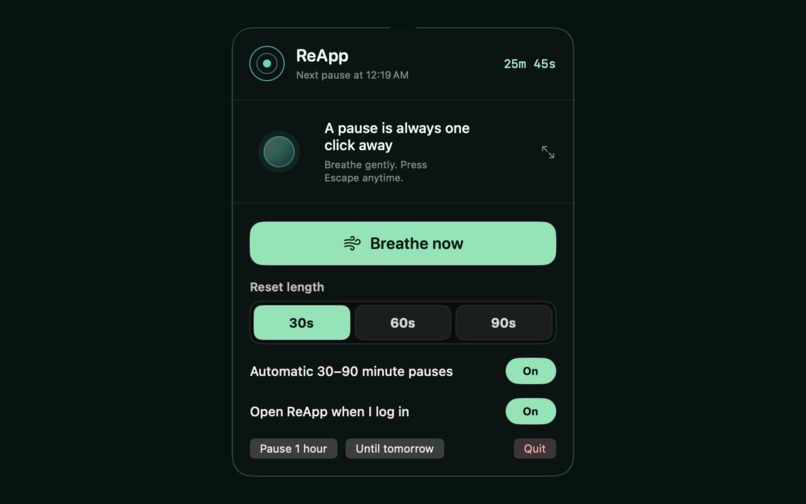
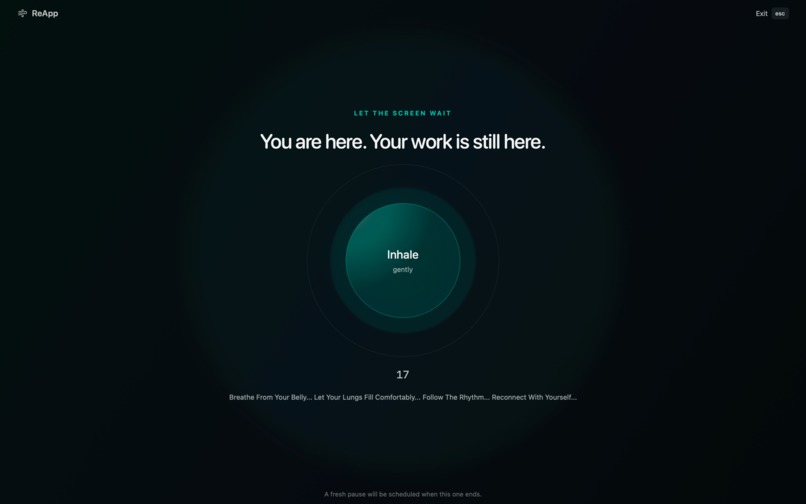
The native Mac companion makes ReApp proactive. It lives in the macOS menu bar and schedules a new pause at a randomized interval between 30 and 90 minutes. When the timer is reached, ReApp opens a screen-covering breathing experience.
Users can press Escape at any time. If a pause is dismissed, ReApp schedules a new randomized interval rather than forcing the exercise.
The Mac companion runs locally. It does not read source code, prompts, ChatGPT conversations, screen contents, or private task information.
How we built it
We have an iOS app that is ReApp, and we gave that app and that repo to Codex and said, "Make me a Mac companion version of this that is extremely simple, that meets the requirements of this hackathon, and lets us get it submitted within the timeframe needed."
I set a /goal, and Codex handled the rest.
It only took a couple prompts, and the entire thing was built. Including the submission to Apple and to OpenAI. Codex was amazing. And super efficient.
ReApp combines four complementary components:
- An MCP server that exposes four typed tools:
companion_setup,plan_reset,start_reset, andcomplete_reset. - An Apps SDK-compatible interface that renders the breathing experience inside ChatGPT and Codex.
- A bundled Codex skill and SessionStart hook that can quietly wake the installed Mac companion without inspecting the developer’s task.
- A native SwiftUI macOS companion that owns the randomized schedule and reliable full-screen experience.
The public MCP service and website run on Node.js and Vercel.
GPT-5.6 uses the Responses API with Structured Outputs to generate a small amount of restrained cue language. The model does not control breathing mechanics. Deterministic application code owns:
- Allowed durations
- The five-second inhale/exhale cadence
- Cycle calculations
- Input validation
- Completion states
- Safety boundaries
- Offline fallback behavior
If the OpenAI request is unavailable, ReApp continues working with reviewed local copy.
The native companion is distributed as a signed and notarized macOS application. It supports menu-bar controls, automatic scheduling, immediate Escape handling, local completion tracking, and full-screen resets.
How Codex helped
Codex was a core development collaborator throughout OpenAI Build Week.
Codex helped us:
- Design the MCP-first architecture
- Implement and test the four MCP tools
- Build the Apps SDK-compatible breathing interface
- Develop and harden the native SwiftUI companion
- Diagnose full-screen timing and layout issues
- Improve menu-bar responsiveness and visibility
- Build the Vercel deployment
- Create the signing and notarization workflow
- Run unit, integration, accessibility, reduced-motion, completion, and early-exit tests
- Prepare the OpenAI plugin and Devpost submission packages
- Prepared and executed all Apple Submissions
- Prepared and executed all OpenAI Plugin Submissions
Human product direction remained responsible for the central experience, product boundaries, breathing cadence, user-control requirements, messaging, and the decision to keep the original ReApp iOS application completely unchanged.
Challenges we ran into
The hardest part was not creating an animated breathing circle. It was making the interruption feel trustworthy.
A product that takes over the screen must make it immediately clear that the user remains in control. We hardened Escape handling, removed distracting layout transitions, kept the countdown alive for the complete session, and added a dedicated success state instead of closing the window unexpectedly.
We also had to separate native operating-system capabilities from what ChatGPT and Codex can do inside an embedded app. An MCP app cannot silently take over a user’s computer on a randomized timer. The native Mac companion provides that functionality after explicit installation and opt-in.
Another challenge was deciding what AI should—and should not—control. GPT-5.6 contributes tone and short cue language, while deterministic code controls timing, pacing, validation, and fallback behavior.
Another challenge was deciding what category to put this in because it can help developers build better products. That was our initial thought, but at the last minute, at the time of submission, we decided to do Apps for Life because this can help more people connect with themselves, regardless if they're developers, virtual assistants, content creators, stock traders, or anybody else who spends a lot of time in front of their screens.
Accomplishments we are proud of
- One concept now works as a Mac menu-bar companion, browser experience, ChatGPT app, MCP service, and Codex skill.
- The native app can schedule randomized pauses without monitoring the user’s screen or work.
- The timer remains functional without an API key or model response.
- Escape remains immediately available throughout the full-screen experience.
- ReApp supports pause/resume, early exit, replay, and three reset lengths.
- The Mac beta is signed, notarized, and distributed independently from the untouched original iOS app.
- The OpenAI plugin has been submitted for review.
- The product stores no remote wellbeing history and requires no ReApp account.
What we learned
Codex is an incredibly powerful development tool. It helped us move from an idea to a working, tested, and delivered product in just a few days. Its process was clean and structured—from architecture and implementation to testing, debugging, deployment, and submission.
The biggest lesson was that keeping things simple is often better than overcomplicating the solution.
The original ReApp iOS application is a much more complex product. For this project, we focused on one clear problem: helping developers take short, intentional pauses during AI-assisted work. That focus allowed us to build and release the Mac companion quickly without sacrificing quality.
Codex made that speed possible, but simplicity made the product possible. By reducing the experience to a menu-bar companion, a randomized timer, and a focused breathing exercise, we were able to deliver something useful in days instead of getting lost in unnecessary complexity.
We also learned that a humane AI product needs clear boundaries. The model can contribute warmth and helpful language, while deterministic code protects the user’s control, privacy, timing, and ability to leave the experience immediately.
What's next
Next, we will gather feedback from developers about whether randomized pauses feel supportive rather than disruptive.
Future development may include:
- More local-only preferences and reset styles
- Additional accessible visual cues
- More breathing patterns
- Improved local streak and completion summaries
- Support for more desktop platforms
- Deeper user-initiated Codex and ChatGPT workflows (inside the Codex App)
- A future iOS companion developed separately from the original application
The larger vision is simple:
Let the pause find you—then return to your work with a clearer mind.
Built With
- api
- apps
- chatgpt
- codex
- context
- github
- gpt-5.6
- html5
- javascript
- macos
- model
- node.js
- openai
- outputs
- protocol
- responses
- sdk
- structured
- swift
- swiftui
- vercel

Log in or sign up for Devpost to join the conversation.