-
-
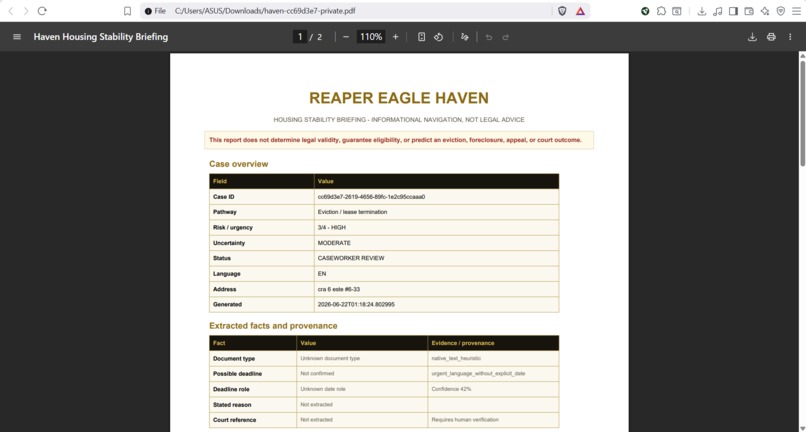
Report Generation
-
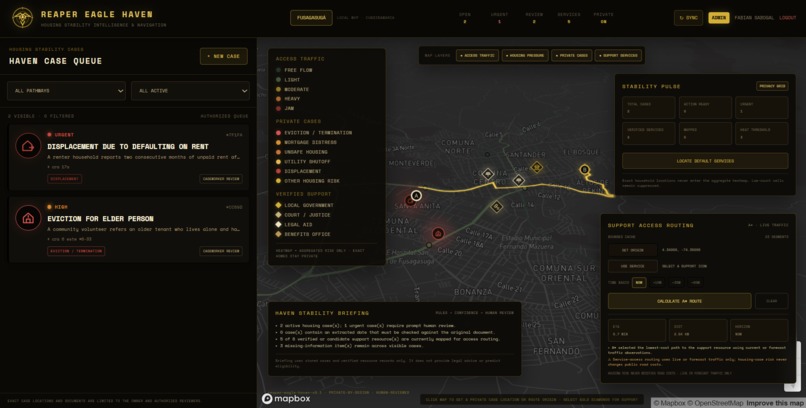
Routing Engine
-
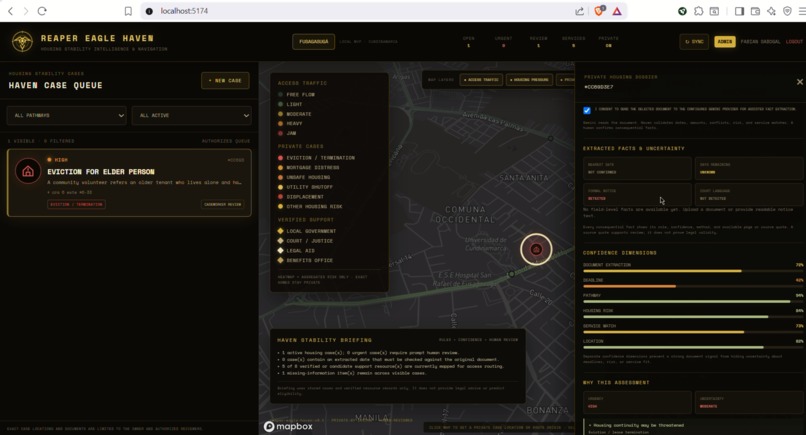
Confidence Intervals
-
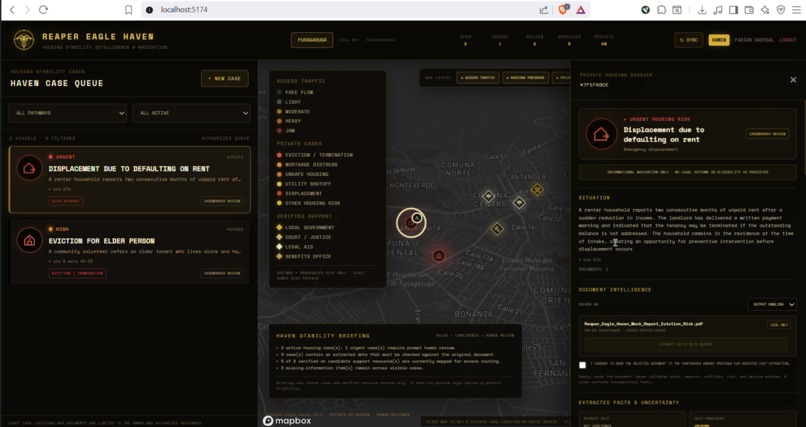
General Overview
Inspiration
Housing instability is often not caused by one single problem. It is caused by confusion under pressure: a notice arrives, several dates appear, the language is hard to interpret, the user is unsure which deadline matters, and the right support resource may be difficult to identify quickly.
Reaper Eagle Haven was built around a simple safety principle:
Gemini reads. Haven reasons. Humans confirm.
The goal is not to replace lawyers, public officials, housing counselors, or caseworkers. The goal is to turn confusing housing documents and narratives into an explainable, human-reviewable support pathway.
What it does
Reaper Eagle Haven is an explainable housing-stability intelligence and navigation system for renters and housing-vulnerable households.
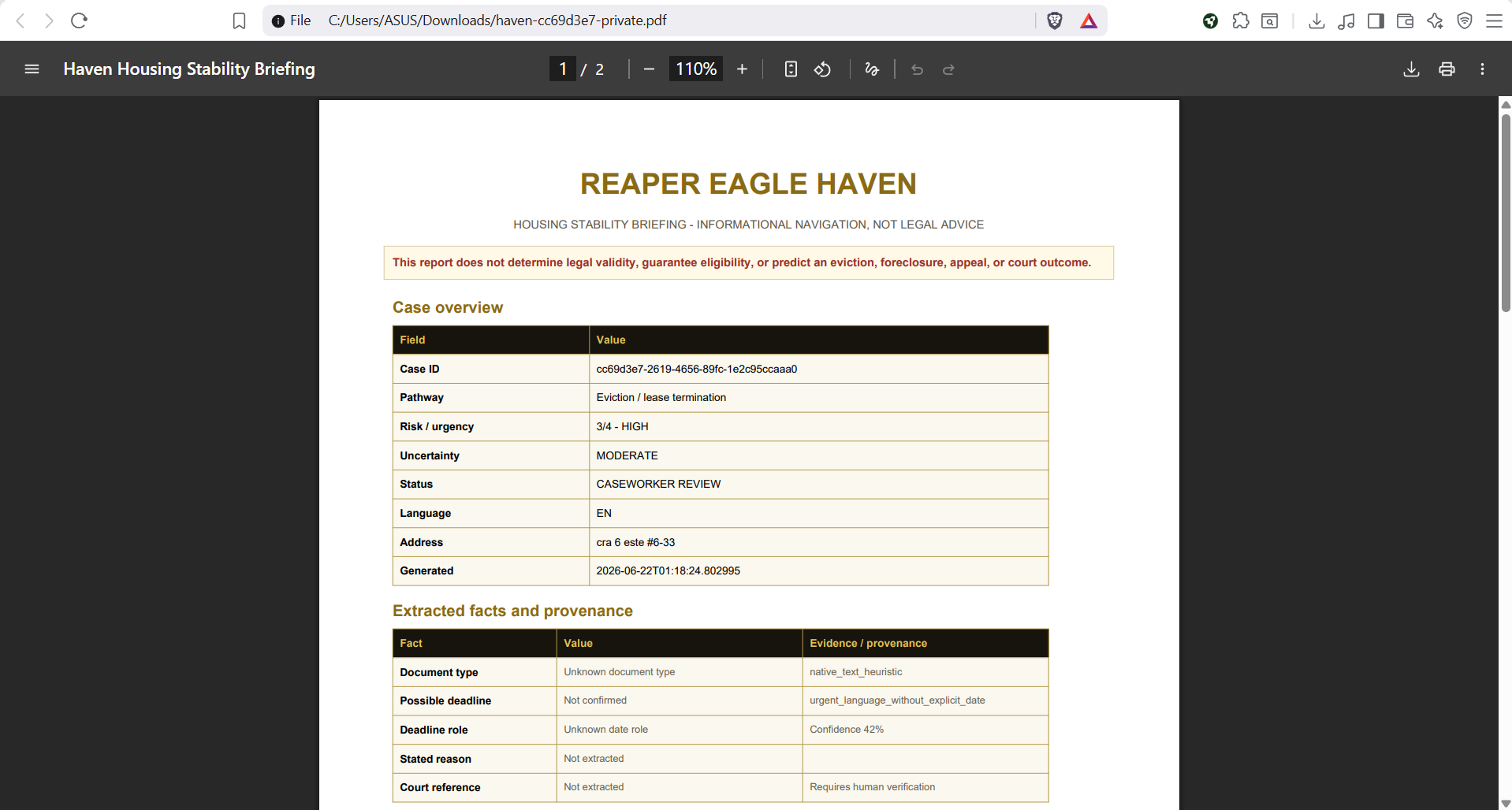
A user can create a housing case, describe their situation, upload a document such as a housing notice, and receive a structured briefing that highlights:
- Important extracted facts
- Relevant dates and their roles
- Missing or conflicting information
- Housing-stability pathway classification
- Human-review warnings
- Verified support resources
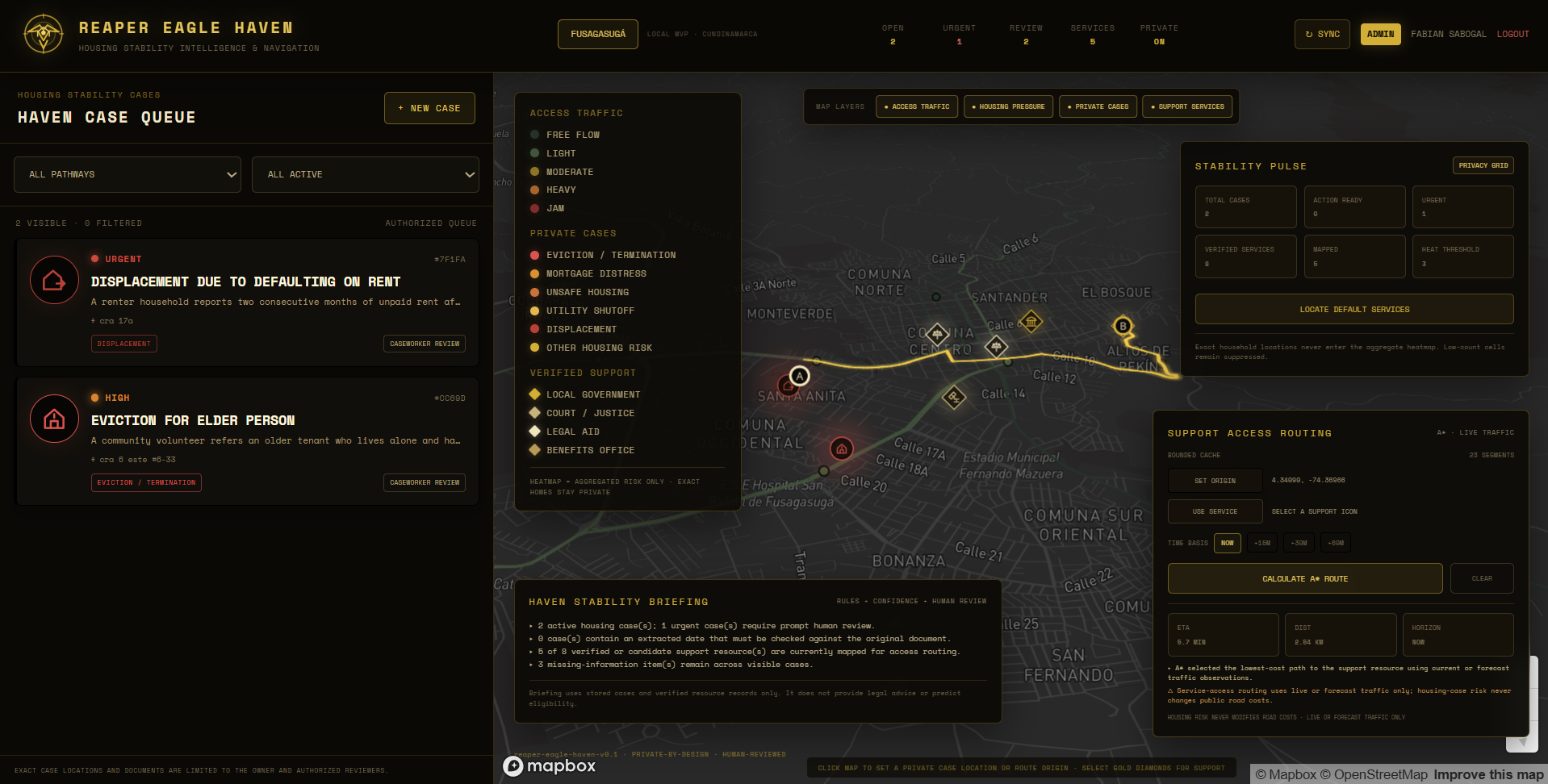
- Service-access navigation
- Private and redacted PDF reports
Haven distinguishes between different kinds of dates, such as:
notice_datepayment_deadlineresponse_deadlinevacate_deadlinehearing_dateappeal_deadlinefiling_date
This matters because a notice date is not automatically the same as a move-out deadline or a response deadline. Misreading that distinction can create real harm.
How it works
The system follows a layered architecture:
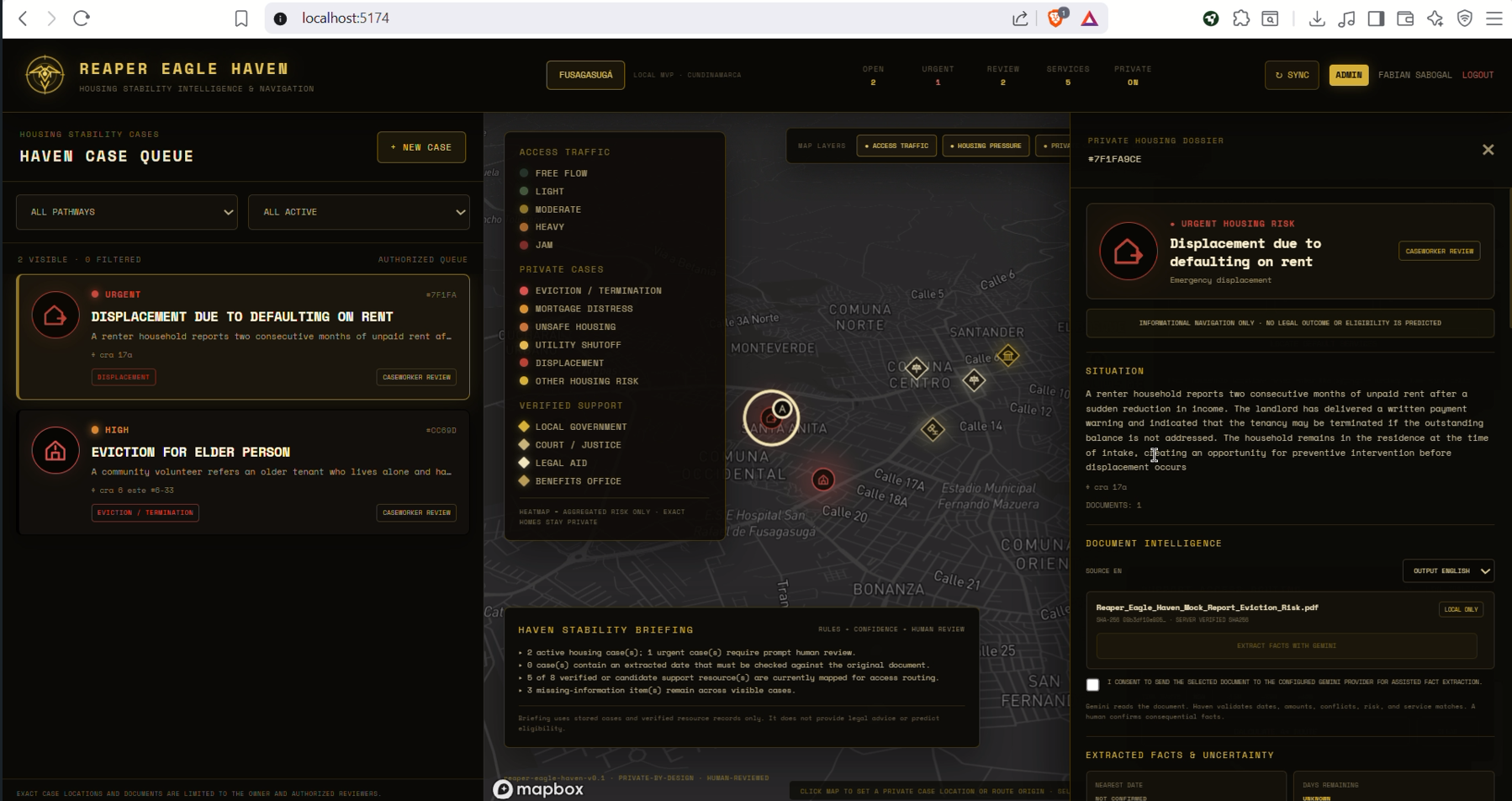
Private case input The user provides a housing narrative, optional location context, and supporting documents.
Document integrity layer Uploaded documents are checked with byte-length and SHA-256 hashing so the system can preserve provenance and avoid silent document changes.
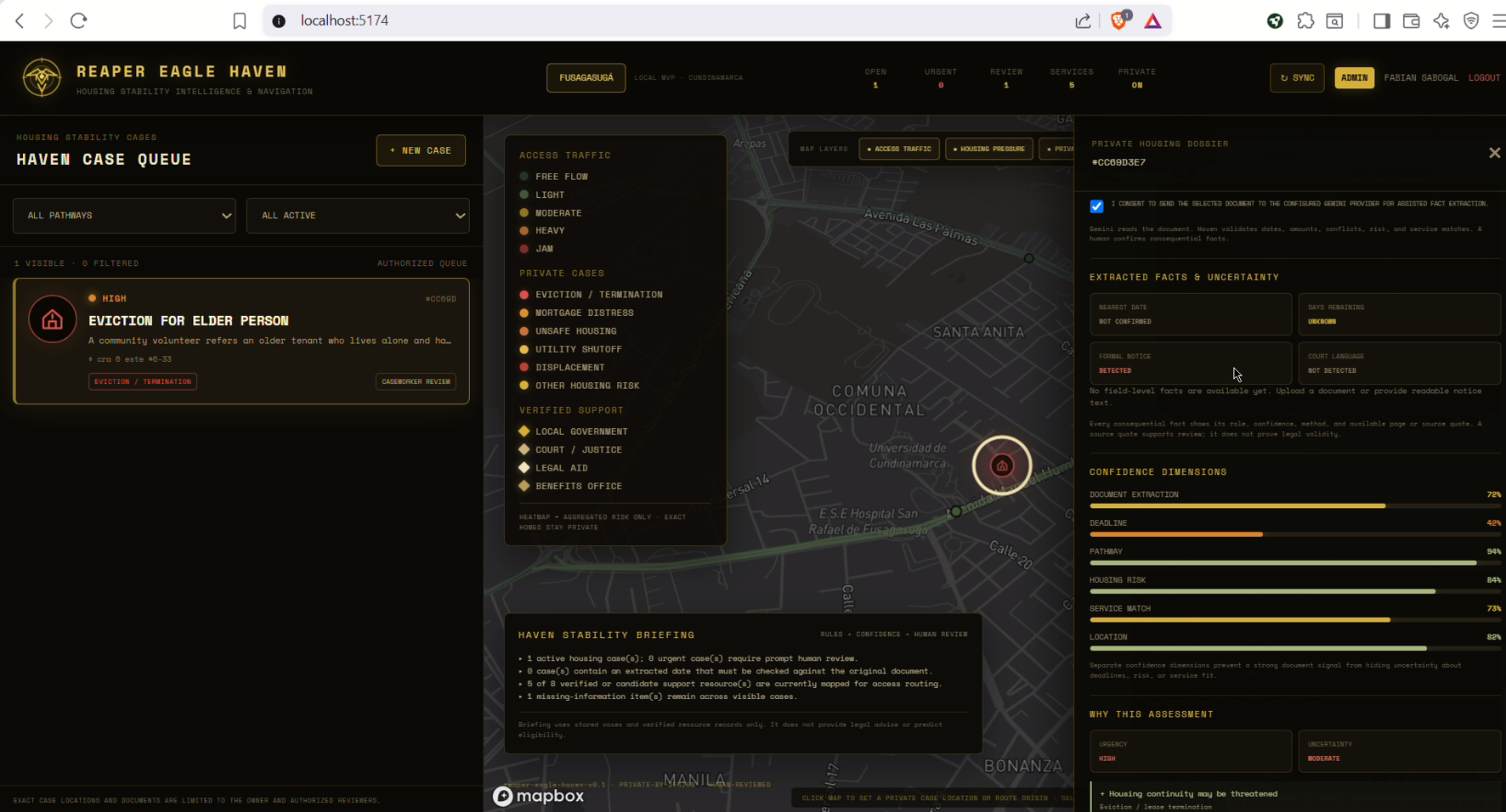
Gemini document perception Gemini can extract visible facts from notices, such as dates, amounts, document type, quoted evidence, page references, and unreadable fields.
Deterministic Haven reasoning Haven validates extracted fields, detects missing information, classifies housing pathways, separates confidence dimensions, and applies safety rules.
Explainability layer The system shows what was found, where it came from, why it matters, what remains uncertain, and what it refuses to conclude.
Support matching and navigation The platform matches the user to verified support resources and can provide service-access routing without exposing exact private household locations publicly.
Human confirmation Consequential decisions remain with humans. Haven flags cases for caseworker, legal, public-service, or human review when uncertainty is high.
PDF reporting Haven can export a private full briefing and a shareable redacted version.
Built with
- FastAPI for backend orchestration
- React / Vite for the frontend
- PostgreSQL / PostGIS for persistence and geospatial support
- Redis for supporting services
- Docker Compose for local deployment
- Gemini multimodal document extraction for optional document perception
- Deterministic Python reasoning modules for validation, safety, explainability, and pathway classification
- PDF generation for private and redacted housing-stability briefings
- Mapbox / TomTom-style service-access mapping concepts for resource navigation
What makes it different
Many AI tools try to give direct answers. Haven is designed to avoid that pattern in high-stakes housing contexts.
Instead of saying “this is legally valid” or “you will be evicted,” Haven separates perception, reasoning, and human review.
It explicitly avoids making legal determinations, predicting court outcomes, guaranteeing eligibility, or replacing professionals. It focuses on making the situation clearer, safer, and easier to review.
The system is also bilingual-oriented. English and Spanish housing cases can map into the same internal reasoning schema, allowing the platform to support multilingual communities without changing the core safety logic.
Challenges we faced
The hardest challenge was not simply building an AI document reader. The real challenge was building a system that knows what it should not say.
Housing instability is sensitive. A wrong interpretation of a deadline, amount, or document type can mislead a user. Because of that, Haven needed:
- Separate confidence dimensions instead of one vague AI score
- Date-role taxonomy instead of raw date extraction
- Missing-information detection
- Human-review thresholds
- Private and redacted reporting modes
- Clear non-conclusions
- Synthetic validation cases instead of real user data
Another challenge was keeping the map layer from becoming a “risk map.” Haven does not publicly expose private household coordinates. The map is for service-access navigation and support matching, not surveillance.
Accomplishments
We built a working housing-stability platform that combines document understanding, deterministic reasoning, explainability, support matching, and report generation.
The project includes:
- A housing case workflow
- Document intelligence architecture
- Date and deadline role extraction
- Safety boundaries for AI-assisted housing guidance
- Bilingual synthetic baselines
- Explainability endpoints
- Private and redacted PDF reports
- Dockerized local services
- A public-service-oriented interface and demo flow
The strongest part of the project is the safety contract: Gemini can assist with perception, but Haven performs structured reasoning, and humans remain responsible for consequential decisions.
What we learned
We learned that responsible AI for public services is less about producing a confident answer and more about producing a trustworthy process.
A useful civic AI system should show its evidence, expose uncertainty, preserve provenance, avoid overclaiming, and make it easy for a human to review or correct the result.
We also learned that explainability is not just a technical feature. In housing stability, explainability can be the difference between panic and a clear next step.
What's next
Next steps include:
- Running additional live Gemini document smoke tests
- Expanding verified local support resources
- Improving provider availability and intake validation
- Hardening OAuth and role-based access
- Extending Spanish-language workflows
- Adding more document types and housing pathways
- Testing with caseworkers and public-service reviewers
- Strengthening privacy-preserving geographic aggregation
Reaper Eagle Haven is a step toward safer, more explainable housing-stability assistance: not an AI lawyer, not a decision-maker, but a human-reviewable guide that helps people understand what matters, what is missing, and where to seek support.
Built With
- bilingual-synthetic-validation
- chatgpt
- deterministic-reasoning-modules
- docker-compose
- fastapi
- gemini-multimodal-document-extraction
- mapbox
- postgis
- postgresql
- powershell
- python
- react
- redis
- reportlab-pdf-generation
- sha-256-provenance
- tomtom-apis
- typescript
- vite


Log in or sign up for Devpost to join the conversation.