-
-
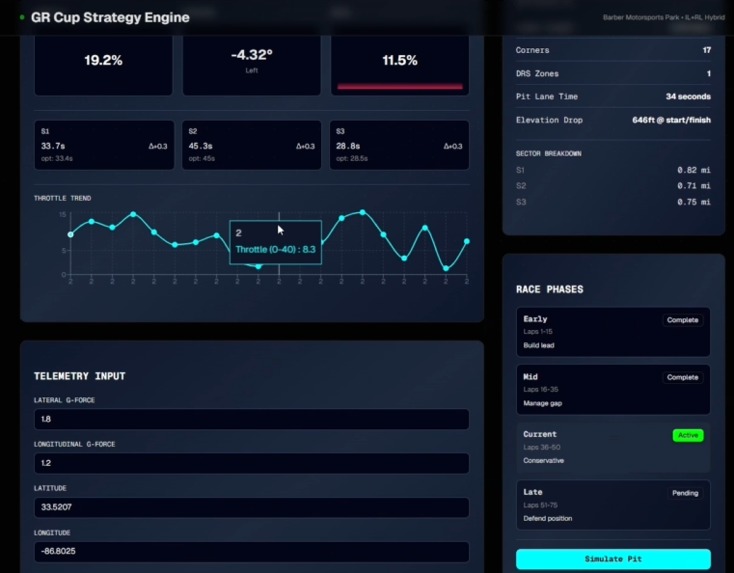
Dashboard
Realtime Racing Strategy Engine – Project Story Inspiration We were fascinated by professional racing and wondered: What if drivers had a real-time co-pilot that analyzed their performance and suggested the best driving moves instantly?
Modern race cars collect tons of data every second—speed, acceleration, steering angles, tire grip—but that data only becomes useful if someone can analyze it right now, not after the race. We wanted to build a system that turns raw sensor data into immediate, actionable advice.
What It Does Realtime Racing Strategy Engine is a live dashboard that watches incoming race data and instantly recommends the best driving actions. Here's what happens:
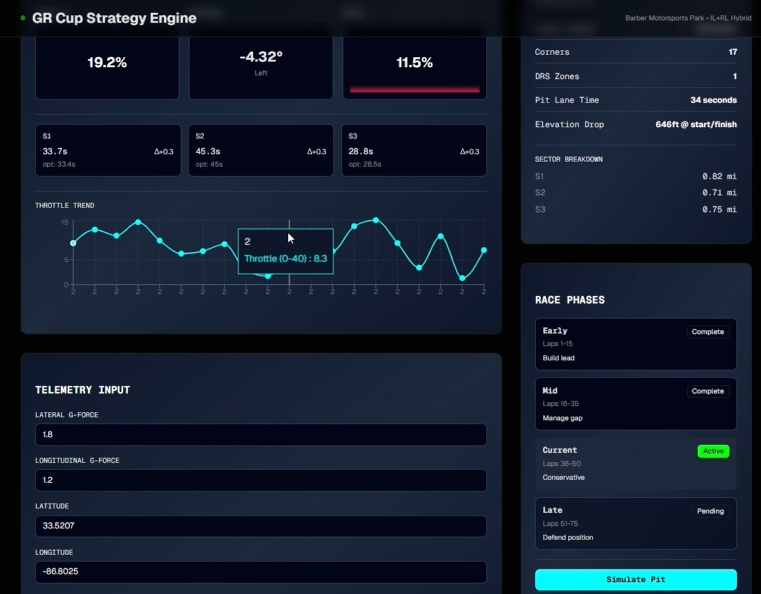
A driver (or simulated race) generates telemetry—speed, throttle position, braking, G-forces, lap progress. The system analyzes this data in real time using machine learning. Within seconds, the dashboard shows: Throttle recommendations (how much to accelerate) Braking guidance (when to slow down) Real-time charts that update as conditions change Strategy insights (what the AI learned from the data) Think of it as a live coach watching the race and giving split-second feedback.
How We Built It We combined two main components:
The Brain (Backend)
Built a machine learning engine using multiple AI models trained on real race data. Models learned driving behavior, race strategy optimization, tire wear patterns, and performance anomalies. Used actual telemetry from professional races to train the system. The Dashboard (Frontend)
Created a clean, responsive interface showing live charts and gauges. Designed it so viewers can see throttle trends, driving recommendations, and analysis—all updating together in real time. Built data streaming so the dashboard responds instantly to incoming telemetry. We connected them so that as new race data arrives, it flows from sensors → AI analysis → dashboard display in seconds.
Challenges We Ran Into Data Timing: Race telemetry comes in fast. We had to buffer and process it efficiently so the dashboard stayed responsive without overwhelming the system.
Realistic Recommendations: Early on, the AI sometimes gave choppy or unrealistic advice (like erratic throttle changes). We fine-tuned it to produce smooth, believable driving guidance.
Matching Display and Reality: We had to ensure the numbers shown on the dashboard matched exactly what the AI computed—no misleading visual noise that confused viewers.
Model Coordination: We used multiple AI models working together (behavioral learning, strategy optimization, tire prediction, anomaly detection). Making sure they all agreed and produced consistent insights took careful integration.
Accomplishments We're Proud Of ✓ Live, end-to-end data flow – Real race telemetry → AI analysis → live dashboard, all in seconds.
✓ Multiple AI models working together – Not just one algorithm; we integrated behavioral cloning, reinforcement learning, LSTM prediction, and anomaly detection into one cohesive system.
✓ Realistic driving recommendations – The throttle and brake suggestions behave like a real driver would, responding smoothly to track conditions.
✓ Clean presentation – Built a polished, professional dashboard that tells a clear story without overwhelming the viewer with technical jargon.
✓ Trained on real data – Our models learned from actual professional race telemetry, so recommendations are grounded in real-world racing.
What We Learned AI needs good data – Garbage in, garbage out. Spending time cleaning and understanding the training data was more valuable than tweaking the model itself.
Real-time systems are tricky – Balancing speed, accuracy, and responsiveness taught us a lot about system design trade-offs.
User experience matters – A beautiful, understandable interface sells the idea better than raw model accuracy. We learned to prioritize clarity.
Ensemble methods work – Using multiple models and combining their insights produced better results than any single approach.
Iteration is key – We built, tested, broke things, learned, and rebuilt multiple times. That process was essential to getting it right.
What's Next for Realtime Racing Strategy Engine Expand to more vehicles – Test with different car types and racing series. Add multi-driver comparison – Show how one driver's recommendations compare to others. Predictive alerts – Warn drivers about risky situations before they happen. Mobile app – Bring the dashboard to trackside on tablets and phones. Tire strategy optimizer – Help teams decide when to pit and change tires based on live data. Multiplayer collaboration – Allow race engineers to annotate and discuss insights in real time.
Built With
- data-analysis
- deep-learning
- machine-learning
- python
- reinforcement-learning


Log in or sign up for Devpost to join the conversation.