RealityProof — Project Story
Inspiration
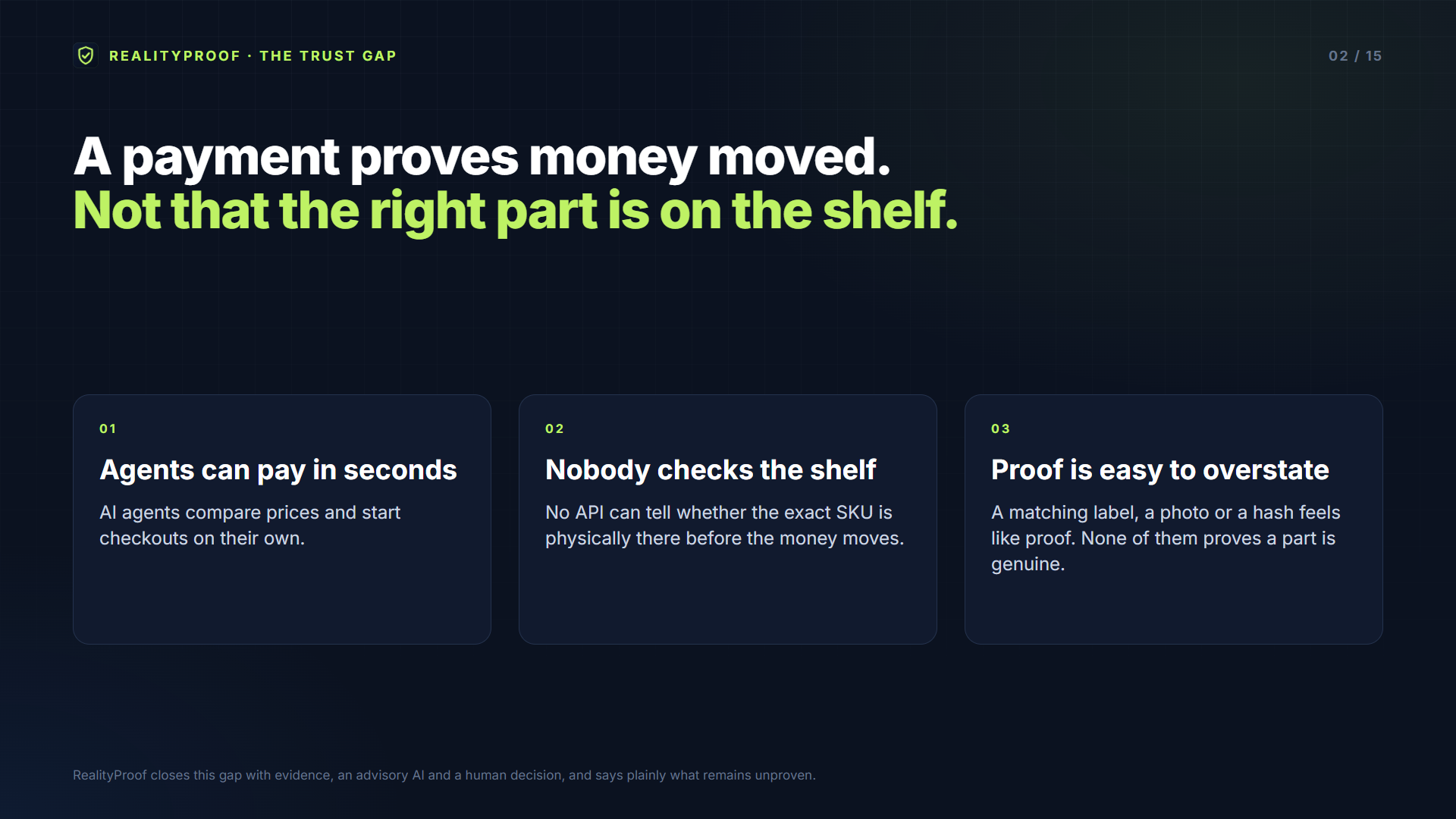
AI agents are getting better at finding products, comparing prices, and making purchases. But there is one question a checkout button cannot answer: Is the item actually what the buyer thinks it is?
Imagine a maintenance team urgently needs a specific replacement part. A listing shows the right part number, the seller accepts payment, and the order goes through. Yet the wrong SKU, a misleading label, or a missing component could turn a seemingly successful transaction into downtime, returns, and an expensive dispute.
A payment record can show that money moved. It cannot prove what was physically on the shelf. And as commerce becomes increasingly agent-driven, that gap between paying and knowing becomes more important.
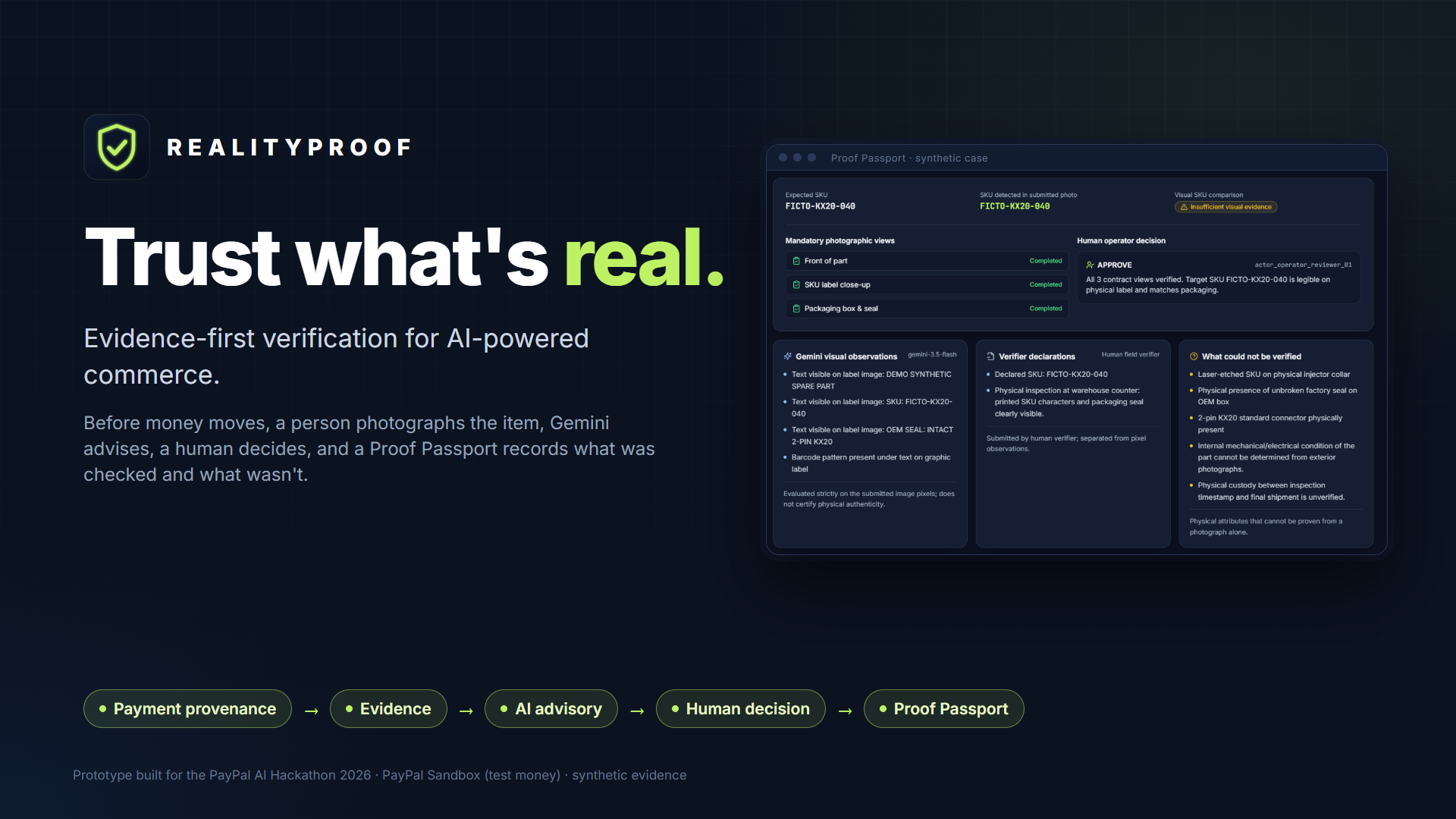
That inspired RealityProof: an evidence-first verification checkpoint for AI-powered commerce. Instead of asking AI to blindly trust a product listing or treating a photograph as conclusive proof, we wanted to build a process where money, evidence, machine observations, human judgment, and auditability each have a distinct role.
Our guiding idea is simple: Proof before payment. Pay a small, justified fee to investigate uncertainty before committing to a potentially costly product purchase.
What it does
RealityProof lets a buyer—or an AI agent acting on a buyer's behalf—request a structured verification of a specific item before making the larger purchasing decision.
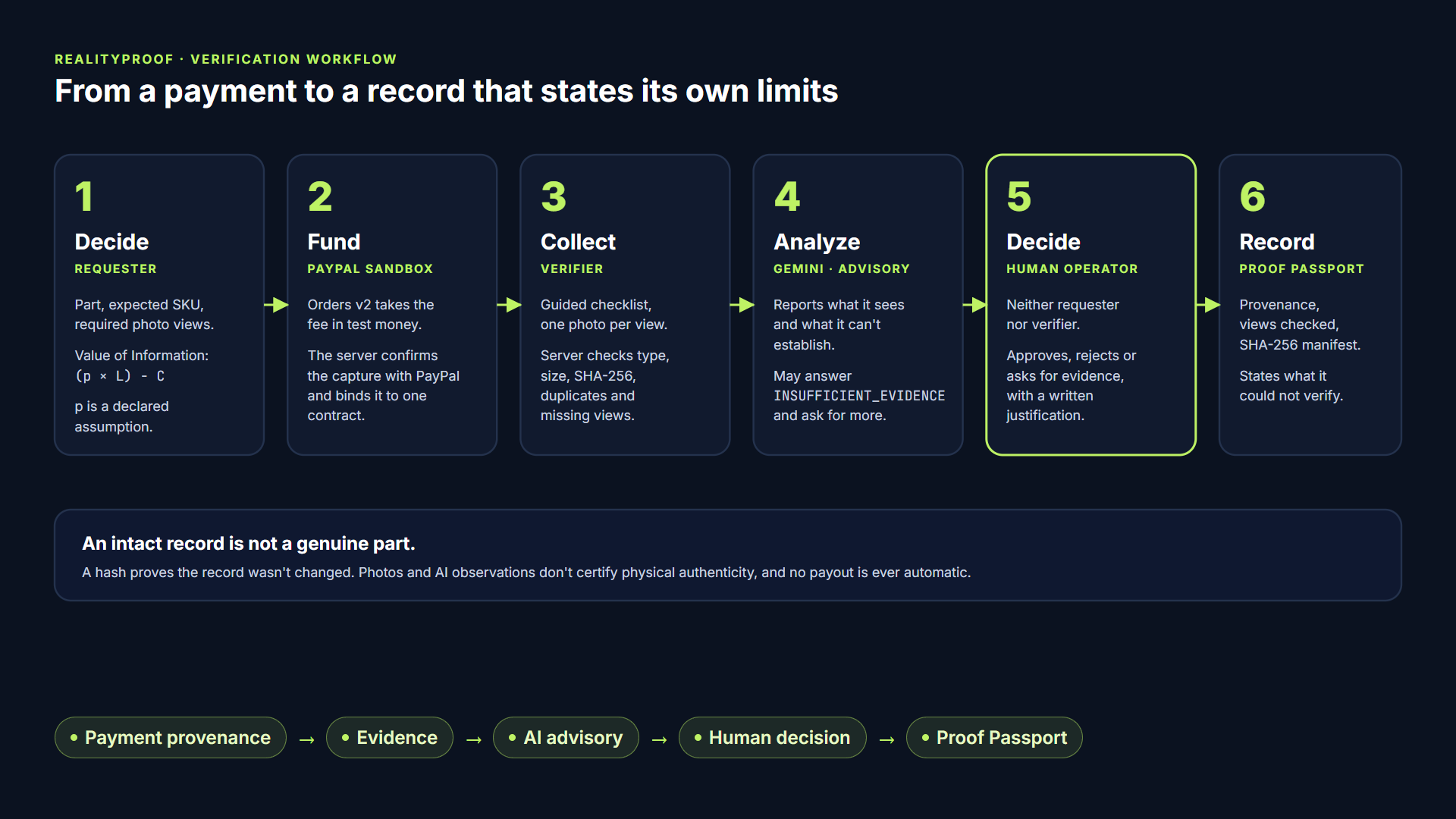
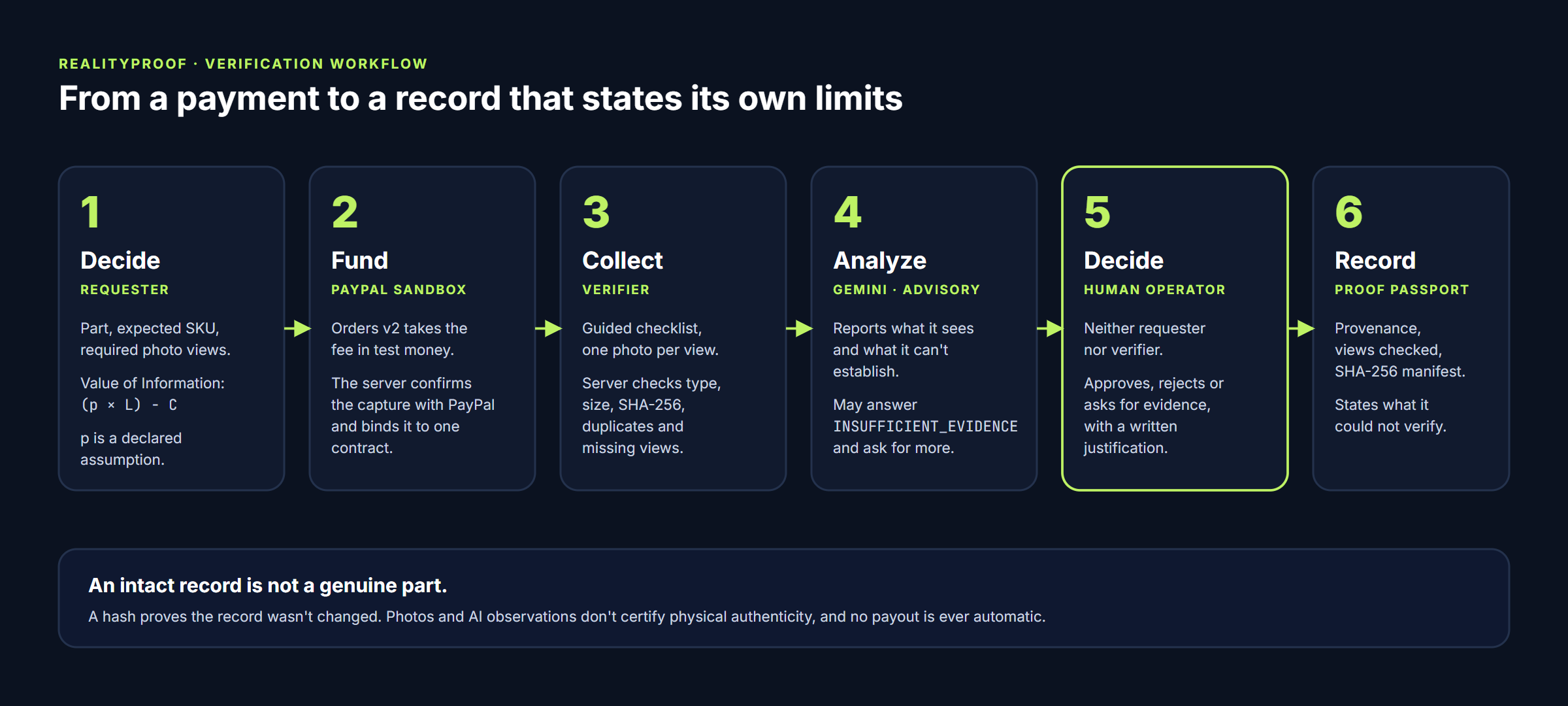
It turns an uncertain product claim into a traceable, human-reviewed decision process:
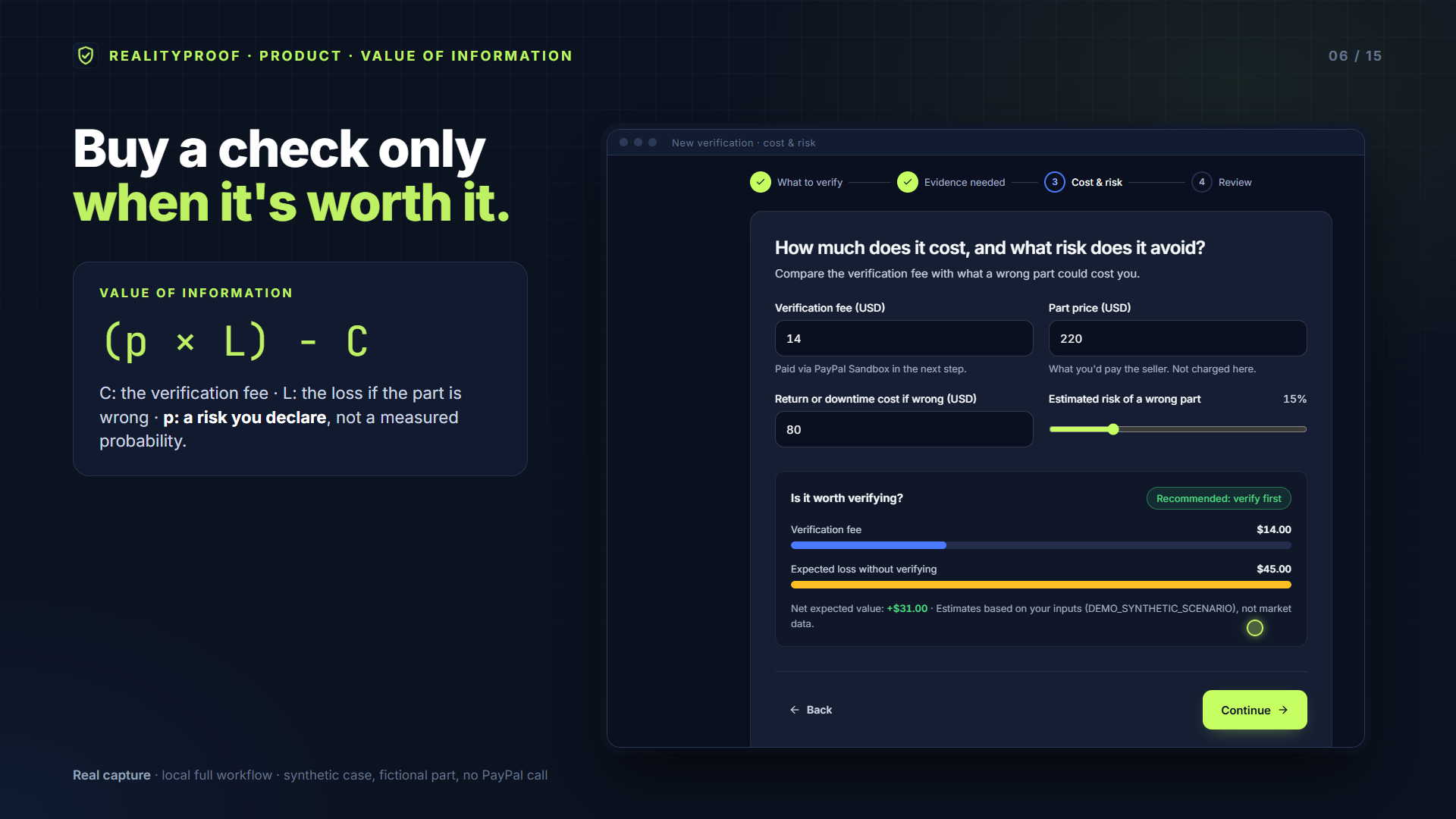
- Define the verification. A requester specifies the part, expected SKU, required photographic views, and verification fee. A Value of Information calculator compares the cost of checking with the potential loss of buying the wrong item. The risk probability is an explicit user assumption, not a prediction invented by AI.
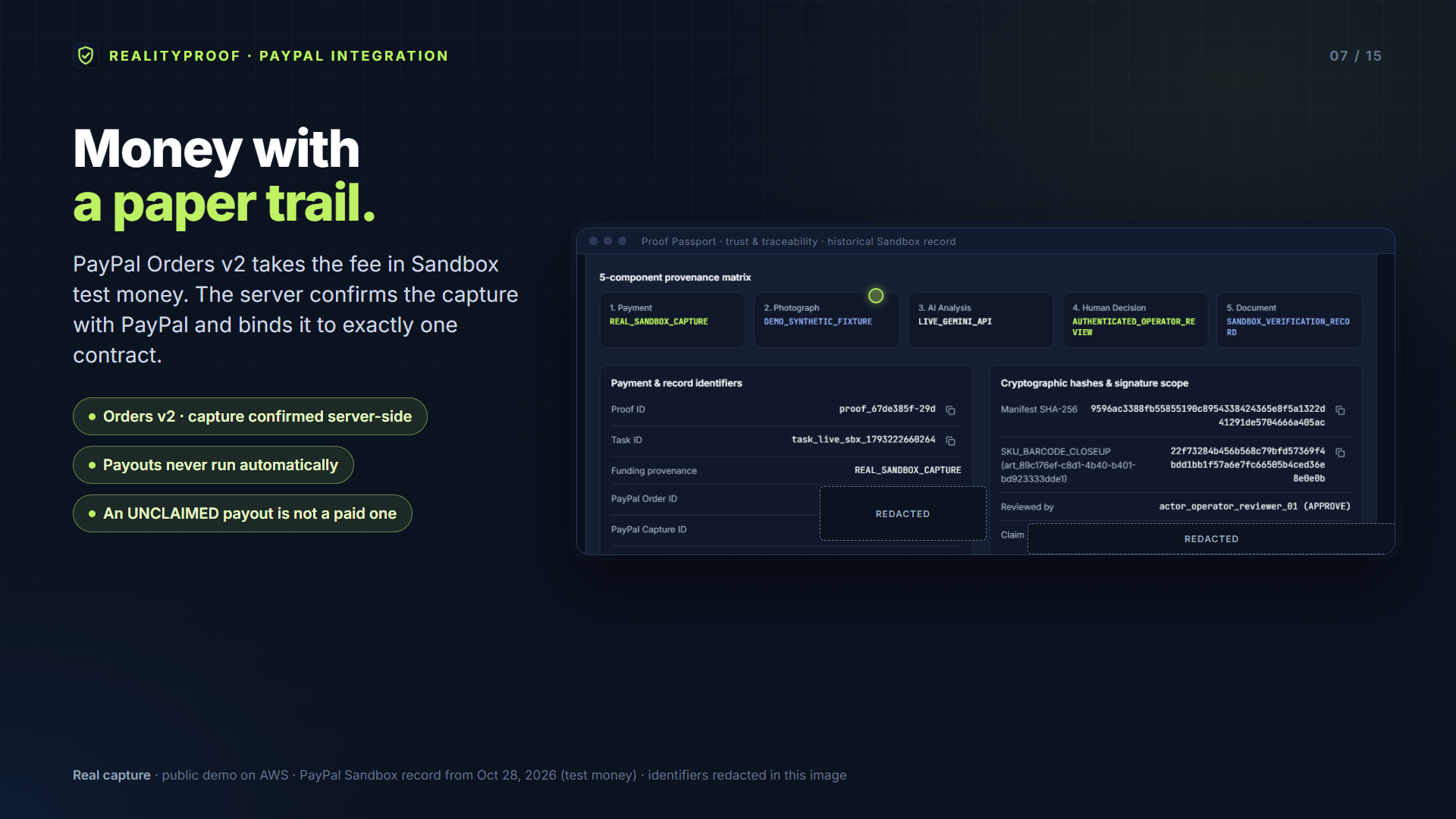
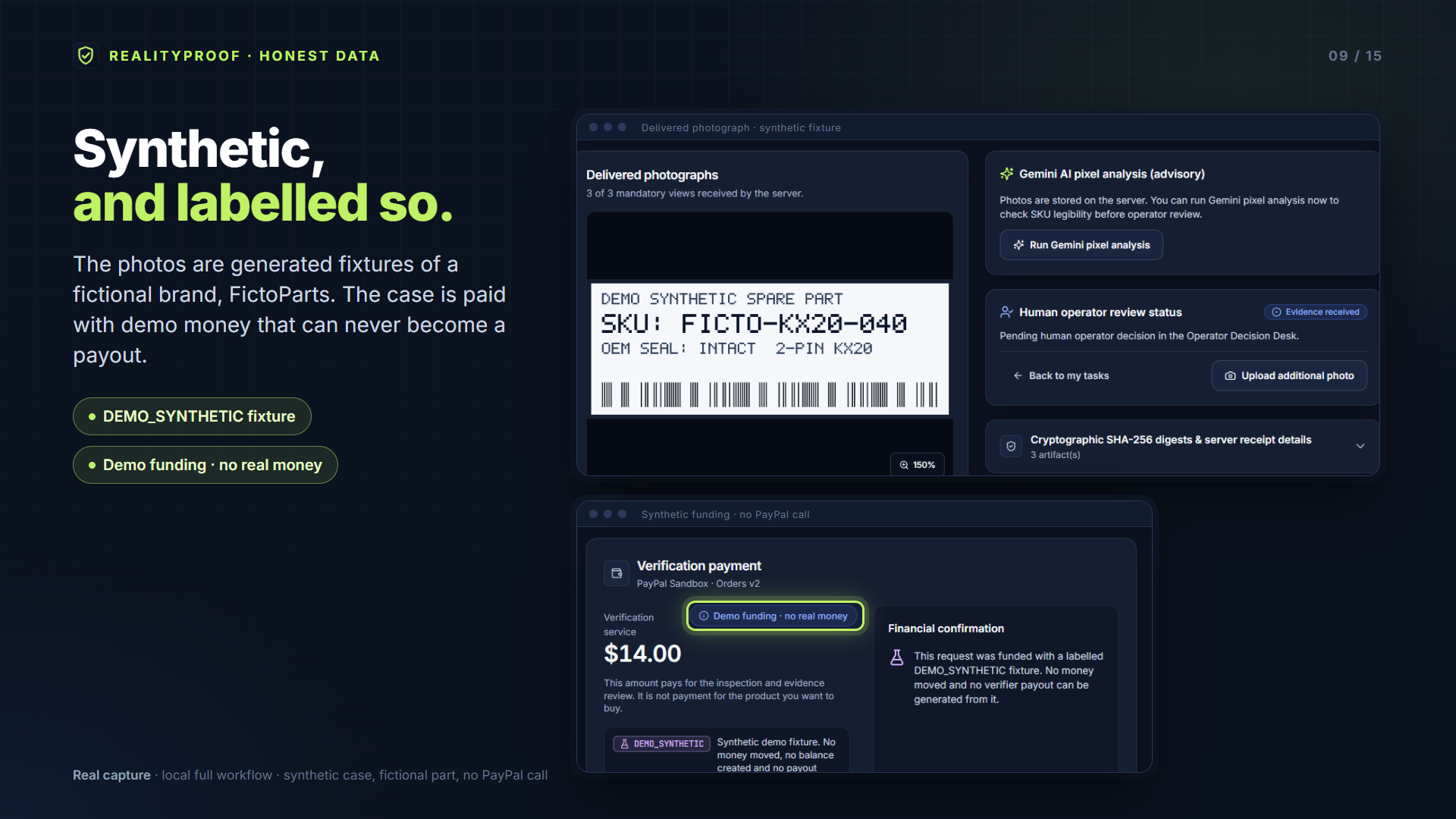
- Fund the check with PayPal. The application integrates PayPal Sandbox Orders v2 to create and capture a verification-fee payment. The server checks the capture with PayPal and links it to the corresponding verification request. The demonstration uses test money only.
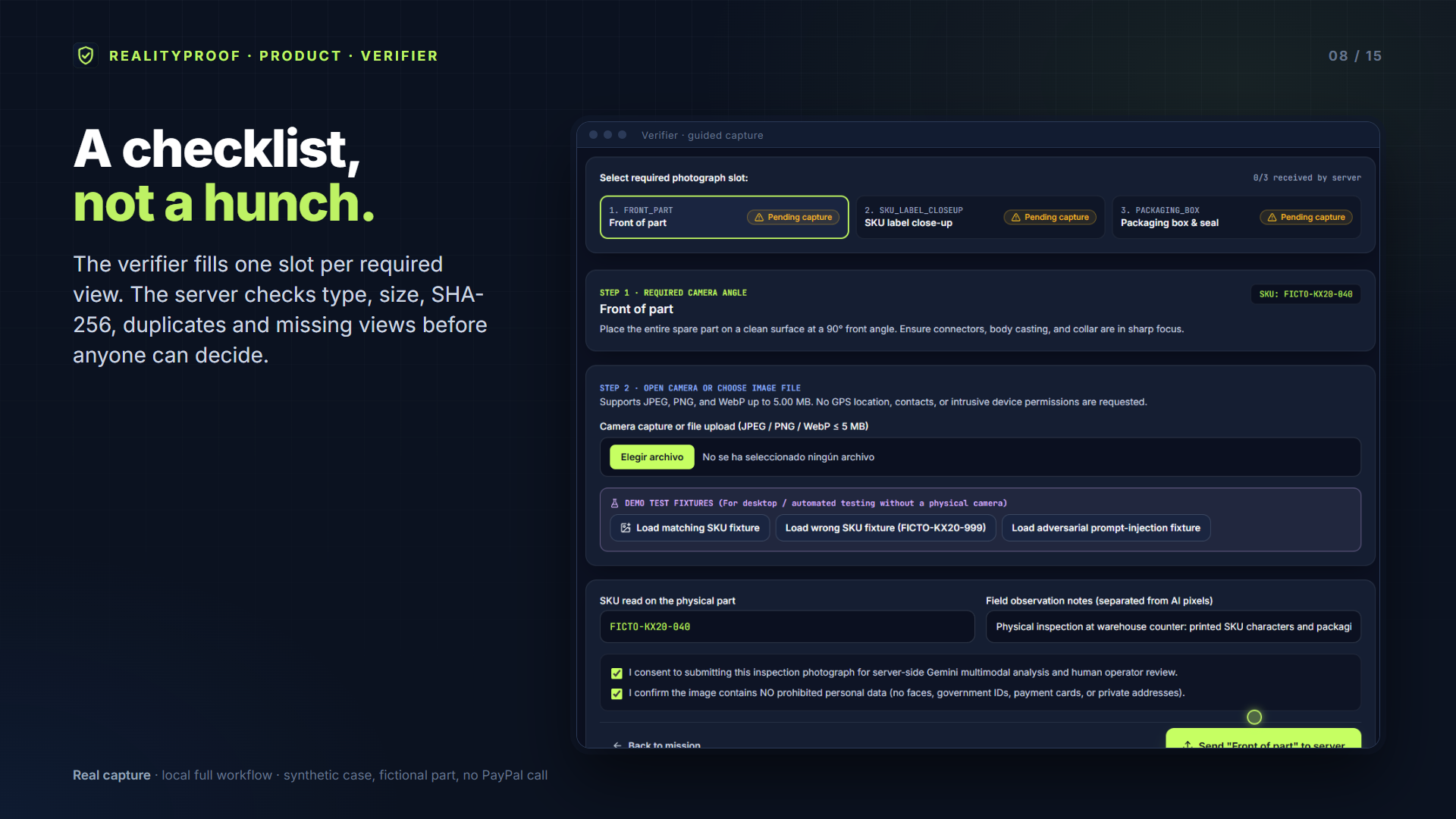
- Collect guided evidence. A verifier follows a mobile-friendly checklist and submits the required photographs. The system checks file validity, duplicates, evidence completeness, and SHA-256 hashes. In this hackathon prototype, the demonstration photos are clearly labeled synthetic fixtures, not images from a real-world inspection.
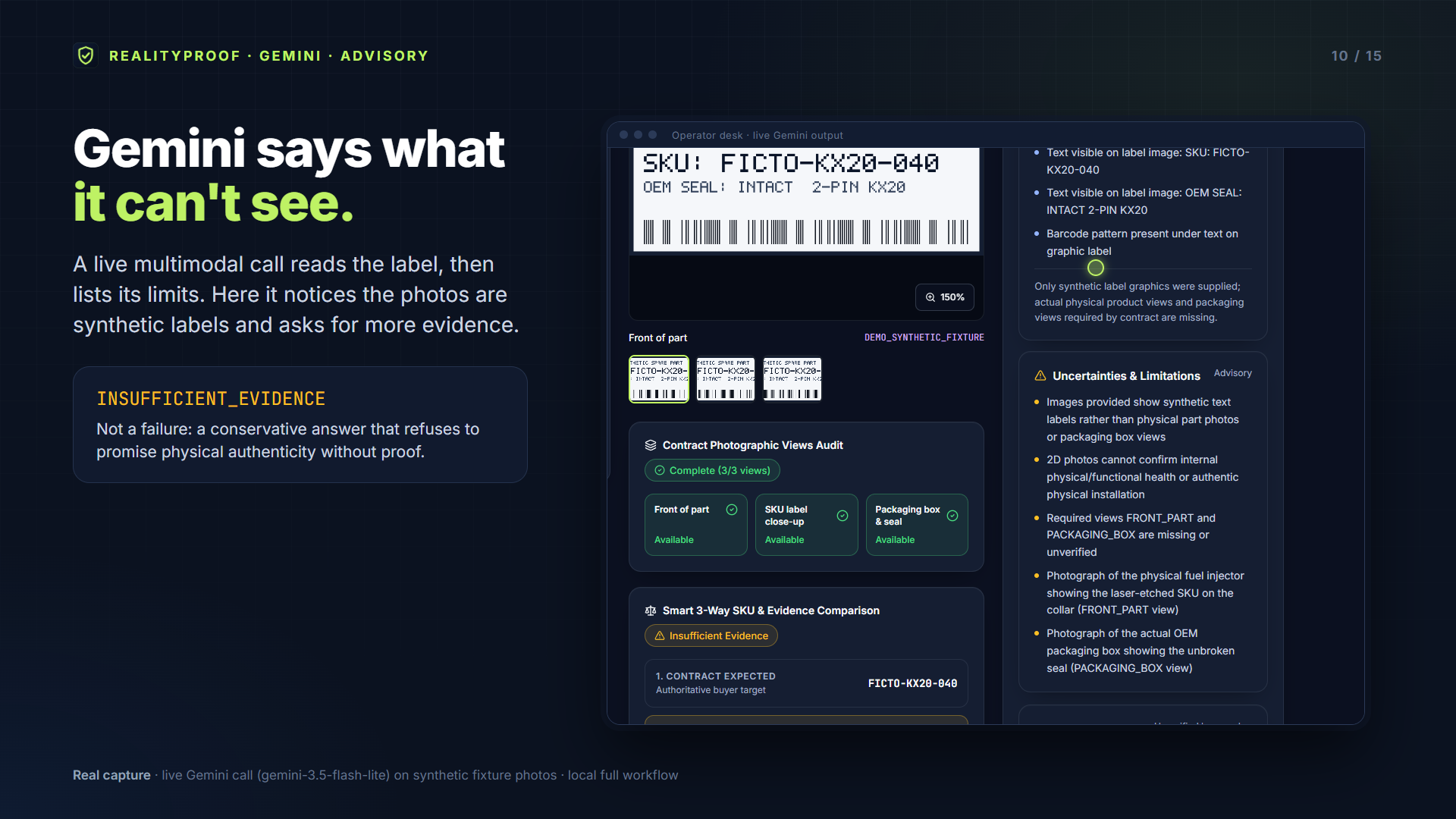
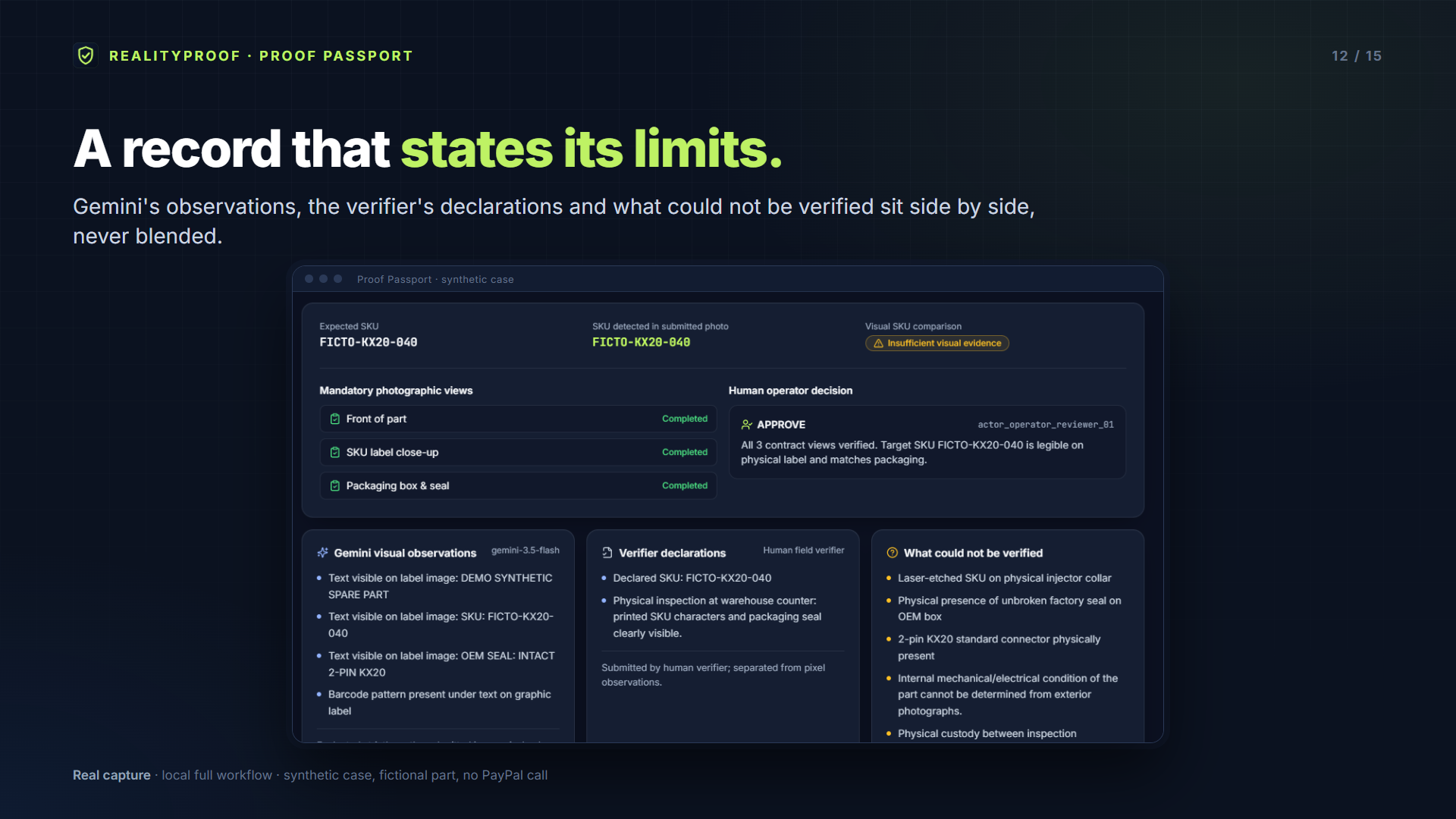
- Ask Gemini what the images actually show. Google Gemini performs multimodal analysis, extracts observable details, compares them with the expected SKU, and reports uncertainty. Crucially, it is allowed to say
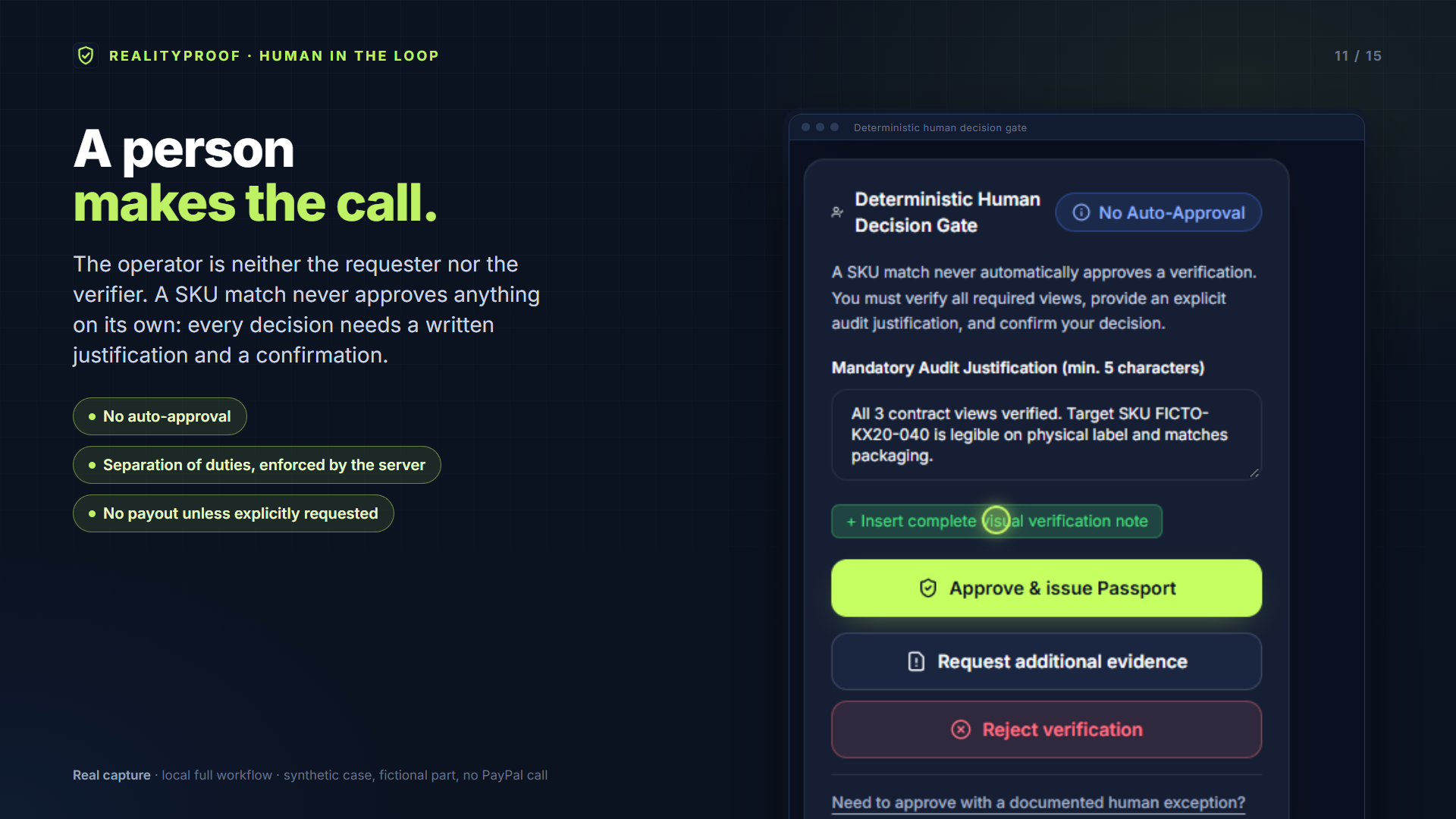
INSUFFICIENT_EVIDENCEinstead of manufacturing certainty. - Keep a human responsible. An independent operator reviews the evidence and AI observations, records a justification, and decides whether to approve, reject, or request more evidence. Gemini cannot approve a case or trigger a payout by itself.
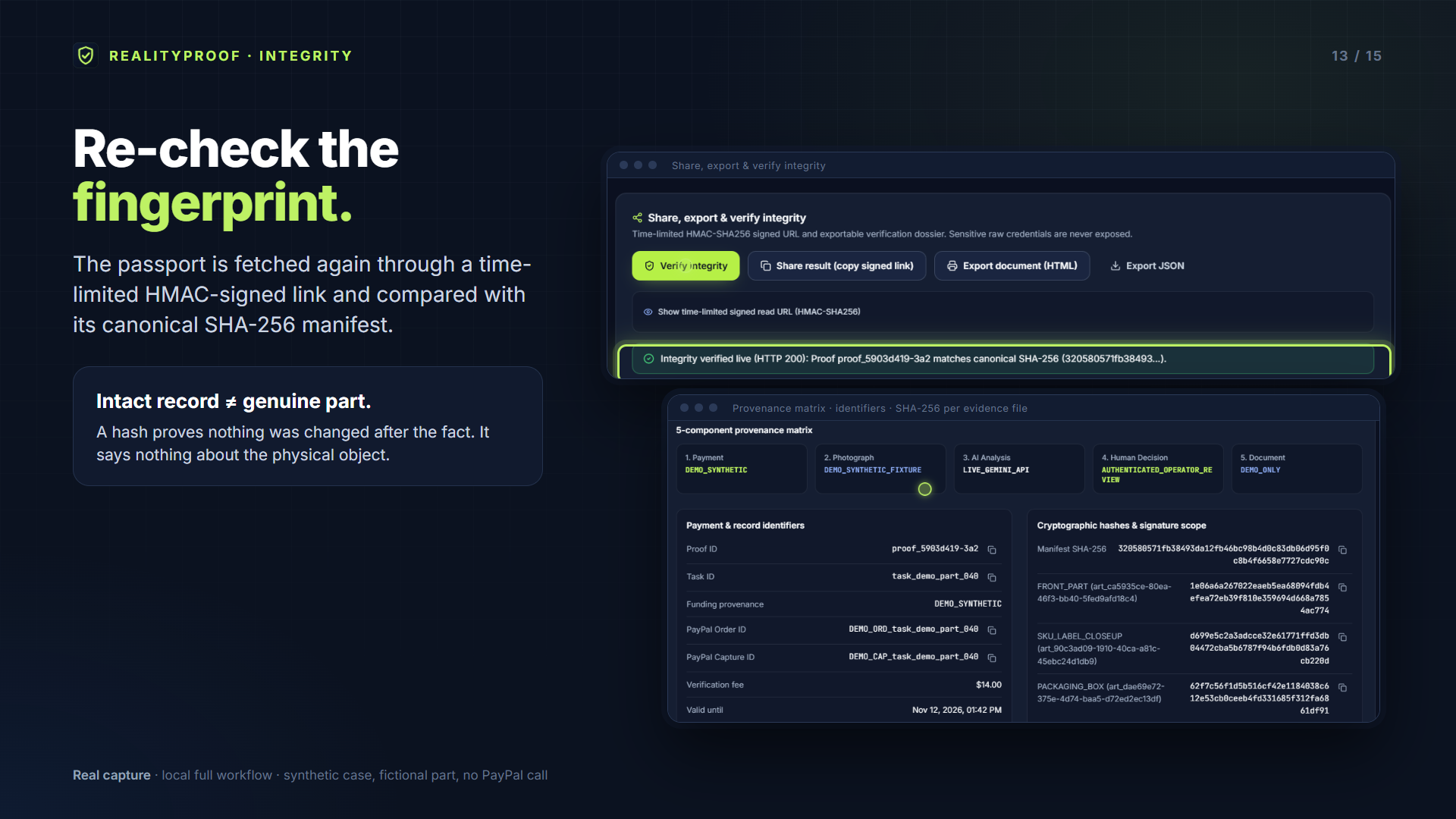
- Issue a Proof Passport. RealityProof produces an auditable record of payment provenance, submitted evidence, AI observations, the human decision, file hashes, and explicit limitations. Its integrity can be checked again, but record integrity is not a guarantee of physical authenticity.
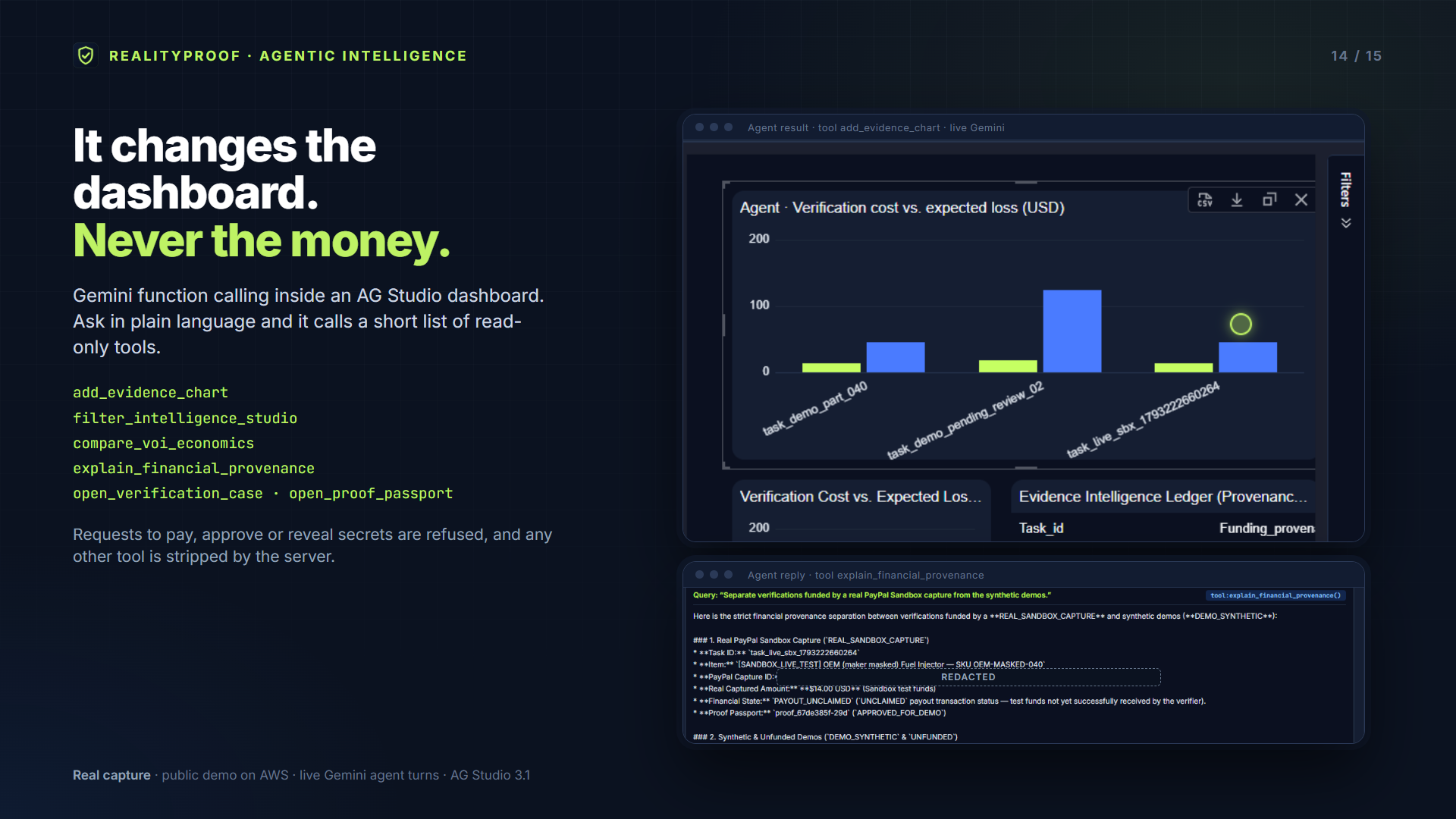
RealityProof also includes an agent-oriented analytical experience: supported requests can explain financial provenance, filter verification data, and add evidence-oriented visualizations through read-only tools. These tools cannot move money or override the human decision. Its AG Studio-based interface is subject to the separate commercial licensing terms disclosed in our repository.
The result is not a magic “genuine / fake” button. It is a better way to decide what evidence is available, what is still unknown, and whether a purchase should proceed.
How we built it
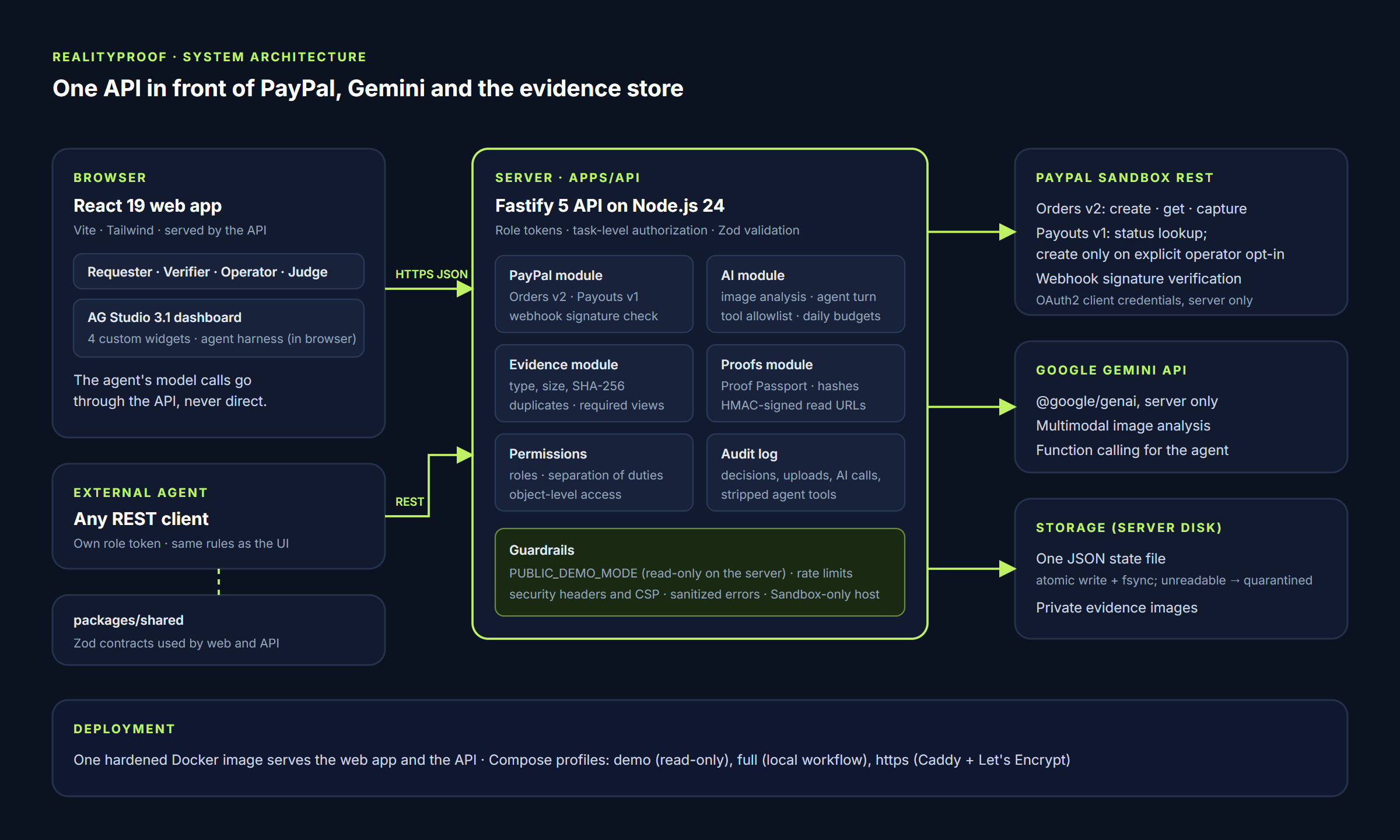
RealityProof is a working, end-to-end TypeScript application—not just a concept or a collection of mockups.
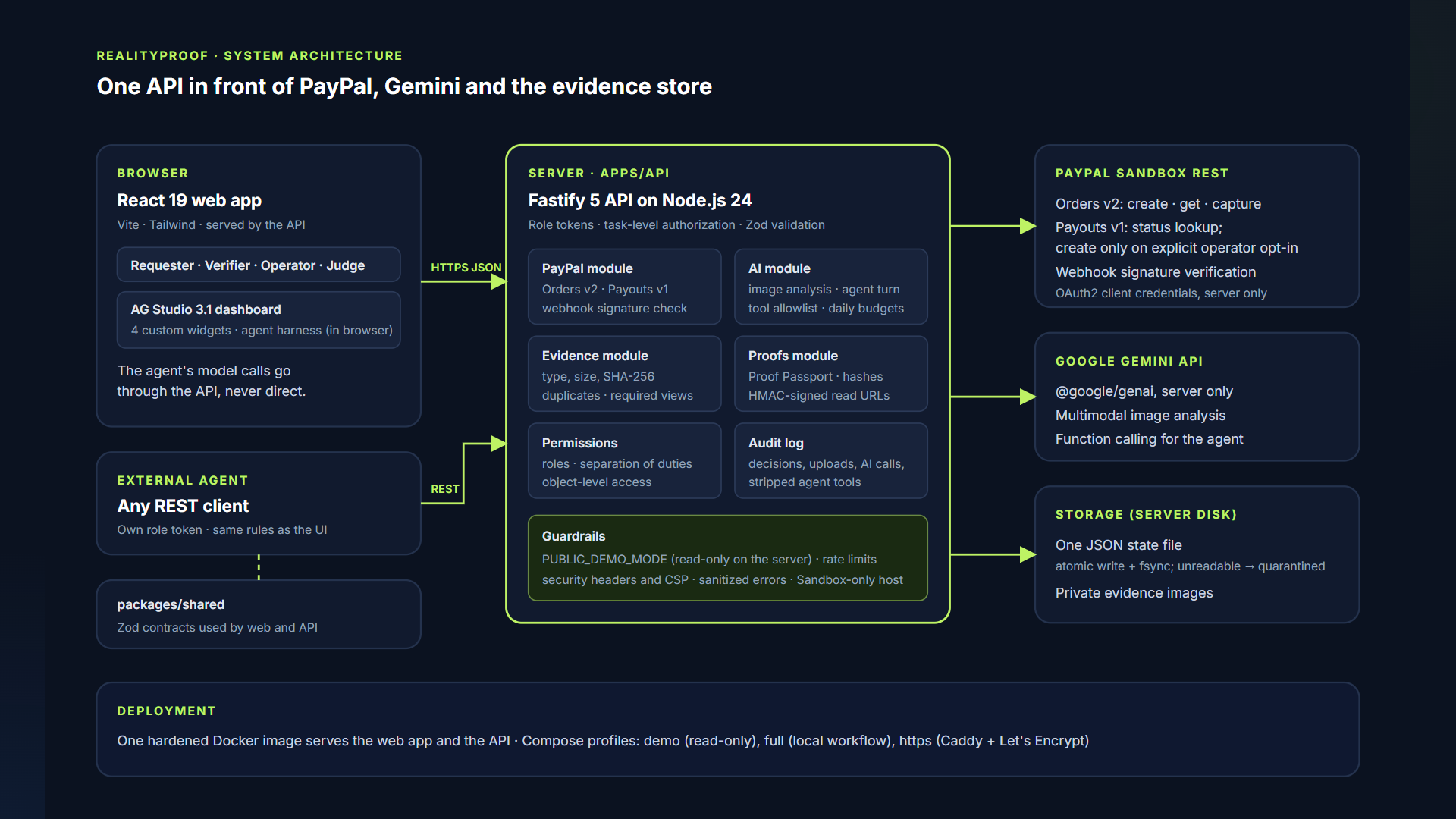
Frontend and experience: We built a React 19, Vite, and Tailwind CSS interface with distinct experiences for the requester, field verifier, human operator, and judge. The guided evidence workflow is designed to make each required view explicit rather than leaving reviewers with an unstructured folder of photographs.
Backend and business rules: A Node.js / Fastify 5 API manages verification contracts, role-based authorization, evidence validation, human reviews, audit events, PayPal integration, and Proof Passports. Zod schemas share validated contracts across the application. State is stored in an atomically written JSON file for this single-instance prototype, with evidence images kept separately on disk; the repository documents that this is not a production-scale storage architecture.
PayPal integration: We implemented Sandbox Orders v2 for verification-fee funding, with server-side confirmation of captures and a one-to-one relationship between a capture and its verification contract. We also implemented PayPal webhook-signature verification and carefully distinguish orders, captures, payouts, and payout status. A historical Sandbox payout item marked UNCLAIMED is not represented as money received. No real-money transfers were made.
AI and agents: We integrated Google Gemini on the server for structured image analysis and function-calling workflows. The model's observations are advisory. The agent interface uses an explicit allowlist of read-only tools, budget controls, and refusal rules so that analytical prompts cannot silently become payment or approval commands.
Provenance and trust: Evidence files receive SHA-256 hashes. The Proof Passport includes a canonical integrity manifest, structured provenance, review history, and an explanation of what the system did not verify. The design deliberately separates a valid payment record, intact digital evidence, and real-world product authenticity.
Deployment: We containerized the application with Docker and deployed a secured preview on AWS Lightsail, using Caddy and HTTPS. Its read-only demo mode blocks financial and other sensitive mutations at the API layer. The public GitHub repository includes reproducible Docker-based instructions for judges and reviewers.
Explore the open-source repository, architecture, and setup instructions on GitHub.
Challenges we ran into
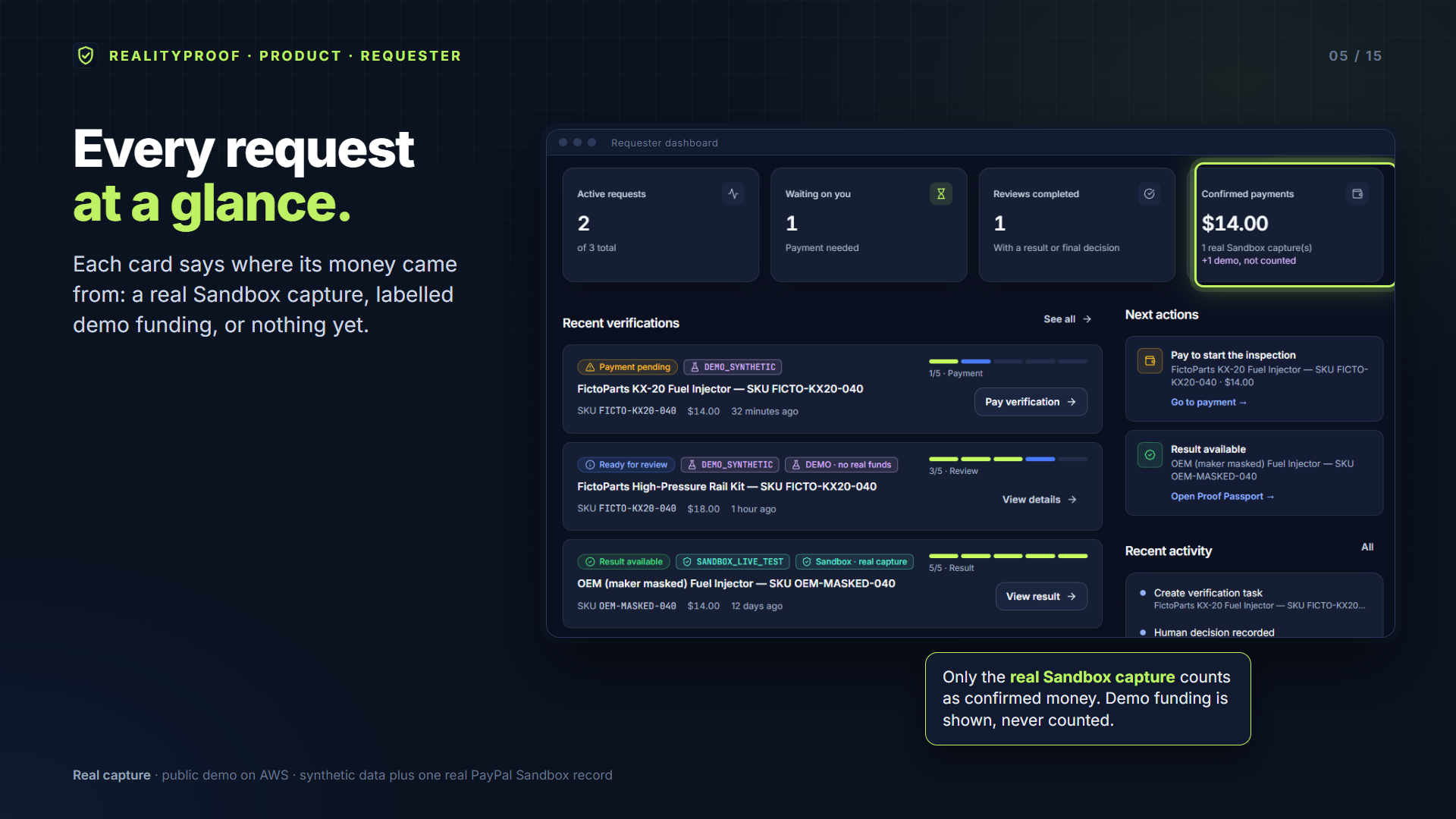
1. Making a real payment integration tell the truth. A Sandbox order can be created, captured, pending, or associated with a payout that is not complete. We had to prevent the interface and the AI agent from collapsing those states into a misleading “paid” label. We built explicit financial-provenance categories and server-side controls instead of trusting what the browser reports.
2. Building useful AI without false confidence. A model can read a SKU from an image, but that does not establish that the photo is genuine, the item is functional, or the product has not been swapped. During a recorded run, Gemini correctly reported INSUFFICIENT_EVIDENCE after recognizing the synthetic nature of the submitted labels. We treated that result as a feature: a reliable system should be able to say “we don't know yet.”
3. Keeping decisions accountable. We needed to stop the requester or verifier from approving their own case and prevent any AI-generated observation from becoming an automatic financial action. Separation of duties, role checks, written justifications, and a distinct review step became central to the design.
4. Securing a demo without making it impossible to judge. We built a read-only demonstration mode with server-enforced restrictions, tested it against forbidden operations, and documented a clean-clone setup. We also kept commercial AG Studio licensing separate from the MIT-licensed project code.
5. Preserving evidence without overclaiming. Cryptographic hashes can detect changes to stored evidence, but they cannot prove a physical object's origin. The Passport needed to communicate both the strength of its audit trail and the limits of its conclusions.
Accomplishments that we're proud of
- An actual PayPal Sandbox integration, including a completed test order/capture, verified server-side and kept separate from synthetic transactions and unclaimed payout records.
- A complete multi-role verification workflow: request, funding, guided evidence collection, Gemini analysis, independent human decision, and Proof Passport.
- An AI system that can express uncertainty rather than forcing a confident answer when the evidence is insufficient.
- A cryptographically checkable evidence record with file hashes, provenance categories, and explicit statements of what remains unverified.
- Real agent tool calls for analysis and dashboard actions, protected by read-only constraints.
- A deployed HTTPS preview and reproducible open-source repository, rather than screenshots standing in for a product.
- 60 passing automated tests and 50 passing black-box security checks reported from the validated release candidate, including checks against the deployed demo.
Most importantly, RealityProof is designed to make trust inspectable. Every important conclusion has a source, a responsible decision-maker, and a boundary around what it means.
What we learned
This project changed how we think about agentic commerce.
Payment is not proof of product. A successful checkout is a financial event, not a physical inspection.
AI should make uncertainty visible. A cautious, well-explained answer can be more valuable than an impressive but unjustified confidence score.
Human-in-the-loop only matters when it is enforced. A label saying “human review” is not enough; the API must actually prevent self-approval and unauthorized decisions.
Provenance and authenticity are different. A trustworthy record can prove what the system received and how it was handled. It cannot retroactively prove what happened outside the system.
The best agent is not always the one that acts fastest. Sometimes the valuable action is to pause, request evidence, explain the risk, and let a person decide.
What's next for RealityProof
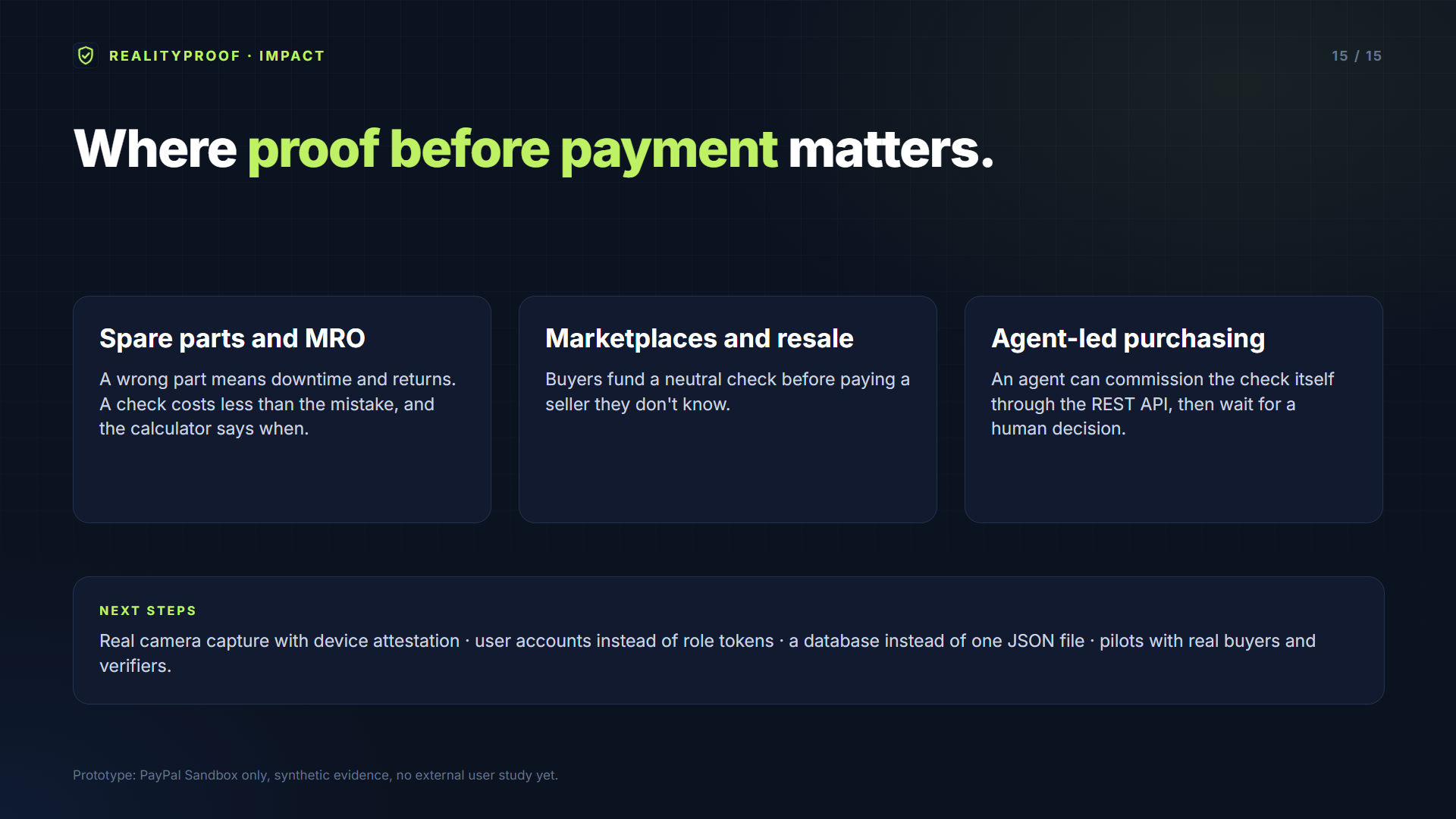
The hackathon prototype demonstrates the workflow with PayPal Sandbox test money and synthetic evidence. The next step is to validate the approach in a controlled field pilot with consenting businesses and real inspection processes—without promising counterfeit detection or physical certification before those claims are independently established.
Our roadmap includes stronger individual identity and verifier accountability, a production-ready database and object storage, richer dispute-resolution workflows, independent evidence-quality evaluation, and integrations that let purchasing agents request verification before executing a high-value transaction.
We also want to study a bigger question: When does purchasing additional evidence create enough value to change a decision? RealityProof's Value of Information model is a starting point for testing that question with real operational data.
Our vision: a future where autonomous commerce does not require blind trust—because buyers and agents can ask for evidence, understand its limitations, and make better decisions before the money for a product moves.
RealityProof — Proof before payment.
Built for the PayPal AI Hackathon 2026.
GitHub: jpablortiz96/realityproof
Built With
- ai-agents
- aws-lightsail
- caddy
- docker
- docker-compose
- fastify
- google-gemini
- google-genai-sdk
- node.js
- paypal-orders-api
- paypal-payouts-api
- paypal-sandbox
- paypal-webhooks
- playwright
- react
- rest-api
- sha-256
- tailwind-css
- typescript
- vite
- zod
