## Inspiration
As a Data Scientist, I spend my days optimizing algorithms, yet I found myself struggling to optimize the most important system: my own action power. Like many, I suffered from chronic procrastination—the "cheap dopamine" from short-form content was winning the battle against my long-term ambitions.
After diving deep into neuroscience research, I realized that the brain needs more than just a "To-Do list"; it needs a feedback loop that makes real-world progress as visible and addictive as a high-stakes RPG. I decided to build Reality Engine—not just to track tasks, but to quantify the human experience and provide a data-driven mirror of my own evolution.
## What it does
Reality Engine is a "Radical Realism" system that treats your life as an evolving character build.
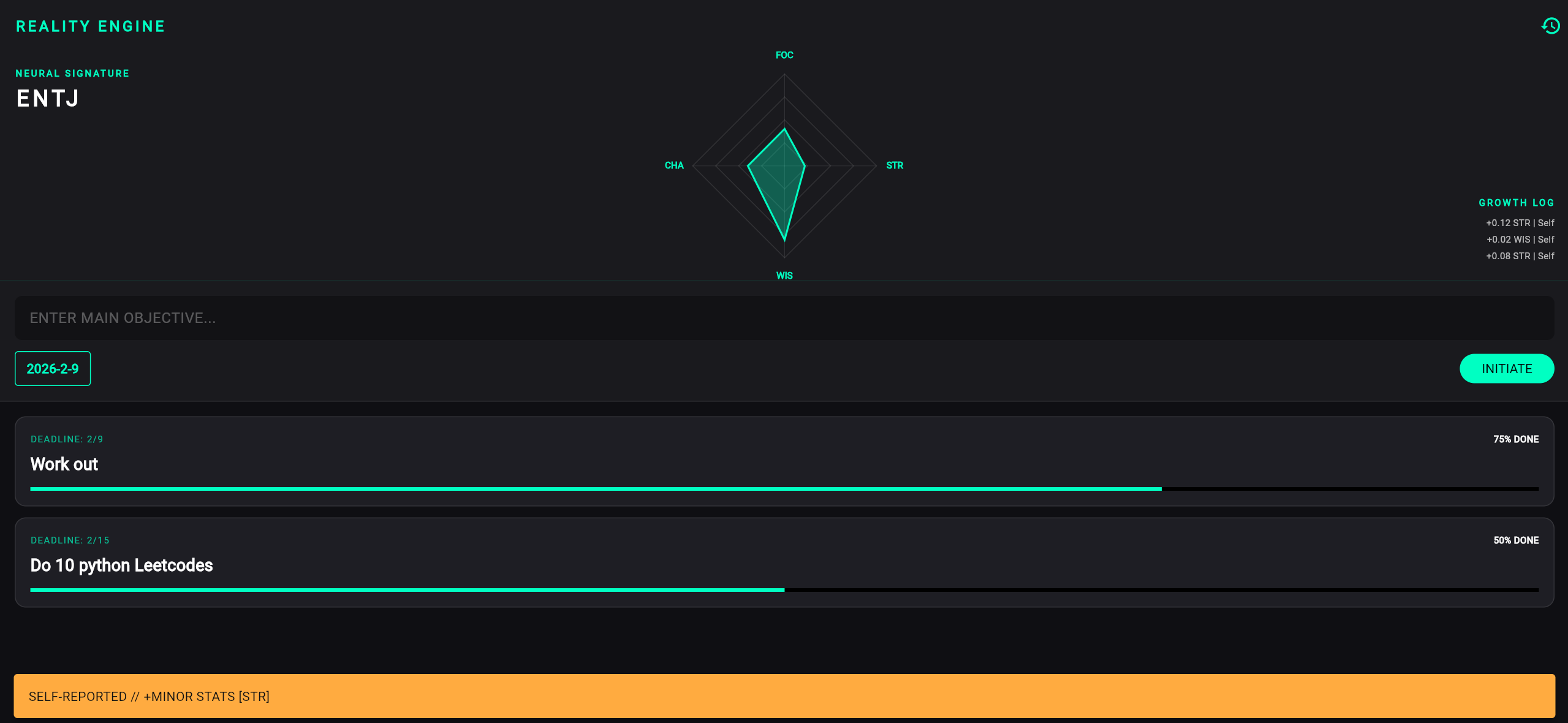
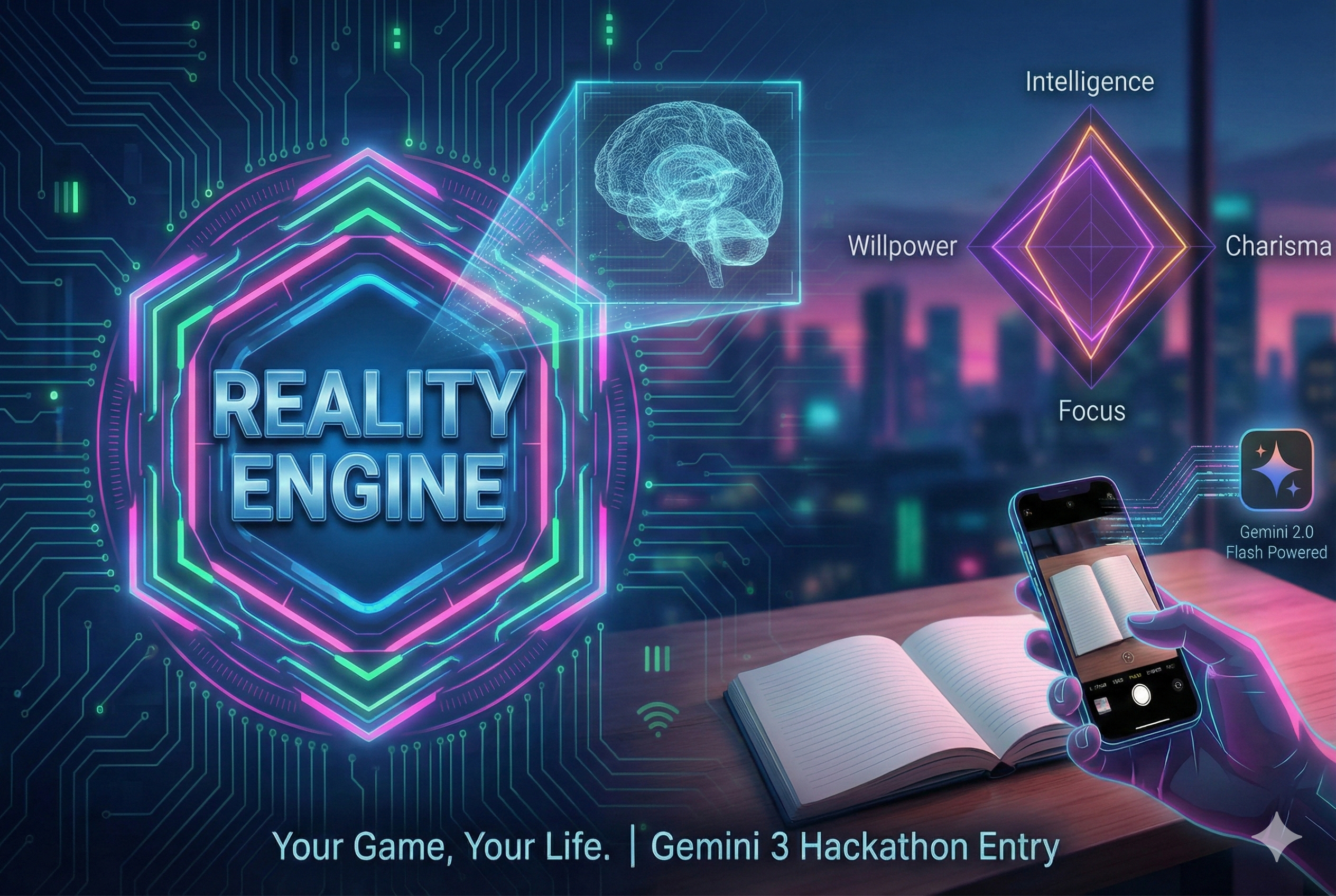
- Bio-Twin Initialization: It maps your cognitive profile (via MBTI) into a 4-stat neural-archetype (Intelligence, Willpower, Charisma, Focus).
- Gemini Tactical Deconstruction: Using Gemini 2.0 Flash, it breaks down intimidating, vague goals into granular, actionable "missions."
- Multimodal Reality Audit: To prevent "cheating," users must submit photo evidence of their work. Gemini acts as an impartial auditor, verifying the effort before awarding attribute points.
- Archive & Evolution: It supports parallel task tracking and archives completed missions, turning past efforts into a permanent record of personal growth.
## How we built it
The project is built with a focus on speed and multimodal reasoning:
- Frontend: Flutter Web for a sleek, cross-platform dashboard.
- Backend: Firebase Hosting and Firebase Core for seamless deployment.
- AI Core: Gemini 2.0 Flash API, utilized for its incredible multimodal speed. We used the
google_generative_aiSDK to handle JSON-mode task deconstruction and image auditing. - Logic: We implemented a weighted attribute growth formula to ensure balanced "character" development:
## Challenges we ran into
- Multimodal Data Flow: Handling image bytes on Flutter Web required a pivot from standard
dart:iotoXFileandUint8Listto ensure the "Audit" feature worked across all browsers. - Prompt Engineering for Strictness: Designing the "Auditor" prompt to be strict enough to catch "fake work" (like a photo of an empty desk) while remaining encouraging was a delicate balance.
- DevOps Hurdles: Navigating Firebase configuration and GitHub authentication in a high-pressure, time-sensitive environment.
## Accomplishments that we're proud of
- The "Aha!" Moment: Seeing the radar chart actually move after Gemini successfully "audited" a real-world study session.
- The Speed: Leveraging Gemini 2.0 Flash to get near-instant feedback on photo evidence, making the "Radical Realism" loop feel alive.
- Self-Utility: I actually used the prototype to manage the final stages of this hackathon project!
## What we learned
- Latency is the Enemy of Habit: If an AI takes 10 seconds to respond, the dopamine loop breaks. Gemini 2.0 Flash is a game-changer for habit-forming apps.
- Data-Driven Motivation: Quantifying "Willpower" or "Focus" as data points makes the struggle against procrastination feel like a winnable game.
## What's next for Reality Engine: Your Game, Your Life
- Social Syncing: "Party Mode" where friends can form squads to tackle shared goals (e.g., a collective 100-hour coding marathon).
- Wearable Integration: Syncing physiological data (HRV, Sleep) to automatically adjust task difficulty based on the user's "Energy" stat.
- Advanced Neural Mapping: Moving beyond MBTI to a more granular, EEG-informed cognitive profile.
Ultimate Goal for Reality Engine: Your Game, Your Life
- Redefining the "True Metaverse": In my vision, the true Metaverse isn't about escaping into a virtual world—it’s about digitizing the physical one. I believe that as we integrate more data into every aspect of our lives, the boundary between the digital and the physical will dissolve. Reality Engine aims to be the operating system for this new existence.
- Spatial & AR Integration: Moving from a mobile/web interface to AR (Augmented Reality) and smart glasses. Imagine seeing your "Focus" stat and mission rewards overlaid directly onto your physical workspace in real-time as you begin to work.
- Biometric & Wearable Ecosystem: Integrating real-time data from smartwatches (HRV, sleep quality, activity levels) to automatically adjust task difficulty and "Stamina" stats. The more data we have about ourselves and our environment, the more accurately we can optimize our "Reality Build."


Log in or sign up for Devpost to join the conversation.