-
-
hehe
Real_Time Hand and Face Tracking Visualization Using Python
Real-Time Hand Tracking and Face Mesh Visualization Using Python image
Introduction
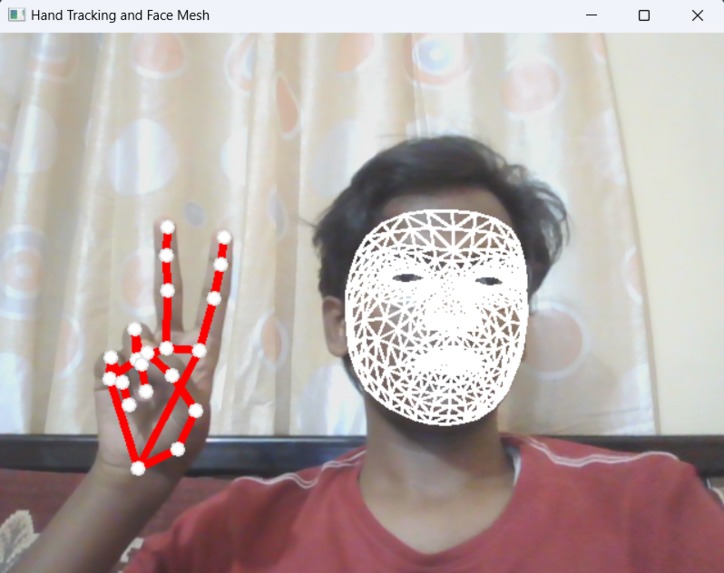
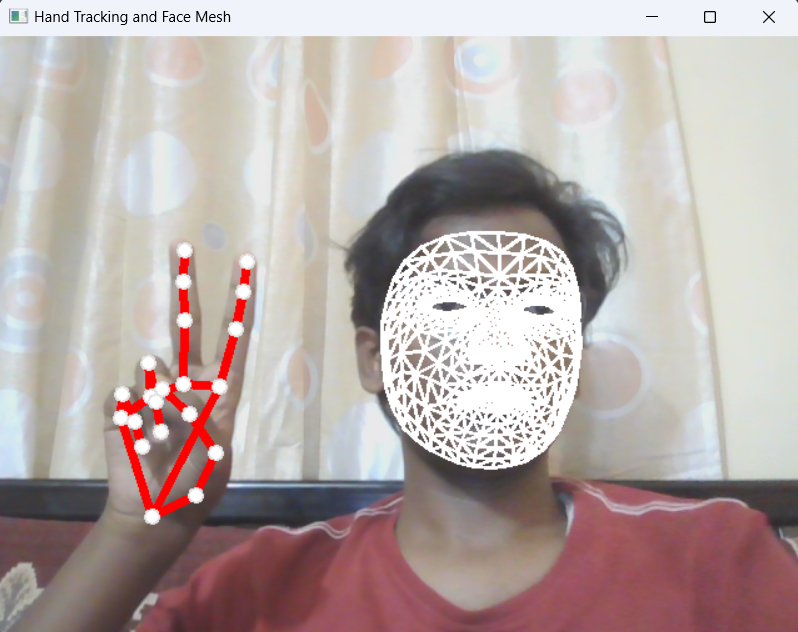
In this article, we will explore a Python script that utilizes the OpenCV and Mediapipe libraries to perform real-time hand tracking and face mesh visualization. This code captures video from a webcam, processes the frames to detect hand landmarks and facial features, and then displays the results in a window. The integration of these technologies allows for interactive applications in fields such as augmented reality, gaming, and human-computer interaction.
Key Concepts
Before diving into the code, let's clarify some key concepts:
OpenCV: An open-source computer vision library that provides tools for image processing and computer vision tasks. Mediapipe: A framework developed by Google that enables the building of multimodal applied machine learning pipelines, particularly for tasks like face detection, hand tracking, and pose estimation. Landmarks: Specific points on a detected object (like hands or face) that can be used for further analysis or visualization.
Code Structure
The code is structured to initialize the necessary libraries, capture video input, process each frame for hand and face detection, and visualize the results. Here’s a breakdown of the main components:
Library Imports: Importing necessary libraries for video capture, image processing, and landmark detection. Initialization: Setting up Mediapipe solutions for hand and face mesh detection. Video Capture: Capturing video from the webcam. Frame Processing: Converting color spaces, processing frames for hand and face detection, and drawing landmarks. Display and Cleanup: Showing the processed frames and handling user input to exit the application.
Conclusion
This Python script effectively demonstrates how to leverage OpenCV and Mediapipe for real-time hand tracking and face mesh visualization. By understanding the structure and functionality of the code, developers can modify and expand upon this foundation to create more complex applications. Whether for educational purposes, research, or practical applications, the integration of these technologies opens up a world of possibilities in computer vision and human-computer interaction.

Log in or sign up for Devpost to join the conversation.