-
-
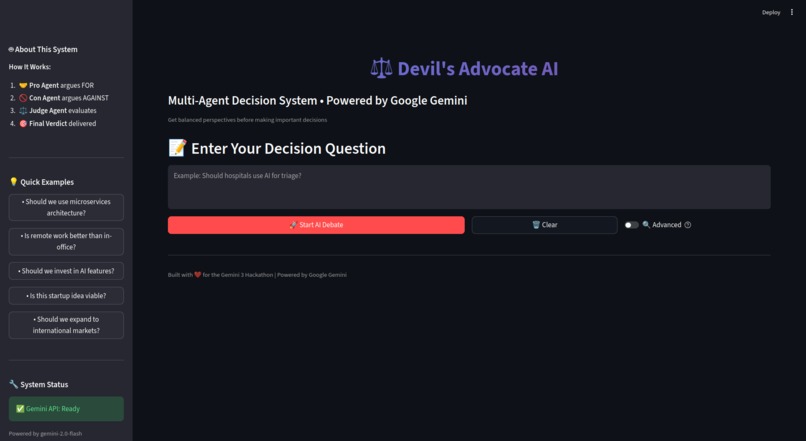
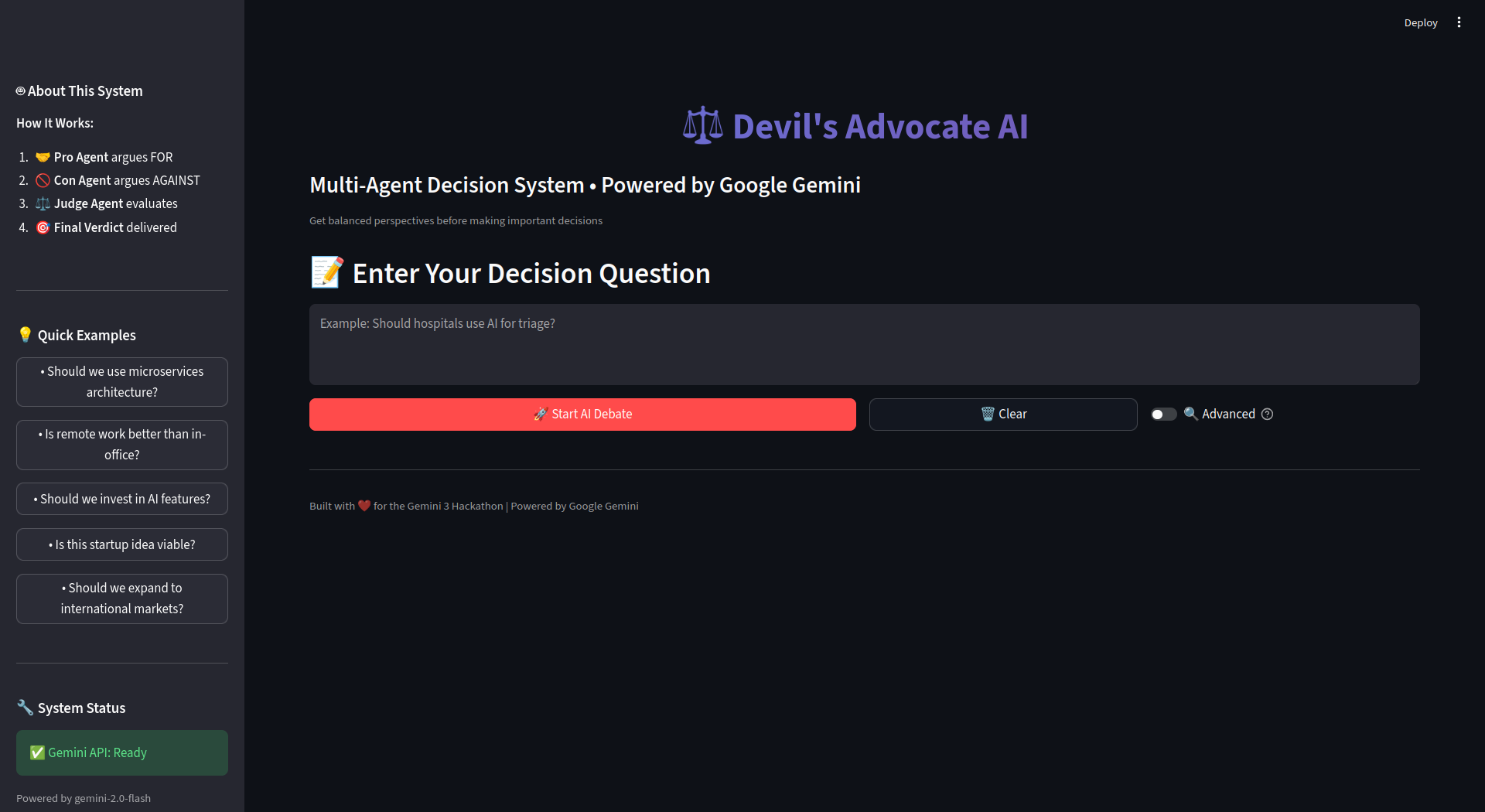
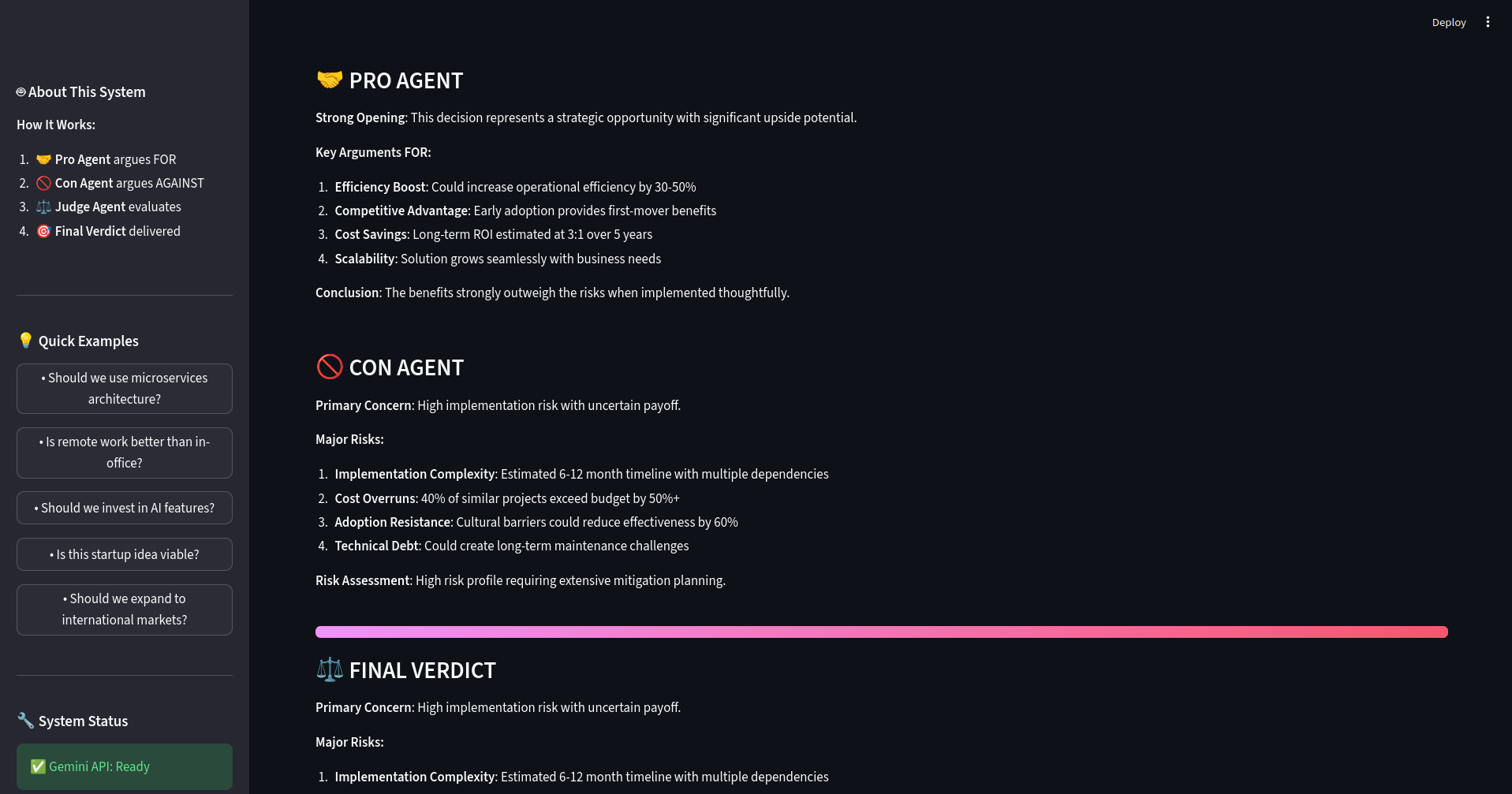
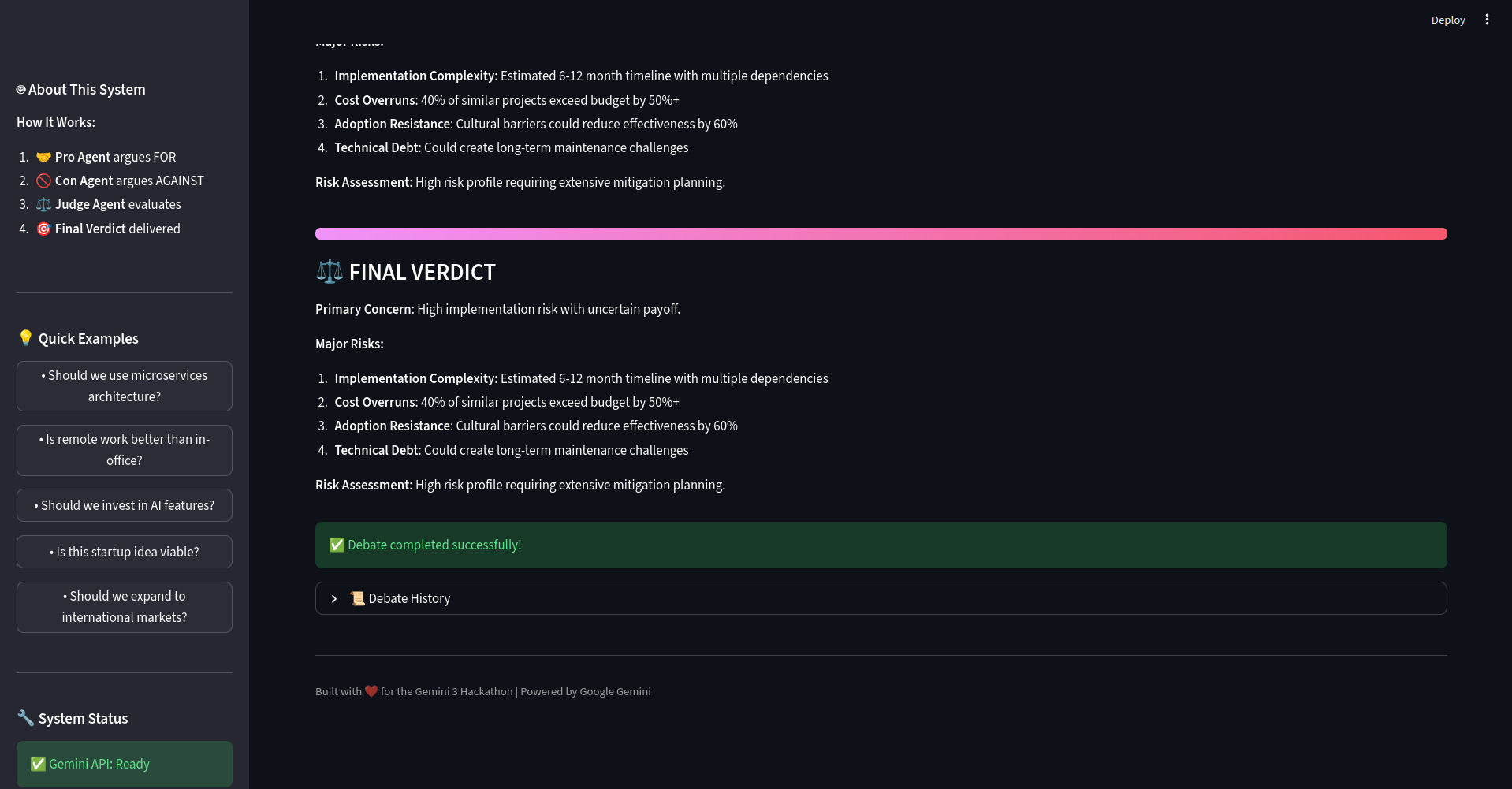
UI Screenshot
-
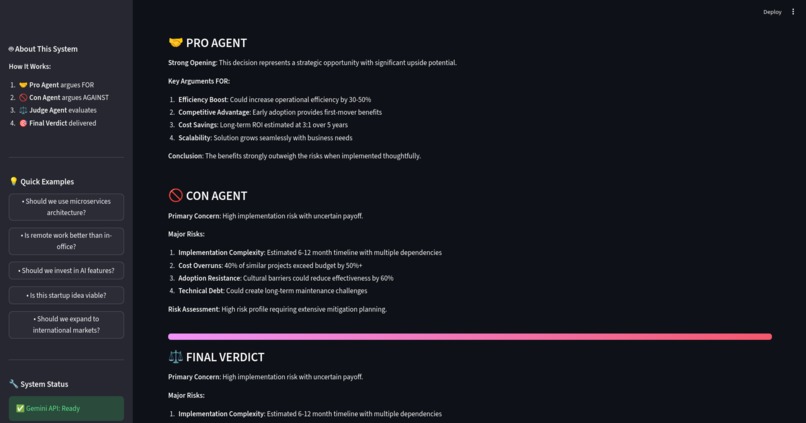
Agents
-
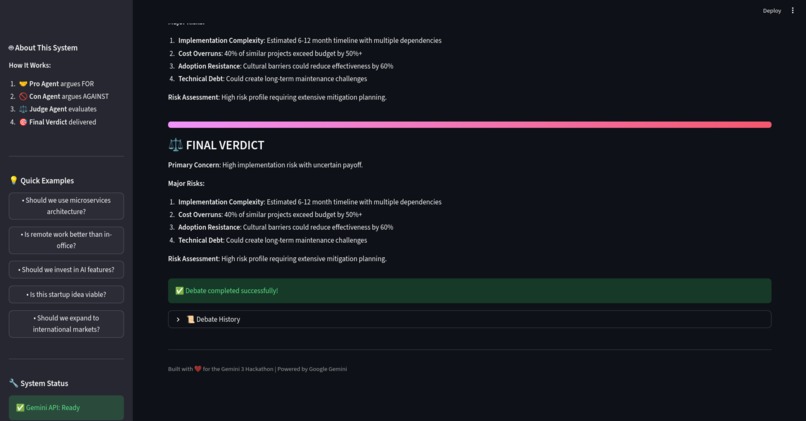
Final Verdict
Inspiration
In today's fast-paced decision-making environments, we often face complex choices without the benefit of diverse perspectives. Traditional AI systems provide singular answers, lacking the nuance of real-world deliberation. We were inspired by legal debates, corporate boardrooms, and philosophical dialectics—where truth emerges through structured argumentation. We wanted to build a system that doesn't just give answers, but helps users think critically by presenting balanced, well-reasoned arguments from multiple viewpoints.
What It Does
Devil's Advocate AI transforms decision-making by creating a structured debate between specialized AI agents. Users submit any question or decision they're facing, and the system:
Generates comprehensive arguments for both sides using specialized Pro and Con agents
Evaluates the debate through an impartial Judge agent that delivers a structured verdict
Provides actionable insights including confidence scores, risk assessments, and recommendations
Offers meta-analysis (optional) to examine the verdict's assumptions and blind spots
The result is not just an answer, but a comprehensive decision analysis framework that helps users understand why one option might be better than another.
How We Built It
Backend Architecture: Python-based multi-agent system with modular design
AI Foundation: Google Gemini API for reasoning and natural language generation
Agent Specialization: Custom system prompts for Pro, Con, Judge, and Reflection agents
Frontend: Streamlit for rapid prototyping and intuitive user experience
Deployment: Streamlit Cloud with environment-based configuration
Error Handling: Robust fallback mechanisms for API failures
The system follows a deliberation pipeline where each agent builds upon the previous output, creating a coherent decision analysis flow.
Challenges We Ran Into
Balancing Agent Personas: Ensuring each agent maintains its specialized perspective without becoming extreme or unreasonable
Structured Output Parsing: Extracting consistent verdict formats from free-form LLM responses
API Latency Management: Handling variable response times while maintaining smooth user experience
State Management: Preserving conversation context in a Streamlit app with multiple interaction points
Cost Optimization: Minimizing token usage while maintaining comprehensive analysis quality
Accomplishments That We're Proud Of
Coherent Multi-Agent Dialogue: Creating agents that build upon each other's arguments meaningfully
Professional UI/UX: Building an intuitive interface that makes complex AI interactions accessible
Production-Ready Reliability: Implementing robust error handling and fallback systems
Clear Value Proposition: Solving a real problem in decision-making processes
Hackathon Execution: Delivering a complete, working system within tight time constraints
What We Learned
Prompt Engineering: How subtle changes in system prompts dramatically affect agent behavior
LLM Limitations: Understanding where AI excels (pattern recognition) versus where it struggles (consistent formatting)
User Experience Design: Balancing feature richness with simplicity in AI applications
Agentic Systems: The power of specialized agents over general-purpose chatbots
Real-World Utility: The importance of actionable outputs over abstract reasoning in decision tools
What's Next for Devil's Advocate AI
Enhanced Analytics: Track decision outcomes and refine recommendations based on real results
Team Collaboration: Allow multiple stakeholders to contribute to and review debates
Domain Specialization: Create industry-specific agents (legal, medical, financial, etc.)
API Access: Enable integration with business intelligence tools and decision support systems
Advanced Features: Historical analysis, decision journaling, and confidence calibration
Mobile Experience: Native mobile app for on-the-go decision support
Custom Agent Creation: Allow users to define their own agent personas and debate formats
We believe this is just the beginning of how AI can enhance, rather than replace, human judgment in complex decision-making scenarios.


Log in or sign up for Devpost to join the conversation.