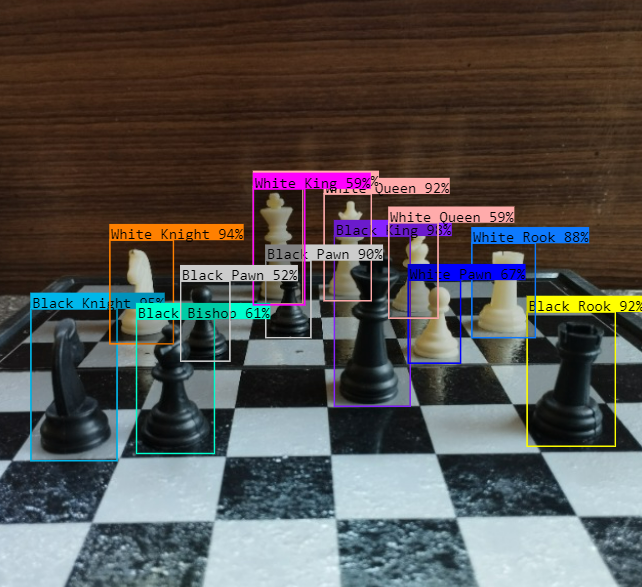
Inspiration The project was inspired by the increasing integration of artificial intelligence into traditional board games. Chess, being one of the most strategic games in history, presents an excellent opportunity to combine technology with gameplay for enhanced learning, analysis, and automation. The goal is to create a tool that can recognize chess pieces in real time, enabling players to analyze moves, record games, and explore new gameplay strategies.
What it Does This system detects and identifies chess pieces on a board in real time using YOLOv8, a state-of-the-art object detection model. It processes live video feeds or images of the chessboard, accurately recognizing the type and position of each piece, allowing for applications such as:
Real-time game analysis Move tracking for automated game recording Feedback for improving gameplay Integration with AI chess engines for strategic assistance How We Built It Dataset Preparation:
Collected a dataset of labeled images with chess pieces from various angles and lighting conditions. Annotated the images using bounding boxes for each piece and their respective labels. Model Training:
Used YOLOv8, leveraging its lightweight architecture and high detection accuracy. Configured the training process with custom datasets, setting parameters like epochs, learning rate, and batch size. Development Environment:
Python for coding and training. Tools like OpenCV for image processing and visualization. Kaggle Notebooks for data handling and experimentation. Inference:
Applied the trained YOLOv8 model to real-time video streams to detect and track chess pieces. Visualization:
Used Matplotlib and OpenCV for visualizing detected pieces, bounding boxes, and game status. Challenges We Ran Into Dataset Challenges: Collecting diverse and high-quality chessboard images with varying lighting and perspectives was difficult. Model Training: Balancing detection accuracy and inference speed while ensuring the model could generalize across unseen chessboards. Real-Time Processing: Optimizing the system to run efficiently on standard hardware without significant delays in detection. Piece Differentiation: Distinguishing visually similar pieces (e.g., pawns from other pieces) under complex conditions. Accomplishments That We're Proud Of Achieving high detection accuracy with YOLOv8 while maintaining real-time performance. Successfully building a system capable of detecting chess pieces under various conditions. Designing a modular and scalable workflow that can be adapted for other board games or real-world applications. Creating a visually appealing and user-friendly visualization of the detected pieces. What We Learned The importance of dataset quality and diversity in achieving robust model performance. Techniques for optimizing object detection models for real-time inference. How to integrate computer vision techniques like bounding box visualization with AI models. Overcoming technical challenges in real-world deployment of object detection systems. What’s Next for Real-Time Chess Pieces Detection Using YOLOv8 Enhanced Detection:
Improve detection accuracy for more complex board setups and low-light environments. Chess Game Analytics:
Incorporate move tracking and game recording features. Enable users to replay games and analyze strategies with AI suggestions. Integration with AI Chess Engines:
Combine detection with chess engines like Stockfish to provide move recommendations during gameplay. Mobile Application:
Develop a mobile app that allows players to use their phone cameras for real-time chess piece detection.
Broader Applications: Extend the system to other board games or educational tools for teaching chess to beginners.
Built With
- ai
- game-development
- image-processing
- yolov8

Log in or sign up for Devpost to join the conversation.